

Faith, work, and rest
You used to start the week with energy. Now Sunday night brings dread. You answer messages late, forget things you never used to forget, and feel strangely numb toward work that once mattered to you. You still pray, but the prayers sound tired. Part of you wonders whether something is wrong with your faith.
Burnout and burnout-like exhaustion can affect employees, healthcare workers, ministry leaders, caregivers, and anyone carrying sustained responsibility. Pastoral counseling for burnout can help you bring that weariness to God honestly and plan faithful limits, while licensed or medical care addresses what pastoral support cannot.
Quick answerBurnout is not a failure of faith. The World Health Organization describes it as the result of chronic workplace stress that has not been successfully managed, marked by exhaustion, mental distance or cynicism toward work, and reduced effectiveness. Start by naming the load honestly, removing one demand, protecting real rest, and telling one safe person. Pastoral counseling can help with the spiritual side of exhaustion and with faithful boundaries. If symptoms persist, worsen, or affect your health, talk with a physician or licensed mental-health provider. If you are thinking about suicide, call or text 988.
What Burnout Is, and What It Is Not
The World Health Organization includes burn-out in ICD-11 as an occupational phenomenon, not as a medical condition. It describes three dimensions: feelings of energy depletion or exhaustion; increased mental distance from one’s job, or feelings of negativism or cynicism about it; and reduced professional efficacy.1 WHO applies the term specifically to the work context and says it should not be used to describe experiences in other areas of life. Even so, long seasons of caregiving or ministry can bring similar strain that deserves care.
Burnout is not the same as depression, although the two can overlap. Persistent low mood, loss of interest in most of life, hopelessness, or thoughts of death point beyond work strain and call for a licensed or medical assessment. Sleep disorders, thyroid problems, medication effects, and other health concerns can also look like burnout. Only a qualified provider can sort those possibilities out.
| What to notice | Ordinary tiredness | Possible burnout |
|---|---|---|
| Rest | A weekend or a good night’s sleep helps. | Time off barely touches the exhaustion, or it returns within days. |
| Feelings about work | Busy, maybe frustrated, but still connected to why it matters. | Cynical, detached, or numb toward work that once mattered. |
| Effectiveness | A hard week, then back to normal. | Ongoing sense of doing more and accomplishing less. |
| Seek more care when | Not usually needed. | Symptoms persist, worsen, affect health or relationships, or include hopelessness. |
Pastoral experience: In pastoral conversations, people facing burnout often describe two burdens at once: the exhaustion itself and the guilt of feeling exhausted while serving God or the people they love. A helpful turning point is realizing that limits are part of being human, not evidence of weak faith. From there, rest and honest conversations about workload become acts of stewardship rather than failure.
Find Your Best Next Step
You do not need to have everything sorted out before you reach out. Tell our care team what feels heavy, and we can help you consider pastoral support, coaching, or a licensed referral.
Six Steps You Can Take This Week
These steps are not treatment. They are a responsible beginning while you decide what level of support you need.
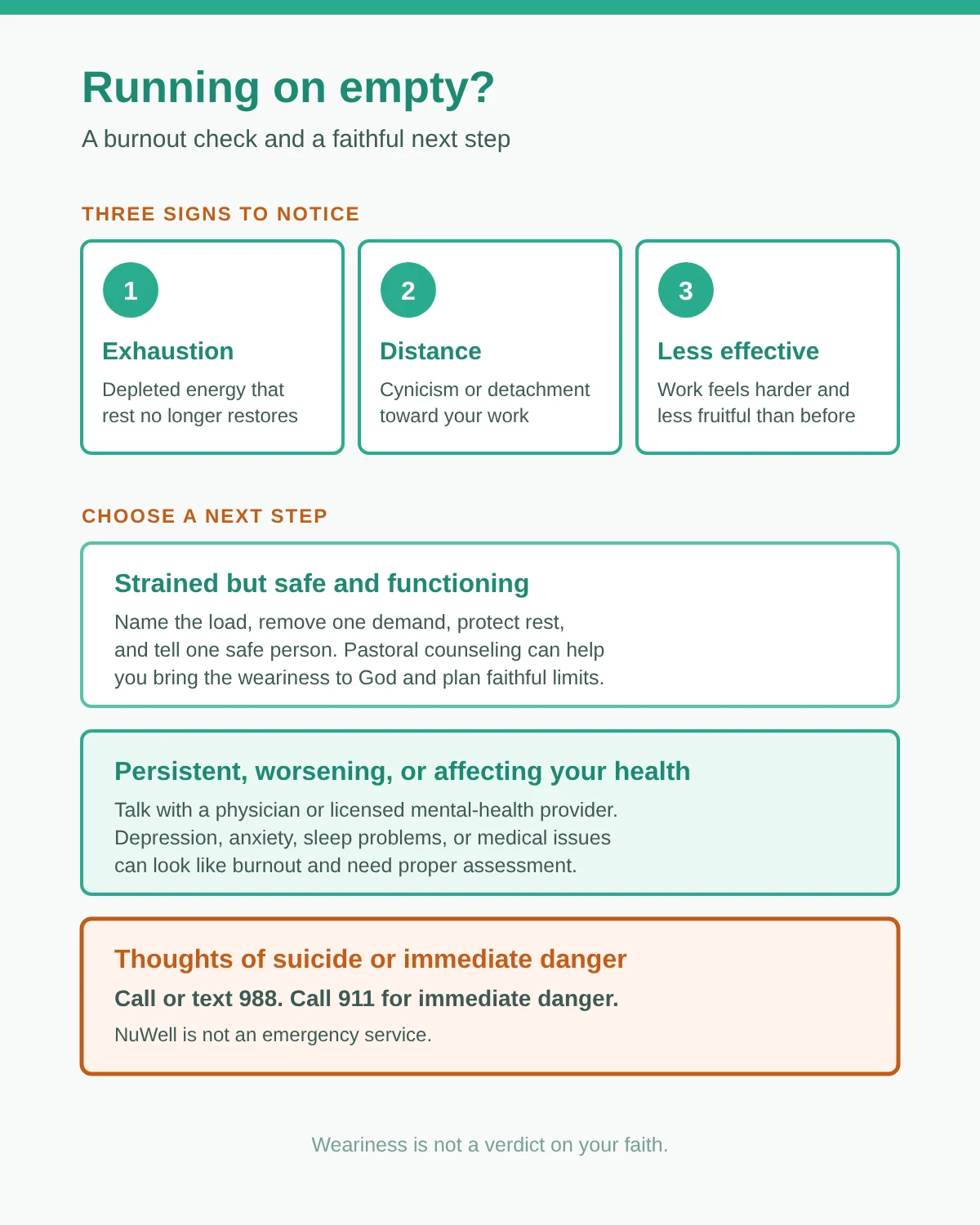
In short: notice exhaustion, distance, and reduced effectiveness. If you are strained but safe and functioning, name the load, remove one demand, protect rest, and tell one safe person. If symptoms persist, worsen, or affect your health, talk with a physician or licensed mental-health provider. If you have thoughts of suicide or are in immediate danger, call or text 988, or call 911.
Name the load honestly
Write down every recurring responsibility: work, caregiving, ministry roles, volunteer commitments, and the emotional labor of being the person everyone calls. Seeing the list on paper often explains the exhaustion better than any self-criticism can. This reflects Recognize the wound.
Check your body and safety
Notice sleep, appetite, headaches, illness, alcohol or substance use, and any thoughts of hopelessness. Physical symptoms deserve a conversation with a physician. Thoughts of death or self-harm deserve immediate support. This reflects Establish safety.
Remove or delay one demand
Choose one commitment you can pause, hand off, or shrink this week. A smaller yes is still faithful. If saying no feels impossible, NuWell’s guide to saying no with grace offers practical language.
Protect a rhythm of rest
Rest is not a reward for finishing everything. Set a realistic stopping time, protect a weekly Sabbath or day off, and include one activity that restores rather than numbs. Jesus told His tired disciples, “Come with me by yourselves to a quiet place and get some rest” (Mark 6:31, NIV).
Tell one safe person the truth
Isolation feeds burnout. Choose someone who will listen without fixing or shaming: a spouse, friend, mentor, supervisor, or pastoral counselor. Say something specific: “I am more exhausted than I have been letting on, and I need help thinking about my load.”
Bring the weariness to God honestly
You do not need polished prayers. Tell God you are tired, discouraged, or numb. Jesus invites, “Come to me, all you who are weary and burdened, and I will give you rest” (Matthew 11:28, NIV). This reflects Separate truth from distortion: rejecting the lie that your worth depends on endless output.
What Scripture Shows About Weariness
Scripture does not treat exhaustion as a moral failure. After a season of intense ministry and threat, Elijah sat under a broom bush and asked to die. God’s first response was not a rebuke. An angel touched him and said, “Get up and eat,” and he slept and ate again before the journey continued (1 Kings 19:4–8). Physical care came before the next assignment.
When Moses tried to judge every dispute alone, his father-in-law Jethro said, “What you are doing is not good. You and these people who come to you will only wear yourselves out. The work is too heavy for you; you cannot handle it alone” (Exodus 18:17–18, NIV). The solution was shared responsibility, not greater effort.
Matthew 11:28 (NIV)“Come to me, all you who are weary and burdened, and I will give you rest.”
When the Person Burning Out Is a Pastor
Pastors face a particular version of burnout. Long hours, constant availability, conflict within the congregation, and isolation can widen the gap between what a leader expects of ministry and what ministry actually asks of them. Many pastors also hesitate to admit strain because they fear it will look like spiritual failure.
- Name the load honestly with an elder board or a trusted peer outside your congregation.
- Protect a weekly Sabbath and real time off, not just a lighter Sunday.
- Share responsibilities so the church does not depend on one person.
- Seek confidential support from someone outside the church you lead.
For more on care options for ministry families, see NuWell’s guide to counseling support for pastors and their spouses. If anxiety is the main struggle, read anxiety help for pastors.
If you are a pastor who has been putting off support, our guide to why pastors refuse counseling explains common barriers and a private first step you can take.
How the RESTORE Path Can Support Recovery From Burnout
NuWell’s RESTORE Path is a flexible pastoral map, not a clinical protocol or guaranteed sequence. Four movements are especially relevant to burnout:
Recognize the wound
Name the load, the losses, and the expectations that brought you here, without minimizing them.
Establish safety
Protect sleep, health, and emotional safety before pushing for productivity.
Separate truth from distortion
Challenge beliefs such as “Rest is selfish” or “If I stop, everything falls apart.”
Rebuild healthy patterns
Practice limits, Sabbath, shared responsibility, and work that flows from calling rather than fear.
What Pastoral Counseling Can and Cannot Do
Pastoral counseling is not psychotherapy. NuWell provides non-clinical, Scripture-grounded care. It does not diagnose or treat mental-health conditions. It can work alongside licensed care when both are needed.
Spiritual guidance and faithful limits
Help with guilt about rest, calling, prayer, boundaries, and discerning one faithful next step. Learn about NuWell’s online pastoral counseling.
Structure and goals
Forward-focused help with priorities, schedules, and sustainable rhythms when you are generally stable. See Christian life coaching.
Assessment and treatment
For depression, anxiety, trauma, or persistent impairment. In Pennsylvania or West Virginia, NuWell can refer you to Grace Christian Counseling for faith-integrated licensed care.
Physical health and safety
A physician for sleep, physical symptoms, or medication questions. Emergency help when someone may be unsafe.
If Exhaustion Has Turned Into Hopelessness
Burnout can sometimes deepen into despair. If you are thinking about suicide or self-harm, reach out now.
In immediate danger or a medical emergency, call 911.
For suicide, self-harm, or emotional or substance-use crisis, call or text 988 or chat at 988lifeline.org. Free, confidential, 24/7.2 NuWell is not an emergency service.
Questions Christians Often Ask
Is burnout a sign of weak faith?
No. Faithful people in Scripture, including Moses and Elijah, reached the end of their strength. Burnout usually reflects sustained demands and too little recovery, not a lack of love for God.
Is burnout the same as depression?
No, though they can overlap. Burnout is tied to chronic work or role strain. Depression affects mood and interest across life. If low mood, hopelessness, or loss of interest persist, talk with a licensed or medical provider.
Can pastoral counseling help with burnout?
It can help with the spiritual side of exhaustion, guilt about rest, boundaries, and discerning next steps. It is not psychotherapy and does not diagnose or treat mental-health conditions, so it may work best alongside licensed or medical care.
Should I quit my job or ministry?
Avoid making a major decision in the most depleted moment if you can. First reduce the load, rest, and get support. Then decide with wise counsel whether the role, the rhythm, or the setting needs to change.
Find Your Best Next Step
Weariness is not a verdict on your faith. Whether you need pastoral support, coaching, or a licensed referral, NuWell’s care team can help you think through the next step without pressure or obligation.

This article was researched with the help of AI and reviewed and edited by Stephen Luther, MEd, MSEd, LPC, for accuracy, Scripture references, and faithfulness to NuWell’s non-clinical scope.
Stephen Luther, MEd, MSEd, LPC, is Executive Director and Founder of Grace Christian Counseling and a licensed professional counselor. He holds a master’s degree in Education and a master’s degree in Marriage and Family Therapy from Duquesne University and has helped children, adolescents, and adults since 1997. His licensed clinical role at Grace Christian Counseling is separate from NuWell’s non-clinical pastoral counseling and Christian life coaching services.
Scope note: This article is educational and pastoral. It is not diagnosis, psychotherapy, medical treatment, individualized professional advice, or emergency care. NuWell provides non-clinical pastoral counseling and Christian life coaching. Grace Christian Counseling is a separate, licensed practice.
Sources
- World Health Organization. Burn-out an “occupational phenomenon”: International Classification of Diseases. May 28, 2019. Accessed October 8, 2026.
- 988 Suicide & Crisis Lifeline. Accessed October 8, 2026.
- Scripture: Mark 6:31; Matthew 11:28; 1 Kings 19:4–8; Exodus 18:17–18 (NIV).
- Grace Christian Counseling. Christian Counseling for Burnout.
