

Cost is not a shallow question. It can determine whether support is sustainable, whether a family can keep other commitments, and whether you begin at all. You deserve a clear answer without shame, pressure, or a comparison that treats every form of care as interchangeable.
Quick answer
Our 50- to 60-minute sessions are $80 to $125 per session depending on income, with intern sessions as low as $55. We keep a card on file, but you are charged only when a session happens: no monthly fees or subscriptions. Because our pastoral counseling is non-clinical, we do not bill health insurance. Rates and availability can change, so our care team will confirm your exact fee before you book.
Rates current as of October 9, 2026.
Price is one part of the decision
The lowest session price is not always the lowest total cost, and the highest fee is not proof of quality. A useful comparison looks at scope, provider qualifications, session length, frequency, privacy, accessibility, referral practices, and whether the service actually matches the need.
Begin with the category of care. We provide online pastoral counseling and Christian life coaching, not diagnosis, psychotherapy, medical treatment, or emergency care. A licensed therapist, physician, psychiatrist, substance-use program, domestic-violence advocate, or crisis service may be the appropriate investment when clinical or safety needs are present. Paying for the wrong category can delay the right help.
What your session fee covers
Every NuWell session is held online through secure Microsoft Teams, so you can meet with us from anywhere in the United States. Before your first session, our care team talks with you about what you are facing and matches you with a pastoral counselor or Christian life coach who fits your needs. In each session, your counselor or coach listens, prays with you, brings Scripture into the conversation, and helps you take practical next steps. See how online pastoral counseling works.
You pay per session, not through an insurance copay or a subscription. We keep a card on file, but you are charged only when a session takes place. There are no monthly fees.
Have questions before you book? Ask our care team whether your first conversation is free and how long it lasts, whether the same rate applies to individual and couples sessions, when payment is due, and whether rates differ by counselor or coach. We will give you current answers, so you never have to rely on an old blog post or a search snippet.
Why insurance may not apply
Health insurance generally reimburses covered medical or behavioral-health services delivered by eligible licensed providers under the plan’s rules. Our pastoral counselors do not provide state-licensed clinical treatment, so we do not bill insurance for pastoral counseling. That reflects the kind of care we offer, not a claim that private-pay pastoral care is always better.
If you need diagnosis, psychotherapy, or insurance-covered care (see pastoral counseling and licensed therapy), contact your insurer and a licensed provider. Ask about deductibles, copays, coinsurance, prior authorization, out-of-network benefits, telehealth rules, and whether a diagnosis is required for reimbursement. Our affiliated licensed practice, Grace Christian Counseling, may also be able to help; insurance participation and availability depend on your location and its current providers.
What this cost decision is not
A budget is not a measure of faith, worth, commitment, or how badly you want change. Choosing a lower-cost option does not make you less serious. Choosing private-pay care does not guarantee a better outcome. A practitioner’s fee does not prove competence, and a testimonial does not predict your result.
The decision is also not a diagnosis. Financial strain, indecision, or stopping a service can have many causes. Avoid providers who use fear, spiritual pressure, guaranteed transformation, or the “cost of staying broken” to override a realistic budget. Informed consent includes financial clarity and freedom to decline.
In pastoral settings, people often ask about cost only after they have already imagined an indefinite weekly commitment. That assumption can make care feel impossible. A clearer conversation begins with the goal, likely scope, proposed frequency, expected review point, and what work happens between sessions. The right plan is not automatically weekly or open-ended; it is the plan the provider can explain and the client can sustain, with referral if the need exceeds pastoral scope.
A practical way to compare options
Match the service to the need
Pastoral counseling may fit spiritual questions, grief support, guilt and shame, forgiveness, boundaries, purpose, church hurt, and relational strain when everyone is safe. Christian life coaching may fit stable, forward-looking goals and accountability. Licensed or medical care fits diagnosis, treatment, significant symptoms, medication, trauma therapy, addiction treatment, or insurance reimbursement. Emergency and safety services come first when danger is present.
Calculate the real monthly commitment
Multiply the confirmed session fee by the proposed number of sessions per month. Add any intake fee, materials, missed-session charges, technology needs, or time away from work. Subtract only discounts or assistance that have been approved, not hoped for. Revisit the plan if the expense competes with housing, food, medication, transportation, or safety.
Compare like with like
A 30-minute messaging check-in, a 50-minute psychotherapy session, a pastoral conversation, a coaching package, and a group program are different products. Compare session length, provider scope, live contact, between-session access, cancellation terms, privacy practices, and referral capacity. Do not compare headline prices without comparing what is actually delivered.
Ask how progress and fit will be reviewed
A provider should be able to describe the purpose of the work, what you will do between meetings, when you will review fit, and what signs would trigger a referral. Pastoral growth is not reducible to a score, but the work should still have direction. You should know whether you are seeking clarity, practicing a boundary, repairing a relationship, rebuilding spiritual habits, or discerning a decision.
Protect your freedom to pause or change course
Read cancellation, refund, package, and automatic-payment terms. Ask whether you are committing to one session or a series. Avoid high-pressure enrollment, unexplained long-term contracts, or claims that stopping means you are resisting God. Ethical care respects informed choice.
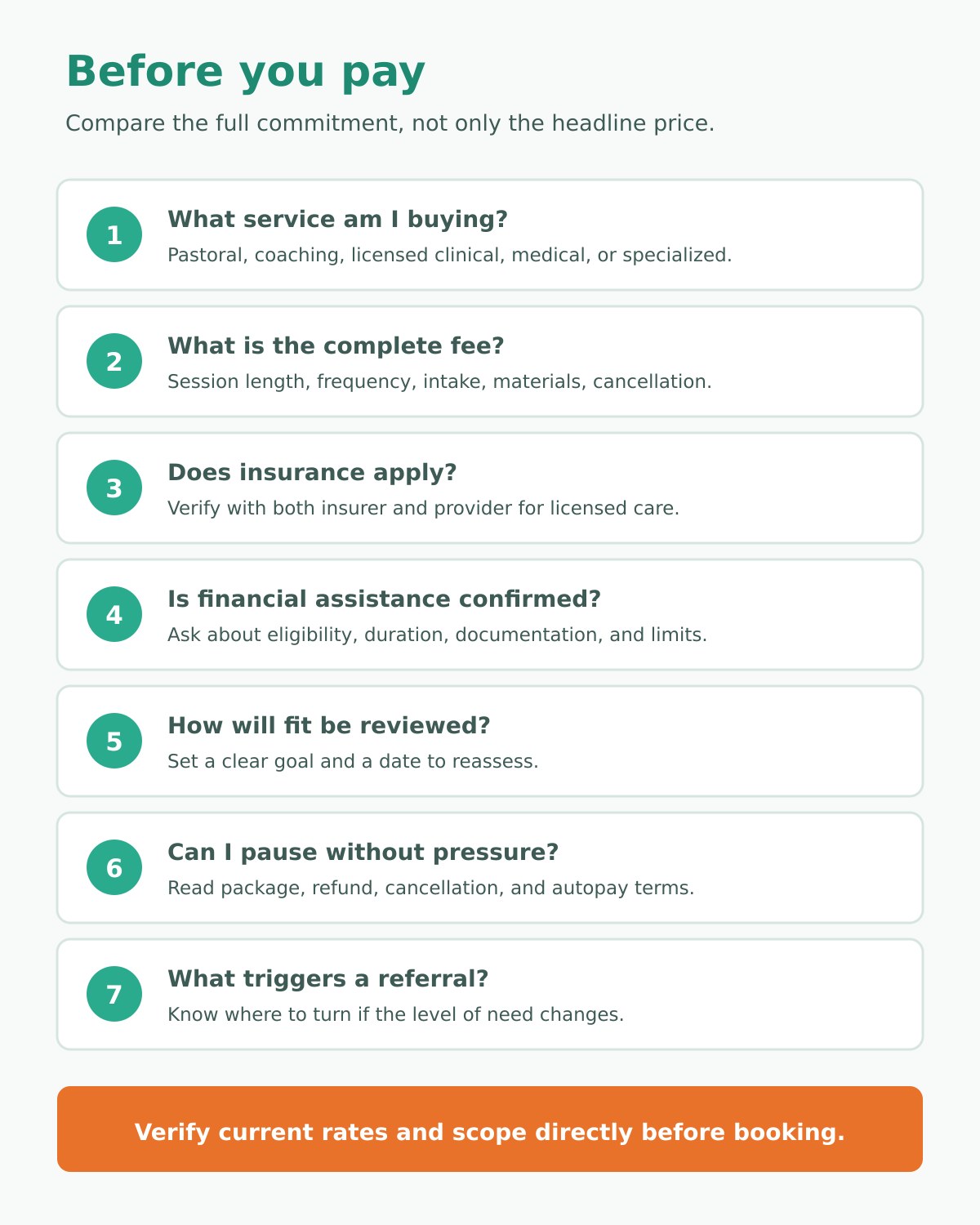
A one-week cost-planning checklist
- Write the need in one sentence. This keeps price comparisons tied to the actual goal.
- Verify the level of care. Pastoral, coaching, licensed clinical, medical, specialized, or emergency.
- Request the full fee. Session length, frequency, intake, cancellations, materials, and payment timing.
- Check insurance correctly. For licensed care, call both the insurer and provider; do not rely on a directory listing alone.
- Ask about assistance. Confirm eligibility, documentation, duration, and whether availability is limited.
- Set a review point. Decide when you and the practitioner will assess fit, progress, scope, and affordability.
- Keep a referral option. Know where you will turn if symptoms worsen or a different level of care becomes necessary.
This planning process reflects the RESTORE movements Establish safety, Separate truth from distortion, and Rebuild healthy patterns. Financial stewardship should create clarity, not shame.
Questions to ask before paying
- What service am I purchasing: pastoral counseling, coaching, psychotherapy, or something else?
- Is the practitioner licensed in my state, and does licensure matter for my need?
- How long is a session, and how often do you recommend meeting?
- What is the complete fee, including intake, materials, or cancellation charges?
- Do you bill insurance, provide a superbill, or operate entirely as private pay?
- Is financial assistance available, and what are the current eligibility terms?
- How is privacy handled for online sessions and payment information?
- What happens if my needs require licensed, medical, or emergency care?
When lower-cost or no-cost support may be wiser
A trusted church, support group, peer community, employee-assistance program, community mental-health center, school, nonprofit clinic, or training clinic may offer appropriate support at lower cost. Free pastoral care from a church can be valuable, especially for prayer, practical help, and community connection. Verify safeguarding, confidentiality, competence, and referral boundaries just as you would with a paid provider.
Do not substitute a free resource for emergency, medical, withdrawal-management, or domestic-violence services. Cost concerns are real, but safety determines the first step.
Safety and urgent needs
If you are in immediate danger, call 911. In the United States, call or text 988 or use 988lifeline.org for suicidal thoughts, self-harm risk, emotional distress, or substance-use crisis. The service is free, confidential, and available 24/7.
For domestic violence support, call 800-799-SAFE (7233), text START to 88788, or chat at TheHotline.org. The Hotline can connect people with local resources, including low- and no-cost care. Use a safer device if internet activity may be monitored.
Frequently asked questions
Does NuWell accept insurance?
No. Our pastoral counseling is non-clinical and private pay, so we do not bill insurance.
Can your rates change?
Yes, rates can change. As of October 9, 2026, our 50- to 60-minute sessions are $80 to $125, with intern sessions as low as $55. Our care team will confirm your exact fee before you book.
Can I meet less often to reduce cost?
Possibly, but frequency should match the goal and level of need. Ask the practitioner what is clinically or pastorally appropriate, what work happens between sessions, and when the plan will be reviewed.
Is pastoral counseling cheaper than therapy?
Sometimes, but there is no universal comparison. Fees, insurance, location, session length, and provider type vary. More important, the services have different scopes. Choose by need first, then compare cost within the right category.
Clarity before commitment
A transparent provider will help you understand what you are buying, what it can and cannot do, what it will cost, and what happens if your needs change. That clarity makes room for both wise stewardship and meaningful care.
Sources and further reading
- NuWell, Pricing, Online Pastoral Counseling, and Financial Assistance (accessed October 9, 2026).
- Telehealth.HHS.gov, Telehealth Information for Patients and Data and Privacy.
- 988 Suicide & Crisis Lifeline and National Domestic Violence Hotline, reverified October 9, 2026.
- Scripture references: Luke 14:28; Proverbs 15:22; Proverbs 21:5; James 1:5. Quotations are from the New International Version (NIV).

Its like you read my thoughts! You appear to understand so much approximately
this, such as you wrote the ebook in it or something. I believe that you simply could do with some percent
to power the message home a bit, but other
than that, this is great blog. An excellent read. I will certainly be back.
Having read this I believed it was extremely informative.
I appreciate you taking the time and energy to put this content together.
I once again find myself spending a lot of time both reading and posting comments.
But so what, it was still worth it!
[url=http://avana.life/]dapoxetine online[/url]
[url=http://onlinedrugstore.guru/]italian pharmacy online[/url]