

When Grief Steals Your Words, Scripture Speaks
Bible verses comfort grieving hearts in ways that human words simply cannot. Here are the most powerful scriptures people turn to in their darkest moments:
- Psalm 34:18 — “The Lord is close to the brokenhearted and saves those who are crushed in spirit.”
- Lamentations 3:22-23 — “God’s compassion never fails; His mercies are new every morning.”
- Matthew 5:4 — “Blessed are those who mourn, for they will be comforted.”
- John 14:27 — “Jesus gives a peace the world cannot offer.”
- Revelation 21:4 — “No more death, mourning, crying, or pain.”
- Romans 8:38-39 — “Nothing can separate us from the love of God.”
- 1 Thessalonians 4:13-14 — “We do not grieve without hope.”
Grief is one of the most isolating experiences a person can face.
Whether you’ve lost a parent, a child, a spouse, or a dream — the pain can feel physically unbearable. One person described it this way after losing their father to brain cancer at just 21 years old: they turned to Lamentations 3:22-23, and those ancient words became a lifeline.
That is what Scripture does. It doesn’t explain away your pain. It enters into it with you.
At NuWell Online, we have seen this again and again. When words fail — when grief is too heavy, too tangled, too raw to articulate — the Bible provides language that reaches the places nothing else can. It doesn’t offer empty reassurances. It offers the voice of a God who sees the brokenhearted and draws near.
This article walks through the most comforting Bible verses for grief, how to apply them practically, and how integrating Scripture with evidence-based support can lead to genuine, lasting healing.
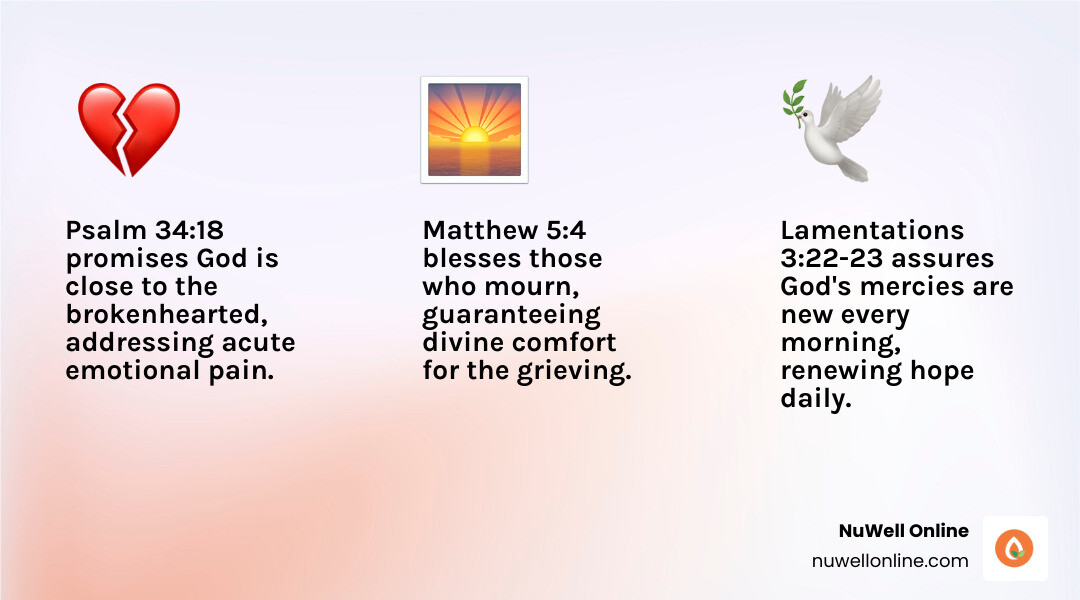
The Immediate Balm: Bible Verses Comfort Grieving Hearts in Acute Pain

When loss is fresh, the pain can feel like a physical weight pressing against your chest. In these moments, theological arguments often fall flat. What the soul needs is a balm—something to soothe the raw edges of a shattered heart.
The Bible addresses this immediate, overwhelming brokenheartedness by revealing a God who is not distant or indifferent. Psalm 34:18 is perhaps the most cited verse for this reason: “The Lord is close to the brokenhearted and saves those who are crushed in spirit.” This isn’t just a nice sentiment; it is a promise of proximity. When you feel at your lowest, God is at His closest.
Another anchor in the storm is Lamentations 3:22-23. Even in a book dedicated to mourning, the author finds a reason to breathe: “Because of the Lord’s great love we are not consumed, for his compassions never fail. They are new every morning; great is your faithfulness.” When you aren’t sure if you can make it through the next hour, this verse reminds us that God’s mercies are distributed in daily, manageable portions.
Matthew 5:4 (NIV) offers a unique perspective on the “blessing” of grief: “Blessed are those who mourn, for they will be comforted.” In the Matthew 5:4 (NLT) version, it reads, “God blesses those who mourn, for they will be comforted.” This suggests that mourning is not a sign of spiritual failure or weakness; rather, it is a state of being that qualifies you for a specific, divine kind of comfort that those who don’t mourn cannot fully know.
Why Bible Verses Comfort Grieving Hearts Better Than Advice
In our efforts to be helpful, we often rush to give advice. We want to “fix” the grief. However, advice often creates distance. It positions the speaker as a teacher and the griever as a student, which is the last thing a mourning person needs.
Bible verses offer something advice cannot: divine empathy. Instead of unhelpful clichés, Scripture provides a humble presence. When we share a verse, we aren’t offering our own wisdom; we are inviting the person to rest under the very words of God. Understanding What To Say To Someone Grieving involves moving away from “at least” statements that minimize pain.
Unhelpful “At Least” Statements to Avoid:
- “At least they lived a long life.”
- “At least you have other children.”
- “At least they aren’t suffering anymore.”
- “At least you’re young and can marry again.”
These phrases, while often well-intentioned, act as “compassion bypasses.” They try to skip the mourning and get straight to the “silver lining.” True biblical comfort, however, sits in the darkness with the person.
Experience: Finding Closeness in the Crushing
At NuWell, we have seen that in the earliest stages of loss, the most profound healing comes not from answers, but from the assurance that God is “close to the brokenhearted.” We have walked with many individuals in April 2026 who felt their hearts were literally breaking—some even making “just in case” arrangements for themselves because the physical pain of a broken heart felt fatal. We have found that Scripture provided the language for their pain when their own words failed. By leaning into the strength of the Lord and crying out to Him, they discovered that God does not abandon those who grieve; He shows compassion due to His unfailing love.
Finding Strength and Refuge When You Feel Broken

Grief is exhausting. It drains your physical energy, your mental clarity, and your spiritual resolve. When you feel like you have nothing left to give, the Bible offers God as a “refuge and strength, an ever-present help in trouble” (Psalm 46:1).
The experience of Grief And Loss often leaves us feeling weary and burdened. We aren’t just sad; we are heavy. This is where the words of Jesus provide a specific kind of solace. He doesn’t just offer to take the grief away; He offers to carry it with us.
Jesus’ Invitation to the Weary
In Matthew 11:28-30, Jesus gives one of the most beautiful invitations in all of history: “Come to me, all you who are weary and burdened, and I will give you rest. Take my yoke upon you and learn from me, for I am gentle and humble in heart, and you will find rest for your souls.”
This “rest” isn’t just a nap; it’s a soul-deep restoration. By taking His “yoke,” we aren’t adding more work to our lives. In ancient times, a yoke was often shared by two oxen. Jesus is saying, “Get in the yoke with Me. I will pull the heavy side. I will set the pace.” This is the essence of Learning With Loss And Grief—discovering that we don’t have to carry the weight of the world on our own shoulders.
Furthermore, Jesus promises a peace that is fundamentally different from what the world offers. In John 14:27, He says, “Peace I leave with you; my peace I give you. I do not give to you as the world gives. Do not let your hearts be troubled and do not be afraid.” The world’s peace depends on circumstances—everything going right. Jesus’ peace is supernatural; it can exist right in the middle of a funeral or a hospital room.
6 Bible Verses to Comfort the Grieving often highlight that one of the ironies of suffering is that it can actually draw us closer to God. When we have nothing else to rely on, we find that God is enough.
The Promise of Reunion: Eternal Hope for the Mourning
One of the hardest parts of grief is the finality of death in this world. The silence of a house, the empty chair at the table—these are constant reminders of what has been lost. However, the Bible provides a massive, world-altering hope: the promise of resurrection and reunion.
In 1 Thessalonians 4:13-14, Paul writes to a group of people who were terrified they would never see their loved ones again. He says, “Brothers and sisters, we do not want you to be uninformed about those who sleep in death, so that you do not grieve like the rest of mankind, who have no hope. For we believe that Jesus died and rose again, and so we believe that God will bring with Jesus those who have fallen asleep in him.”
Notice he doesn’t say “don’t grieve.” He says “don’t grieve without hope.” There is a kind of “hopeful grieving” that acknowledges the pain of the present while looking forward to the victory of the future.
This hope is anchored in the person of Jesus. In John 11:25-26, standing before the tomb of His friend Lazarus, Jesus declares, “I am the resurrection and the life. The one who believes in me will live, even though they die; and whoever lives by believing in me will never die.” This is the ultimate assurance. Death is not a period; for the believer, it is a comma.
Even the Old Testament echoes this hope. In Psalm 30:11-12 (ESV), we see the promise of transformation: “You have turned for me my mourning into dancing; you have loosed my sackcloth and clothed me with gladness, that my glory may sing your praise and not be silent.”
The Physicality of Our Future Hope
A common misconception is that our loved ones become “ghosts” or “angels.” But the Bible points to a much more tangible hope. When Jesus was resurrected, He wasn’t a ghost. He could be touched. He could eat (Luke 24:41-43). He was recognizable.
Job 19:25-27 gives us a stunning glimpse into this: “I know that my redeemer lives, and that in the end he will stand on the earth. And after my skin has been destroyed, yet in my flesh I will see God; I myself will see him with my own eyes—I, and not a stranger.”
This means our future hope includes:
- Tangible Reunion: We will see and recognize our loved ones.
- Glorified Bodies: Our bodies will be healed, free from cancer, old age, and pain (Philippians 3:20-21).
- Recognizable Identity: We will still be “us,” but the best, most whole version of ourselves.
The promise of Revelation 21:4 is the final word on grief: “He will wipe every tear from their eyes. There will be no more death or mourning or crying or pain, for the old order of things has passed away.”
Practical Ways to Apply Scripture to Your Healing Journey
Knowing the verses is the first step; letting them sink into your soul is the second. At NuWell, we encourage 7 Powerful Strategies For Overcoming Grief that move beyond passive reading into active engagement.
One of the most powerful tools is the biblical concept of lament. Lament is not just complaining; it is a relational conversation with God where you bring your rawest questions to Him.
| Feature | Grumbling | Lament |
|---|---|---|
| Direction | Third-person (talking about God) | First-person (talking to God) |
| Heart Posture | Closed, contemptuous | Open, seeking |
| Foundation | Accusation (“You aren’t good”) | Trust (“You are good, so I’m confused”) |
| Outcome | Bitterness and isolation | Intimacy and peace |
How Bible Verses Comfort Grieving Individuals in Daily Life
Incorporating Bible verses comfort grieving souls through practical daily habits:
- Scripture Journaling: Write out a verse and then write your “lament” or prayer underneath it. Tell God exactly how you feel in light of that verse.
- Prayer Cards: Keep verses like Psalm 34:18 on your dashboard or bathroom mirror.
- Musical Worship: Many modern hymns and songs are based directly on scriptures of comfort. Music can often reach the heart when the mind is too tired to read.
- Community Support: Don’t grieve alone. Grieving As A Christian involves being part of the “Body of Christ” where others can bear your burdens when you are too weak to stand.
For those planning a memorial, selecting the Top 10 Comforting Bible Verses about Grief can provide a thematic anchor for the service, offering guests a specific promise to take home and meditate on.
Integrating Faith and Evidence-Based Healing
At NuWell Online, we believe in “holistic wholeness.” This means we don’t just look at the spiritual side of grief, nor do we just look at the psychological side. We integrate them.
The Bible tells us we are “fearfully and wonderfully made” (Psalm 139:14). This includes our nervous systems, our brain chemistry, and our emotional processing. When we experience trauma or loss, our bodies react. Grieving As A Christian doesn’t mean ignoring the science of grief; it means using faith as the foundation for navigating it.
Our Faith-Based Coping Mechanisms Include:
- Pastoral Counseling: Bringing the “Great Physician” into the counseling room.
- Cognitive Reframing: Using the truths of Scripture to challenge the lies that grief often tells us (e.g., “I’ll never be happy again”).
- Community Anchoring: Connecting you with a church or support group.
Experience: The NuWell Approach to Wholeness
At NuWell Online, we have found that the most sustainable path to healing involves integrating the timeless truths of the Bible with practical, research-informed tools. Our pastoral counselors and Christian life coaches help you navigate the “hard places” by inviting God’s presence into the trauma, ensuring that your journey toward wholeness is rooted in both faith and practical wisdom.
Frequently Asked Questions about Bible Verses for Grief
Is it okay for a Christian to feel deep sadness or anger during grief?
Absolutely. Jesus Himself wept at the tomb of Lazarus (John 11:35), even though He knew He was about to raise him from the dead. The Psalms are filled with “lament”—raw, messy, and sometimes angry cries to God. Being a Christian doesn’t mean you have a “smile” requirement. It means you have a safe place to bring your struggle. As seen in 9 Bible Verses To Comfort Those Who Are Grieving, God welcomes your honesty.
How do I help a friend who is grieving when I don’t know what to say?
Focus on presence over advice. You don’t need to have the “right” words; often, there are no right words. Offer practical service—walk their dog, bring a meal, or clean their house. When you do speak, share a single, comforting verse and tell them, “I am praying this for you.” For more guidance, see our resource on What To Say To Someone Grieving.
What is the difference between “hopeful grieving” and “grieving without hope”?
“Grieving without hope” (1 Thessalonians 4:13) is the belief that death is the end—that the person is gone forever and there is nothing but void. “Hopeful grieving” acknowledges the searing pain of the separation but rests in the assurance of the resurrection. It’s the difference between saying “Goodbye” and saying “See you soon.”
Conclusion
Grief is a journey through a dark valley, but you do not have to walk it alone. We were created for more than just surviving loss; we were created for healing and wholeness. Whether you are in the acute pain of a fresh loss or the long, dull ache of a years-old sorrow, God speaks when words fail.
At NuWell Online, we are dedicated to your holistic restoration. If you are struggling to find your footing, our pastoral counselors and certified Christian coaches are here to help you integrate biblical truth with practical tools for healing.
You don’t have to have it all together. You just have to take the next step. Let us walk with you toward the light.
This article was researched with the help of AI and reviewed and edited by Jordan Oliver for accuracy, Scripture references, and faithfulness to NuWell’s non-clinical scope.
Jordan is an author, ordained minister, and online host for His Glory TV, sharing biblically grounded insights on faith, prayer, and spiritual growth. She is the co-founder of Triple-Braided Cord Co., an intercessory prayer and healing ministry inspired by Ecclesiastes 4:12.
Jordan holds a Bachelor’s degree in Communications and Religious Studies from High Point University and is a certified Spiritual Life Coach through iCoachLife in Nashville, Tennessee. Drawing from her ministry, coaching, and academic experience, she creates trustworthy, faith-based content that helps readers grow in their relationship with God. Learn more about Jordan here.
