

When Faith and Struggle Collide: Finding the Right Support
Pastoral care and counseling can feel like a confusing landscape — especially when you’re already hurting and just need to know where to turn.
Here’s a quick answer to what most people want to know:
What is pastoral care and counseling?
- Pastoral care is relational spiritual support offered by pastors, church leaders, or lay members — no license required. Think hospital visits, grief support, and prayer.
- Pastoral counseling goes deeper. It combines clinical therapy with Biblical truth, offered by a trained counselor who integrates your faith into the healing process.
- Online pastoral counseling brings that same faith-rooted support to you — wherever you are, without insurance headaches or waiting rooms.
Who is it for? Anyone facing anxiety, grief, relationship pain, or a loss of purpose — who wants healing that honors both their mental health and their walk with God.
You don’t have to choose between good therapy and your faith. The two belong together.
At NuWell Online, we’ve seen how powerful it is when someone finally finds a counselor who speaks both languages — the language of evidence-based care and the language of Scripture. That combination changes things.
This guide will walk you through exactly how to find trustworthy Biblical counseling online, what to look for in a counselor, and how to take your next step toward wholeness.
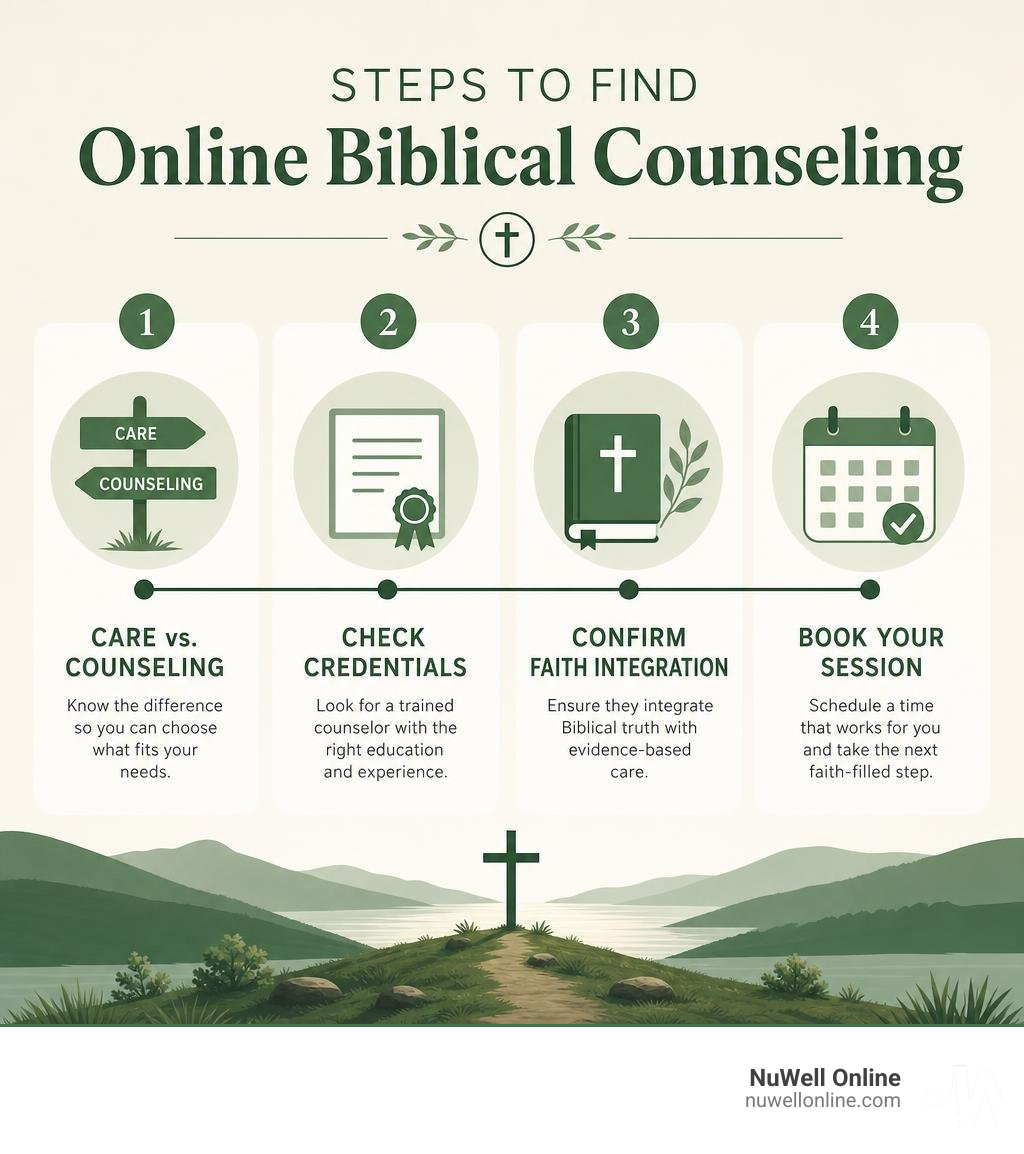
Understanding Pastoral Care and Counseling: What is the Difference?
To navigate faith-based support, we must first clear up the confusion between “pastoral care” and “pastoral counseling.” While they sound almost identical, they serve different functions in your life and spiritual journey.
Pastoral care is fundamentally relational and communal. It is a broad, non-licensed ministry that flows from Christian love. It is the heartbeat of a healthy church community. When a church deacon brings meals to a family with a newborn, when an elder visits a church member in a hospital, or when a small group prays over someone experiencing grief, that is pastoral care.
According to the Guidelines for Good Practice in Pastoral Care, pastoral care can be structured using the “All, Some, and Few” framework. “All” believers are called to care for one another informally. “Some” are recognized as having specific gifts for lay caregiving, such as leading support groups. The “Few” are those called into specialized, structured leadership.
Pastoral counseling, on the other hand, is a structured, intentional, and often clinical practice. It is a specialized branch of mental health care that explicitly integrates psychological theories with theological frameworks. Pastoral counselors are trained professionals — often possessing master’s degrees or doctorates — who understand both human psychology and spiritual development.
At NuWell Online, we believe that understanding this distinction is crucial for your healing. If you are looking for a deep dive into how these two approaches compare, we encourage you to read our detailed breakdown on Pastoral Counseling vs Traditional Therapy: What is the Difference? and explore our core Pastoral Counseling services.
Here is a quick reference table to help you visualize the core differences:
| Feature | Pastoral Care | Pastoral Counseling |
|---|---|---|
| Primary Goal | Spiritual encouragement, community connection, and immediate crisis support. | Deep, structured healing of emotional, psychological, and relational wounds. |
| Who Provides It? | Pastors, elders, deacons, lay leaders, or church members. | Licensed mental health professionals, certified pastoral counselors, or clinically trained clergy. |
| Setting | Church sanctuaries, hospitals, living rooms, or informal coffee shops. | Professional counseling offices or secure online telehealth platforms. |
| Licensure | Not required. | Often required for clinical practice (state-dependent). |
| Scope of Care | Short-term comfort, prayer, and community support. | In-depth therapy addressing depression, trauma, anxiety, and relational patterns. |
Historically, the field of pastoral counseling grew out of a desire to bridge the gap between faith and science. In the early 20th century, pioneers like Anton Boisen recognized that spiritual distress and mental illness were deeply intertwined. Boisen helped establish Clinical Pastoral Education (CPE) to train clergy in healthcare settings.
Later, figures like Dr. Smiley Blanton (a psychiatrist) and Norman Vincent Peale (a minister) teamed up to found the Blanton-Peale Institute, cementing the partnership between psychiatry and the Christian faith. This rich history demonstrates that pastoral counseling is not a modern trend, but a rigorous, time-tested discipline designed to care for the whole person.
The Power of Integrating Faith and Evidence-Based Therapy
At NuWell Online, we believe that true healing is a “whole-person” endeavor. You are not just a mind, and you are not just a spirit — you are a beautifully integrated creation. Therefore, your therapy should reflect that.
Integrating faith with evidence-based therapy means we do not have to throw out the clinical tools of modern psychology to remain faithful to Scripture. Instead, we use tools like Cognitive Behavioral Therapy (CBT) to help you identify negative thought patterns, while anchoring those tools in the absolute truth of God’s Word.

In David Powlison’s seminal work, The Pastor as Counselor: The Call for Soul Care, he emphasizes that counseling is an essential extension of shepherding. Counseling is not a secular invention; it is “soul care.” When we bring spiritual resources like prayer, Scripture, and theological reflection into the counseling room, we are inviting the Holy Spirit into the therapeutic process.
At NuWell, we have found that incorporating spiritual disciplines into evidence-based clinical practices helps clients find faster, deeper traction. For example, when treating anxiety, we might use evidence-based mindfulness and somatic grounding techniques alongside the comforting truth of Philippians 4:6-7. This dual approach respects both the psychological mechanisms of the brain and the spiritual needs of the soul.
To learn more about how this integration works in practice, check out our resource on Understanding the Power of Pastoral Counseling: Integrating Faith and Therapy.
The Role of Pastoral Care and Counseling in Mental Wellbeing
When you are battling depression, anxiety, or severe grief, it can feel like God is distant. You might ask, “Why is this happening to me?” or feel a deep sense of spiritual guilt for struggling with your mental health. This is where pastoral counseling shines.
Traditional, secular therapy can help you manage symptoms, but it often stops short of addressing these existential and spiritual questions. A pastoral counselor will not ignore your spiritual doubts; they will run toward them with you.
We address mental wellbeing by looking at three core dimensions:
- Care for Stories: Listening to your unique narrative, trauma, and personal history.
- Care for Systems: Understanding how your environment, family dynamics, and daily stressors impact your mental health.
- Care for Self: Helping you establish sustainable spiritual and emotional habits to prevent burnout.
Whether you are walking through a difficult life transition, processing the loss of a loved one, or dealing with chronic depression, our goal is to help you find hope. We invite you to read more about our specific approach to Pastoral Counseling for Depression and Mental Wellbeing.
What to Look for in an Online Pastoral Counselor
Finding the right counselor online can feel overwhelming. How do you know if someone is qualified, safe, and a good theological fit?
First, look for a balance of clinical training and theological education. A great online pastoral counselor should be “bilingual” — meaning they are equally comfortable discussing clinical psychological concepts and scriptural truths.

To help you navigate your search, we have mapped out the decision-making process for choosing the right professional:
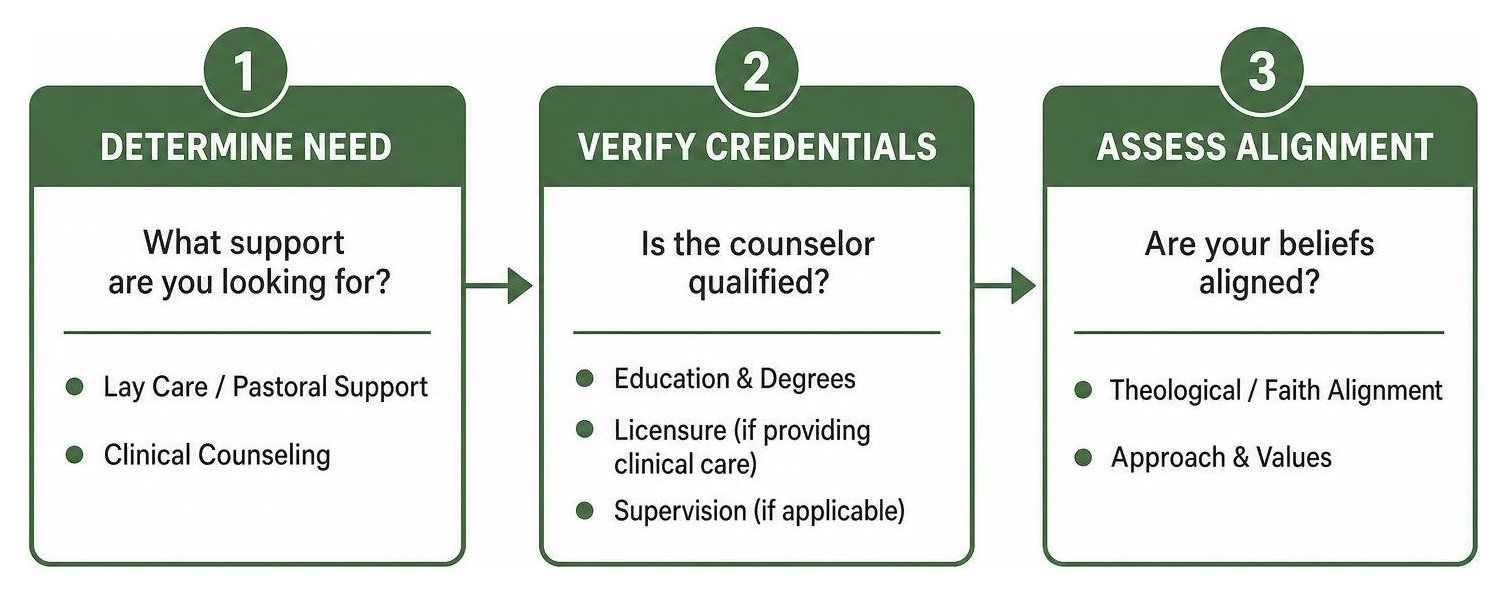
When evaluating an online platform or an individual therapist, keep these key criteria in mind:
- Education: Look for degrees from accredited universities or seminaries (such as a Master of Arts in Pastoral Counseling, Master of Divinity, or Master of Science in Clinical Mental Health Counseling).
- Licensure: If you need clinical mental health treatment, ensure the professional is licensed in your state (e.g., as an LPC, LMFT, or LCSW).
- Supervision: If they are a pre-licensed counselor or a master’s-level student, ensure they are actively supervised by a licensed professional.
- Theological Alignment: Ensure their statement of faith aligns with your beliefs.
For a deeper dive into choosing the right professional, read our comprehensive A Guide to Online Pastoral Counseling and consult the foundational academic text, Understanding Pastoral Counseling, which outlines the rigorous standards of the profession.
Navigating the Credentials of Pastoral Care and Counseling Professionals
The alphabet soup of credentials can be confusing. Here is a quick guide to the terms and abbreviations you will likely encounter when looking for Online Pastoral Counselors:
- CPE (Clinical Pastoral Education): This is the gold standard for hands-on chaplaincy and pastoral care training. It involves supervised clinical hours in high-stress environments like hospitals, hospices, or correctional facilities.
- CAS (Certificate of Advanced Study in Pastoral Counseling): A post-master’s certificate for licensed clinical therapists who want to specialize in integrating faith into their existing practice.
- CPCS (Pastoral Care Specialist Certificate): A certification designed for lay leaders, deacons, and ministers who want to provide high-quality pastoral care but do not intend to practice as licensed psychotherapists.
- BCPC (Board Certified Pastoral Counselor): A credential awarded by professional organizations to recognize advanced training in both theology and counseling.
If you are looking for local care in our home state, you can find trusted resources through Grace Christian Counseling as well as NuWell Online.
Frequently Asked Questions About Online Biblical Counseling
Can a pastoral counselor diagnose mental health conditions?
Generally, no. A traditional pastoral counselor or minister cannot diagnose mental health conditions or prescribe medications.
However, if your pastoral counselor is also a state-licensed mental health professional (such as a Licensed Professional Counselor or Licensed Marriage and Family Therapist), they do have the legal scope of practice to diagnose and treat mental health conditions.
At NuWell Online, we know our limits. If a client presents with a severe psychiatric condition that requires specialized medical intervention, we utilize a pre-vetted referral list to connect them with trusted psychiatrists or local clinical specialists, ensuring they get the comprehensive care they need.
How long does it take to become a pastoral counselor?
It typically takes 6 to 8 years of higher education and clinical training to become a professional pastoral counselor.
- Bachelor’s Degree (4 years): Usually in psychology, theology, or behavioral sciences.
- Master’s Degree (2 to 3 years): A Master of Divinity (M.Div.) or a Master’s in Pastoral Counseling, such as those modeled in academic courses like Liberty University’s Introduction to Pastoral Care and Counseling – PACO 505 – Liberty University Online.
- Clinical Hours and Supervision: Achieving state licensure or board certification often requires completing thousands of supervised clinical hours. For example, some clinical pastoral counseling certifications require up to 1,375 hours of clinical experience and 250 hours of direct supervision.
What is the difference between online pastoral counseling and traditional therapy?
The primary difference lies in the integration of your faith. While traditional therapy often treats spiritual beliefs as a secondary detail (or ignores them entirely), online pastoral counseling places your relationship with God at the center of your healing journey.
We conduct formal spiritual assessments to understand how your faith can be a source of strength, and we utilize virtual sessions to make this care accessible from the comfort of your home. To explore the many ways faith and therapy can meet, read our article Faith Meets Therapy: Exploring the Various Forms of Pastoral Care.
Conclusion: Taking Your Next Step Toward Wholeness
You were created for more than just survival. You were created for a life of purpose, joy, and deep connection with your Creator.
If you are ready to stop feeling stuck and start healing, we are here to walk beside you. At NuWell Online, we provide professional, compassionate, and Scripture-rooted online counseling that honors your faith while giving you the practical tools you need to thrive.
Whether you need marriage therapy, grief support, Christian life coaching, or pastoral counseling, your journey to wholeness starts with a single step.
Begin your journey with NuWell Online today and schedule your first online session. Let us help you find the peace and healing you’ve been searching for.
This article was researched with AI and heavily edited by Jordan Oliver for accuracy and relevance.
Jordan is an author, ordained minister, and online host for His Glory TV, sharing biblically grounded insights on faith, prayer, and spiritual growth. She is the co-founder of Triple-Braided Cord Co., an intercessory prayer and healing ministry inspired by Ecclesiastes 4:12.
Jordan holds a Bachelor’s degree in Communications and Religious Studies from High Point University and is a certified Spiritual Life Coach through iCoachLife in Nashville, Tennessee. Drawing from her ministry, coaching, and academic experience, she creates trustworthy, faith-based content that helps readers grow in their relationship with God. Learn more about Jordan here.
