

Choosing the right care
You may know that your faith belongs in the conversation, but still be unsure what kind of conversation you need. Is the issue a spiritual question, a painful relationship pattern, a mental-health condition, a major life decision, or several of these at once? The labels can make the choice harder, because “pastoral counseling” does not mean the same thing in every setting.
The safest way to compare pastoral counseling vs therapy is to look at the actual service, the provider’s credentials, the goals, and the limits. At NuWell, pastoral counseling is non-clinical, Scripture-rooted support. Licensed psychotherapy is health care delivered within a regulated professional scope that can assess and treat mental-health conditions.
Quick answerPastoral counseling helps people explore spiritual, relational, moral, and life concerns through Scripture, prayer, theological reflection, and practical support. Licensed therapy, also called psychotherapy or talk therapy, uses psychological methods to assess and treat troubling emotions, thoughts, behaviors, and mental-health conditions. The difference is not that one cares about the whole person and the other does not. It is the provider’s role and license, the methods, the problems addressed, and the accountability structure.
NuWell provides online pastoral counseling and Christian life coaching as non-clinical services across the United States. A NuWell practitioner may hold a professional credential used elsewhere, but that credential does not turn a NuWell session into licensed psychotherapy.
Pastoral Counseling vs Therapy at a Glance
| Question | NuWell pastoral counseling | Licensed psychotherapy |
|---|---|---|
| Primary purpose | Biblical discernment, spiritual formation, relational wisdom, practical next steps, and pastoral support | Assessment and treatment of mental-health symptoms, disorders, distress, and impaired functioning |
| Foundation | Scripture, prayer, theological reflection, pastoral wisdom, and practical tools | Psychological science and the clinician’s treatment approach; faith may be integrated when the client requests it and the therapist is competent to do so |
| Provider status | Pastoral counselor or practitioner working within NuWell’s non-clinical service | State-licensed mental-health professional practicing under applicable law and ethics |
| Diagnosis and treatment | Does not diagnose or provide psychotherapy or medical treatment | May diagnose and treat within license, training, jurisdiction, and setting |
| Typical goals | Clarify beliefs and values, process spiritual confusion, strengthen relationships, discern boundaries | Reduce symptoms, improve functioning, treat a condition, or process trauma clinically |
| Prayer and Scripture | Central and explicit when it fits the client’s goals | May be included in faith-integrated therapy; discuss it with the therapist |
| Insurance | Not billed to insurance, because NuWell’s pastoral counselors are not state-licensed | Coverage varies by plan, diagnosis, provider, network, and medical necessity |
| Crisis care | Not provided | Outpatient therapy is not crisis care, but licensed systems can assess risk and coordinate higher levels of treatment |
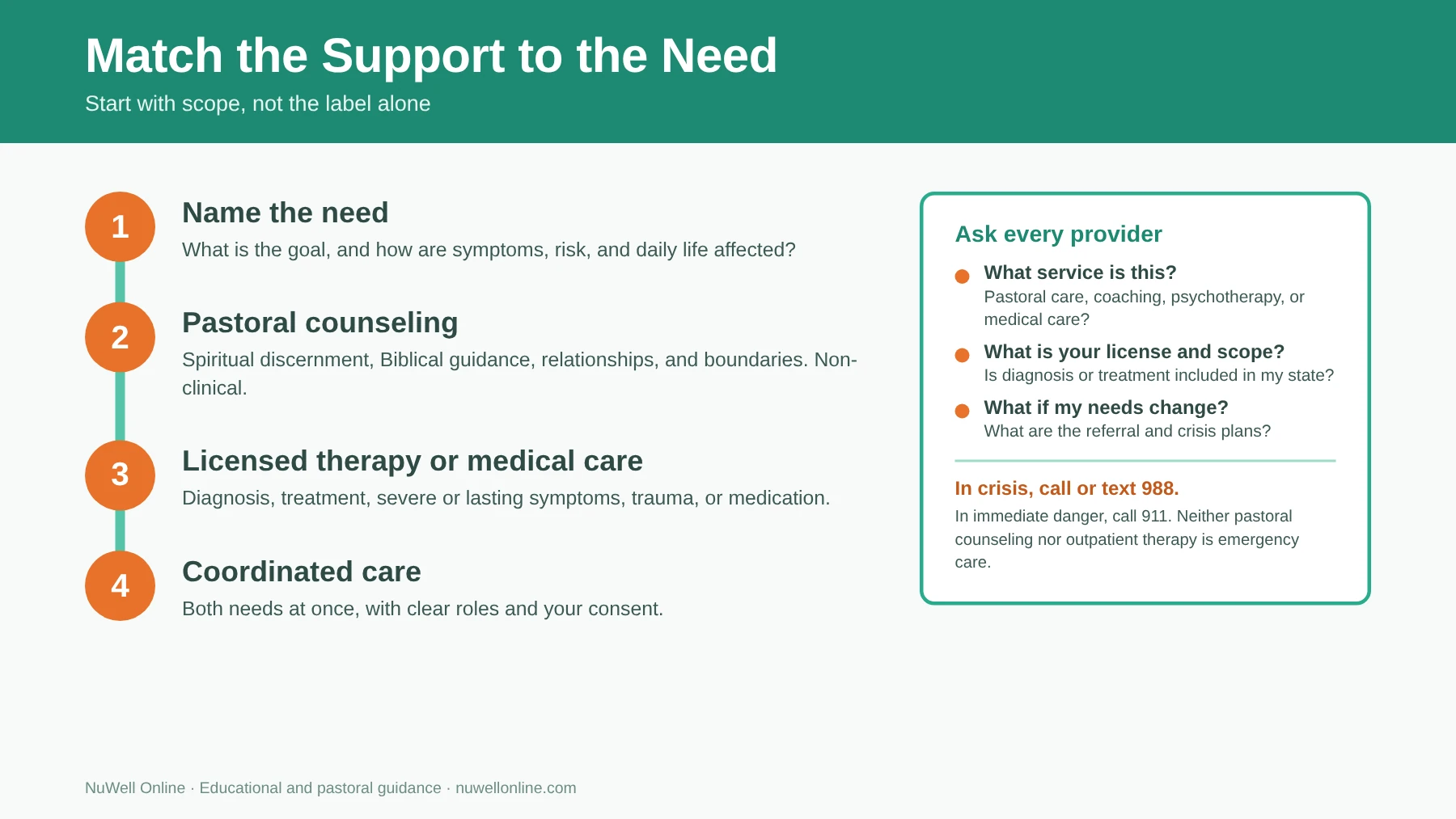
In short: for spiritual discernment, Biblical guidance, relational wisdom, and non-clinical support, pastoral counseling may fit. For diagnosis, persistent or severe symptoms, trauma treatment, medication, or impaired daily functioning, choose licensed mental-health or medical care. When both needs are present, coordinated care may fit.
What Counts as Pastoral Counseling?
Across churches, hospitals, private practices, and ministries, “pastoral counseling” can describe different roles. A pastor may offer short-term soul care. A chaplain may provide spiritual support in a hospital. A state-licensed clinician with theological training may offer psychotherapy that integrates faith. A ministry or online practice may offer non-clinical pastoral counseling.
That variation makes one question essential: What service am I actually receiving here? Ask whether the provider is acting as clergy, coach, non-clinical pastoral counselor, or licensed clinician; whether diagnosis or treatment is offered; what confidentiality rules apply; and what happens in a crisis.
At NuWell, the answer is clear: the service is Biblical Restoration Care delivered through non-clinical pastoral counseling and Christian life coaching. Practitioners use Scripture, prayer, reflection, education, and practical tools, but they do not provide psychotherapy, diagnosis, or medical treatment through NuWell.
What Is Licensed Therapy?
The National Institute of Mental Health describes psychotherapy as “a variety of treatments that aim to help a person identify and change troubling emotions, thoughts, and behaviors.” Most psychotherapy takes place one-on-one with a licensed mental health professional or in a group. In general, its goals are relief from symptoms, better daily functioning, and improved quality of life.
“Traditional therapy” is therefore an imprecise term. Therapy is not automatically secular, anti-Biblical, or indifferent to spiritual concerns. Some licensed therapists offer explicitly Christian, faith-integrated psychotherapy; others respectfully include faith as a client value. Ask directly rather than assuming.
What the Difference Is Not
Both can honor God
Christians can receive skilled health care without placing psychology above Scripture, and seek pastoral care without pretending prayer eliminates medical needs.
Wisdom matches need to scope
Choosing therapy does not mean someone lacks faith. Choosing pastoral counseling does not mean someone is denying reality.
Suffering has many dimensions
A person is not “a therapy case” or “just a spiritual problem.” One provider does not have to do every kind of work.
Pastoral experience: A recurring non-identifying pattern in pastoral work is that people often arrive asking which label is correct when the more useful question is what kind of help the situation requires now. Someone may want Biblical clarity about forgiveness while also experiencing panic that disrupts sleep and work. Another person may be clinically stable but spiritually confused after church hurt. Clear scope reduces shame and allows complementary care without asking one practitioner to work outside the role promised.
How Biblical Restoration Care Approaches the Decision
NuWell’s RESTORE Path is a flexible pastoral map, not a clinical protocol.
- Recognize the wound. Name what hurts and how it affects faith, relationships, choices, and daily life, without rushing to decide whether the problem is only spiritual or only psychological.
- Establish safety. Screen for immediate danger, suicidal thinking, violence, coercive control, substance withdrawal, psychosis, or inability to function. These need crisis, medical, domestic-violence, substance-use, or licensed care.
- Separate truth from distortion. Examine beliefs about God, self, suffering, responsibility, and hope. This is pastoral work when it stays educational and spiritual; it becomes clinical when it involves diagnosing or treating a condition.
- Tend what was wounded and rebuild healthy patterns. Use the right supports: pastoral conversations, therapy, medical care, a recovery program, church community, coaching, or a coordinated combination.
When Pastoral Counseling May Fit
NuWell pastoral counseling may fit when you are stable enough for non-clinical work and want Scripture-rooted support for:
- spiritual confusion, church hurt, shame, forgiveness, or identity in Christ;
- relationship patterns, boundaries, conflict, grief, or a life transition;
- discernment about a faithful next step;
- prayer, spiritual practices, or rebuilding trust in God.
Pastoral counseling should never be used to promise reconciliation, pressure forgiveness, excuse abuse, or spiritualize symptoms. A good pastoral fit still includes informed consent, clear boundaries, privacy expectations, readiness to refer, and respect for your agency.
When Licensed, Medical, or Specialized Care Is the Better First Step
Start with licensed mental-health or medical care when symptoms are persistent, severe, worsening, or impair sleep, work, self-care, judgment, or relationships. Clinical care is especially important for possible major depression, bipolar symptoms, psychosis, eating disorders, severe anxiety, post-traumatic stress, obsessive-compulsive symptoms, or risk of self-harm. NuWell’s guide to choosing the right care for anxiety walks through one common example, and our guide to scrupulosity versus conviction covers religious doubts that keep returning despite repeated confession or reassurance.
Seek medical evaluation for new or unexplained changes in mood, energy, appetite, sleep, or physical functioning. Use specialized substance-use treatment for dependence, overdose risk, or withdrawal risk. Contact a domestic-violence advocate when coercive control, threats, stalking, or violence may be present.
Can Pastoral Counseling and Therapy Work Together?
Yes, when roles are clear and you consent. A therapist might treat panic, trauma symptoms, or depression while a pastoral counselor helps you reflect on prayer, lament, forgiveness, church relationships, or spiritual identity. A physician may address medication or physical contributors. A church community may provide worship, friendship, practical help, and belonging. Parallel care works best when each provider stays within scope and communicates only with your permission.
Questions to Ask Before Choosing a Provider
- What exact service are you offering: pastoral care, coaching, psychotherapy, medical care, or something else?
- Are you licensed for this service in my state, and does it include diagnosis or treatment?
- How will Scripture, prayer, and my Christian beliefs be included?
- What training and experience do you have with my concern?
- What are the privacy limits, referral plan, and crisis procedure?
- How will we set goals, review progress, and handle fees or insurance?
Before beginning, you can meet the NuWell team, review NuWell pricing and financial assistance, and see how NuWell’s process works.
Urgent Support
Neither pastoral counseling nor routine outpatient therapy is emergency care. If you or someone else may be in danger, reach out now.
In immediate danger, call 911.
Suicidal crisis or emotional distress: call or text 988 or chat at 988lifeline.org. Treatment referrals: FindTreatment.gov or SAMHSA at 1-800-662-HELP (4357). Domestic-violence support: 800-799-SAFE (7233), text START to 88788, or thehotline.org.
Frequently Asked Questions
Is a pastoral counselor a therapist?
Not necessarily. Some pastoral counselors are state-licensed mental-health professionals and provide psychotherapy in a clinical setting. Others provide clergy care or non-clinical pastoral support. At NuWell, pastoral counseling is non-clinical and is not psychotherapy, even if an individual practitioner holds a clinical license used in a separate role elsewhere.
Can a therapist include Christian faith?
Yes. Some therapists specialize in Christian or faith-integrated psychotherapy. Others can respectfully include a client’s faith as part of culturally responsive care. Ask about the therapist’s training, approach, and willingness to integrate Scripture or prayer rather than assuming.
Does insurance cover NuWell pastoral counseling?
No. NuWell’s pastoral counselors are not state-licensed, so NuWell is unable to bill insurance. Coverage for licensed psychotherapy varies by insurer, plan, network, diagnosis, and medical necessity, so verify benefits directly with the provider and insurer.
Is Christian life coaching another option?
It may be. Christian life coaching is generally forward-focused and suited to goals, decisions, habits, accountability, purpose, or leadership when the person does not need diagnosis or treatment. Coaching is not a substitute for therapy, medical care, or crisis support.
Match the Support to the Need
The right question is not whether pastoral counseling or therapy is better. It is whether the service matches the need, whether the provider is qualified for the role, and whether the limits are honest. Use both when the needs overlap and the roles stay clear.
NuWell’s care team can explain its non-clinical scope and help you consider whether NuWell is a reasonable fit, or whether another level of care is wiser.
Learn more about NuWell pastoral counseling.

This article was researched with the help of AI and reviewed and edited by Stephen Luther, MEd, MSEd, LPC, for accuracy, Scripture references, and faithfulness to NuWell’s non-clinical scope.
Stephen Luther, MEd, MSEd, LPC, is Executive Director and Founder of Grace Christian Counseling and a licensed professional counselor. He holds a master’s degree in Education and a master’s degree in Marriage and Family Therapy from Duquesne University and has helped children, adolescents, and adults since 1997. His licensed clinical role at Grace Christian Counseling is separate from NuWell’s non-clinical pastoral counseling and Christian life coaching services.
Scope note: This article is educational and pastoral. It does not provide diagnosis, psychotherapy, medical treatment, legal advice, substance-use treatment, domestic-violence services, or emergency care. NuWell provides non-clinical pastoral counseling and Christian life coaching.
Sources
- National Institute of Mental Health. Psychotherapies and Help for Mental Illnesses.
- SAMHSA. 988 FAQs and National Helpline.
- National Domestic Violence Hotline. Get Help.
- NuWell. Pricing (insurance and scope).
