

Pastoral counseling basics
Maybe a friend suggested you “talk to someone,” and you want that someone to understand your faith. Maybe you are carrying grief, guilt, a strained relationship, or questions about God that do not fit neatly into a Sunday conversation. You may have heard the term pastoral counseling and wondered what it actually is.
What is pastoral counseling? This guide explains its meaning, what a pastoral counselor does, how a session works, its roots in Christian soul care, and how to tell whether it fits what you are facing.
Quick answerPastoral counseling is faith-centered care that brings Scripture, prayer, and wise conversation to spiritual, relational, and life struggles. A pastoral counselor helps you name what hurts, reflect on it in light of God’s truth, and take practical next steps. At NuWell, pastoral counseling is non-clinical: it does not diagnose or treat mental-health conditions, and it works best alongside licensed or medical care when those are needed.
The Meaning of Pastoral Counseling
The word pastoral comes from the image of a shepherd who knows, guides, and protects the flock. Pastoral counseling applies that care to individual lives: it asks not only “What is happening?” but also “Where is God in this, and what does faithfulness look like now?”
The term is used in more than one way. A pastor offering short-term care to a congregant, a hospital chaplain, a non-clinical pastoral counselor, and a licensed clinician who integrates faith into psychotherapy may all use the label. That is why it is wise to ask any provider what service they actually offer. NuWell’s guide to pastoral counseling vs therapy compares these roles side by side.
Rooted in Christian Soul Care
Caring for one another’s souls is as old as the church. Paul urged believers to “encourage the disheartened, help the weak, be patient with everyone” (1 Thessalonians 5:14, NIV), and to “carry each other’s burdens” (Galatians 6:2, NIV). He described God as “the God of all comfort, who comforts us in all our troubles, so that we can comfort those in any trouble with the comfort we ourselves receive from God” (2 Corinthians 1:3-4, NIV).
Colossians 3:16 (NIV)“Let the message of Christ dwell among you richly as you teach and admonish one another with all wisdom…”
In the twentieth century, pastoral care became more structured. Clinical Pastoral Education, which began in the 1920s, trains chaplains and other spiritual care providers, and its accrediting body, ACPE, today serves CPE educators, chaplains, pastoral counselors, and spiritually integrated psychotherapists. Pastoral counseling today ranges from church-based soul care to online services like NuWell’s.
What a Pastoral Counselor Does
Space for your story
Helps you tell the truth about what hurts without rushing to fix it or offering easy answers.
God’s word in context
Explores what Scripture says and tests beliefs about God, yourself, and others that may be distorted.
With your consent
Prays with you, introduces spiritual practices, and helps you discern a faithful next step.
Refers when needed
Recognizes when you need licensed, medical, crisis, or domestic-violence support, and helps you find it.
Pastoral experience: A recurring, non-identifying pattern in pastoral conversations is that people arrive believing their struggle proves something is wrong with their faith. Often the first relief comes from hearing that faithful people in Scripture lamented, doubted, and asked for help, and that bringing a burden into the open is itself an act of trust.
How a Pastoral Counseling Session Works
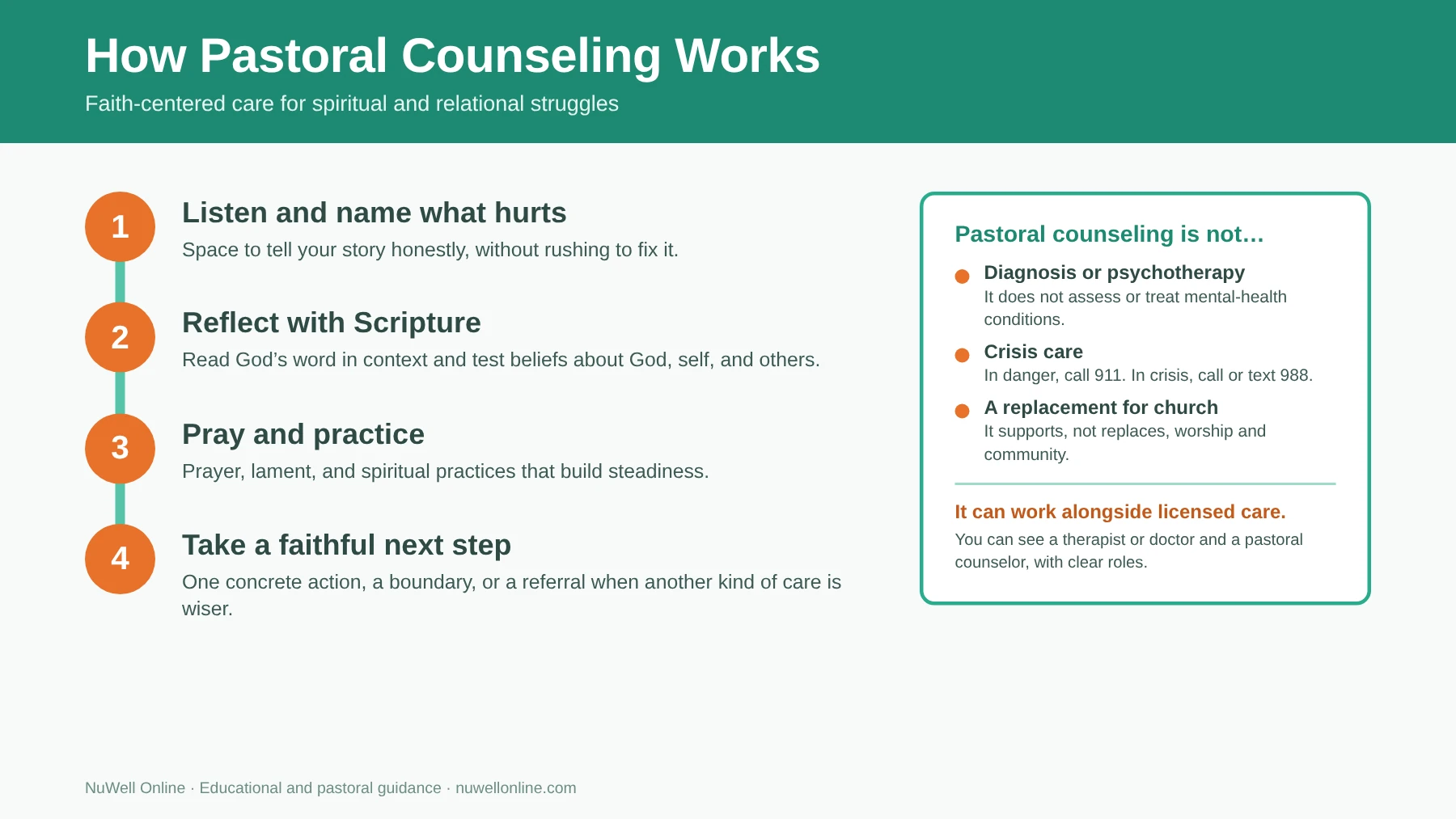
Listen and name what hurts
A session begins with your story: what is happening, how it affects your faith and relationships, and what you hope will change. A good pastoral counselor asks questions before offering answers.
Reflect with Scripture
Together you look at what Scripture actually says in context. This is where many people find that a belief such as “God must be disappointed in me” does not match what God reveals about himself.
Pray and practice
With your consent, sessions may include prayer, lament, Scripture meditation, or other spiritual practices you can carry into the week.
Take a faithful next step
Each conversation ends with something concrete: a conversation to have, a boundary to set, a practice to try, or a referral when another kind of care would serve you better.
Common Pastoral Counseling Techniques
Pastoral counseling techniques are practical and spiritual rather than clinical. Depending on your needs, they may include:
- Reflective listening that helps you hear your own story more clearly.
- Scripture reflection that reads passages in context rather than as slogans.
- Prayer and lament, including honest prayers of grief and complaint like many of the Psalms.
- Discernment questions about motives, responsibilities, and the fruit a choice is producing.
- Forgiveness and repentance work that does not rush the process or skip safety and boundaries.
- Spiritual practices such as rest, Sabbath, journaling, and gratitude.
- Accountability for small, faithful steps between sessions.
The Benefits of Pastoral Counseling
Pastoral counseling can be valuable when you want support that takes both your struggle and your faith seriously. People often seek it for:
- Faith questions and doubt, including suffering and unanswered prayer.
- Guilt, shame, and forgiveness; NuWell’s guide to Christian shame vs conviction explores the difference.
- Marriage and family strain, such as rebuilding trust after lying or family conflict that feels spiritual.
- Patterns that keep repeating, examined calmly through the lens of spiritual strongholds.
- Grief, transitions, and questions of purpose.
These are possible benefits, not guarantees. Growth usually comes through honest conversation, practice, and time.
Is Pastoral Counseling Right for You?
You want faith-centered support
Spiritual questions, relationship patterns, guilt and forgiveness, grief, purpose, or discernment, and you are stable enough for non-clinical care.
Symptoms need treatment
Anxiety, depression, trauma symptoms, or substance use are persistent, severe, or affecting daily life, or you need a diagnosis. See choosing the right care for anxiety.
Pastoral counseling and licensed care can also work together, each within its own role. When licensed Christian counseling is needed, NuWell’s care team can point you to Grace Christian Counseling, an affiliated licensed practice, or to another provider.
Online Pastoral Counseling at NuWell
NuWell offers online pastoral counseling and Christian life coaching anywhere in the United States, through secure video sessions. NuWell’s pastoral counselors are not state-licensed, so services are not billed to insurance; see pricing and financial assistance. NuWell does not provide diagnosis, psychotherapy, medical treatment, or emergency care.
If You Are in Crisis
Pastoral counseling is not emergency care. If you or someone else may be in danger, reach out now.
In immediate danger, call 911.
For suicide, self-harm, or emotional or substance-use crisis, call or text 988 or chat at 988lifeline.org. For domestic-violence support, call 800-799-SAFE (7233) or text START to 88788.
Frequently Asked Questions
What is the meaning of pastoral counseling?
Pastoral counseling is faith-centered care that helps people bring their spiritual, relational, and life concerns into conversation with Scripture, prayer, and wise guidance. The exact meaning varies by setting: some pastoral counselors are clergy, some are non-clinical practitioners, and some are licensed clinicians who integrate faith into psychotherapy.
What does a pastoral counselor do?
A pastoral counselor listens, helps you name what hurts, reflects with you on Scripture and your beliefs about God, prays with your consent, and helps you take practical, faithful next steps. A responsible pastoral counselor also recognizes when you need licensed, medical, or crisis care and helps you find it.
Is pastoral counseling the same as therapy?
Not at NuWell. NuWell’s pastoral counseling is non-clinical and does not provide diagnosis or psychotherapy. Elsewhere, some licensed therapists practice faith-integrated psychotherapy, so it is always worth asking what service a provider actually offers.
Do I have to be very religious to benefit?
No. You do not need to be a Bible scholar or attend church every week. People come with faith that is strong, searching, or still forming. What matters is that you want support that takes faith seriously.
Bring Your Questions to a Pastoral Counselor
Pastoral counseling is an old practice in a new format: Christians helping one another carry burdens, hear God’s truth, and take the next faithful step. You do not need the right words to begin.
Talk with NuWell’s care team about whether pastoral counseling, coaching, or another kind of care fits what you are facing.
You can also meet the NuWell team or see how NuWell’s process works.

This article was researched with the help of AI and reviewed and edited by Stephen Luther, MEd, MSEd, LPC, for accuracy, Scripture references, and faithfulness to NuWell’s non-clinical scope.
Stephen Luther, MEd, MSEd, LPC, is Executive Director and Founder of Grace Christian Counseling and a licensed professional counselor. He holds a master’s degree in Education and a master’s degree in Marriage and Family Therapy from Duquesne University and has helped children, adolescents, and adults since 1997. His licensed clinical role at Grace Christian Counseling is separate from NuWell’s non-clinical pastoral counseling and Christian life coaching services.
Scope note: This article is educational and pastoral. It is not diagnosis, psychotherapy, medical treatment, individualized professional advice, or emergency care. NuWell provides non-clinical pastoral counseling and Christian life coaching.
Sources
- 1 Thessalonians 5:14; Galatians 6:2; 2 Corinthians 1:3-4; Colossians 3:16 (NIV).
- ACPE: The Standard for Spiritual Care & Education. About ACPE (history archive and membership).
- National Institute of Mental Health. Psychotherapies.
- 988 Suicide & Crisis Lifeline; National Domestic Violence Hotline, Get Help.
