

You may want support that takes your faith seriously, but the nearest provider is an hour away. Perhaps work, caregiving, disability, or a packed family schedule makes another weekly drive unrealistic. Or maybe you can find a local counselor, but you are not sure whether Scripture, prayer, church hurt, or questions about God will be welcome. That is often when people start weighing the benefits of online Christian counseling.
Faith, access, and choosing care
Meeting online can remove some of those barriers. It can also introduce new ones. A video session is not automatically private because it happens at home, and “Christian counseling” does not tell you whether a provider offers pastoral care, coaching, or licensed psychotherapy. The useful question is not whether online care is always better. It is whether its benefits match your need, safety, setting, and desired kind of support.
Quick answerThe main benefits of online Christian counseling are wider access to faith-aligned practitioners, less travel, more scheduling flexibility, continuity during ordinary disruptions, and the freedom to bring Scripture, prayer, and spiritual questions into the conversation. Online video can still support a meaningful working relationship, although fit varies by person and provider. It also requires a private setting, reliable technology, clear scope, and a plan for emergencies. At NuWell, online Christian counseling means non-clinical online pastoral counseling: Scripture-grounded spiritual and relational support, not diagnosis, psychotherapy, medical treatment, or emergency care.
Tell our care team what you are facing. We can help you consider pastoral counseling, Christian life coaching, or a referral to another level of care.
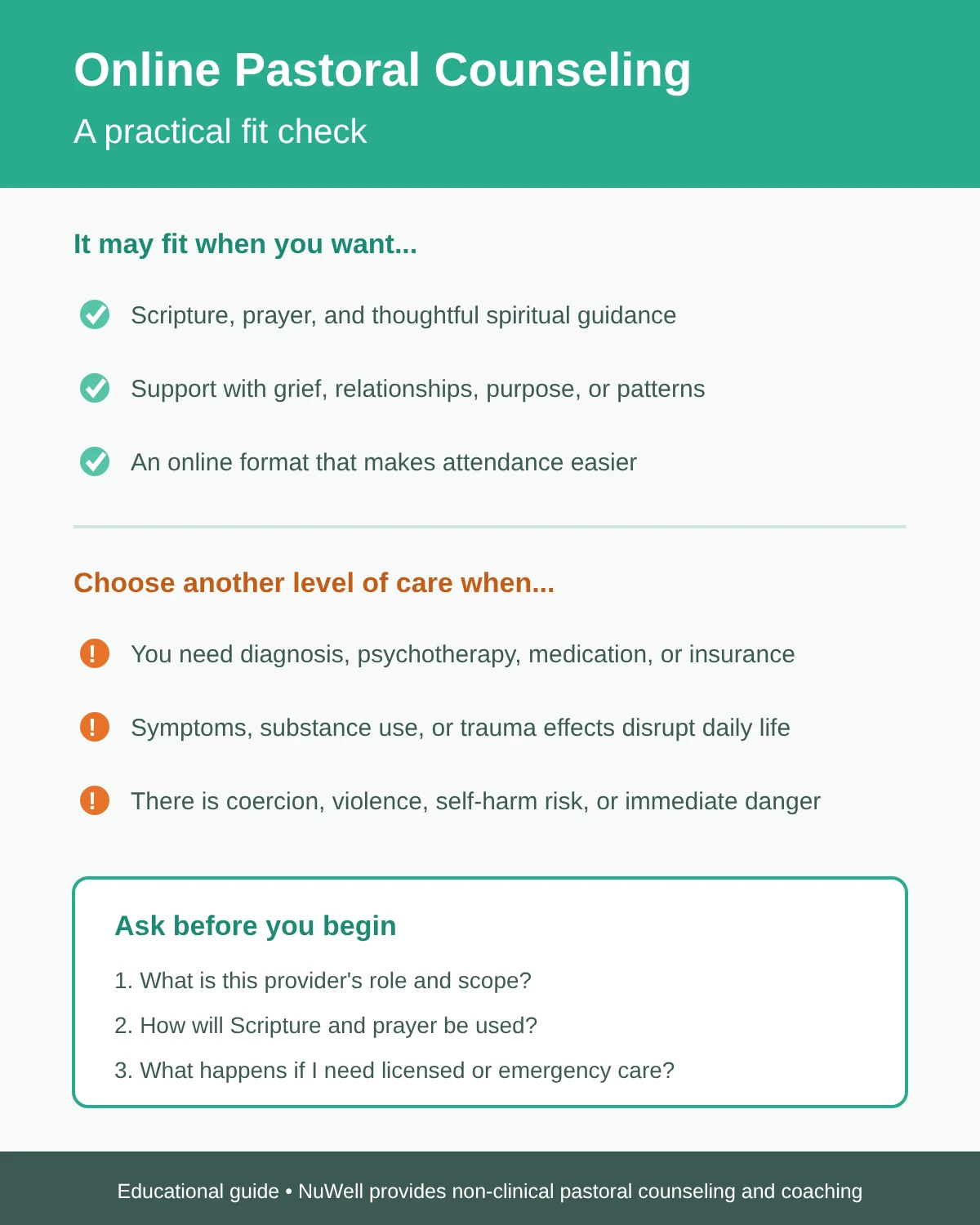
What Christian Counseling Online Is, and Is Not
Christian counseling is a broad label. A licensed therapist may use it to describe psychotherapy that integrates Christian faith. A pastor, chaplain, coach, or pastoral counselor may use it for non-clinical spiritual care. Those services can all be valuable, but they are not interchangeable. Ask what service is being offered, what credentials and license the provider holds, whether that license applies where you live, and how the provider responds when a need exceeds scope.
We provide online pastoral counseling and Christian life coaching across the United States. Pastoral sessions may include careful listening, prayer, Scripture in context, practical reflection, and relational skills. They do not create a diagnosis or clinical treatment plan. Our guide to pastoral counseling and licensed therapy explains the distinction.
Choosing pastoral care does not mean your struggle is “only spiritual,” that you lack faith, or that licensed treatment is unbiblical. Responsible care begins by naming what is happening, checking safety and daily functioning, and matching the need to an appropriately trained provider.
7 Benefits of Online Christian Counseling
You can look beyond driving distance
In-person choices may be limited by rural location, mobility, transportation, weather, or the number of faith-integrated providers nearby. Online care makes geography less decisive, so you can consider practitioners whose approach, experience, availability, and theological posture fit more closely. That does not make every remote provider a good choice. Review training, scope, privacy practices, and referral habits. If you need licensed psychotherapy, confirm that the clinician is authorized to serve clients in your state. For non-clinical support, meet our pastoral counselors and ask the care team how matching works.
You remove the commute, not the commitment
A session from home or another private setting can remove travel time, parking, waiting rooms, and some accessibility barriers. That may make a consistent appointment more realistic for a parent, caregiver, remote worker, ministry leader, or person managing limited energy. Convenience is not the same as affordability, however. Review current session costs rather than assuming that online care is cheaper.
Your faith can be part of the conversation
You do not have to translate every spiritual concern before it can be discussed. A Christian pastoral counselor can engage questions about God, guilt, lament, forgiveness, church hurt, calling, boundaries, and hope with Scripture and prayer explicitly available.
Faith integration should deepen honesty, not shut it down. Scripture must not be used to bypass apology, responsibility, safety, grief, or follow-through. Proverbs 15:22 says, “Plans fail for lack of counsel, but with many advisers they succeed” (NIV). The verse commends wise counsel; it does not claim that one adviser or one type of care can meet every need.
A meaningful connection can form by video
Some people worry that a screen makes genuine connection impossible. Research on video-based psychotherapy cannot prove outcomes for non-clinical pastoral care, but it can answer a narrower question: can people form a working relationship by video? A systematic review and meta-analysis found no statistically significant difference in therapeutic-alliance ratings between videoconference and in-person psychotherapy.1 That supports cautious confidence in the format, not a promise about any individual relationship. Notice whether the practitioner welcomes questions, explains scope, and can discuss referral without defensiveness.
Your own setting can support honest reflection
Some people speak more freely in a familiar room, with their Bible, journal, or notes close at hand. But home is not private or safe for everyone. Children may interrupt, walls may be thin, a partner may listen, or a device may be monitored. Federal telehealth guidance recommends a private location, headphones, password-protected devices, and avoiding public Wi-Fi when discussing sensitive information.2 If someone monitors your technology or may retaliate for what you say, use a safer device and contact a specialized safety resource before scheduling a joint session.
Practical steps can move into daily life quickly
Pastoral care is most useful when insight becomes faithful action. Because you are already in your ordinary environment, you can finish a session with a concrete next step: write the apology, rehearse the boundary, schedule the medical appointment, ask a trusted friend for support, or return to a passage of Scripture in context. The online format does not cause growth by itself; follow-through still requires attention and repetition.
Support may continue through ordinary disruptions
Travel, a temporary move, bad weather, or a demanding week may be less likely to interrupt a remote appointment. Continuity still has limits: provider availability, technology failure, time zones, and changing needs can all affect whether online support remains appropriate. A good provider should have a backup plan for a dropped connection and be willing to reconsider the level of care when circumstances change.
The Benefits of Online Christian Counseling Do Not Erase the Tradeoffs
Online support may not fit if you lack a private space or reliable connection, find video communication exhausting, need hands-on medical assessment, require intensive or emergency services, or simply connect better face to face. It can also be a poor setting for a joint relationship conversation when one person is afraid, monitored, coerced, or at risk of retaliation.
Privacy is not anonymity. Any provider will need identifying and contact information, and responsible care includes explaining records, confidentiality limits, emergency procedures, and who may be present. Comfort is also not proof of safety, quality, or proper scope. Weigh these benefits alongside the personal fit check in is online Christian pastoral counseling right for me?
Pastoral experience: Across pastoral settings, a recurring pattern is that people initially name convenience as the reason they chose online care, then discover that fit depends on something deeper. They need enough privacy to speak honestly, a practitioner who can hold spiritual questions without rushing them, and a clear understanding of what the service can and cannot do. When one of those pieces is missing, the convenience of video does not repair it. When all three are present, the format can support focused, practical pastoral work.
Weighing Online Pastoral Counseling Benefits: A Decision Sequence
- Recognize the wound. Write one sentence describing what is happening without diagnosing yourself or another person: “I am looking for help with…”
- Establish safety. Ask whether anyone is in danger, afraid to speak freely, being monitored, or experiencing threats, coercion, violence, self-harm risk, dangerous withdrawal, or severe loss of functioning.
- Separate truth from distortion. List what you know, what you fear, and what remains uncertain.
- Choose the category of care. Pastoral counseling, coaching, licensed psychotherapy, medical care, substance-use treatment, a domestic-violence advocate, or emergency support.
- Check the online setting. A private room, headphones, a charged device, password-protected internet, and a backup plan if the connection fails.
- Interview the provider. Ask about scope, credentials, licensure, faith integration, privacy, records, fees, emergency limits, and referrals.
- Review after the first conversation. Did you feel respected? Could you ask questions? Were boundaries and next steps clear?
The first three steps come from the NuWell RESTORE Path, a flexible pastoral map rather than a clinical protocol. They help you put safety and truth before convenience, then begin to Rebuild healthy patterns with the right support.
When Faith-Based Online Counseling at NuWell Fits, and When Another Service Should Lead
NuWell may fit when you are an adult in the United States seeking explicitly Christian, non-clinical help with grief, guilt, shame, forgiveness, boundaries, purpose, church hurt, spiritual confusion, difficult decisions, or relational strain when everyone is safe. Christian life coaching may fit when you are generally stable and want forward-focused goals, habits, or accountability. See what pastoral counseling can help with.
Licensed mental-health or medical care should lead when you need diagnosis, psychotherapy, a treatment plan, medication evaluation, trauma treatment, or help with significant or worsening symptoms. For licensed Christian counseling, we refer to our partners at Grace Christian Counseling. Qualified substance-use services are important for dependence, overdose risk, or dangerous withdrawal. Pastoral care may accompany these services when roles are clear; it should not replace them.
When Safety Comes First
Abuse is not a communication cycle. If coercive control, stalking, threats, sexual coercion, intimidation, or violence may be present, seek individual help and specialized safety planning before any couples work. Forgiveness does not require reconciliation, restored trust, or renewed access.
In immediate danger in the United States, call 911.
For suicidal thoughts, self-harm, emotional distress, or a substance-use crisis, call or text 988 or chat at 988lifeline.org. It is free, confidential, and available 24/7. NuWell is not an emergency service.
For domestic-violence support, call 800-799-SAFE (7233), text START to 88788, or chat at TheHotline.org. If your device may be monitored, use a safer device when possible.
Frequently Asked Questions
What are the main benefits of online Christian counseling?
The main benefits are broader access to faith-aligned practitioners, less travel, scheduling flexibility, continuity through ordinary disruptions, and room to discuss Scripture, prayer, and spiritual questions. These benefits depend on provider fit, a private setting, reliable technology, and the right level of care.
Can online Christian counseling feel personal?
Yes. A meaningful working relationship can form by video, but the format does not guarantee connection. Pay attention to whether the practitioner listens carefully, welcomes questions, agrees on goals, explains boundaries, and responds honestly when another kind of care would fit better.
When is online pastoral counseling not a good fit?
It is not a good starting point for immediate danger, diagnosis, psychotherapy, medication management, medically risky withdrawal, active abuse, or a need for intensive treatment. It may also be impractical when you cannot speak privately, your device is monitored, the connection is unreliable, or video makes communication substantially harder.
Find Your Best Next Step
The benefits of online Christian counseling are real: it can make faithful support easier to reach, easier to schedule, and easier to carry into daily life. None of those benefits removes the need for privacy, honest scope, wise referral, and personal fit. Choose the service because it matches the need, not because “online” or “Christian” sounds automatically better.
You can meet the NuWell care team, talk with us, and see whether NuWell is the right fit without pressure or obligation.

This article was researched with the help of AI and reviewed and edited by Stephen Luther, MEd, MSEd, LPC, for accuracy, Scripture references, and faithfulness to NuWell’s non-clinical scope.
Stephen Luther, MEd, MSEd, LPC, is Executive Director and Founder of Grace Christian Counseling and a licensed professional counselor. He holds a master’s degree in Education and a master’s degree in Marriage and Family Therapy from Duquesne University and has helped children, adolescents, and adults since 1997. His licensed clinical role at Grace Christian Counseling is separate from NuWell’s non-clinical pastoral counseling and Christian life coaching services.
Scope note: This article is educational and pastoral; it is not diagnosis, psychotherapy, clinical treatment, medical or legal advice, domestic-violence intervention, or emergency care. NuWell provides non-clinical pastoral counseling and Christian life coaching.
Sources
- Seuling, P. D., Fendel, J. C., Spille, L., Göritz, A. S., & Schmidt, S. (2024). Therapeutic alliance in videoconferencing psychotherapy compared to psychotherapy in person: A systematic review and meta-analysis. Journal of Telemedicine and Telecare, 30(10), 1521–1531.
- U.S. Department of Health and Human Services. Protecting patients’ privacy and How do I protect my data and privacy? Telehealth.HHS.gov. Accessed October 12, 2026.
- 988 Suicide & Crisis Lifeline. About 988. Accessed October 12, 2026.
- National Domestic Violence Hotline. TheHotline.org. Accessed October 12, 2026.
