

Family and spiritual life
A family disagreement can become spiritually disorienting. One sharp exchange turns into weeks of silence. Relatives recruit allies. Old wounds return, prayer feels harder, and everyone becomes certain that someone else is the problem. It can feel as if division itself has entered the room.
When you are facing what feels like spiritual warfare in the family, you do not have to choose between taking spiritual opposition seriously and facing ordinary human responsibility. Scripture tells believers to stand against spiritual evil, and it also tells us to examine our desires, tell the truth, control our speech, seek peace, and protect people from harm. Biblical discernment holds those truths together.
Quick answerSpiritual warfare in the family is not a license to label a relative as the enemy or to assign every conflict, addiction, mental-health symptom, or painful boundary to a demon. Ephesians 6:12 says our struggle is not against flesh and blood. That should make us less willing to attack people, not less willing to address harmful behavior. A faithful response asks three questions: What is observable? What is mine to own? What response serves truth, peace, and safety now?
For broader teaching on conflict itself, read what the Bible says about family conflict.
A Biblical Way to Discern the Conflict
Ephesians 6:12 (NIV)“For our struggle is not against flesh and blood, but against the rulers, against the authorities, against the powers of this dark world and against the spiritual forces of evil in the heavenly realms.”
Ephesians 6:10-18 describes armor made of truth, righteousness, readiness that comes from the gospel of peace, faith, salvation, the word of God, and prayer. Paul does not tell believers to become suspicious of every relative. He tells them to stand in practices that keep them faithful to Christ.
The wider New Testament also names more than one source of struggle. The world can normalize contempt and self-protection. The flesh can pull us toward envy, rage, selfish ambition, and refusal to listen (Galatians 5:19-21). The devil deceives, accuses, and seeks to divide. NuWell’s guide to the three fronts of spiritual warfare explores that framework in depth.
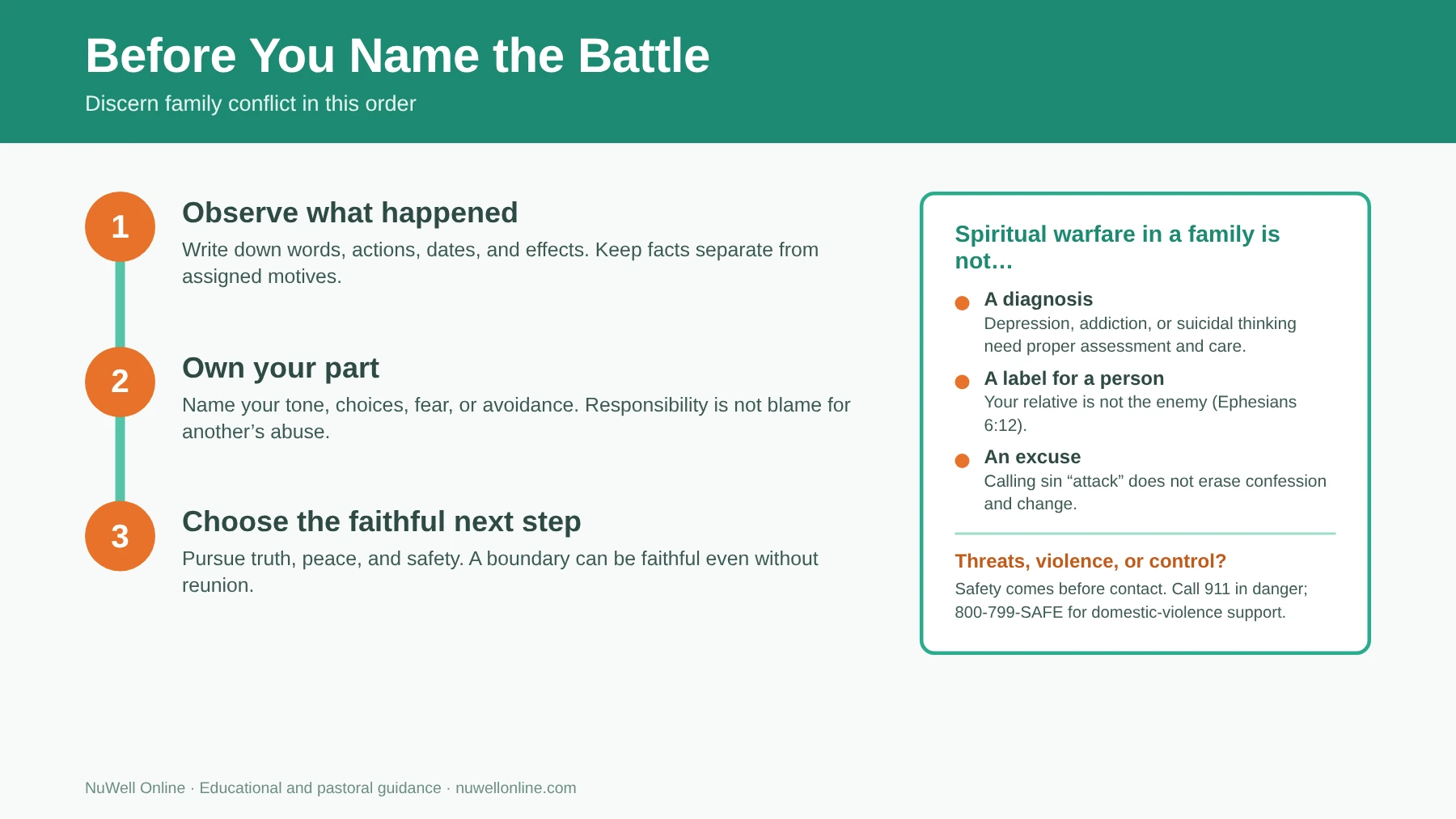
What is observable?
Write down words, actions, dates, and effects without assigning motives. “My sister did not answer two messages” is observable. “A spirit of rejection made her abandon me” is an interpretation.
What is mine to own?
Ask whether your tone, secrecy, pressure, gossip, harshness, fear, or avoidance has added fuel. James 1:19-20 calls us to be “quick to listen, slow to speak and slow to become angry.” Responsibility is not the same as taking blame for another person’s abuse.
What response reflects Christ?
Romans 12:18 (NIV)“If it is possible, as far as it depends on you, live at peace with everyone.”
Choose truth without cruelty, peace without pretending, and boundaries without revenge. The qualifications in Romans 12:18 matter: peace is pursued, but it is not always within one person’s control.
What Spiritual Warfare in a Family Is Not
Symptoms need care
Depression, panic, intrusive thoughts, substance dependence, psychosis, and suicidal thinking require careful assessment and may require licensed, medical, or substance-use care. Prayer can accompany care; it should not replace it.
People are more than labels
A person may act selfishly or destructively without becoming “the narcissist,” “the Jezebel,” or “the problem” in every story. Labels shut down curiosity and accountability.
But take patterns seriously
Families can have painful conflict without coercive control. When intimidation, threats, violence, stalking, or control of money or communication are present, treat it as a safety concern, not a communication exercise.
Resisting starts with submitting
Calling sin “spiritual attack” does not erase confession, apology, restitution, or change. James 4:7 says, “Submit yourselves, then, to God. Resist the devil, and he will flee from you.”
Pastoral experience: In pastoral settings, a recurring pattern is that families become most stuck when every person can describe the other person’s failure but no one can name the fear, grief, pride, or protective habit shaping their own response. Another common pattern is premature reconciliation: pressure to forgive is used to skip honest acknowledgment, safety, and the slow rebuilding of trust. Naming these patterns does not prove demonic causation or diagnose anyone. It gives the family a more responsible place to begin.
Four Restoration Movements for Family Division
NuWell’s RESTORE Path is a flexible pastoral map, not a rigid protocol. Four movements are especially useful here.
Recognize the wound
Conflict is rarely only about the latest sentence. Ask what loss or fear is underneath the reaction: rejection, betrayal, invisibility, unfairness, loss of control, or a family role that never felt safe. Recognizing a wound explains intensity; it does not excuse harm.
Establish safety
Decide what conditions are necessary before contact. That may mean choosing a public place, communicating only in writing, including a trusted third party, pausing the conversation when voices rise, or not making contact at all. Safety comes before access.
Separate truth from distortion
Compare the story in your mind with evidence and Scripture. “I made a serious mistake” may be true. “I am beyond grace and must accept mistreatment forever” is distortion. NuWell’s guide to Biblical strongholds can help you examine entrenched beliefs without turning them into identities.
Rebuild healthy patterns
Replace accusation with specific requests, triangulation with direct communication when safe, vague apologies with ownership, and instant trust with observable follow-through. Rebuilding is measured in patterns, not promises.
A Practical Sequence to Use This Week
Day 1: Slow the story down
Write one paragraph describing what happened using only observable details. Then list the meanings you attached to it. Keeping facts and interpretations separate reduces accusation and makes discernment possible.
Day 2: Pray for light, not leverage
Ask God to reveal truth, protect everyone involved, expose your own sin, and give wisdom. Avoid using prayer to declare motives you cannot know or to recruit God to your side.
Day 3: Name your responsibility
Complete this sentence: “Regardless of what they did, my responsibility before Christ is…” Your answer might involve an apology, a boundary, ending gossip, seeking treatment, or refusing to retaliate.
Day 4: Choose one wise adviser
Speak with a mature pastor, qualified practitioner, or trusted person who will protect confidentiality, challenge you fairly, and take safety seriously. Do not build a team whose only job is to confirm your view.
Day 5: Make a specific request
If contact is safe“When ___ happened, I felt ___. I own ___. I am asking for ___.”
Do not demand an immediate answer. If the person has threatened, stalked, controlled, or assaulted you, skip this step and seek safety support.
Day 6: Set the next boundary
Clear“If insults begin, I will end the call and try again another day.”
Vague“You need to respect me.”
A boundary states what you will do. Boundaries do not guarantee another person’s cooperation; they clarify your stewardship.
Day 7: Review fruit, not fantasy
Ask what produced greater truth, self-control, peace, patience, and wise action (Galatians 5:22-23). Do not measure success only by whether the relationship returned to normal. Sometimes the faithful outcome is a repaired conversation. Sometimes it is a safer distance with less hatred.
Boundaries, Abuse, Addiction, and Crisis Safety
Abuse is not a communication cycle, and coercive control is not solved by mutual vulnerability. Family or couples sessions are not appropriate when threats, violence, stalking, sexual coercion, or coercive control may be present, unless a qualified domestic-violence professional determines otherwise.
Forgiveness is not reconciliation. Reconciliation is not restored trust. Personal restoration does not require renewed access to an unsafe person. You can release vengeance to God while maintaining strong legal, physical, digital, relational, or church boundaries.
In immediate danger, call 911.
National Domestic Violence Hotline: 800-799-SAFE (7233), text START to 88788, or chat at thehotline.org. Suicidal crisis or emotional distress: call or text 988 or chat at 988lifeline.org. Mental-health or substance-use treatment referrals: FindTreatment.gov or SAMHSA’s National Helpline at 1-800-662-HELP (4357). NuWell is not an emergency service.
When NuWell May Fit and When Other Care Is Needed
Non-clinical, Scripture-rooted help
Discerning a family pattern, processing spiritual confusion, clarifying a boundary, preparing for a difficult conversation, or rebuilding healthier personal responses through online pastoral counseling. Christian life coaching may fit forward-focused goals.
Match the need to the right help
Licensed mental-health care for persistent or severe symptoms, medical care for physical contributors, specialized substance-use services, a domestic-violence advocate for coercive control or threats, and 911 or 988 for emergencies.
Related reading: For parents facing estrangement from an adult child, read When Your Adult Child Cuts You Off: A Christian Parent’s Next Step.
Frequently Asked Questions
Does family conflict always mean Satan is attacking?
No. Scripture recognizes spiritual opposition, human sin, ordinary misunderstanding, exhaustion, grief, learned family patterns, and the consequences of choices. Christians can pray and practice spiritual discernment without claiming certainty about an unseen cause.
Should I call an estranged family member today?
Only if contact is safe and wise. Before reaching out, consider the history, the other person’s stated boundaries, your purpose, and whether threats, stalking, violence, or coercive control are present. A letter you do not send, counsel from a wise adviser, or continued distance may be the better next step.
Can prayer replace counseling or treatment?
Prayer is central to Christian life, but it is not a substitute for licensed treatment, medical care, substance-use services, domestic-violence advocacy, or emergency support when those are needed. Receiving appropriate care can be an act of wisdom, not a failure of faith.
Take One Faithful Step
The enemy is not your flesh-and-blood relative. That truth does not make harmful behavior harmless, and it does not erase your responsibility. It changes the posture of the fight: truth against deception, grace and accountability against accusation, wise peace against division, and protection rather than denial in the face of danger.
Begin with what you can see. Own what is yours. Establish safety. If family conflict has tangled spiritual questions, painful history, and difficult decisions, NuWell’s care team can help you consider a next step.
You can also meet the NuWell team or see how NuWell’s process works.

This article was researched with the help of AI and reviewed and edited by Stephen Luther, MEd, MSEd, LPC, for accuracy, Scripture references, and faithfulness to NuWell’s non-clinical scope.
Stephen Luther, MEd, MSEd, LPC, is Executive Director and Founder of Grace Christian Counseling and a licensed professional counselor. He holds a master’s degree in Education and a master’s degree in Marriage and Family Therapy from Duquesne University and has helped children, adolescents, and adults since 1997. His licensed clinical role at Grace Christian Counseling is separate from NuWell’s non-clinical pastoral counseling and Christian life coaching services.
Scope note: This article is educational and pastoral. It does not provide diagnosis, psychotherapy, medical treatment, legal advice, substance-use treatment, domestic-violence services, or emergency care. NuWell provides non-clinical pastoral counseling and Christian life coaching.
Sources
- Ephesians 6:10-18; James 1:19-20; James 4:7; Romans 12:18; Galatians 5:19-23 (NIV).
- National Institute of Mental Health. Psychotherapies and Help for Mental Illnesses.
- National Domestic Violence Hotline. Get Help.
- SAMHSA. National Helpline and 988 FAQs.
