

Scripture and spiritual discernment
Sometimes the struggle feels spiritual because it is spiritual. Temptation keeps returning. A lie about God has become familiar. A relationship is filling with accusation and division. At other times, exhaustion, trauma effects, illness, grief, substance use, or a mental-health condition may be shaping what you feel. Mature Christian discernment does not panic, deny spiritual reality, or force every problem into one explanation.
Quick answerScripture helps Christians recognize three connected fronts of spiritual conflict: the world, meaning values and systems organized against God’s ways; the flesh, meaning the fallen desires and habits within us; and the devil, the personal spiritual adversary who deceives and accuses. Ephesians 2:1-3 brings all three together. The faithful response is not fear or spectacle, but truth, repentance, prayer, Christian community, practical obedience, and appropriate professional care.
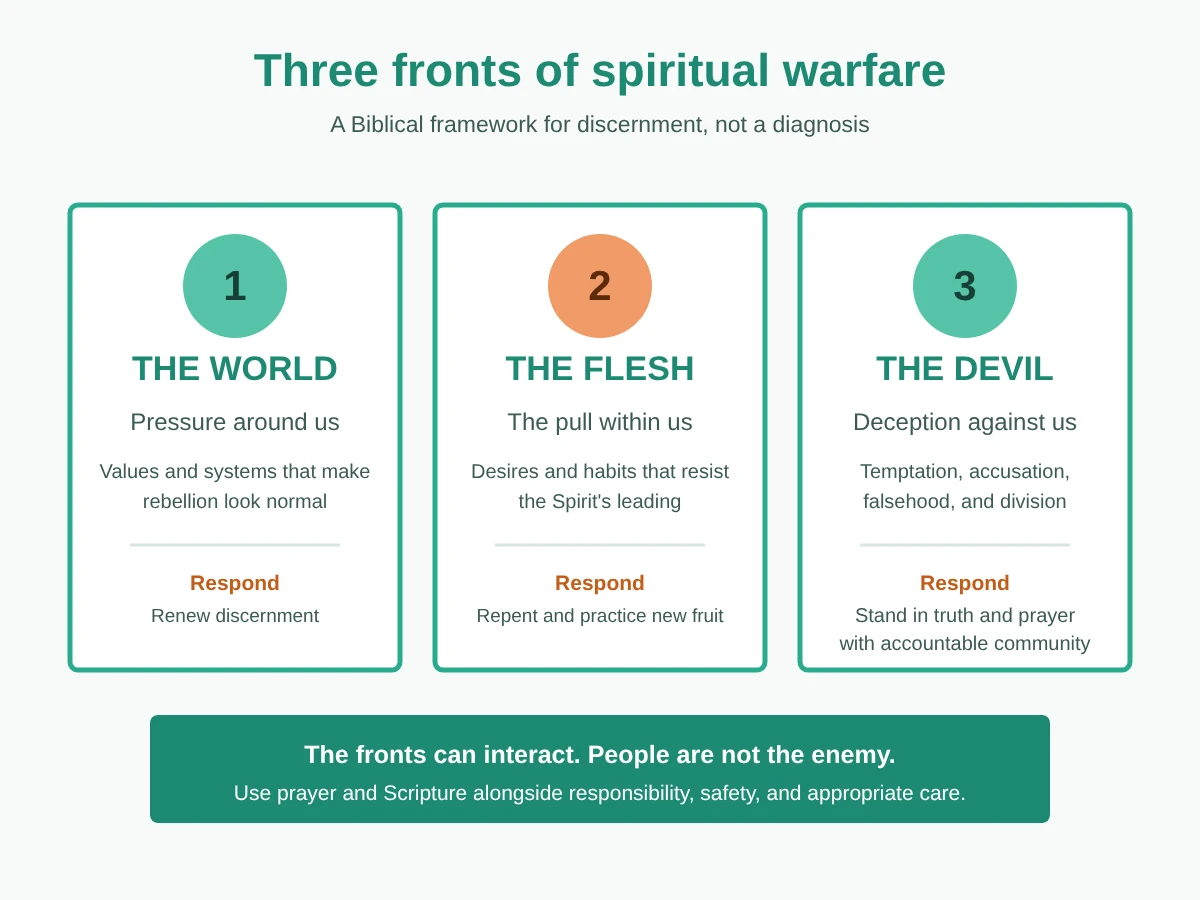
This framework is a theological map, not a diagnosis. It does not prove that a symptom is demonic, turn another person into the enemy, or remove responsibility for harmful choices. It helps you ask a better question: What kind of pressure is present, and what faithful response fits it?
Where the Three-Front Framework Comes From
Paul tells the Ephesian church that they had once followed “the ways of this world,” “the ruler of the kingdom of the air,” and “the cravings of our flesh” (Ephesians 2:2-3, NIV). Across the New Testament, these themes recur. The world pressures believers toward distorted loyalties. The flesh pulls from within. The devil deceives, accuses, tempts, and divides.
These fronts interact, but they are not identical. A culture may reward contempt; your flesh may enjoy the feeling of superiority; the devil may exploit the resulting accusation and division. Naming the layers can help you stop blaming one invisible cause for everything and start responding responsibly.
The framework is also not a fixed identity. Experiencing temptation does not make you a hopeless person. Living in a broken culture does not remove your agency. Feeling spiritual opposition does not mean Christ has abandoned you. Christians stand in a victory Christ has secured, while still practicing watchfulness, repentance, and endurance.
Pastoral experience: A recurring, non-identifying pattern in pastoral conversations is that people often arrive asking, “Is this spiritual warfare or is it me?” The more useful answer is sometimes “several things may be happening.” A painful belief can be reinforced by culture, repeated through a protective habit, and used to fuel accusation. Progress begins when the person can name observable facts, own choices, receive appropriate care, and return to Scripture without fear.
1. The World: Pressure That Trains Our Desires
In this context, “the world” does not mean creation or every person outside the church. John can say that God loves the world (John 3:16) and also warn believers not to love a world organized around “the lust of the flesh, the lust of the eyes, and the pride of life” (1 John 2:16, NIV). The word points to patterns of value that make rebellion look normal and faithfulness look foolish.
The world’s pressure can be loud, but it is often ordinary. It tells you that worth comes from attention, that security comes from control, that enemies deserve contempt, that bodies are commodities, or that success excuses harm. Algorithms, workplaces, peer groups, political tribes, family systems, and even unhealthy church cultures can reinforce those messages.
How to respond to the world
Paul’s response is renewal rather than isolation: “Do not conform to the pattern of this world, but be transformed by the renewing of your mind” (Romans 12:2, NIV). Ask what your environment repeatedly celebrates, fears, or punishes. Reduce inputs that train contempt or compulsion. Seek a church and friendships where truth, humility, accountability, and love are practiced rather than merely praised.
2. The Flesh: The Battle We Must Own
“Flesh” does not mean that the physical body is evil. Paul uses the term in passages such as Galatians 5 to describe human life curved inward and resistant to God’s Spirit. The works he names include sexual immorality and drunkenness, but also hatred, jealousy, fits of rage, selfish ambition, dissension, and envy (Galatians 5:19-21).
This front requires responsibility. We should not call a repeated choice “an attack” when confession, restitution, a changed boundary, or treatment is needed. James writes that temptation can grow from one’s own desire (James 1:14-15). That truth is sobering, but it is also hopeful: the Spirit forms new fruit, and practiced obedience can replace practiced harm.
How to respond to the flesh
Name the behavior precisely. Confess without excuse. Repair what you can. Remove access to a recurring temptation. Invite accountability that includes questions and consequences. Practice the opposite fruit of the Spirit in one observable way. Repentance is more than intense regret; it is a changed direction supported by truthful action. When a false belief has become deeply entrenched, see NuWell’s guide to Biblical strongholds.
Find Your Best Next StepIf a spiritual pattern feels tangled with shame, relationships, or difficult decisions, NuWell’s care team can help you consider non-clinical pastoral counseling, coaching, licensed care, or another resource. Start a confidential intake conversation.
3. The Devil: Deception, Accusation, and Division
Scripture presents the devil as a real adversary, but never as God’s equal. Jesus calls him a liar (John 8:44). Revelation calls him an accuser (Revelation 12:10). Peter tells believers to be alert and resist him by standing firm in the faith (1 Peter 5:8-9). His work bends toward falsehood, condemnation, temptation, and rupture.
Ephesians 6:10-18 does not give Christians a technique for hunting hidden spirits. It calls them to stand in truth, righteousness, the gospel of peace, faith, salvation, God’s word, and prayer. Notice the posture: stand. The armor directs attention toward God’s gifts and faithful practice, not fascination with darkness.
How to respond to the devil
Submit to God and resist the devil (James 4:7). Test claims against Scripture in context. Reject condemnation that erases the gospel, while receiving conviction that names a specific wrong and leads toward repentance. Pray with trusted believers. Refuse secrecy. Do not accuse another person of demonic influence as a shortcut around evidence, conversation, boundaries, or accountability.
How the Three Fronts Can Work Together
Imagine that a workplace rewards constant availability. That is a worldly pressure. You begin measuring worth by output and hiding your limits. That is a fleshly pattern of fear and pride. Accusing thoughts then insist that rest proves you are useless and God is disappointed. That pattern may carry spiritual temptation. The response can address every layer: reject the false value, confess dishonesty or self-reliance, establish a work boundary, receive the gospel’s assurance, pray, and ask for wise support.
Or consider a marriage conflict. A culture of winning teaches contempt. Each spouse protects pride. Accusation grows. Ephesians 6:12 says the struggle is not against flesh and blood; that should make spouses less willing to treat each other as the enemy. It does not make threats, coercion, or violence harmless. Safety and accountability still come first. For more on this situation, see spiritual warfare in the family.
A Discernment Practice You Can Use This Week
NuWell’s RESTORE Path is a flexible pastoral map, not a clinical protocol. These five movements can help you slow the situation down.
Recognize the wound and the trigger
Write what happened using observable language. Then name what it stirred: fear of rejection, shame, anger, craving, grief, or a need for control. A wound may explain intensity without excusing harm.
Establish safety
Ask whether anyone is in danger, losing contact with reality, unable to care for basic needs, withdrawing from substances, or at risk of self-harm. Spiritual reflection is not the first task in an emergency. Use crisis, medical, substance-use, or licensed support.
Separate truth from distortion
Make three columns: facts you can verify, interpretations you are making, and Scripture that speaks to the issue in context. “I was criticized” is a fact. “Everyone is against me” is an interpretation. “Nothing can separate us from the love of God” is a gospel truth (Romans 8:38-39).
Rebuild one healthy pattern
Choose one action that fits the actual front: change an input, confess and repair, call a physician, attend a recovery meeting, ask a mature believer to pray, sleep, eat, or set a boundary. Do not use a dramatic spiritual explanation to avoid an ordinary faithful action.
Review the fruit
After seven days, ask whether the response produced greater truth, love, self-control, responsibility, and steadiness. Emotional relief may take time. Fruit is not the same as intensity.
When Spiritual Language Can Cause Harm
Fear-based spiritual labeling can delay care and increase shame. Anxiety, depression, intrusive thoughts, mania, psychosis, trauma symptoms, substance use, sleep deprivation, and physical illness can affect thoughts and perceptions. The National Institute of Mental Health advises seeking health care when changes such as reduced sleep, suspiciousness, confused speech, difficulty telling reality from fantasy, or declining functioning intensify or persist.
Prayer and professional care are not rivals. Seek licensed mental-health or medical assessment for persistent, severe, or worsening symptoms, sudden behavioral change, hallucinations, delusions, inability to function, medication concerns, or possible substance effects. Do not stop medication or treatment because someone supplied a spiritual explanation.
Spiritual language can also be used to control. If a leader or family member uses claims about demons, submission, anointing, or rebellion to demand secrecy, isolate you, override consent, threaten consequences, or block outside care, seek independent help. Abuse is not spiritual warfare to solve through joint vulnerability.
In immediate danger, call 911. For suicidal crisis, self-harm risk, emotional distress, or substance-use crisis in the United States, call or text 988 or chat at 988lifeline.org. NuWell is not an emergency service.
Message Our Care TeamYou do not need to decide alone whether pastoral support, coaching, licensed care, or medical care fits. Share the broad concern without disclosing private details in an initial message. Message NuWell’s care team.
When NuWell May Fit
NuWell’s non-clinical online pastoral counseling may fit when you want Scripture-rooted help with discernment, spiritual confusion, shame, prayer, relational patterns, confession, forgiveness, or boundaries. Christian life coaching may fit present-focused habits and goals when you are stable enough for coaching. If you are unsure which kind of help fits, compare pastoral counseling vs therapy.
NuWell does not diagnose, provide psychotherapy, treat mental-health or substance-use conditions, prescribe medication, conduct deliverance ministry, or provide emergency care. Licensed, medical, substance-use, domestic-violence, or emergency services are more appropriate when those needs are present. The right next step may include pastoral care alongside licensed care, with clear roles and consent.
Frequently Asked Questions
Are all hardships spiritual attacks?
No. Scripture recognizes spiritual opposition, personal sin, the pressures of a fallen world, ordinary consequences, illness, grief, and human limitation. Christians can pray while also investigating practical causes and seeking appropriate care.
How can I tell whether a thought is conviction or accusation?
Conviction is specific, truthful, and leads toward confession, repair, and Christ’s mercy. Accusation is often sweeping, hopeless, and identity-destroying: “You are beyond grace.” Test the message against Scripture and discuss it with a mature, accountable person.
Can a Christian experience spiritual warfare?
Yes. The New Testament’s instructions to stand, resist, pray, and remain alert are addressed to believers. Experiencing conflict does not mean Christ has lost authority or that the believer has lost belonging.
Stand in Truth Without Living in Fear
The world, the flesh, and the devil name real fronts of Christian struggle. The framework is most useful when it produces clear-eyed faithfulness: examine the pressure around you, own the choices within you, resist deception, stay close to Christ and His people, and use the level of care the situation requires.
Begin with one honest observation, one truth in context, and one responsible action. Biblical spiritual warfare is not a hunt for dramatic explanations. It is a steady life of allegiance to Christ.
Find Your Best Next Step
Explore NuWell’s simple intake process and ask what kind of support fits your situation.
Talk with NuWell’s care team, explore your options, and see whether NuWell is the right fit, without pressure or obligation.
You can also see how NuWell’s process works.

This article was researched with the help of AI and reviewed and edited by Stephen Luther, MEd, MSEd, LPC, for accuracy, Scripture references, and faithfulness to NuWell’s non-clinical scope.
Stephen Luther, MEd, MSEd, LPC, is Executive Director and Founder of Grace Christian Counseling. He holds a master’s degree in Education and a master’s degree in Marriage and Family Therapy from Duquesne University and has worked with children, adolescents, and adults since 1997. His licensed professional counseling role at Grace Christian Counseling is separate from NuWell’s non-clinical pastoral counseling and Christian life coaching services.
Scope note: This article is educational and pastoral. It is not diagnosis, psychotherapy, mental-health or substance-use treatment, deliverance ministry, medical care, or emergency care. NuWell provides non-clinical pastoral counseling and Christian life coaching across the United States.
