

Church hurt and spiritual abuse
A pastor can preach compelling sermons, grow a church, and still use spiritual authority in harmful ways. The clearest warning is usually not one awkward conversation or unpopular decision. It is a repeated pattern in which power protects the leader, questions bring retaliation, Scripture is used to force compliance, and people become less free to tell the truth.
Quick answerFive signs of a dangerous pastor are insulation from real accountability, punishment of honest questions, misuse of Scripture or claimed divine authority to override consent, secrecy around conduct or money, and a pattern of control that costs people their safety and freedom. These signs call for careful documentation and outside counsel. Suspected crimes or abuse should never be handled only inside the church.
“Dangerous pastor” is not a diagnosis or shorthand for a leader you dislike. Pastors make mistakes and need correction like every other Christian. Concern becomes serious when harm forms a pattern, accountability fails, and credible concerns are met with silence or punishment.
What Spiritual Abuse Is and Is Not
Spiritual abuse occurs when religious authority, beliefs, Scripture, or access to community is used to control, shame, exploit, or silence another person. It can accompany emotional, sexual, financial, or physical abuse, but it can also appear through coercion and threats presented as God’s will.
Ordinary conflict leaves room for facts, disagreement, repair, and appeal. A spiritually abusive pattern makes one person or inner circle functionally untouchable. The National Domestic Violence Hotline describes spiritual abuse as including using religious beliefs to manipulate or shame someone, or to minimize and rationalize other abuse.[2] The Assemblies of God notes that harmful mistakes may reflect immaturity or incompetence, but that “when a pattern forms through repeated mistakes, it may reveal an abusive leader.”[3]
Pastoral experience: A recurring, non-identifying pattern is that people harmed by church authority may struggle to name what happened. They may defend the leader while describing fear, lost community, or pressure to ignore their conscience. A wise first step is not forcing a verdict, but naming behaviors, establishing safety, and separating God’s character from a leader’s conduct.
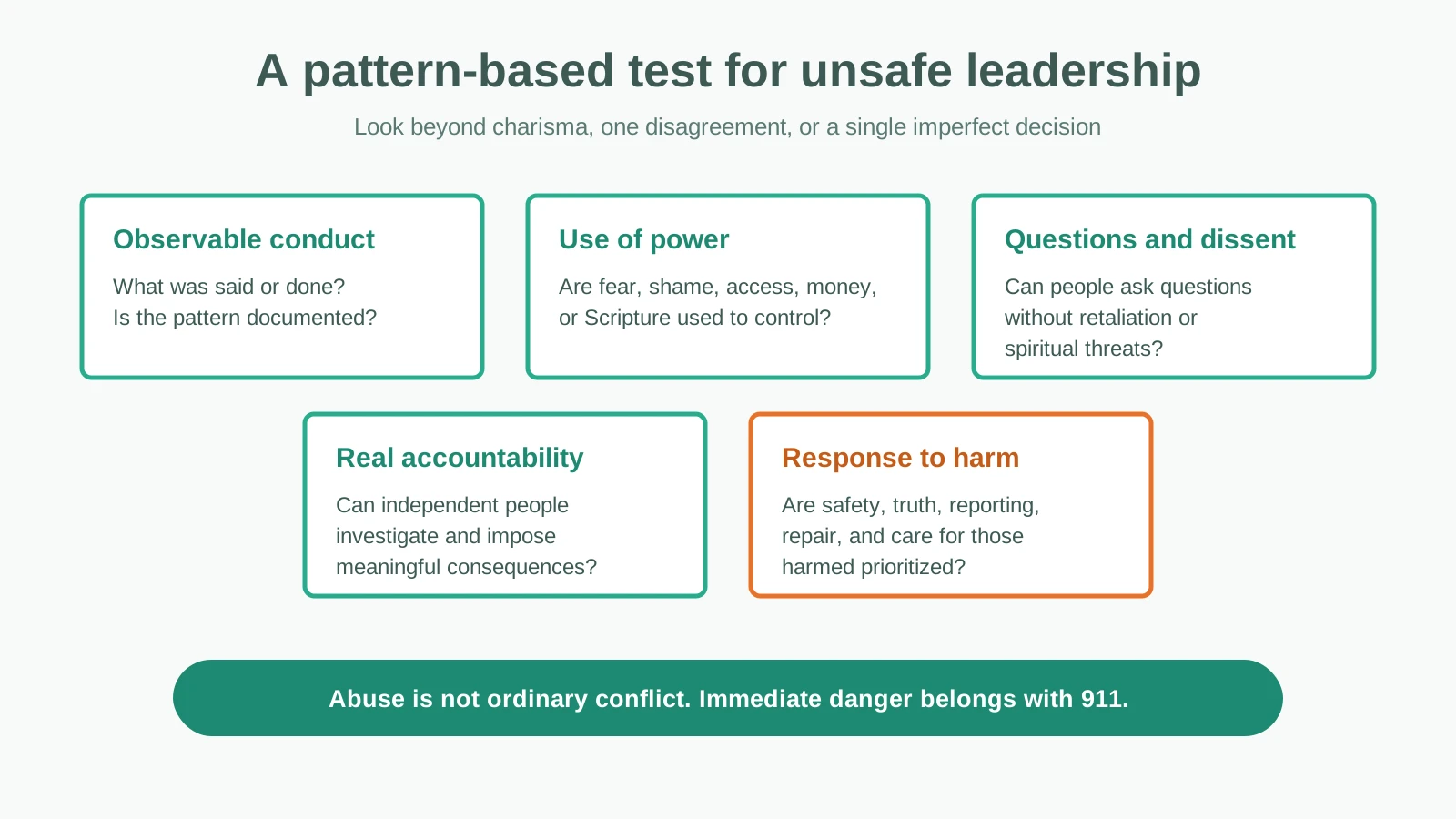
In short: take five patterns seriously when they recur together: accountability is blocked; questions bring retaliation; Scripture or claimed revelation removes consent; secrecy protects conduct or reputation; and control produces fear, isolation, or dependence. One mistake does not establish abuse.
Five Signs of a Dangerous Pastor
Accountability exists on paper but not in practice
Healthy authority has real limits. Watch for a pastor who appoints only loyal friends, withholds information, removes challengers, treats outside review as persecution, or controls the complaint process through people who depend on him.
“not lording it over those entrusted to you, but being examples to the flock”
1 Peter 5:3 (NIV)
Peter tells elders to shepherd willingly and by example. Biblical leadership is accountable stewardship, not ownership of people.
Questions are recast as rebellion
A dangerous leader assigns a spiritual defect to the person asking a question: bitterness, disloyalty, demonic influence, or lack of submission. Public shaming, selective disclosure, lost ministry roles, social exclusion, and warnings about “leaving God’s covering” shift attention away from evidence and raise the cost of speaking up.
In Acts 20:28–31, Paul warns that destructive leaders can arise from within the church. His instruction is watchfulness, not unquestioning loyalty. Discernment is not disobedience simply because a leader dislikes the question.
Scripture and “God told me” language remove consent
Pastors rightly teach Scripture and offer counsel. Danger appears when a verse, prophecy, or claimed revelation takes control of another adult’s choices about marriage, medical care, money, or reporting harm.
Invoking “touch not the Lord’s anointed” to stop examination does not place modern leaders beyond accountability. Matthew 20:25–28 contrasts domination with service. Be cautious when a leader demands secrecy, private access, intimate disclosure, or obedience outside a defined role. Divine claims do not cancel another person’s boundaries.
Need a confidential place to sort out what happened?
NuWell’s non-clinical online pastoral counseling can help you name the pattern, examine Scripture in context, and consider a safe next step.
Secrecy protects misconduct or institutional reputation
Confidentiality protects dignity; secrecy protects power. Warning signs include unexplained finances, resistance to independent audits, demands that silence reports, investigations run by the leader’s allies, or pressure to protect the church’s reputation by avoiding outside authorities.
First Timothy 3 and Titus 1 emphasize observable character: self-control, faithfulness, gentleness, freedom from greed, and a good reputation. Visibility, charisma, or organizational success cannot substitute for those qualifications.
Do not treat every rumor as fact. Record firsthand facts and preserve original messages and dates when it is safe to do so. Avoid public speculation while a concern is unverified. Careful process protects potential victims and people who may be falsely accused.
Control produces fear, isolation, and dependence
The strongest warning may be the system’s fruit: members fear honesty, outside friendships are discouraged, families cut off people who leave, and the leader’s approval feels necessary for spiritual security.
Not every strict church is abusive, and theological disagreement alone does not prove danger. Look for an ongoing combination of coercion, humiliation, spiritual threats, punishment for noncompliance, and blocked routes of appeal. The Church of England’s safeguarding guidance lists characteristics such as misusing Scripture to coerce, requiring unquestioning obedience, public shaming, and threats of spiritual consequences, and it warns that it is harmful to suggest someone speak directly to their abuser about the abuse.[4]
Godly conviction is specific and leads toward truth, repentance, and grace. Manipulative shame is global: “You are the problem, so you have no right to question us.” NuWell’s guide to shame and conviction can help clarify the difference.
A Seven-Day Plan for a Wise First Response
You do not have to settle everything at once. Take one step a day, and skip ahead to safety and reporting if anyone is in danger now.
Write facts, not conclusions.
Record dates, exact words, witnesses, and documents. Separate what you observed from what you infer, and store records somewhere safe.
Check immediate safety.
Consider threats, stalking, sexual harm, physical danger, and retaliation. Call 911 for immediate danger, and do not privately confront a leader you fear.
Consult someone independent.
Choose a victim advocate, attorney, licensed clinician, safeguarding professional, outside pastor, or denominational official beyond the leader’s control. Ask about confidentiality and reporting duties first.
Use the correct reporting route.
Internal review may fit policy or doctrinal concerns. Suspected child abuse, sexual assault, violence, stalking, theft, or fraud may require civil reporting. Church discipline must not replace a civil investigation.
Set one protective boundary.
Decline private contact, bring support, communicate in writing, resign from a role, or step away. A boundary governs access; it is not a verdict about anyone’s soul.
Review Scripture in context.
Read Ezekiel 34, Matthew 20:25–28, Acts 20:28–31, 1 Timothy 3:1–7, Titus 1:5–9, and 1 Peter 5:1–4. Scripture ties authority to character, service, and accountability.
Choose the next faithful step.
Consider safeguards, an appeal, outside reporting, leaving, or specialized support. Begin with the RESTORE movements Recognize the wound, Establish safety, and Separate truth from distortion. Later, Tend what was wounded and Rebuild healthy patterns, without any requirement to return.
Safety, Reporting, and the Limits of Church Process
If a child or vulnerable person may be experiencing abuse, contact your state’s child-protection agency or law enforcement. Mandated-reporting rules, clergy obligations, and confidentiality laws vary by state and role. Do not assume clergy privilege applies or that telling another church leader satisfies a legal duty. The Child Welfare Information Gateway explains that reporters do not have to prove abuse occurred; they report a reasonable suspicion.[5] Verify the current rule in your state.
Matthew 18 is not a requirement that a survivor privately confront an alleged abuser. That passage addresses sin and community discipline; it is not a substitute for safeguarding, mandated reporting, emergency action, or a criminal investigation.
Forgiveness does not erase evidence, remove consequences, or require renewed access. Reconciliation requires truth, repentance, safety, and freedom. Even sincere repentance does not automatically qualify a leader to return to office. Personal restoration and restoration to a role are different questions.
In immediate danger, call 911.
For sexual assault support, contact RAINN’s National Sexual Assault Hotline at 800-656-HOPE (4673), text HOPE to 64673, or use its online chat.[6]
For abuse in a relationship, contact the National Domestic Violence Hotline at 800-799-SAFE (7233), text START to 88788, or chat at thehotline.org.[2]
If you may harm yourself or someone else, call or text 988.
When NuWell May Fit, and When Other Care Is Needed
NuWell provides non-clinical online pastoral counseling and Christian life coaching across the United States. Pastoral counseling may fit for spiritual confusion, church hurt, shame, boundaries, or prayer. Coaching may fit when you are stable and want present-focused support rebuilding routines and goals.
NuWell is not a reporting agency, law firm, licensed clinical practice, or emergency service. Seek a licensed, trauma-informed clinician, such as the trauma counselors at Grace Christian Counseling, when panic, depression, intrusive memories, dissociation, sleep disruption, or difficulty functioning needs assessment or treatment. Contact an attorney for legal advice and a victim advocate for safety planning.
Safe support should restore your freedom, not pressure you to forgive on a timetable, defend an institution, reconcile, or return to church. Reclaiming an identity rooted in Christ can help separate God’s character from a leader’s conduct.
Frequently Asked Questions
Does one angry sermon make someone a dangerous pastor?
No. One poor sermon, defensive conversation, or mistaken decision may call for correction, apology, and growth. The danger lies in a repeated pattern of coercion, retaliation, secrecy, exploitation, or blocked accountability, especially when harm increases after concerns are raised.
Should I confront the pastor privately?
Not when you fear retaliation, the concern involves abuse or a crime, or the pastor controls the complaint process. Seek independent advice first. You may use a formal process, bring support, communicate in writing, report to civil authorities, or leave without a private meeting.
Is leaving an unhealthy church rebellion against God?
No pastor or congregation owns your access to Christ. Leaving may be a wise boundary when leaders refuse accountability or safety cannot be established. Take time to seek trustworthy counsel and a healthier community without rushing.
Can a pastor repent and return to leadership?
Repentance matters, but forgiveness and personal restoration do not guarantee restoration to office. Leadership qualifications, the severity and pattern of harm, legal findings, safeguarding needs, restitution, and the well-being of those harmed all matter. Some conduct should permanently disqualify a person from a position of trust.
You Are Allowed to Tell the Truth
You do not need to decide today whether every troubling behavior deserves the label “abuse.” Begin with what you know: the words used, the power involved, the response to questions, and whether accountable care was present. Christ does not need secrecy, coercion, or fear to protect His church.
Tell NuWell’s care team what feels unsafe or confusing. We can help you consider non-clinical pastoral support, licensed care, advocacy, or another next step, without any pressure to return to an unsafe setting.
See how NuWell’s process works. When you are ready to consider a new congregation, read what healthy accountability looks like in a church.

This article was researched with the help of AI and reviewed and edited by Stephen Luther, MEd, MSEd, LPC, for accuracy, Scripture references, and faithfulness to NuWell’s non-clinical scope.
Stephen Luther, MEd, MSEd, LPC, is Executive Director and Founder of Grace Christian Counseling and a licensed professional counselor. He holds a master’s degree in Education and a master’s degree in Marriage and Family Therapy from Duquesne University and has helped children, adolescents, and adults since 1997. His licensed clinical role at Grace Christian Counseling is distinct from NuWell’s non-clinical pastoral counseling and Christian life coaching services.
Scope note: This article provides educational and pastoral information. It is not legal advice, diagnosis, psychotherapy, treatment, an investigation, or emergency care. NuWell provides non-clinical pastoral counseling and Christian life coaching. Reporting duties and legal options vary by jurisdiction; consult the appropriate agency or a qualified attorney.
Sources
- The Holy Bible, New International Version: Ezekiel 34; Matthew 20:25–28; Acts 20:28–31; 1 Timothy 3:1–7; Titus 1:5–9; 1 Peter 5:1–4.
- National Domestic Violence Hotline. What Is Spiritual Abuse? and Get Help.
- Assemblies of God (USA). Misuse of Spiritual Leadership (position paper, 2025).
- Church of England. Safeguarding e-manual, Section 4.2: Spiritual Abuse. A non-U.S. church safeguarding source, cited for pattern recognition, not U.S. legal guidance.
- Child Welfare Information Gateway, U.S. Children’s Bureau. Mandatory Reporting of Child Abuse and Neglect.
- RAINN. National Sexual Assault Hotline.
- 988 Suicide & Crisis Lifeline.
Scripture quotations taken from The Holy Bible, New International Version® NIV®. Copyright © 1973, 1978, 1984, 2011 by Biblica, Inc.™ Used by permission. All rights reserved worldwide.
