

Faith and recovery
You said the last time was the last time. Now the bottle, pill, or drug is back at the center of the day, and secrecy is taking more energy than honesty. Faith may still matter deeply, but shame whispers that a real Christian should be able to stop alone.
Looking for Christian help for addiction is a faithful step, not a failure. This page walks through the safest order of care: protect life first, find qualified treatment, and then let pastoral support take its proper place alongside recovery.
Quick answerSubstance-use disorder is a health condition, not a measure of a person’s worth or faith. Qualified medical and addiction professionals should assess and treat it. NuWell does not provide detox, diagnosis, psychotherapy, medication, or substance-use treatment. Non-clinical pastoral counseling may support spiritual questions, shame, relationships, prayer, and accountability alongside appropriate treatment and recovery support.
A Concerning Pattern Is Not a Fixed Identity
People use the word addiction loosely. A qualified provider looks at patterns such as difficulty controlling use, craving, risky use, continued use despite harm, role or relationship problems, tolerance, or withdrawal. A list cannot diagnose you, and one sign does not prove a disorder. It can tell you that an honest assessment is worth arranging.
Substance use is not simply bad willpower, a villain label, or automatic proof of demonic activity. Choices and responsibility matter, but so do physical dependence, brain and body changes, trauma, mental health, pain, access, environment, and social support. Reducing the problem to one cause can delay the help that protects life. NuWell’s guide to understanding spiritual warfare carefully explains why health symptoms should not be relabeled as purely spiritual.
This page focuses on alcohol and drugs. Gambling, pornography, compulsive sexual behavior, gaming, food, and shopping raise different questions and deserve their own careful guidance.
Safety Comes Before a Recovery Plan
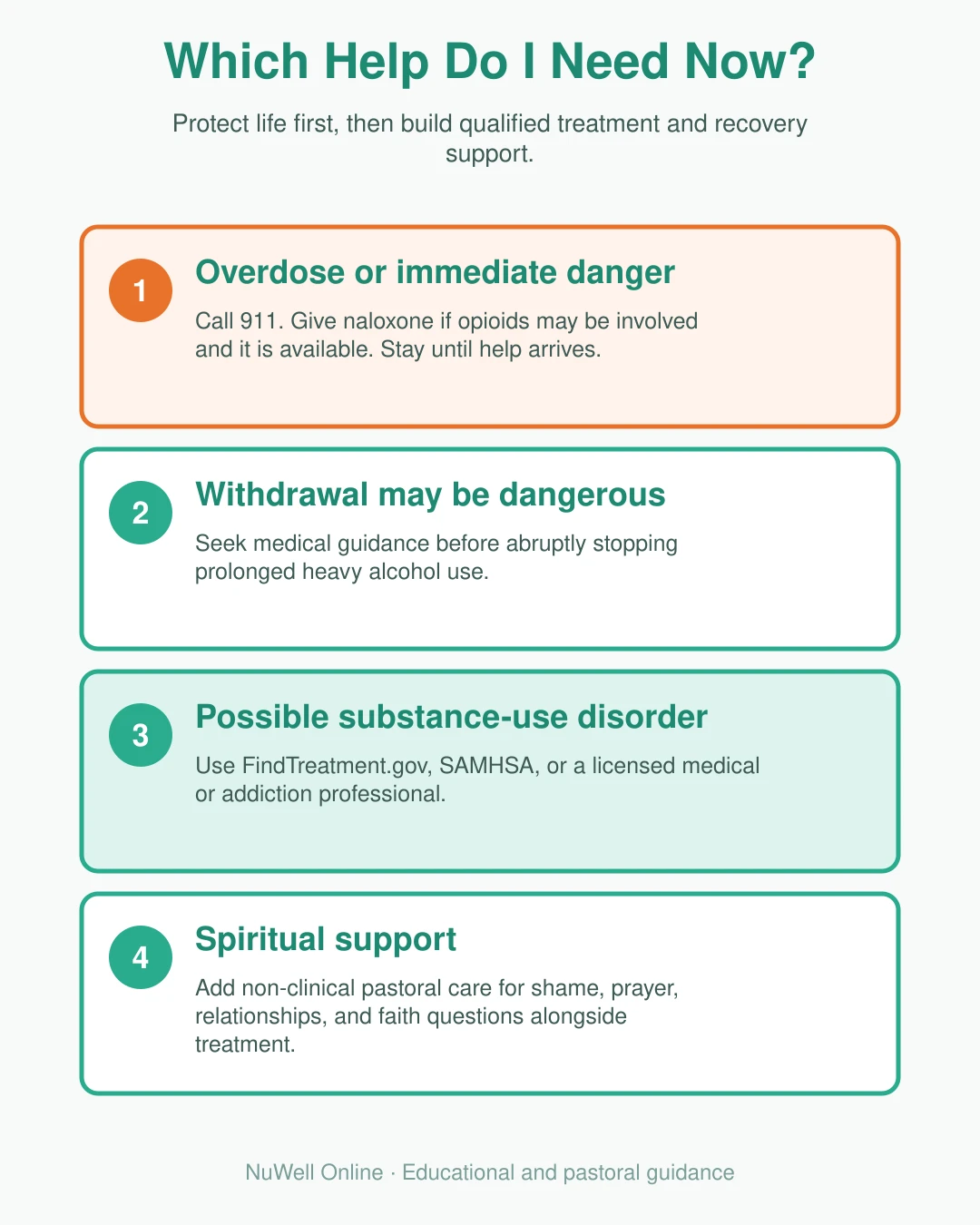
If someone is hard to wake, breathing slowly or not at all, making choking or gurgling sounds, or has discolored lips or nails, treat it as a possible overdose. Call 911. Give naloxone if available when opioids may be involved, try to keep the person awake and breathing, lay them on their side, and stay until help arrives. Naloxone will not harm someone if opioids are not the cause.
Alcohol withdrawal can be dangerous. Suddenly stopping after prolonged heavy drinking can be life-threatening for some people and may require medically monitored care. Contact a medical professional or addiction treatment provider before stopping. An article or pastoral counselor cannot determine detox needs.
In immediate danger or a life-threatening medical emergency, call 911.
For a suicide, emotional, mental-health, or substance-use crisis, call or text 988 or chat at 988lifeline.org. Free, confidential, 24/7/365. NuWell is not an emergency service.
Which Help Do I Need Now?
Qualified Treatment Has More Than One Form
Effective substance-use care is individualized. No single path fits everyone, and a good plan may combine several of these:
Evaluation and withdrawal management
Medical assessment, medically monitored withdrawal when needed, and medications for alcohol or opioid use disorder.
Counseling and programs
Licensed addiction counseling and residential or outpatient programs matched to the level of need.
Peers and family
Peer recovery support, family support, and help with housing, work, pain, or mental health.
SAMHSA’s FindTreatment.gov locator helps people search for state-licensed treatment. SAMHSA’s National Helpline is available at 1-800-662-HELP (4357), with TTY at 1-800-487-4889; you can also text your ZIP code to 435748 (HELP4U). It is a free, confidential, 24/7 treatment referral and information service in English and Spanish.
Christian addiction treatment in Western Pennsylvania: NuWell’s affiliated Grace Recovery Services offers Christian outpatient and intensive outpatient addiction treatment that also makes room for co-occurring mental health concerns, trauma, relationships, and faith. Spiritual practices are always your choice. Grace Recovery Services is located in North Huntingdon, PA; call its care team at 724-345-2411 or text 724-515-9120. It is a separate treatment provider from NuWell’s non-clinical services and is not a substitute for emergency care, hospital care, residential treatment, or medically supervised withdrawal when those are needed.
Medication for opioid or alcohol use disorder is medical care, not a spiritual shortcut or failure. Do not stop prescribed medication because a pastor, coach, family member, or online article says faith should be enough. Discuss benefits and risks with an appropriately qualified prescriber.
Substance use often travels with anxiety, depression, trauma, or relationship strain. For licensed, faith-integrated counseling for those concerns, NuWell refers to Grace Christian Counseling, a separate licensed practice; see also Christian help for anxiety.
Where Pastoral Support May Fit
Recovery often raises spiritual questions: Can God receive me after repeated relapse? How do confession and consequences belong together? What does forgiveness require? How do I return to Christian community without hiding or giving up wise privacy? NuWell’s non-clinical online pastoral counseling can provide Scripture-grounded conversation about those questions.
Romans 8:1 (NIV)“Therefore, there is now no condemnation for those who are in Christ Jesus.”
Freedom from condemnation does not erase responsibility or consequences. It creates room for truth without reducing a person to the worst thing they have done.
James 5:16 connects confession and prayer within community. Galatians 6:1–2 tells believers to restore gently and carry burdens while watching themselves. These passages support honest, bounded community; they do not authorize surveillance, humiliation, forced disclosure, or amateur detox.
Pastoral experience: A recurring, non-identifying pattern is that Christians arrive carrying sincere faith alongside secrecy and shame. Spiritual honesty becomes more useful when it is paired with qualified treatment, concrete safety planning, and trustworthy accountability. Prayer can support recovery; it should not be used to avoid the care a person needs.
NuWell may help you Recognize the wound beneath secrecy, Establish safety by supporting appropriate referral, Separate truth from distortions such as “I am beyond grace,” and Rebuild healthy patterns of prayer, responsibility, connection, and follow-through. These RESTORE movements are a pastoral map, not substance-use treatment.
Seven Steps You Can Take This Week
Tell one safe person the truth
Choose someone who can respond calmly and help you take action, not someone likely to shame, threaten, or publicize the disclosure.
Check immediate safety
If overdose is possible, call 911 and use naloxone if available. If alcohol withdrawal may be dangerous, contact medical help before stopping abruptly.
Arrange a qualified assessment
Use FindTreatment.gov, call SAMHSA’s helpline, or contact a licensed medical or addiction professional. In Western Pennsylvania, you can also contact Grace Recovery Services. Ask about credentials, state licensure, levels of care, medication options, and how faith can be respected.
Make an overdose plan if opioids are involved
Obtain naloxone where available, tell trusted people where it is, and learn how to use it. Avoid using alone; a clinician or harm-reduction service can discuss additional precautions.
Choose one recovery support
Attend a credible peer meeting, speak with a recovery coach, or accept a referral from a qualified program. Evaluate the group’s safety and fit rather than assuming one model suits everyone.
Protect practical stability
Ask for help with transportation, appointments, child care, food, or communication. Recovery is harder when every logistical burden remains private.
Add pastoral support in its proper role
Bring spiritual shame, Scripture, prayer, restitution, boundaries, and community questions to a pastoral counselor while treatment professionals address the disorder and medical risk.
For Family Members
You cannot control another adult’s recovery, but you can respond to immediate danger, stop concealing consequences, protect children and finances, learn about naloxone, and seek your own support. Boundaries describe what you will do to protect safety and integrity; they are not threats designed to force change.
Do not dispose of alcohol or medication or force an abrupt stop when withdrawal could be dangerous. Do not promise secrecy about overdose, violence, child endangerment, or imminent self-harm. A qualified professional can help you understand safety, confidentiality, and local reporting obligations.
Questions Christians Often Ask
Is addiction a sin or a disease?
The question creates a false either-or. Substance-use disorders are health conditions involving impaired control and harm. People also make moral choices and need responsibility, repair, and grace. Good Christian care refuses both condemnation and denial.
Can faith-based support replace addiction treatment?
No. Faith, prayer, community, and pastoral counsel may support meaning and perseverance, but detox, diagnosis, medication, and clinical treatment require qualified providers. The safest model is collaboration within clear scopes.
What if relapse happens?
Relapse can be dangerous, especially after tolerance has fallen. Contact the treatment team promptly, reassess overdose risk, and strengthen the care plan. Relapse is not proof that change is impossible, but it does require honest action rather than secrecy or a spiritual slogan.
Does NuWell provide addiction counseling?
No. NuWell provides non-clinical pastoral counseling and Christian life coaching, not substance-use treatment. For addiction treatment, NuWell’s affiliated Grace Recovery Services offers Christian outpatient and intensive outpatient programs in Western Pennsylvania. A conversation with NuWell’s care team may also help identify a pastoral role alongside that treatment.
Begin With the Help That Protects Life
“Therefore, there is now no condemnation for those who are in Christ Jesus” (Romans 8:1, NIV).
Christian hope is compatible with emergency medicine, evidence-informed treatment, medication, peer support, honest consequences, and patient rebuilding. Take the safest next step first: begin with qualified treatment when substance use may be a disorder. For non-clinical spiritual support alongside that care, NuWell’s care team can help you consider fit or refer elsewhere.
Outside Western Pennsylvania? Search FindTreatment.gov or call SAMHSA’s National Helpline at 1-800-662-4357, free and confidential, 24/7.

This article was researched with the help of AI and reviewed and edited by Stephen Luther, MEd, MSEd, LPC, for accuracy, Scripture references, and faithfulness to NuWell’s non-clinical scope.
Stephen Luther, MEd, MSEd, LPC, is Executive Director and Founder of Grace Christian Counseling and a licensed professional counselor. He holds a master’s degree in Education and a master’s degree in Marriage and Family Therapy from Duquesne University and has helped children, adolescents, and adults since 1997. His licensed clinical role at Grace Christian Counseling is separate from NuWell’s non-clinical pastoral counseling and Christian life coaching services.
Scope note: This article is educational and pastoral. It is not diagnosis, psychotherapy, medical treatment, substance-use treatment, individualized professional advice, or emergency care. NuWell provides non-clinical pastoral counseling and Christian life coaching. Grace Recovery Services and Grace Christian Counseling are separate providers.
Sources
- SAMHSA. Find Substance Use Disorder Treatment and FindTreatment.gov.
- SAMHSA. National Helpline.
- Centers for Disease Control and Prevention. What to Do If You Think Someone Is Overdosing and Lifesaving Naloxone.
- National Institute on Alcohol Abuse and Alcoholism. Alcohol Use Disorder: From Risk to Diagnosis to Recovery.
- 988 Suicide & Crisis Lifeline.
- Romans 8:1; James 5:16; Galatians 6:1–2 (NIV).
- Grace Recovery Services. Christian Outpatient Addiction Treatment.
