

Marriage and repair
The room is quiet after the argument, but the sentence you said is still hanging there. You know it landed hard. You may want to explain what you meant, point out what your spouse did first, or say a quick “sorry” so the evening can move on. Yet you also know that a rushed apology may protect you more than it repairs the hurt.
Learning how to apologize to your spouse begins with a simpler goal than making everything feel normal again: tell the truth about what you did, acknowledge its impact, offer a fitting repair, and change the behavior without demanding immediate forgiveness, trust, or closeness.
Quick answerA trustworthy apology names the behavior, accepts responsibility without a “but,” acknowledges the impact, listens without arguing, offers a concrete repair, and follows through over time. It asks for forgiveness without treating forgiveness as a debt your spouse must pay on demand.
An Apology Is a Beginning, Not a Reset Button
A Christian apology is more than a polite phrase and less than a guarantee that the relationship will return to where it was. It is an act of truth and repentance. You stop defending the behavior long enough to name it accurately and turn toward a different way of living.
Research on apologies supports a modest point: content matters. In one set of studies, acknowledging responsibility and offering to repair the damage were rated the most important parts of an apology, and apologies with more of the core elements were judged more effective than thinner ones.1 Other research suggests apologies help partly because they signal that the relationship and the harmed person still matter.3 These findings do not mean the right script produces forgiveness, and they do not turn reconciliation into a formula. They help explain why “I’m sorry you feel that way” often fails: it describes the other person’s reaction while leaving your conduct untouched.
Explanations are not always wrong. Timing matters. When an explanation comes before ownership, however, it often sounds like an excuse. Research on apologizing also notes that people often hold back or water down an apology to protect their own self-image.2 Begin with what is yours. Context can be discussed after your spouse has heard a clear acknowledgment of the harm.
Pastoral experience: In pastoral conversations, we often hear spouses describe apologies that became a second argument. One person tried to explain; the other heard blame. The conversation became more constructive when the apologizing spouse named one behavior and its impact before discussing intent or context. That shift did not erase the hurt or guarantee forgiveness. It made room for truth, responsibility, and a next step that could be observed.
How to Apologize to Your Spouse in Six Parts
The six parts below are not magic words. They are a structure for slowing down defensiveness and making responsibility concrete. Use ordinary language that sounds like you.
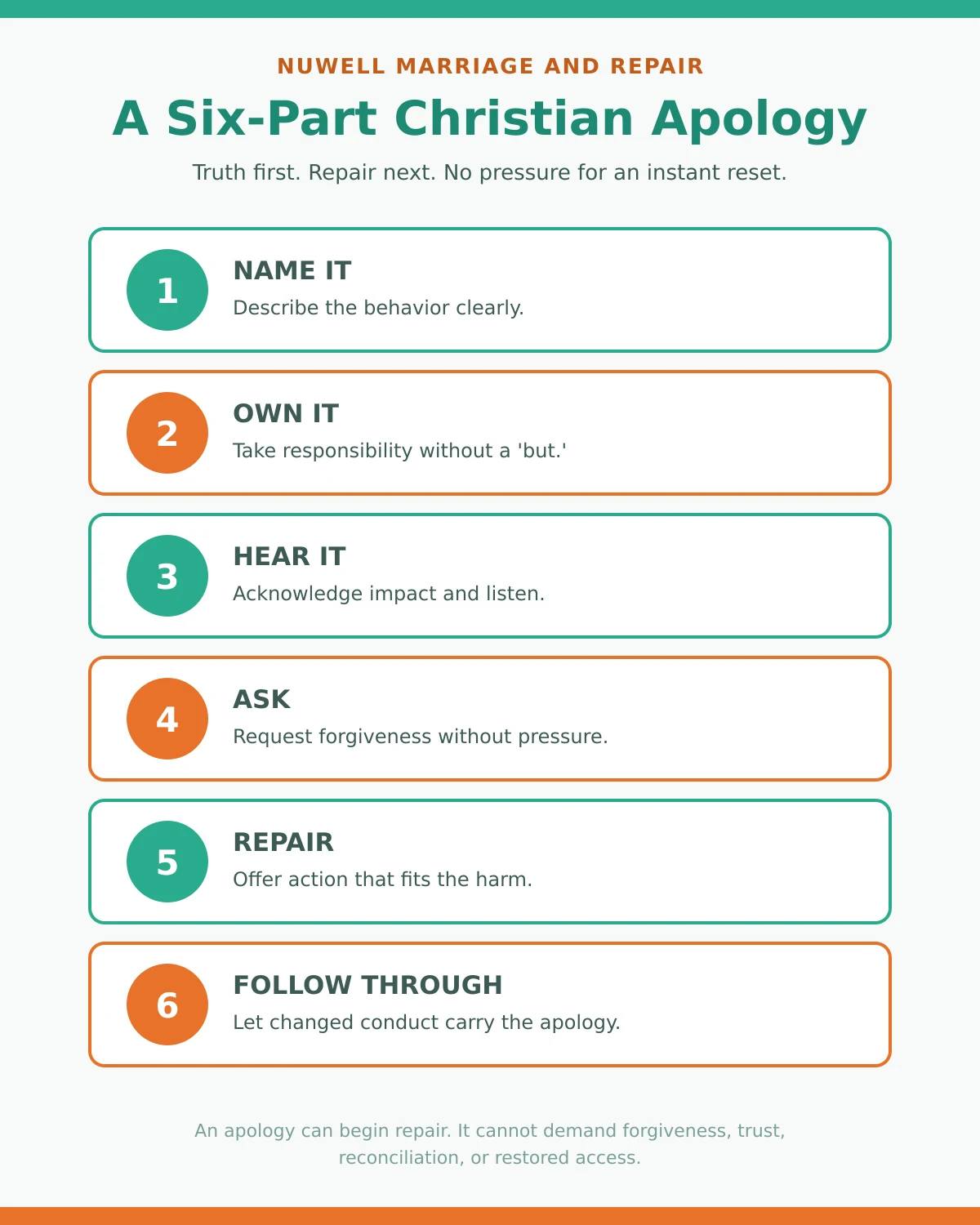
Name what you did
Use active, specific language. Avoid foggy phrases that hide who did what. Specific language shows that you are willing to look directly at your conduct.
Say“I raised my voice and mocked your concern in front of the kids.”
Avoid“Things got out of hand.” · “Mistakes were made.”
Own it without a “but”
Say why the behavior was wrong without transferring responsibility. If your next sentence begins with “but you,” stop. Your spouse may also need to own something, but their responsibility does not reduce yours. Separate the conversations if necessary.
Say“That was disrespectful, and it was my choice.”
Avoid“I’m sorry, but you know how you get when you push me.”
Acknowledge the impact and listen
Name the effect you can already see, then ask rather than assume. Listen for information, not for a detail you can disprove. Intent matters, but good intent does not cancel real impact.
Say“I can see that I embarrassed you and made it harder to feel safe speaking honestly. What was that like for you?”
Avoid“That’s not what I meant, so you shouldn’t be that upset.”
Express remorse and ask for forgiveness
Use direct words. A request leaves the other person free to answer honestly. Do not add a deadline, quote Scripture as leverage, or ask repeatedly until you receive reassurance.
Say“I am sorry. I was wrong. Will you forgive me?”
Avoid“The Bible says you have to forgive me.”
Offer a repair that fits the harm
Repair should address what your conduct damaged. Replace what you broke. Correct false information you shared. Return money. Tell the children that your disrespect was wrong without recruiting them into the conflict. If harsh speech is the pattern, agree on a pause-and-return plan so you can take a responsible break without stonewalling. For a serious breach, ask what information, accountability, boundaries, or outside support would help, while recognizing that the harmed spouse is not required to design your repentance for you.
Follow through without managing the response
An apology gains credibility when conduct changes. Keep the agreement even when your spouse is still cautious. Do not say, “I apologized, so why are you still upset?” The other person may need time, questions, distance, or additional evidence. Your task is faithful follow-through, not control of their emotional timetable.
A simple script you can adapt
Name it“I interrupted you, called your concern ridiculous, and kept talking after you asked me to stop.”
Own it“That was disrespectful and wrong.”
Hear it“I can see that it made this conversation feel unsafe and left you unheard.”
Ask“I am sorry. Will you forgive me? I won’t ask you to settle this tonight.”
Repair & follow through“Tomorrow I will listen for ten minutes without interrupting, and if I become heated, I will use our agreed pause and come back at the time we set.”
Put it in your own words. Sincerity matters more than polish.
What a Biblical Apology Requires
Scripture treats confession as truth spoken before God and one another, not as image management. These passages shape the posture of a Christian apology:
James 5:16
“Confess your offenses to one another, and pray for one another, that you may be healed.”
Confession and prayer belong together within a community of care. Prayer can prepare your heart to apologize, but it cannot replace the apology.
Ephesians 4:25
“Therefore putting away falsehood, speak truth each one with his neighbor. For we are members of one another.”
The surrounding passage (4:25–32) joins truthful speech, restrained anger, gracious words, kindness, and forgiveness. It describes putting off an old way of living and practicing a new one, not saying one correct sentence.
Ephesians 4:32
“And be kind to one another, tender hearted, forgiving each other, just as God also in Christ forgave you.”
Forgiveness is modeled on God’s grace, freely given. It is not something one spouse can extract from the other.
2 Corinthians 7:10
“For godly sorrow produces repentance to salvation, which brings no regret. But the sorrow of the world produces death.”
Paul contrasts godly sorrow with sorrow that stays centered on the self. In verse 11 he describes its fruit as earnest care and zeal to see wrong addressed.
In marriage, remorse may be emotional, but repentance becomes visible through truth, restitution, boundaries, accountability, and changed patterns. Asking God to forgive you does not remove the need to address the person you harmed. Likewise, saying “God knows my heart” should not be used to dismiss the impact of your behavior.
Ephesians 4:26 (“don’t let the sun go down on your wrath”) is sometimes used to insist that every conflict be resolved before bed. The verse warns against letting anger take root; it does not require a hurt spouse to reach resolution on your timetable. If anger keeps driving the harm, our practical plan for dealing with anger as a Christian can help you build a different pattern.
Forgiveness, Trust, Reconciliation, and Access Are Different
Christians sometimes compress four decisions into one. They should be distinguished carefully:
Releases personal vengeance
A response before God that refuses to make revenge the goal. It should not be coerced or used to silence grief, consequences, or truth.
Responds to evidence
After repeated harm, confidence may return gradually as words and behavior become dependable.
Requires both people
It needs participation from both spouses and enough truth and safety for that participation to be free.
Follows safety
Practical privileges such as proximity, finances, passwords, leadership, or intimacy should not run ahead of safety and trustworthy conduct.
A sincere apology can begin repair. It cannot command any of these outcomes. If the harm involved repeated lying, use NuWell’s guide to rebuilding trust after lying in marriage. If you keep arriving at the same escalation pattern, first learn to name the recurring argument cycle.
When an Apology Is Not the Main Safety Step
Ordinary conflict, defensiveness, and poor communication are not automatically abuse. Abuse is also not a mutual communication problem. If there are threats, intimidation, stalking, forced sex, physical violence, control of money or transportation, isolation, monitoring, destruction of property, threats involving children or pets, or spiritual pressure backed by retaliation, the priority is safety rather than a better couple’s conversation.
A person being harmed should not be pressured to accept false blame to calm an abusive partner. The National Domestic Violence Hotline does not encourage couples counseling with an abusive partner, because it cannot fix the imbalance of power and what is said in a session may later be used against the person being harmed.4 Contact an individual advocate or licensed professional from a safer device when possible.
In immediate danger, call 911.
In the United States, contact the National Domestic Violence Hotline at 800-799-SAFE (7233), text START to 88788, or chat at thehotline.org. Internet use can be monitored; use a safer device when possible. For suicide, self-harm, emotional distress, or an alcohol or drug-use crisis, call or text 988 or chat at 988lifeline.org. NuWell is not an emergency service.
Use the RESTORE Path to Support Repair
NuWell’s RESTORE Path is a flexible pastoral map, not a rigid protocol and not a promise of reconciliation. For an apology, its seven movements can help you keep the larger work in view:
Choose Support That Fits the Concern
NuWell offers Christian marriage counseling and coaching online across the United States. Which kind of help fits depends on what is going on:
Pastoral counseling
May fit when the relationship is mutually safe and you want non-clinical, Scripture-grounded help with confession, responsibility, relational patterns, prayer, boundaries, and practical follow-through. Learn more about online pastoral counseling.
Christian life coaching
May fit a stable relationship focused on forward-looking habits and shared goals rather than recovering from a serious breach.
Licensed care and other services
May be a better fit when clinical assessment, diagnosis, psychotherapy, or treatment is needed. Our licensed partner practice, Grace Christian Counseling, provides that care. Medical, substance-use, domestic-violence, legal, or emergency services may also be necessary.
NuWell’s pastoral counseling and Christian life coaching are non-clinical; they do not provide diagnosis, psychotherapy, clinical treatment, domestic-violence intervention, or emergency care. If you want help but your spouse is unwilling, see what to do when a spouse refuses support. You can also meet the NuWell care team.
Related reading: If the apology concerns hidden debt, accounts, or spending, see financial infidelity in marriage for the first steps toward facts and repair. If you and your spouse are already living apart, see how to reconcile a marriage after separation before deciding on next steps.
Related reading: If your apology involves an outside relationship, Emotional Affair in Marriage: Signs and What to Do Next covers the first week and safe truth-telling.
Frequently Asked Questions
Should I apologize if I did not intend to hurt my spouse?
Yes. You can acknowledge impact without confessing an intention you did not have: “I did not intend to embarrass you, but I interrupted and mocked what you said. That was wrong, and I am sorry.” Intent can clarify the story; it should not erase responsibility for your conduct.
What if my spouse will not accept my apology?
Do not pressure a response. Ask whether something important was missing, make the repair you can make, and follow through. Your spouse may need time or may decide that trust and access should remain limited. An apology gives truth and repair; it does not purchase a particular answer.
Do I need to apologize when we were both wrong?
Yes, for the part that is actually yours. Avoid apologizing for everything simply to end the conflict, and do not make your ownership conditional on your spouse going first. Two accurate apologies are healthier than one vague statement that “we both made mistakes.”
Does the Bible require my spouse to forgive immediately?
Scripture calls Christians toward forgiveness, but it does not authorize forced words, denial of harm, or instant restoration of trust and access. Serious wounds may require grief, boundaries, accountability, and time. Forgiveness must never be used to pressure someone back into danger.
Find Your Best Next Step
Do not wait for the perfect wording. Begin with one truthful sentence about one behavior. Own it without a defense, listen for the impact, offer a repair, and let changed conduct carry the apology forward.
Talk with our care team, explore your options, and see whether NuWell is the right fit, without pressure or obligation.

This article was researched with the help of AI and reviewed and edited by Stephen Luther, MEd, MSEd, LPC, for accuracy, Scripture references, and faithfulness to NuWell’s non-clinical scope.
Stephen Luther, MEd, MSEd, LPC, is Executive Director and Founder of Grace Christian Counseling and a licensed professional counselor. He holds a master’s degree in Education and a master’s degree in Marriage and Family Therapy from Duquesne University and has helped children, adolescents, and adults since 1997. His licensed clinical role at Grace Christian Counseling is distinct from NuWell’s non-clinical pastoral counseling and Christian life coaching services.
Scope note: This article provides educational and pastoral information. It is not diagnosis, psychotherapy, clinical treatment, legal advice, domestic-violence intervention, or emergency care. NuWell provides non-clinical pastoral counseling and Christian life coaching. Seek licensed mental-health, medical, substance-use, domestic-violence, legal, or emergency support when those needs are present.
Sources
- Lewicki, R. J., Polin, B., & Lount, R. B., Jr. (2016). An exploration of the structure of effective apologies. Negotiation and Conflict Management Research, 9(2), 177–196.
- Schumann, K. (2018). The psychology of offering an apology: Understanding the barriers to apologizing and how to overcome them. Current Directions in Psychological Science, 27(2), 74–78.
- Forster, D. E., et al. (2021). Experimental evidence that apologies promote forgiveness by communicating relationship value. Scientific Reports, 11, 13107.
- National Domestic Violence Hotline. Should I Go to Couples Therapy With My Abusive Partner? and Safety Planning Tool.
- 988 Suicide & Crisis Lifeline; SAMHSA, 988 Frequently Asked Questions.
- Scripture quotations are from the World English Bible (public domain).
