

Marriage and trust
The story has changed again. Maybe it concerns a purchase, a message, a habit, a place your spouse said they were, or a promise they insisted they had kept. The subject matters, but another question now sits beneath it: Can I rely on what I am being told?
If you are trying to rebuild trust after lying in marriage, a heartfelt apology may matter, but trust cannot be argued back into place. It grows when truth becomes more complete, responsibility becomes more specific, repair becomes observable, and faithful conduct continues without demanding a quick return to normal.
Quick answerTrust can sometimes be rebuilt after repeated lying, but neither spouse can manufacture it in one conversation. The spouse who lied must stop the deception, tell the relevant truth, own the impact, accept wise accountability, and follow through consistently. The hurt spouse may set boundaries, ask questions, seek support, and choose the pace of renewed trust. Forgiveness, trust, reconciliation, and restored access are related, but they are not the same decision.
Repeated Lying Changes the Problem
A single false statement can be serious. Repeated lying adds another layer: the hurt spouse no longer knows whether the current explanation is complete. New facts may cause old conversations to be reinterpreted. Ordinary reassurance begins to sound like one more claim that has not yet been tested by action.
This is more than a communication mistake, although communication will be part of repair. If you are stuck in a mutual loop, the issue may be the same argument in marriage. Repeated lying is different. It is a trust breach: a pattern in which words and reality have stopped matching reliably. That phrase describes what is happening; it is not a diagnosis, a fixed identity, or permission to reduce a person to “a liar.” People remain responsible for their choices without becoming identical to their worst choices.
Repeated dishonesty is also not automatic proof of abuse. People may lie from fear, shame, selfishness, conflict avoidance, addiction, financial secrecy, or a desire to protect an image. Those motives do not excuse the deception. They do show why the next step must address the actual pattern rather than attach a label too quickly. At the same time, lying used to control, isolate, exploit, threaten, hide violence, or make another person doubt clear reality can be part of coercive abuse. That requires a different safety response.
Pastoral experience: In pastoral conversations, we often hear the hurt spouse say that the newest lie is painful, but the deeper exhaustion comes from having to reconsider what else may not be true. We also hear the spouse who lied focus on the latest explanation while underestimating how repeated changes have weakened the credibility of every new promise. Naming that mismatch helps clarify why apology and reassurance alone do not restore trust.
Forgiveness, Trust, and Reconciliation Are Three Decisions
Christians can feel pressure to collapse several processes into one. Scripture calls believers away from vengeance and toward forgiveness, but that does not require pretending the breach was small or treating access as automatically restored. NuWell’s broader guide to Christian forgiveness without confusing it with restored trust explores that distinction in depth.
Releases personal retaliation
A response before God that refuses to make revenge the goal. It can be sincere while grief, consequences, questions, and boundaries remain. It should not be forced on a timetable or used to silence the person who was harmed.
Responds to evidence
Confidence that another person’s words and actions are dependable. After repeated lying, caution is not necessarily bitterness. Trust usually returns through truthful conduct observed over time, not through pressure to “believe me this time.”
Requires mutual participation
A two-person process that needs enough truth and safety for both people to participate freely. It may include confession, repentance, restitution, new boundaries, outside help, and time.
Follows, not precedes
Forgiveness does not guarantee reconciliation, and reconciliation does not require immediate restoration of every former privilege, password, or shared account.
What Observable Repair Looks Like
Apology researcher Karina Schumann, PhD, has described an apology as an important starting point for serious offenses such as infidelity or a continued pattern of harm, one that must then be followed by behavioral change. A 1998 study of how people manage discovered deception similarly found that prosocial repair strategies were associated with greater trust, affection, and intimacy afterward. Associations like these cannot promise an outcome for any marriage. The practical point is modest: repair becomes more credible when it is behavioral, not merely emotional.
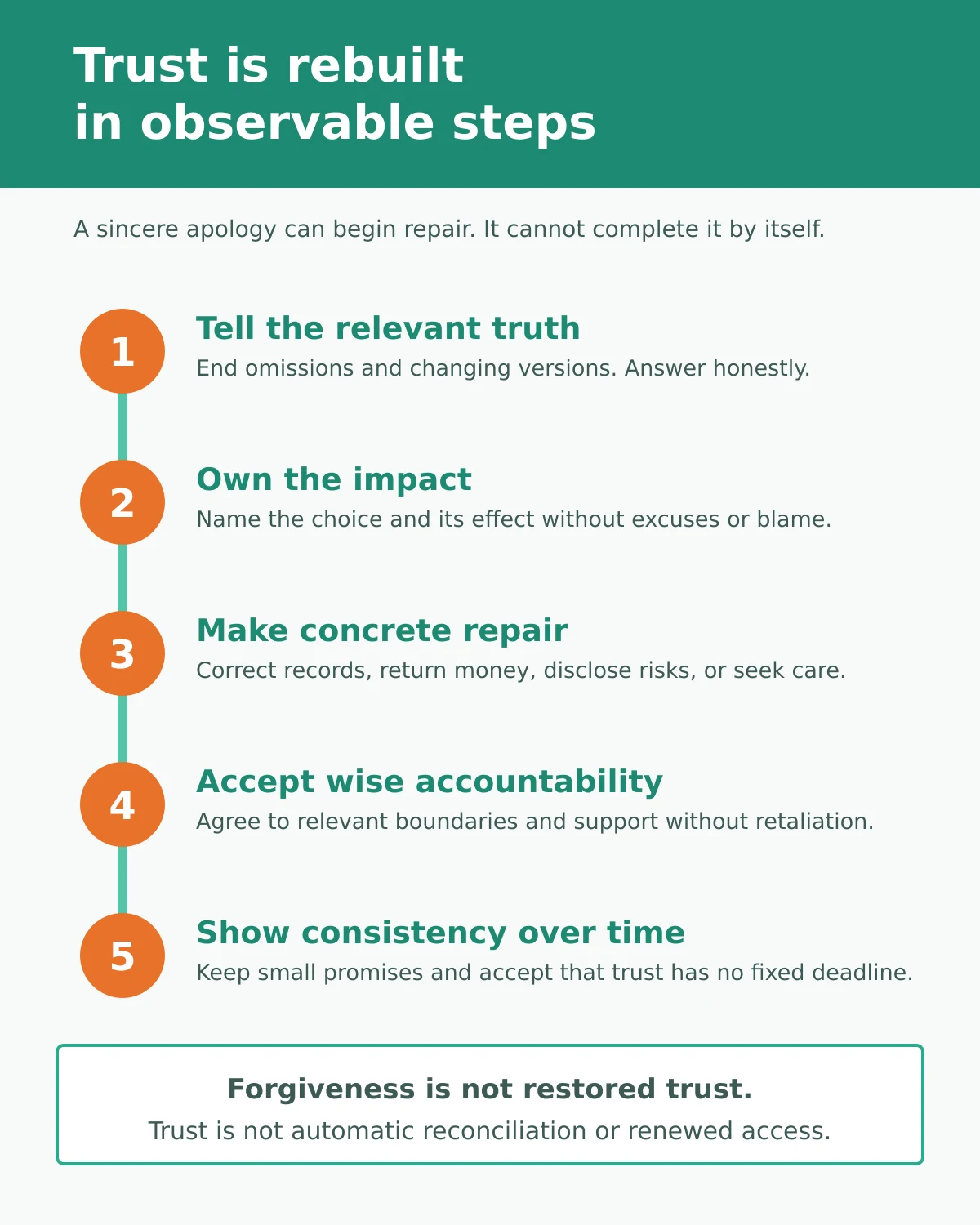
Tell the relevant truth
Stop the changing versions and strategic omissions. Answer reasonable questions honestly. “Relevant truth” means information the other spouse needs to understand the breach, evaluate health or financial risk, make decisions, and know what is being repaired. It does not mean forcing a dangerous confrontation or demanding graphic details that serve no wise purpose.
Own the choice and its impact
Context can be discussed later, but blame-shifting keeps the center of attention away from the choice that caused the breach.
Owns it“I lied about the account, and that left you making decisions with false information.”
Shifts blame“I lied because you always overreact.”
Conditional“I’m sorry if you were hurt.”
Make concrete repair
Repair should fit the harm. Correct a false record. Return money. End undisclosed contact. Arrange a medical test when sexual health may be affected. Seek specialized help for substance use, gambling, compulsive sexual behavior, or another issue that pastoral support cannot treat. An apology without a repair plan leaves the hurt spouse carrying the consequences alone. For help with the conversation itself, see NuWell’s guide on how to apologize to your spouse.
Accept wise accountability
Accountability is not humiliation or permanent surveillance. It is a voluntary structure that makes future truth easier to verify and broken agreements easier to address. It may include a budget review, clear contact boundaries, a trusted mentor, professional care, or scheduled check-ins. The agreement should be relevant, proportionate, time-limited when appropriate, and reviewed together.
Show consistency over time
Keep small promises. Tell the truth before being confronted. Admit a mistake without waiting for proof. Respect a boundary without punishing the person who set it. Trust has no universal deadline, and the spouse who caused the breach does not get to set one.
A One-Week Trust-Repair Plan
This plan is for a relationship in which both spouses can speak, pause, seek help, and make choices without fear of retaliation. It is not a safety plan for abuse.
For the spouse who lied
- Write a truthful inventory. Identify what was false, omitted, or allowed to be misunderstood. Do not destroy records or recruit others to protect the story.
- Prepare a specific apology. Name the choice, the impact you understand, and the repair you will make. Leave out “but” and requests for immediate forgiveness.
- Take one corrective action. Correct the account, schedule appropriate help, make restitution, or propose a relevant accountability step.
- Answer without attacking. You may ask for a thoughtful pause if the conversation becomes unproductive, but give a specific return time and keep it.
For the hurt spouse
- Write what you know and what you need to know. Separate confirmed facts, unanswered questions, and fears. This can reduce pressure to solve everything at once.
- Name one immediate boundary. A boundary describes what you will do to protect health, finances, safety, or clarity. It is not a tool for revenge.
- Choose support that does not pressure you. A wise pastor, advocate, licensed professional, attorney, physician, or trusted person may be appropriate depending on the issue.
- Do not accept responsibility for rebuilding trust alone. You can communicate clearly and choose your next step. You cannot make another person become truthful.
For both spouses, when the relationship is mutually safe
- Set one 30-minute conversation with one topic and a clear stopping time.
- Agree on what information is relevant, what first repair action is due, and when you will review it.
- If either person becomes unable to listen, take a responsible break and return at a stated time.
- End with the written next step, not a demand for an emotional verdict about the whole marriage.
A Biblical Posture: Truth With Repentance and Mercy
Ephesians 4:25 (NIV)“Therefore each of you must put off falsehood and speak truthfully to your neighbor, for we are all members of one body.”
Paul’s instruction appears within a larger call to put off the old way of life and practice truth, constructive speech, responsibility, kindness, and forgiveness. In marriage, truth-telling is not merely avoiding technically false sentences. It is leaving behind the pattern that made deception useful and learning a way of life in which words and actions agree.
Proverbs 28:13 (NIV)“Whoever conceals their sins does not prosper, but the one who confesses and renounces them finds mercy.”
Biblical repentance includes confession and turning. The verse does not authorize interrogation, forced disclosure in an unsafe setting, or instant restoration of trust. Mercy and consequences can exist together. Prayer can support courage and humility, but it should never replace apology, restitution, boundaries, or follow-through.
How the RESTORE Path Can Guide Discernment
NuWell’s RESTORE Path is a flexible pastoral map, not a rigid protocol or guaranteed sequence. Five movements are especially relevant here:
- Recognize the wound. Name both the lie and the uncertainty it created.
- Establish safety. Protect health, finances, freedom, and the ability to speak without retaliation.
- Separate truth from distortion. Distinguish verified facts from fear, minimization, blame, and spiritual pressure.
- Tend what was wounded. Make room for grief, anger, shame, and spiritual confusion without letting them decide every next step.
- Rebuild healthy patterns. Practice honest disclosure, specific responsibility, wise accountability, and dependable follow-through.
When Lying Is Part of a Safety Problem
Not every lie is abuse. Abuse is also not simply a more intense communication problem. The U.S. Department of Justice describes domestic violence as a pattern of abusive behavior used to gain or maintain power and control over an intimate partner, including emotional, economic, psychological, technological, and coercive behavior as well as physical or sexual violence.
Pause joint repair work and seek individual guidance if deception is connected with threats, stalking, forced sex, physical violence, hidden weapons, retaliation, identity theft, controlling money or transportation, isolation, monitoring, dangerous substance use, crimes, or spiritual pressure used to demand silence. If one spouse is afraid of what will happen after a joint conversation, couples work may increase risk. The National Domestic Violence Hotline does not recommend couples counseling in abusive relationships.
In immediate danger, call 911.
In the United States, contact the National Domestic Violence Hotline at 800-799-SAFE (7233), text START to 88788, or chat at thehotline.org. Internet use can be monitored; use a safer device when possible. For suicide, self-harm, or an emotional or substance-use crisis, call or text 988 or visit 988lifeline.org. NuWell is not an emergency service.
Choose the Right Kind of Support
NuWell offers online pastoral counseling and Christian life coaching across the United States. Pastoral counseling may fit when participation is voluntary, the relationship is mutually safe, and you want Biblical guidance, pattern discernment, accountability, and practical support. Christian life coaching may fit when the marriage is generally stable and both spouses want forward-focused goals and practice.
Licensed mental-health care may be a better fit when clinical assessment or treatment is needed. Medical, legal, financial, substance-use, compulsive-behavior, domestic-violence, or emergency services may be necessary when the hidden issue falls within those areas. NuWell’s pastoral counseling and coaching are non-clinical; they do not provide diagnosis, psychotherapy, clinical treatment, or emergency care. Learn more about Christian marriage counseling and coaching at NuWell.
Related reading: If the lying led to a separation, see how to reconcile a marriage after separation for five readiness gates to consider before moving back in.
Related reading: If the deception involved hidden messages or an undisclosed outside relationship, see Emotional Affair in Marriage: Signs and What to Do Next.
Frequently Asked Questions
Can trust return after repeated lying in marriage?
Sometimes, but no article or practitioner can guarantee it. Trust becomes more possible when deception stops, relevant truth is offered, responsibility is specific, repair fits the harm, and consistent conduct continues. The hurt spouse is allowed to evaluate that evidence over time.
How long does it take to rebuild trust?
There is no fixed or spiritually superior timeline. The subject of the lie, duration of the pattern, new disclosures, degree of risk, quality of repair, and each spouse’s capacity all matter. A calendar cannot substitute for evidence.
Do I have to forgive before I know the whole truth?
Forgiveness should not be used to shut down reasonable questions or remove wise boundaries. You can begin bringing anger and vengeance to God while still asking for relevant truth, seeking safety, and deciding what level of contact or trust is appropriate.
Should spouses share passwords after lying?
Temporary, voluntary transparency can be one relevant accountability step, but it is not a universal rule and should not become coercive surveillance. The agreement should fit the breach, respect safety and lawful privacy, include clear limits, and be reviewed. Password access cannot substitute for character change.
Start With One Truthful Next Step
You do not have to decide the entire future of your marriage tonight. Begin with the next truthful action: name the breach accurately, establish the boundary or support you need, and look for repair that can be observed rather than promised. Christian hope can tell the truth, make room for repentance, and move at the pace wisdom and safety require.
Talk with NuWell’s care team, explore your options, and see whether pastoral counseling, Christian life coaching, licensed care, or another resource is the right fit, without pressure or obligation.
You can also see how NuWell’s process works.

This article was researched with the help of AI and reviewed and edited by Stephen Luther, MEd, MSEd, LPC, for accuracy, Scripture references, and faithfulness to NuWell’s non-clinical scope.
Stephen Luther, MEd, MSEd, LPC, is Executive Director and Founder of Grace Christian Counseling and a licensed professional counselor. He holds a master’s degree in Education and a master’s degree in Marriage and Family Therapy from Duquesne University and has helped children, adolescents, and adults since 1997. His licensed clinical role at Grace Christian Counseling is separate from NuWell’s non-clinical pastoral counseling and Christian life coaching services.
Scope note: This article provides educational and pastoral information. It is not diagnosis, psychotherapy, clinical treatment, legal advice, domestic-violence intervention, or emergency care. NuWell provides non-clinical pastoral counseling and Christian life coaching. Seek licensed, medical, legal, financial, substance-use, domestic-violence, or emergency support when those needs are present.
Sources
- American Psychological Association. (2022). Why you should apologize even when it’s hard to, with Karina Schumann, PhD [Speaking of Psychology, Episode 213].
- Aune, R. K., Metts, S., & Hubbard, A. S. (1998). Managing the outcomes of discovered deception. The Journal of Social Psychology, 138(6), 677–689.
- U.S. Department of Justice, Office on Violence Against Women. Domestic Violence.
- National Domestic Violence Hotline. Can I Save Them? and Get Help.
- 988 Suicide & Crisis Lifeline.
