

Marriage and communication
The conversation stops, but the conflict does not. Your spouse may leave the room, answer only practical questions, or move through the house as if you are not there. You wonder whether to give more space, ask again, apologize just to end the tension, or accept that the subject will never be discussed.
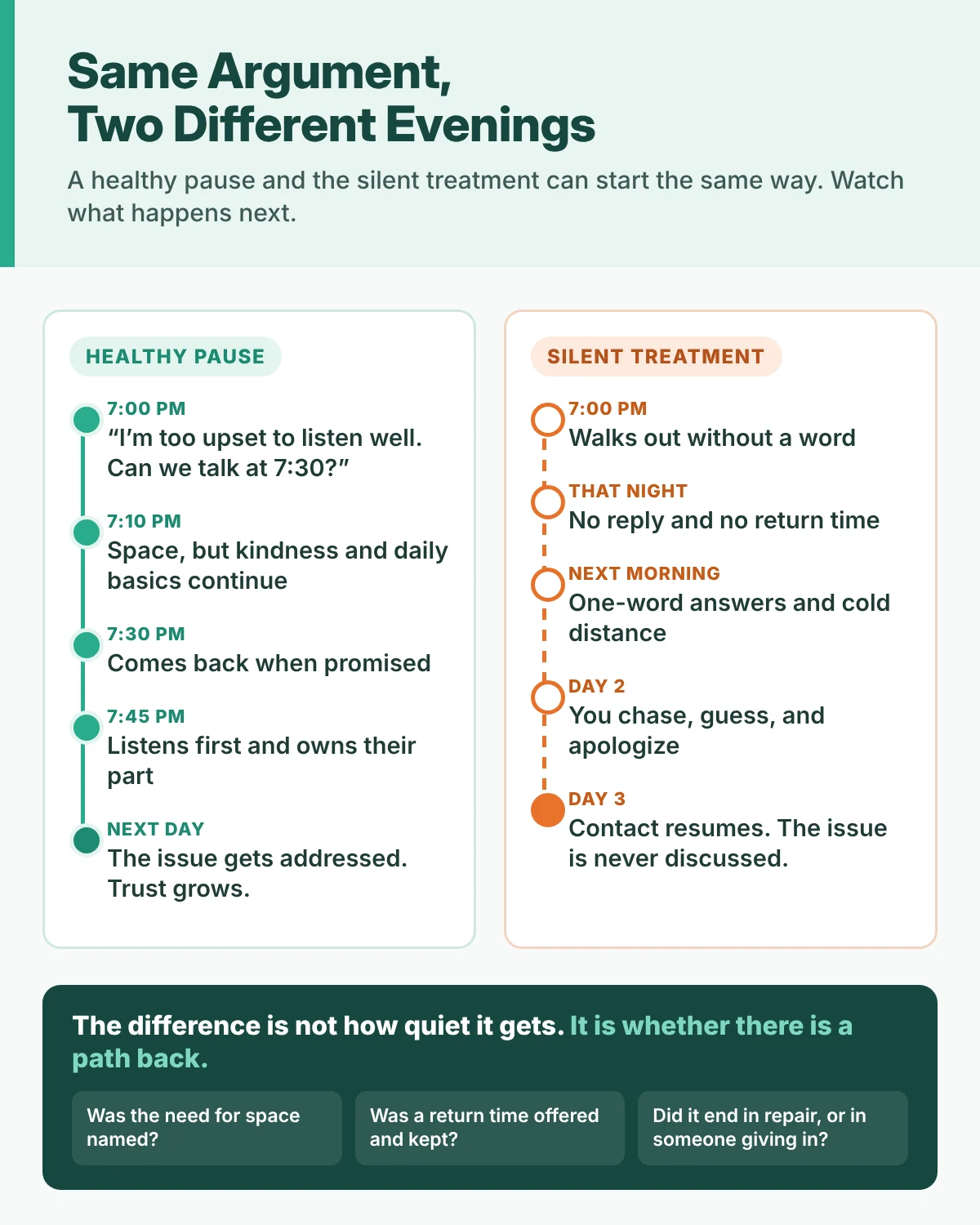
The silent treatment in marriage is not the same as every quiet moment. A healthy pause protects the conversation and includes a path back. Overwhelmed shutdown may be poorly communicated but still requires responsibility and repair. Punitive silence withholds connection to punish, pressure, or force someone to give in. When silence sits inside a broader pattern of fear, retaliation, surveillance, threats, or control, the first question is safety, not communication technique.
Quick answerLook at the pattern you can observe, not a motive you cannot prove. Did your spouse say they needed space? Is there a specific return plan? Does basic respect continue? Do they come back when promised? Or does the silence end only after you chase, apologize, give up a boundary, or give in? One calm invitation usually helps more than repeated pursuit. If you fear retaliation or cannot safely speak, say no, or leave, seek individual safety support instead of pushing for a joint conversation.
Four Kinds of Silence That Should Not Be Confused
Not every case of silent treatment in marriage looks the same. Labels can clarify a pattern, but they can also become weapons. Do not diagnose your spouse from one quiet evening. Compare what happens before, during, and after the silence.
| Pattern | What you can observe | What it needs |
|---|---|---|
| Responsible pause | Care is communicated, a capacity limit is named, a realistic return time is offered, basic logistics and respect continue, and the person comes back. | Space, follow-through, listening, and repair. |
| Overwhelmed shutdown | The person may go blank, struggle to speak, or leave abruptly. The response can be involuntary or poorly explained, but there is not yet a reliable plan back. | Responsibility, settling skills, a return script, and support if the pattern repeats. |
| Punitive silence | Communication is withheld to make the other person guess, chase, suffer, apologize, or give in. Contact resumes on the silent spouse’s terms, without mutual repair. | A clear boundary, less chasing, accountability, and appropriate outside support. |
| Coercive control | Silence appears within a broader pattern of intimidation, threats, monitoring, isolation, financial restriction, sexual coercion, blocked exits, property destruction, or retaliation. | Individual safety planning and specialized domestic-violence support. Not a mutual communication cycle. |
A 2026 systematic review of 15 studies described silent treatment as a complex form of communication avoidance with varied motives, including emotional regulation, avoidance, and manipulation. It found links with loneliness, distress, and lower relationship satisfaction, while noting that most of the evidence is qualitative or cross-sectional rather than long-term.[1] Recurring silence deserves attention, but a single behavior does not prove a motive or an abusive pattern.
Research on demand-withdraw communication also links repeated press-and-retreat patterns with poorer relational and communication outcomes.[2] Context matters, though. The same spouse may pursue one topic and withdraw from another. If your conflict is mainly a mutual loop, NuWell’s guide to the recurring press-and-pull cycle addresses that pattern in depth.
Pastoral experience: In pastoral conversations, we often hear one spouse say, “I keep asking because I do not know whether this will ever be addressed,” while the other says, “I go quiet because every answer feels wrong.” We also hear a different kind of story, in which silence ends only after the other spouse gives in. Those situations can look alike from across the room, but the return plan, the freedom to disagree, and the response to a boundary reveal important differences.
A Safety-First Way to Respond
First, start with safety
Can you speak, say no, or leave without threats, intimidation, monitoring, blocked exits, or retaliation? If not, or if you are unsure, set the communication plan aside and seek individual safety support. If yes, use the five steps below and watch the pattern, not one moment.
Check the function.
Notice whether the silence seems to help someone settle, avoid discomfort, punish, or control. Hold this as a working observation, not a diagnosis.
Name the impact once.
“The open-ended silence is hurting trust.”
Ask for a specific return.
Invite a day and time, or ask for one clear reply.
Hold your boundary.
Do not chase, retaliate, or pretend repair has happened.
Choose support by the response.
A reliable return opens a path to repair. Repeated shutdown calls for outside support. Fear or retaliation calls for safety planning.
When You Are Receiving the Silent Treatment
Steady yourself before you pursue
Open-ended silence creates urgency. You may want to send ten messages, follow your spouse from room to room, recruit family members, or apologize for anything that might restore contact. Pause first. Pray honestly, take a walk, write down the one issue that needs a response, and talk with one safe person who will not inflame the conflict. Settling yourself is not accepting the behavior. It lets you choose your next move instead of letting panic choose it.
Make one clear invitation
Use brief, concrete language. If a face-to-face request feels too heated, one written message may be wiser. A specific request gives you information. Repeated requests often create a chase that buries the original concern.
Try saying
“I can respect a need for space. I am not willing to leave this open-ended. Please tell me by noon tomorrow when you can talk for 30 minutes.”
Keep ordinary responsibilities clear
Silence should not make children carry messages, leave essential caregiving uncertain, or hide urgent information about money, health, transportation, or schedules. Use neutral logistical communication when it is safe. Do not put a child in the middle or ask them to watch the silent spouse.
Set a boundary around what you will do
A boundary describes your action; it does not command another adult’s emotions. You might say, “If we cannot choose a time to address this by Friday, I will seek individual support and make decisions based on the information I have.” Do not threaten consequences you cannot or should not carry out. And do not mistake renewed conversation for repair. The issue still needs truthful discussion, responsibility, and follow-through. If the silence is covering a deeper breach, such as repeated deception, NuWell’s guide to rebuilding trust after repeated lying may fit better.
Keep a private record when decisions are becoming serious
A short factual record can help you see frequency and context: what topic came before the silence, what was said, how long it lasted, whether basic responsibilities continued, what ended it, and whether threats or retaliation occurred. Keep it secure, especially if devices may be monitored. The goal is clarity, not building a case.
If You Are the One Shutting Down
Needing space does not make you uncaring. But leaving your spouse without a path back still has an impact. Replace disappearance with a short return script that has three parts: care, capacity, and return.
A return script
“I care about this, and I am too overwhelmed to listen well right now. I need space. I will check in by 7:30 tonight and either talk then or propose a specific time tomorrow.”
Then keep the promise. During the break, do not continue the argument through social media, indirect comments, spending, affection, sex, the children, or spiritual pressure. Use the time to settle, not to rehearse your rebuttal. When you return, name your part without making your overwhelm the only subject: “I left without explaining, and that created uncertainty. I am sorry. I want to hear the concern now.” NuWell’s guide on how to offer a specific apology can help with that repair.
It helps to agree on a pause plan before the next hard conversation, when neither of you is at the edge of your capacity:
- Choose a neutral pause signal either spouse can use, such as “I need our pause.” It means “I want to protect this conversation,” not “I win” or “Stop talking.”
- The person who asks for the pause proposes the return time. That small rule keeps the spouse who wants space from holding all the control.
- Watch for early signals that listening is slipping: racing thoughts, a tight chest, interrupting, rehearsing a rebuttal, or going blank.
- Return, listen, and repair. Pick one issue, let one spouse speak while the other summarizes, then switch. If the topic itself needs solving, use NuWell’s guide to Biblical conflict resolution in marriage.
- Reschedule once if you must, then address the pattern. A pause that keeps getting postponed has become avoidance.
If words regularly disappear under stress, prepare a written phrase in advance and seek support for the repeating pattern. The purpose is not to force instant access. It is to make space trustworthy.
A Biblical Posture: Truth, Restraint, and Return
“My dear brothers and sisters, take note of this: Everyone should be quick to listen, slow to speak and slow to become angry”
James 1:19, NIV
That wisdom supports restraint; it does not bless indefinite avoidance. Ephesians 4:25–32 joins truthful speech, responsible anger, words that build up, kindness, and forgiveness. Silence that protects self-control can serve those aims when it includes a faithful return. Silence used to make another person suffer or submit does not.
“If it is possible, as far as it depends on you, live at peace with everyone”
Romans 12:18, NIV
The qualifications matter. You are responsible for truthful, peaceful action within your control. You are not responsible for manufacturing reconciliation, giving up wise boundaries, or proving your faith by renewing access to someone unsafe. Prayer should open both spouses to truth and responsibility. It should never become leverage for an immediate conversation, forgiveness, trust, or reunion.
How the RESTORE Path fits this moment
NuWell’s RESTORE Path is a flexible pastoral map, not a rigid protocol or guaranteed sequence. Four movements are especially useful here:
Recognize the wound. Name what the silence touches: abandonment, shame, helplessness, fear, or an older breach of trust.
Establish safety. Confirm that both spouses can speak, pause, disagree, and seek help without punishment.
Separate truth from distortion. Test thoughts such as “I must solve this tonight,” “silence proves I am worthless,” or “needing space excuses me from returning.”
Rebuild healthy patterns. Practice clear pause language, reliable return, listening, apology, boundaries, and visible follow-through.
When Silence Is Part of a Safety Problem
Ordinary withdrawal, poor conflict skills, or one failed pause are not automatically abuse. And abuse is not a mutual communication problem. Look at the broader pattern of power, fear, and control. The National Domestic Violence Hotline lists punishing a partner by withholding attention or affection among the signs of emotional abuse, alongside isolation, monitoring, and threats.[3]
If silence comes with threats, stalking, monitoring, blocked exits, financial control, forced sex, property destruction, isolation, threats involving children or immigration status, or retaliation for speaking or seeking help, do not push for couples work. Contact a domestic-violence advocate individually, from a safer device if needed.
In immediate danger, call 911.
Contact the National Domestic Violence Hotline at 800-799-SAFE (7233), text START to 88788, or chat at thehotline.org. Help is free, confidential, and available 24/7.[4]
For suicidal thoughts, self-harm, emotional distress, or a substance-use crisis, call or text 988 or visit 988lifeline.org.[5]
NuWell is not an emergency or domestic-violence service.
Choose Support by the Pattern
Both spouses can speak freely, and the pause-and-return process is unreliable but safe. Pastoral counseling can help you name the pattern, bring Scripture in responsibly, and practice clearer next steps.
A generally stable couple wants forward-focused habits, a shared pause plan, and accountability for follow-through.
Distress is persistent, daily functioning is affected, or a clinical assessment or treatment is needed. Grace Christian Counseling offers licensed Christian marriage counseling.
Coercion, threats, or violence may be present. Seek individual guidance from a domestic-violence advocate rather than assuming joint work is safe.
When the silent treatment in marriage has become a repeated pattern, the right support depends on safety and on how each spouse responds. NuWell provides online pastoral counseling and Christian life coaching across the United States. These are non-clinical services. If your spouse will not consider outside help, NuWell’s guide on what to do when your spouse refuses help offers next steps you can take on your own. Medical, substance-use, or legal services may be the better next step when those needs are present.
Frequently Asked Questions
How long is too long for silence after an argument?
There is no universal number of minutes or hours. Look for communication, a realistic return plan, basic respect, and follow-through. Overnight space may be responsible in one situation and open-ended punishment in another. Repeated silence with no dependable return needs attention.
Should I keep texting until my spouse answers?
Usually, one calm message with a specific invitation is clearer than repeated pursuit. Keep essential logistical communication factual. If you fear retaliation, your devices are monitored, or messages are used against you, seek individual safety guidance before setting a communication plan.
Is the silent treatment emotional abuse?
Silence by itself does not establish abuse. It becomes more concerning when it is repeated, used to punish or force compliance, and especially when it belongs to a broader pattern of intimidation, isolation, surveillance, threats, financial restriction, sexual coercion, or retaliation. A domestic-violence advocate can help you assess the pattern without pressuring you.
Find Your Best Next Step
You do not need to win a chase for conversation. Begin with the clearest question: Is everyone safe? Then make one specific invitation, hold a boundary around open-ended silence, and let the response show you what kind of support fits.
Talk with our care team, explore your options, and see whether NuWell is the right fit, without pressure or obligation.
See how NuWell’s process works or learn more about NuWell’s online pastoral counseling.

This article was researched with the help of AI and reviewed and edited by Stephen Luther, MEd, MSEd, LPC, for accuracy, Scripture references, and faithfulness to NuWell’s non-clinical scope.
Stephen Luther, MEd, MSEd, LPC, is Executive Director and Founder of Grace Christian Counseling and a licensed professional counselor. He holds a master’s degree in Education and a master’s degree in Marriage and Family Therapy from Duquesne University and has helped children, adolescents, and adults since 1997. His licensed clinical role at Grace Christian Counseling is distinct from NuWell’s non-clinical pastoral counseling and Christian life coaching services.
Scope note: This article provides educational and pastoral information. It is not diagnosis, psychotherapy, clinical treatment, legal advice, domestic-violence intervention, or emergency care. NuWell provides non-clinical pastoral counseling and Christian life coaching. Seek licensed mental-health, medical, substance-use, domestic-violence, legal, or emergency support when those needs are present.
Sources
- Dubey, A., et al. (2026). Antecedents and consequences of silent treatment in close adult relationships: a systematic review. Frontiers in Psychology, 17, 1659694.
- Schrodt, P., Witt, P. L., & Shimkowski, J. R. (2014). A meta-analytical review of the demand/withdraw pattern of interaction and its associations with individual, relational, and communicative outcomes. Communication Monographs, 81(1), 28–58.
- National Domestic Violence Hotline. What Is Emotional Abuse? Accessed October 7, 2026.
- National Domestic Violence Hotline. Get Help. Accessed October 7, 2026.
- 988 Suicide & Crisis Lifeline. Accessed October 7, 2026.
Scripture quotations taken from The Holy Bible, New International Version® NIV®. Copyright © 1973, 1978, 1984, 2011 by Biblica, Inc.™ Used by permission. All rights reserved worldwide.
