

You start with the budget, the in-laws, parenting, intimacy, or an unfinished chore. Ten minutes later, you are no longer talking about the original issue. One spouse is pressing for an answer. The other is getting quiet, defensive, or leaving the room. Both feel unheard, and both can predict how the conversation will end.
If you keep having the same argument in marriage, the topic may not be the only problem. You may be caught in a pursue-withdraw cycle: one spouse pushes for engagement or change while the other pulls back to reduce pressure. The harder one pursues, the more the other withdraws. The more one withdraws, the more urgent pursuit feels.
If the repeating pattern is mostly your own reaction rather than a dynamic between you and your spouse, learn how to interrupt a behavior cycle.
This pattern does not mean your marriage is doomed, and it does not make either spouse the villain. It does mean the cycle needs to become the shared problem. Research has repeatedly associated demand-withdraw communication with lower relationship satisfaction, although context matters and a pattern is not a diagnosis.1, 2
The quick answer: name the cycle before solving the topic
When the same argument keeps returning, pause the content and notice the process. Ask: “What happens between us after this topic comes up?” You may see a familiar sequence:
- One spouse raises a concern and wants to settle it now.
- The other feels criticized, overwhelmed, or unsure what to say.
- The first spouse increases questions, volume, urgency, or examples.
- The second spouse explains, goes silent, changes the subject, or leaves.
- Each response confirms the other spouse’s fear: “I do not matter” or “I cannot get this right.”
The next step is not to decide who started it. It is to recognize the loop early, establish enough safety to slow it down, and return to the concern with clearer words and a concrete plan.
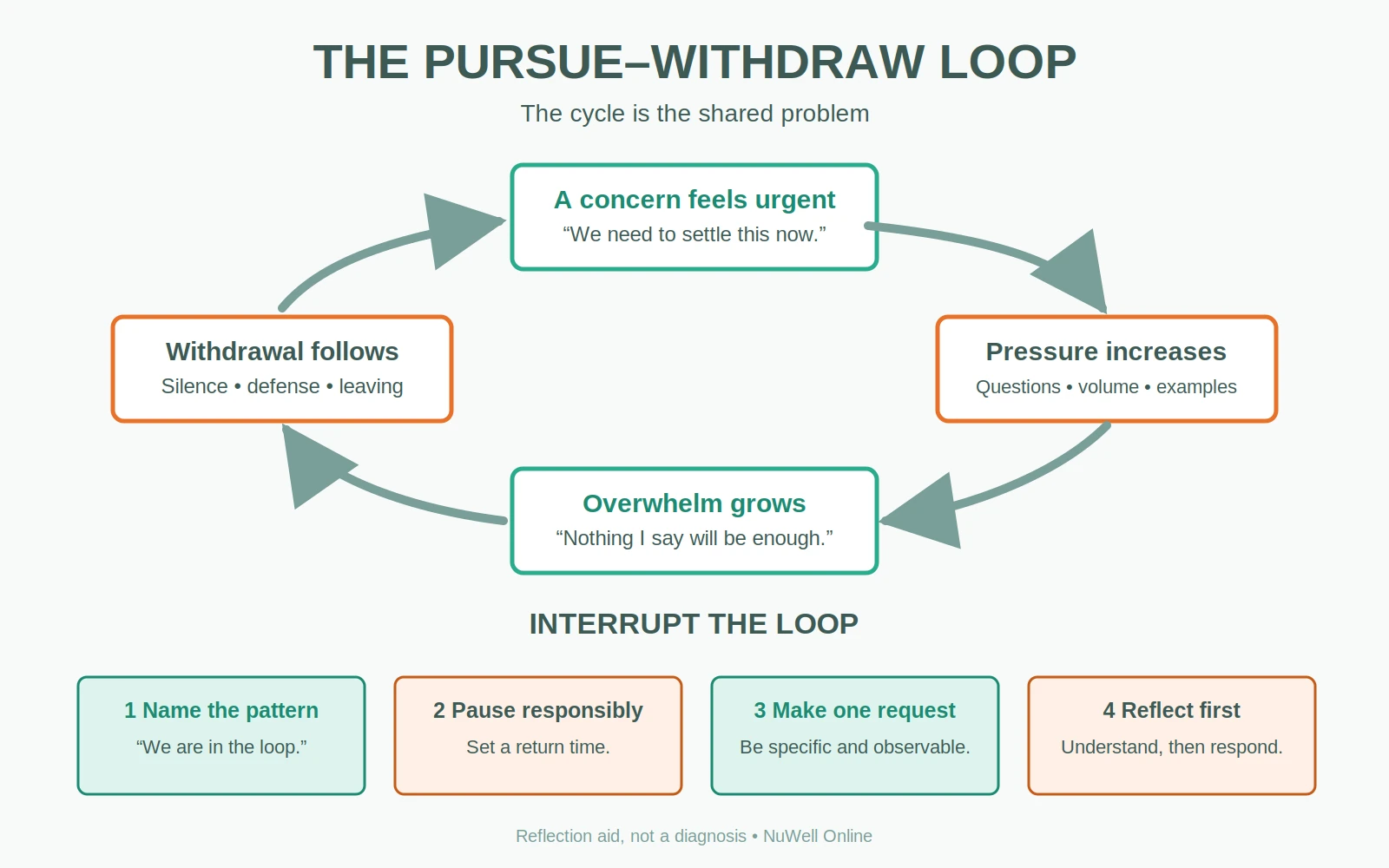
What the pursue-withdraw cycle looks like
The pursuing response
The pursuing spouse often wants closeness, clarity, responsibility, or visible change. Pursuit can sound like repeated questions, criticism, bringing up several examples, following a spouse from room to room, or insisting that the conversation continue immediately.
Beneath that intensity may be a reasonable concern: “Will this ever be addressed?” or “Am I alone in carrying this?” Yet a legitimate concern can be delivered in a way that feels impossible to receive. Pressure may win a response without creating understanding.
The withdrawing response
The withdrawing spouse often wants lower intensity, time to think, protection from shame, or an end to a conversation that feels unproductive. Withdrawal can look like short answers, defensiveness, distraction, changing the subject, emotional shutdown, or physically leaving.
Stepping away is not always wrong. A thoughtful pause can protect a conversation. The problem comes when the pause has no explanation, no return time, and no willingness to re-engage. Then space feels like abandonment, indifference, or control.
Roles can change
“Pursuer” and “withdrawer” are descriptions of behavior, not permanent identities. The same person may pursue around money and withdraw around sex or parenting. Culture, stress, health, power, and the importance of the topic can all shape the pattern. Avoid turning a useful description into a label you use against your spouse.
Why the same fight keeps repeating
Recurring arguments often contain two conversations at once. The visible conversation is about a decision or behavior. The quieter conversation is about what the interaction seems to mean:
The quieter conversation
Do you care about me?
Can I speak without being attacked?
Will you keep your word?
Is there room for my limits?
Are we still on the same team?
Because both spouses are trying to protect something important, each can mistake the other’s protection for bad intent. The pursuer reads a pause as proof that the issue does not matter. The withdrawer reads urgency as proof that nothing they say will be enough. Each then does more of the very thing that alarms the other.
That insight is not an excuse for harshness, avoidance, broken promises, or sin. It is a way to see where responsibility can begin. You cannot control your spouse’s move, but you can make your own move less automatic.
A six-step way to interrupt the cycle
Give the pattern a neutral name
Choose language that makes the cycle the problem: “We are in the loop,” “We are speeding up and shutting down,” or “This is our press-and-pull pattern.” A neutral name helps you notice what is happening without announcing a verdict about who is wrong.
Call a responsible pause
A responsible pause includes care, a reason, and a specific return.
Try saying
“I care about this, and I want to finish the conversation. I am too overwhelmed to listen well right now. Can we pause and come back at 7:30?”
The person requesting space should help name a realistic return time and keep it. The person wanting immediate resolution should allow the agreed pause unless safety requires different action. During the break, do something that settles you rather than rehearsing your case. Need a reliable timeout, or has one spouse’s silence become open-ended? Learn how to tell the silent treatment in marriage from a healthy pause.
Reduce the issue to one clear concern
Do not bring the entire history of the marriage into one conversation. Describe one observable event, its impact, and one request. Research on change conversations suggests that specific requests and “we” language are associated with less resistance and better problem resolution than vague or escalating demands.3
“You never help.”
“When bedtime falls to me four nights in a row, I feel alone in the load. Could we choose two nights you will own this week?”
Specificity gives both spouses something they can understand and revisit.
Reflect before responding
Each spouse gets a turn to speak without interruption. The listener summarizes the concern and asks, “Did I understand you?” before defending, correcting, or proposing a solution. Reflection does not mean agreement. It means you can represent your spouse’s experience accurately enough for the conversation to continue.
Name your part without claiming all the blame
Responsibility is more useful when it is concrete: “I kept pressing after you asked for ten minutes,” or “I left without saying when I would return.” Do not use mutuality to flatten unequal behavior. One spouse may have more responsibility for a specific breach, lie, threat, or repeated refusal to engage. When your part calls for a full apology, NuWell’s guide on how to apologize to your spouse walks through each step.
Make one agreement and schedule a check-in
End with a small, observable next step. Decide who will do what, by when, and when you will review it. Trust grows through truthful follow-through, not through the emotional intensity of a single conversation. If the plan fails, study the plan before attacking each other’s character. If you are stuck on the decision itself, our guide to Biblical conflict resolution in marriage walks through how to decide together.
A Biblical posture for hard conversations
“Everyone should be quick to listen, slow to speak and slow to become angry.”
James 1:19 (NIV)
James tells believers to be “quick to listen, slow to speak and slow to become angry” (James 1:19, NIV). In context, this is not permission to avoid a necessary conversation or silence the spouse who raises a concern. It is a call to receive truth humbly before reacting.
Ephesians 4:25–32 holds truth and grace together. Paul calls the Christian community away from falsehood, destructive speech, bitterness, and malice, and toward truthful words that build others up. Applied to marriage, that means neither peacekeeping through avoidance nor truth-telling through contempt reflects the whole instruction. We speak honestly, choose words that serve the need of the moment, and remain accountable for harm.
Prayer can help spouses slow down and remember that the other person is not the enemy. Prayer should not become a shortcut around apology, repair, boundaries, or practical change.
How the RESTORE Path can guide the next conversation
NuWell’s RESTORE Path is a flexible pastoral map, not a rigid formula. Four movements are especially relevant to recurring conflict:
Recognize the wound.
Notice the topic, the cycle, and the deeper fear or loss each spouse is carrying.
Establish safety.
Lower the intensity, stop intimidation or contempt, and agree on a responsible pause when needed.
Separate truth from distortion.
Test assumptions such as “If you need space, you do not care” or “If you raise a concern, you are attacking me.”
Rebuild healthy patterns.
Practice specific requests, reflective listening, reliable return, and follow-through over time.
You do not have to force all seven movements into one evening. Faithful change is often built through repeated, honest practice.
When this is not simply a communication cycle
A pursue-withdraw framework assumes both spouses have meaningful freedom to speak, pause, disagree, and seek help. It does not adequately describe coercive control, threats, stalking, forced sex, physical violence, financial control, spiritual intimidation, or retaliation for setting boundaries.
If one spouse is afraid of what will happen after the session or conversation, joint counseling may be unsafe. The National Domestic Violence Hotline cautions against couples counseling in abusive relationships because abuse is not a shared communication problem and disclosures may increase danger.4 Seek individual safety planning and qualified local support.
In immediate danger, call 911. In the United States, contact the National Domestic Violence Hotline at 800-799-SAFE (7233), text START to 88788, or visit thehotline.org.
When outside support may help
Consider support when conversations repeatedly collapse, promises do not lead to change, either spouse feels hopeless, or the conflict involves betrayal, addiction, trauma effects, or safety concerns.
NuWell provides online pastoral counseling and Christian life coaching across the United States. For a couple whose primary need is Biblical guidance, pattern recognition, communication practice, and faithful next steps, pastoral support may be a helpful fit. Learn more about NuWell’s Christian marriage counseling and coaching. NuWell pastoral counseling is non-clinical; it is not licensed therapy, diagnosis, or treatment of a mental-health condition.
Licensed mental-health, medical, substance-use, domestic-violence, or emergency care may be more appropriate when those needs are present. Some couples benefit from pastoral support alongside licensed care, with clear roles and consent.
Frequently asked questions
Is taking a break during an argument the same as withdrawing?
No. A healthy pause communicates care, explains the need for space, gives a specific return time, and follows through. Withdrawal avoids the issue indefinitely, punishes with silence, or leaves the other spouse guessing.
Who should change first in a pursue-withdraw cycle?
Either spouse can interrupt the loop. The pursuing spouse can make a smaller, more specific request and allow a responsible pause. The withdrawing spouse can stay emotionally present, name what is happening, and reliably return. Each remains responsible for their own behavior.
Does recurring conflict mean we need marriage counseling?
Not always. Some couples change the pattern through honest practice and trusted community. Outside help is wise when the cycle is entrenched, the issue is high stakes, repair attempts keep failing, or either spouse feels unsafe or overwhelmed. If you want help and your spouse does not, see what to do when your spouse refuses marriage counseling.
Can online pastoral counseling help with the same argument in marriage?
Pastoral counseling can help couples slow the pattern, bring Scripture into the conversation responsibly, and practice clearer next steps. A care conversation can also help determine whether non-clinical pastoral support, Christian life coaching, licensed care, or another resource best fits the situation.
Start with the next faithful conversation
You do not have to solve your entire marriage in one sitting. Start by recognizing the cycle, choosing a safer way to pause, and returning to one concern with one clear request. The goal is not to win the argument. It is to tell the truth, protect the dignity of both spouses, and make room for faithful change.
Talk with NuWell’s care team, explore your options, and see whether online pastoral counseling or Christian life coaching is the right fit—without pressure or obligation.
You can also see how NuWell’s intake process works or meet NuWell’s care team.

This article was researched with the help of AI and reviewed and edited by Stephen Luther, MEd, MSEd, LPC, for accuracy, Scripture references, and faithfulness to NuWell’s non-clinical scope.
Stephen Luther, MEd, MSEd, LPC, is Executive Director and Founder of Grace Christian Counseling and a Pennsylvania-licensed professional counselor. Since 1997, he has supported children, adolescents, adults, and families, with particular experience serving foster, adoptive, and trauma-affected families. His licensed clinical role at Grace Christian Counseling is separate from NuWell’s non-clinical pastoral counseling and Christian life coaching services.
Scope note: This article offers educational and pastoral information, not diagnosis, psychotherapy, emergency care, or individualized professional advice. NuWell provides non-clinical pastoral counseling and Christian life coaching. Seek licensed or emergency services when clinical needs, abuse, self-harm, or immediate danger are present.
Sources
- Christensen, A., Eldridge, K., Catta-Preta, A. B., Lim, V. R., & Santagata, R. (2006). Cross-cultural consistency of the demand/withdraw interaction pattern in couples. Journal of Marriage and Family, 68, 1029–1044.
- Papp, L. M., Kouros, C. D., & Cummings, E. M. (2009). Demand-withdraw patterns in marital conflict in the home. Personal Relationships, 16(2), 285–300.
- Mitnick, D. M., Heyman, R. E., Malik, J., & Smith Slep, A. M. (2009). The differential association between change request qualities and resistance, problem resolution, and relationship satisfaction. Journal of Family Psychology, 23(4), 464–473.
- National Domestic Violence Hotline. Should I go to couples therapy with my abusive partner? Accessed September 29, 2026.
- NuWell Online. Christian marriage counseling and coaching. Accessed September 29, 2026.
- Grace Christian Counseling. Counselor directory. Accessed September 29, 2026.
