

Marriage and intimacy
Sex can be one of the most joyful and one of the most tender parts of marriage. It brings bodies, beliefs, expectations, health, history, desire, disappointment, and trust into the same conversation. Many Christian couples want a Biblical vision but have inherited silence, pressure, shame, or rules that leave little room for honest care.
This guide to sex in Christian marriage offers that Biblical vision, along with practical steps for talking about intimacy and clear boundaries for when couple-focused help is not safe.
Quick answerScripture presents marital intimacy as embodied covenantal love marked by mutuality, honor, delight, fidelity, and self-giving care. Marriage never creates entitlement to another person’s body. Healthy intimacy requires mutual consent, honest communication, freedom from coercion, attention to the whole person, and room for medical or licensed help when needed.
Genesis 2 describes a one-flesh union in which the man and woman “felt no shame” (Genesis 2:25, NIV). Song of Songs celebrates desire and delight. First Corinthians 7 addresses mutual responsibility and says any pause is to be “by mutual consent” (verse 5, NIV). Ephesians 5 begins its household instruction with “submit to one another out of reverence for Christ” (verse 21, NIV) and calls husbands toward Christlike, self-giving love. Read together, these texts do not support domination or sexual demand.
A Biblical Vision Bigger Than Frequency
Sexual intimacy is not a performance score for a Christian marriage. Couples differ in desire, energy, health, history, season of life, and preferred forms of affection. A faithful sexual relationship is not defined by meeting a universal quota. It is shaped by how spouses tell the truth, listen, honor limits, seek one another’s good, and repair hurt. Newlyweds may also find NuWell’s tips for a new Christian marriage helpful.
1 Corinthians 7:5 (NIV)“Do not deprive each other except perhaps by mutual consent and for a time, so that you may devote yourselves to prayer.”
Biblical mutuality means each spouse matters. First Corinthians 7 uses strikingly reciprocal language about husband and wife. The passage corrects unilateral withholding in its ancient context; it should not be isolated to justify pressure. “Mutual consent” rules out coercion. Love, as 1 Corinthians 13 describes it, is patient and kind and “is not self-seeking” (verses 4-5, NIV).
No pressure
A yes obtained through threats, spiritual condemnation, repeated pressure, financial punishment, intimidation, or fear is not healthy mutuality.
This moment
Agreement to one thing, or on one night, is not agreement to everything, every time.
Either spouse can pause
A spouse can change their mind. Tenderness pays attention to words, body language, pain, freezing, and uncertainty.
Marriage is a covenant
Marriage never creates a right to another person’s body. Mutual dignity is the starting point, not a reward.
This is not a diagnosis of every awkward interaction, mismatched desire, or disappointing season. Nor is a lower-desire spouse automatically withholding, or a higher-desire spouse automatically selfish. Villain labels make curiosity and responsibility harder. Name the pattern without turning it into a permanent identity.
Pastoral experience: A recurring, non-identifying pattern in work with couples is that the argument about frequency often covers a deeper concern: one spouse feels unwanted, while the other feels pressured, unseen, exhausted, hurt, or physically uncomfortable. Progress begins when both experiences can be spoken without demand, ridicule, or a rushed spiritual answer.
What Can Affect Desire and Comfort
Desire is influenced by more than devotion or attraction. Stress, sleep, pregnancy, postpartum changes, menopause, illness, disability, pain, medication, depression, anxiety, trauma history, body image, unresolved betrayal, workload, and relationship conflict can all matter. The American College of Obstetricians and Gynecologists lists hormonal changes, some illnesses and medications, relationship problems, past negative experiences with sex, and depression, anxiety, or stress among common causes of sexual problems. Pain during sex deserves medical attention rather than pressure to endure.
Research supports the value of communication while also requiring humility about cause and effect. A 2022 meta-analysis of 93 studies found positive associations between sexual communication and both relationship and sexual satisfaction, with the quality of communication showing a stronger association than how often couples talked. These are associations, so they cannot prove that one conversation will cause a particular outcome. They do support making room for clear, respectful dialogue.
Biblical Restoration Care may involve Recognize the wound, Establish safety, Tend what was wounded, and Rebuild healthy patterns. A spouse may need to grieve betrayal, challenge shame learned in church or family, address a medical concern, rebuild nonsexual affection, or practice accountable repair before sexual closeness feels safe.
A Conversation You Can Use This Week
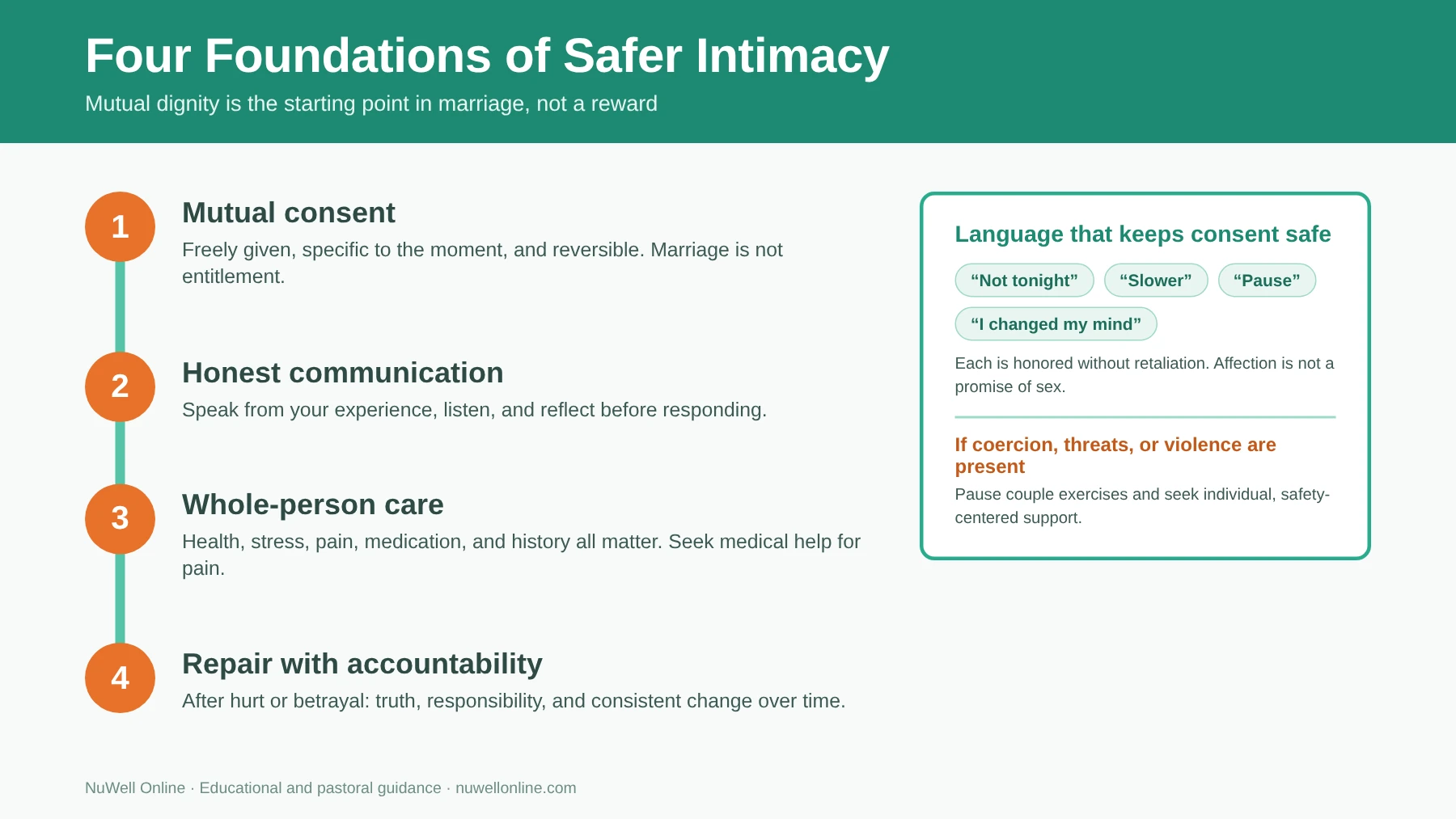
The four foundations above, mutual consent, honest communication, whole-person care, and repair with accountability, shape the conversation below. Choose a neutral time outside the bedroom when neither spouse is asking for sex, and keep the first conversation to 20 or 30 minutes. If coercion, threats, or violence are present, skip this exercise and go to the safety section below.
Open with shared purpose
Try“I want our intimate life to feel safe, honest, loving, and mutually meaningful. Could we talk about what is helping and what is hard?”
Speak from your experience
Use “I feel,” “I notice,” and “I need” instead of diagnosing motives. Be specific about affection, initiation, rejection, pressure, pain, fatigue, or disconnection.
Listen and reflect
Before responding, summarize what you heard and ask whether you understood. Understanding is not surrender; it is the beginning of accurate care. If talks keep looping, NuWell’s guide to the same argument in marriage may help.
Ask about safety and comfort
Is anything painful, frightening, unwanted, medically concerning, or connected to trauma? Do not press for trauma details your spouse does not want to share.
Choose one small experiment
Examples include a weekly check-in, more nonsexual affection, a medical appointment, a pause on a pressured activity, a shared bedtime routine, or a clearer way to initiate and decline.
Agree on consent language
Normalize“Not tonight.” “Slower.” “Pause.” “I changed my mind.”
Agree that each will be honored without retaliation, and that affection will not automatically be treated as a promise of sex.
Schedule a review
Return to the conversation in a week or two. Ask what felt safer, what still hurt, and what support may be needed.
Repair After Hurt or Betrayal
Forgiveness cannot be demanded on a timetable, and it does not erase consequences. Reconciliation requires truth and participation from both people. Restored trust requires consistent evidence over time. Where pornography, secrecy, infidelity, or compulsive sexual behavior is involved, the person who caused harm must accept responsibility, stop deception, respect boundaries, and seek the appropriate level of help. For first steps and care options, see Christian help for compulsive sexual behavior. NuWell’s guide to rebuilding trust after lying in marriage walks through that repair process.
Do not use sex to prove forgiveness or restore peace before safety and truth are present. A spouse who has been betrayed may need space, individual support, testing for sexually transmitted infections, financial clarity, or other concrete protections. Pastoral care can support confession and discernment, but it is not a substitute for licensed treatment, medical evaluation, or specialized support.
When Couple-Focused Help Is Not Appropriate
Abuse is not a communication problem. If one spouse uses threats, intimidation, monitoring, isolation, financial control, forced or pressured sex, stalking, physical violence, or spiritual language to maintain power, prioritize individual safety planning.
The National Domestic Violence Hotline does not recommend couples counseling in abusive relationships. Abuse is a pattern of power and control, and that imbalance is not something ordinary communication exercises can repair.
In immediate danger, call 911.
The Hotline offers 24/7 support at 800-799-SAFE (7233), by texting START to 88788, or at thehotline.org. If internet use may be monitored, use a safer device when possible. For suicide, self-harm, or emotional crisis, call or text 988. NuWell is not an emergency service.
When NuWell May Fit and When to Seek Other Care
NuWell’s non-clinical online pastoral counseling may fit couples or individuals seeking Biblical reflection, communication practice, shame-sensitive pastoral care, accountability, or discernment about next steps. Christian life coaching may fit present-focused relationship habits and goals when there is safety and adequate stability. Learn more about Christian marriage counseling and coaching at NuWell.
Seek a licensed couples or sex therapist for persistent sexual distress, trauma treatment, complex betrayal, severe conflict, or clinical concerns. Seek a physician, gynecologist, urologist, pelvic-health professional, or other qualified medical provider for pain, sudden changes in desire or function, medication effects, hormonal concerns, or other physical symptoms. Seek specialized domestic-violence help when coercion or abuse may be present. NuWell is not a licensed clinical counseling practice and does not provide diagnosis, psychotherapy, medical treatment, or emergency care.
Frequently Asked Questions
Does the Bible require a spouse to have sex on demand?
No. First Corinthians 7 teaches reciprocity and mutuality, not unilateral entitlement. The passage’s reference to mutual consent is incompatible with coercion, threats, or punishment.
Is a difference in sexual desire a sign the marriage is failing?
Not by itself. Desire differences are common and can reflect health, stress, relationship history, season of life, or many other factors. The task is to approach the difference as a shared concern without pressure or contempt.
Should we pray or seek professional help?
These options can belong together. Pray, study Scripture in context, and seek wise pastoral support. Also use licensed or medical care when trauma, pain, sexual difficulties, mental health, or safety concerns require it.
Intimacy Grows Where Truth Is Safe
Christian marital intimacy is not sustained by pressure, silence, or a perfect script. It grows where two people can tell the truth, give and receive affection freely, respect a no, tend pain, repair harm, and seek wise care. Start with one conversation outside the bedroom and one agreement that protects mutual dignity.
You do not need to describe private details in an initial message. Tell us the broad concern, and NuWell’s care team can help identify an appropriate next step.
You can also see how NuWell’s process works.

This article was researched with the help of AI and reviewed and edited by Stephen Luther, MEd, MSEd, LPC, for accuracy, Scripture references, and faithfulness to NuWell’s non-clinical scope.
Stephen Luther, MEd, MSEd, LPC, is Executive Director and Founder of Grace Christian Counseling and a licensed professional counselor. He holds a master’s degree in Education and a master’s degree in Marriage and Family Therapy from Duquesne University and has helped children, adolescents, and adults since 1997. His licensed clinical role at Grace Christian Counseling is separate from NuWell’s non-clinical pastoral counseling and Christian life coaching services.
Scope note: This article is educational and pastoral. It is not diagnosis, psychotherapy, sex therapy, medical treatment, individualized professional advice, or emergency care. NuWell provides non-clinical pastoral counseling and Christian life coaching.
Sources
- 1 Corinthians 7:1-7, New International Version.
- Genesis 2:18-25; Song of Songs; 1 Corinthians 13:4-7; Ephesians 5:21-33 (NIV).
- Mallory, A. B. (2022). Dimensions of couples’ sexual communication, relationship satisfaction, and sexual satisfaction: A meta-analysis. Journal of Family Psychology, 36(3), 358–371.
- American College of Obstetricians and Gynecologists. Your Sexual Health and When Sex Is Painful.
- National Domestic Violence Hotline. Can I Save Them? and Get Help.
