

Marriage and communication
You need to decide where the holidays will be spent. Or whether to take the new job, how much to spend on the car, how to handle a teenager’s curfew, or whether an aging parent should move in. You love each other, you both want what is good, and you still see it differently.
Disagreement is not a sign that something is wrong with your marriage. Two people who share a life will face decisions where their wisdom, fears, and preferences point in different directions. Biblical conflict resolution in marriage is not about avoiding those moments or winning them. It is about working through one disagreement in a way that tells the truth, honors both spouses, and ends in a decision you can both live with.
Quick answerTo resolve a disagreement Biblically, start with your own heart before your spouse’s faults, define the problem together in one sentence, share the needs underneath your positions, weigh several options on paper, and agree on a decision with a date to review it. Repair quickly when either of you speaks or acts wrongly. Threats, intimidation, or control are not disagreements to negotiate; they call for safety-focused support.
This guide focuses on resolving a specific disagreement. If the same argument keeps returning no matter what you decide, with one of you pressing and the other pulling away, start with our guide to why you keep having the same argument in marriage. That pattern needs attention before any decision method will hold.
What Biblical Conflict Resolution Is, and What It Is Not
Scripture does not promise a conflict-free marriage. It does describe a posture for handling conflict: humility, honest speech, attention to the other person’s interests, and quick repair. Paul urges believers to look “not to your own interests but each of you to the interests of the others” (Philippians 2:4, NIV). In marriage, that means a disagreement is a shared problem to solve, not a contest with a loser.
It is
Humble self-examination, honest words, curiosity about your spouse’s concerns, a fair way to decide, and follow-through that builds trust.
It is not
Avoiding every hard subject, one spouse always giving in, using Scripture to win the argument, or treating fear, threats, or control as an ordinary difference of opinion.
Before You Talk: Prepare Your Heart
Many conflicts are lost before the first sentence, because each spouse enters the conversation ready to defend a position. A few minutes of preparation can change the tone of the whole discussion.
Look at your own part first
Jesus warns against focusing on the speck in another person’s eye while ignoring the plank in our own (Matthew 7:3–5). Before you raise the issue, ask: What have I contributed to this? Have I been unclear, impatient, or unwilling to listen? Owning your part does not mean accepting blame that is not yours. It means you walk in ready to be honest about yourself.
Name what you actually want
James asks where fights and quarrels come from and points to desires that battle within us (James 4:1–2). Write down what you want and why it matters to you. You may discover that the real issue is not the vacation destination but a fear of being overlooked, or not the budget but a need for security.
Pray for your spouse, not only about them
Pray for your spouse’s wellbeing, for wisdom for both of you, and for a humble spirit in yourself. Prayer that only asks God to change the other person rarely softens anyone’s heart.
Choose a good time and place
Avoid starting an important conversation when either of you is exhausted, hungry, rushing out the door, or in front of the children. Ask, “Can we set aside thirty minutes tonight to talk about the move?” A planned conversation signals respect.
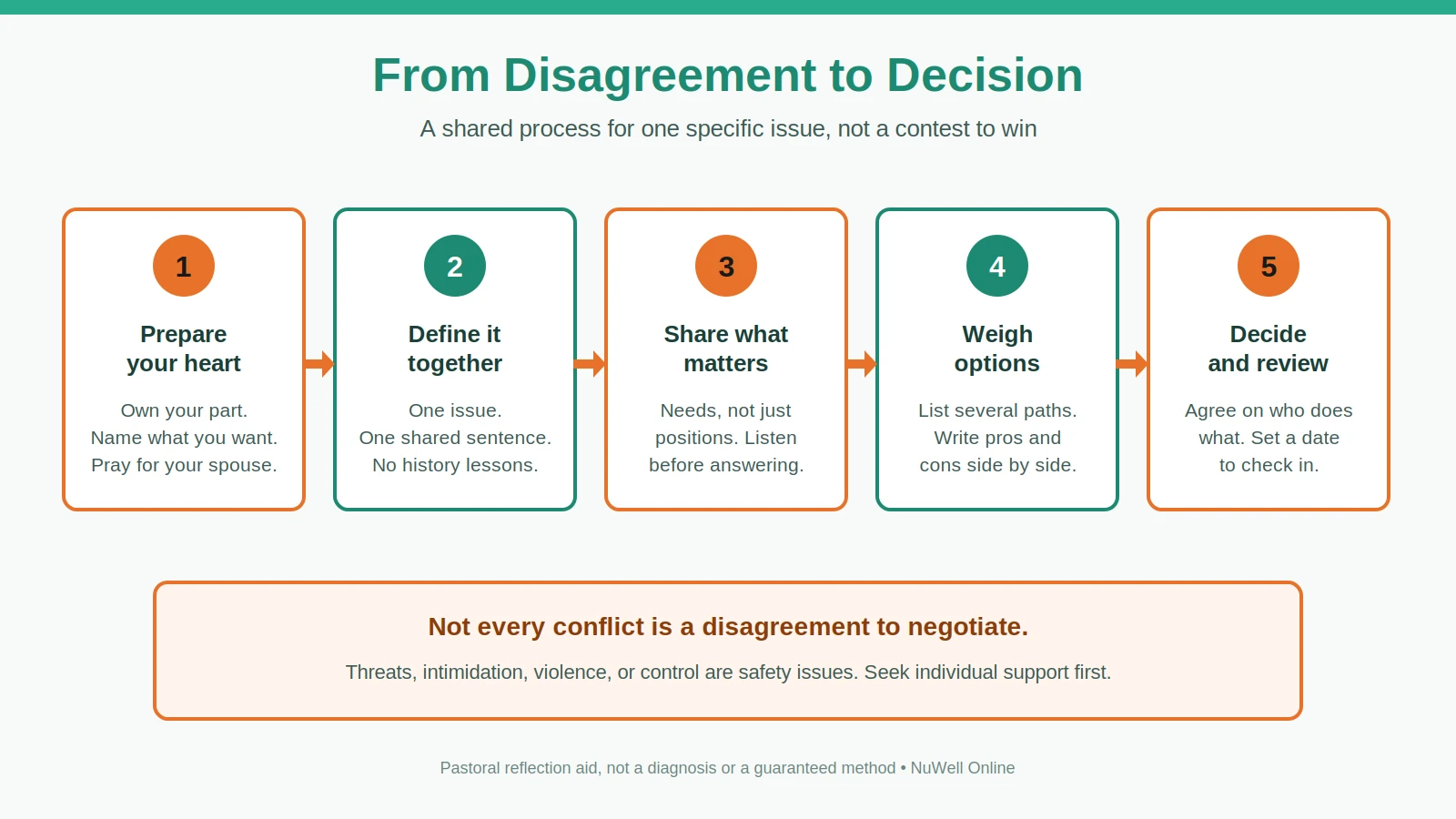
A Five-Step Conversation for Working Through a Disagreement
Use these steps for one issue at a time. They work best when both spouses feel safe to speak and are willing to participate.
Define the problem together
Agree on a single sentence that describes the decision in front of you, such as “We need to decide whether to accept the job offer in Ohio by Friday.” Leave out accusations and history. If you cannot agree on what the problem is, you are not ready to solve it yet, and that is useful to know.
Share what matters to each of you
Each spouse explains their position and, more importantly, the concern underneath it. “I want to stay” is a position. “I am afraid of losing the support of our church and my parents’ help with the kids” is a need your spouse can respond to.
The listening spouse summarizes what they heard before responding. Proverbs puts it bluntly: “To answer before listening—that is folly and shame” (Proverbs 18:13, NIV). You do not have to agree with your spouse’s view to show that you understand it.
Put several options on paper
Resist the urge to choose between only two options, yours and theirs. Brainstorm at least three or four paths, including ones neither of you proposed at first. For each serious option, draw two columns and list the likely benefits and costs for both of you, your family, and your walk with God. Seeing the options side by side often lowers the emotional temperature.
Choose a fair way to decide
Not every decision has to be settled the same way. Talk about which approach fits this situation:
- Full agreement. Keep talking until you find an option you can both genuinely support.
- Shared compromise. Each spouse gives up something so both core needs are met.
- A trial period. Try one approach for a set time, then review it honestly together.
- Lean on the spouse most affected or most informed, with the other’s concerns fully heard and weighed.
- Seek wise counsel from a mature mentor couple, pastor, or pastoral counselor before deciding.
- Agree to differ on matters of preference that do not require a single shared decision.
Christian couples hold different convictions about how leadership and mutual submission work in marriage. Whatever your convictions, no Biblical model permits one spouse to silence, dismiss, or dominate the other. A decision that ignores one spouse’s real concerns is rarely the wise one.
Confirm the plan and set a review date
End by saying the decision out loud: what you chose, who will do what, and by when. Put a check-in on the calendar, such as two weeks or three months from now, to ask whether the decision is working. A review date makes it easier to agree, because neither spouse has to treat the choice as permanent and perfect.
Pastoral experience: In pastoral conversations, we often hear couples say they are stuck between “my way” and “your way.” The conversation usually opens up when each spouse can name the need underneath their position and they begin writing out other options together. Couples are frequently surprised that the choice they end up making was not either spouse’s first proposal.
When One of You Was Wrong: Repair Quickly
Even well-intended conversations can go wrong. A sharp word, an eye roll, a threat to leave, or a decision made behind the other’s back can wound more deeply than the original disagreement.
Paul writes, “In your anger do not sin: Do not let the sun go down while you are still angry” (Ephesians 4:26, NIV). This is a call not to nurse anger or let resentment settle in. It does not require you to finish every hard conversation before bedtime. A couple may wisely pause and return, as long as they are not using the delay to punish or avoid. Here is how to tell a healthy pause from the silent treatment in marriage.
A meaningful apology names the specific behavior, acknowledges its impact, and states what you will do differently: “I dismissed your concern about the money in front of your sister. That was disrespectful, and I am sorry. Next time I will ask to talk privately.” Forgiveness is a gift Christians are called to extend (Ephesians 4:32), but forgiveness is not the same as pretending nothing happened. Trust is rebuilt through changed behavior over time.
When You Still Cannot Agree
Some decisions stay hard even after a good conversation. “Plans fail for lack of counsel, but with many advisers they succeed” (Proverbs 15:22, NIV). Inviting a trusted third party is not a failure; it is wisdom. Choose someone who respects both of you and will not take sides by default.
It can also help to remember what you promised each other. Your covenant is bigger than this one decision. Romans 12:18 calls believers to live at peace with others “as far as it depends on you.” You are responsible for your own words, attitude, and follow-through, even when you cannot control your spouse’s response.
How the RESTORE Path Can Guide the Conversation
NuWell’s RESTORE Path is a flexible pastoral map, not a rigid formula. Three movements are especially useful when working through a disagreement:
Recognize the wound.
Notice the fear, disappointment, or unmet need underneath each spouse’s position.
Establish safety.
Agree on a respectful tone, a good time to talk, and freedom to pause and return.
Rebuild healthy patterns.
Practice defining issues together, weighing options, deciding fairly, and following through.
When This Is Not an Ordinary Disagreement
The steps in this article assume both spouses can speak freely, disagree without fear, and say no without punishment. They are not a framework for abuse. Threats, intimidation, physical or sexual violence, stalking, controlling money or transportation, monitoring devices, isolating a spouse from support, or retaliating when boundaries are set are safety issues, not communication problems. In those situations, joint conversations or couples work may increase risk.
If you may be experiencing abuse, seek individual support and make decisions with a trained domestic-violence advocate.
In immediate danger, call 911.
The National Domestic Violence Hotline is available at 800-799-SAFE (7233), by texting START to 88788, or at thehotline.org.
If conflict is connected with thoughts of suicide, self-harm, or an emotional crisis, call or text 988 or visit 988lifeline.org. NuWell is not an emergency or domestic-violence service.
Choosing the Right Kind of Support
NuWell offers online pastoral counseling and Christian life coaching across the United States. You can also learn more about NuWell’s Christian marriage support.
Pastoral counseling may fit
When both spouses participate voluntarily and want Biblical guidance, practical support, and help working through decisions and recurring disagreements.
Christian life coaching may fit
When the relationship is generally safe and stable, and you want forward-focused support for shared goals, habits, and accountability.
Licensed care may fit better
When distress is severe, trauma symptoms are prominent, a mental-health condition affects communication, or clinical assessment and treatment are needed.
NuWell’s pastoral counseling and coaching are non-clinical services. They do not provide diagnosis, psychotherapy, clinical treatment, or emergency care.
Frequently Asked Questions
Is it Biblical to agree to disagree?
Yes, on matters of preference or conscience that do not require one shared decision. Romans 14 describes believers holding different convictions on disputable matters without condemning one another. When a decision does affect both of you, such as finances, parenting, or where you live, keep working toward a choice you can both support.
Who should have the final say when we cannot agree?
Christian couples hold different convictions about leadership in marriage. Whatever your view, no Biblical model permits one spouse to silence, dismiss, or dominate the other. Many couples find it helpful to seek wise counsel, try a time-limited trial, or let the spouse most affected lead while fully weighing the other’s concerns.
Does “do not let the sun go down on your anger” mean we must resolve every argument before bed?
No. Ephesians 4:26 warns against nursing anger and letting resentment take root. A couple can wisely pause a heated conversation and return to it later, as long as the pause is not used to punish, avoid, or control the other spouse.
Does Christian forgiveness mean we must drop the issue?
No. Forgiveness does not erase consequences, replace repentance, or instantly restore trust. A couple may pursue forgiveness while still requiring truth, changed behavior, boundaries, restitution, and time.
Work Through the Next Decision Together
You do not have to settle every disagreement this week. Start with one issue. Prepare your heart, define the problem together, listen for what matters most to your spouse, and choose a decision you can review. Faithful marriages are not free of conflict; they learn to walk through it with truth and grace.
If you would like faith-rooted help, talk with NuWell’s care team, explore your options, and see whether pastoral counseling or coaching is the right fit, without pressure or obligation.
You can also see how NuWell’s process works or meet NuWell’s care team.

This article was researched with the help of AI and reviewed and edited by Stephen Luther, MEd, MSEd, LPC, for accuracy, Scripture references, and faithfulness to NuWell’s non-clinical scope.
Stephen Luther, MEd, MSEd, LPC, is the founder and Executive Director of Grace Christian Counseling, where he serves in a licensed clinical role and has worked with children, adolescents, adults, and families since 1997. He also contributes leadership and educational insight to NuWell Online. NuWell’s pastoral counseling and Christian life coaching are non-clinical services and are distinct from Stephen’s licensed practice at Grace Christian Counseling.
Scope note: This article provides educational and pastoral information. It is not diagnosis, psychotherapy, clinical treatment, legal advice, domestic-violence intervention, or emergency care.
Sources
- Scripture quotations are from the New International Version (NIV): Philippians 2:4, Proverbs 18:13, Ephesians 4:26, and Proverbs 15:22. Other passages referenced: Matthew 7:3–5, James 4:1–2, Ephesians 4:32, Romans 12:18, and Romans 14.
- National Domestic Violence Hotline. Contact and safety information reverified September 30, 2026.
- 988 Suicide & Crisis Lifeline. Contact information reverified September 30, 2026.

To the nuwellonline.com admin, Keep up the great work!