

Relationships and repair
You sit down at the end of the day and realize you have exchanged schedules, reminders, and complaints, but not much of yourselves. Or a small disagreement turns into the same familiar sequence: one person presses, the other shuts down, and both leave feeling alone.
Learning how to build a stronger relationship with your partner is rarely about one dramatic conversation. Strength grows through repeated moments of safety, attention, truth, repair, affection, and follow-through. The right first step is not to diagnose your partner. It is to ask whether both of you are free to speak and choose, then identify one pattern you can change this week.
Quick answerA stronger relationship grows through mutual safety, truthful listening, specific repair, reliable follow-through, warmth, and small repeated choices. One person can change their own conduct, but one person cannot create mutuality or make an unsafe partner safe. Check for freedom and safety before using shared communication exercises.
What Makes a Relationship Stronger?
Healthy strength includes mutual respect, freedom to disagree, truthful speech, dependable action, appropriate boundaries, warmth, and repair after harm. Conflict itself is not automatic proof of dysfunction. Emotional distance is not a diagnosis or a fixed identity. A relationship can have stress and still contain the freedom needed for honest growth.
Mutuality matters. One person can listen more carefully, make clearer requests, apologize, and keep boundaries. One person cannot force honesty, manufacture trust, or make another person safe. Relationship advice becomes harmful when it treats intimidation, coercion, or violence as a communication style both people created equally.
Is This a Growth Problem or a Safety Problem?
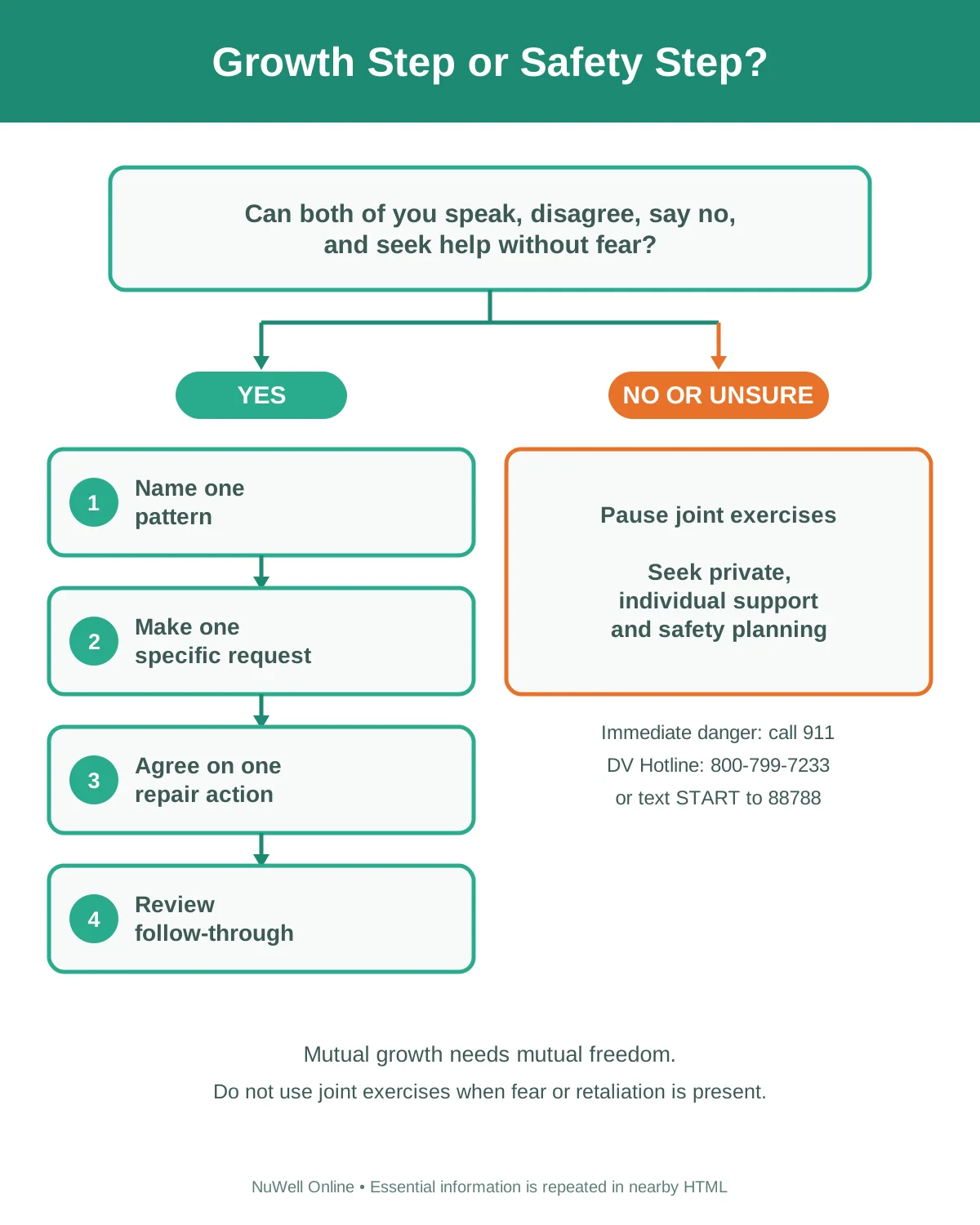
Before trying a weekly check-in, ask: Can both people speak, pause, disagree, keep private contact with supportive people, and seek help without fear of retaliation? Can either person say no to sex, spending, travel, church involvement, or a conversation without threats or punishment?
If the answer is yes, a shared growth exercise may be useful. If the answer is no or you are unsure, do not begin with more vulnerability or a joint confrontation. Seek private, individual support and safety planning.
Name the Pattern Before You Try to Fix It
The visible topic may be money, time, sex, chores, family, or phones. The repeating process underneath may be criticism and defensiveness, pressure and withdrawal, secrecy and suspicion, or hurt followed by a quick apology with no changed behavior. Name the sequence neutrally: “We speed up and shut down,” or “We promise and do not revisit.”
A pattern is a description, not a villain label. Ask what you do when the sequence begins, what impact it has, and what one different response is available to you. If you are married and the same fight keeps returning, NuWell’s guide on why you keep having the same argument explores that cycle in more depth.
Pastoral experience: Couples often focus on the latest argument while missing the sequence underneath. Progress begins when each person can name their own part without absorbing responsibility for the other person’s choices. That distinction makes room for both humility and boundaries.
A One-Week Christian Relationship Reset
Try one small practice each day for a week. Each step is short enough to repeat and specific enough to notice.
Describe what is happening without labels
Write one observable pattern and its impact. Replace “You are selfish” with “We have canceled our planned time together three weeks in a row, and I feel unimportant.”
Ask one listening question
Try, “What has this week felt like for you?” Listen without correcting the details immediately. Summarize what you heard and ask whether you understood. Reflection is not agreement; it is accurate attention.
Name one specific appreciation
Tie it to an action: “Thank you for handling bedtime when I was exhausted.” Specific appreciation helps both people notice the behaviors that support the relationship.
Make one clear request
A request names an action and leaves room for a truthful response. “Could we put our phones away for twenty minutes after dinner on Tuesday?” is more workable than “Be more present.”
Repair one recent hurt
Name what you did, acknowledge the impact, avoid excuses, ask what repair would help, and follow through. For married readers, NuWell’s guide on how to offer a specific apology gives a fuller framework, and rebuilding trust after lying covers deeper breaches.
Create one protected connection ritual
Choose something small enough to repeat: a walk, shared prayer, coffee without devices, a weekly planning conversation, or ten minutes of undistracted attention. Consistency matters more than novelty.
Review the week
Ask what felt safer, clearer, warmer, or still stuck. Keep one practice for the next week. If promises repeatedly disappear, contempt remains high, or either person is afraid, move from self-help to the appropriate outside support.
How to Review the Week Without Keeping Score
A weekly review is not a trial where each person presents evidence against the other. Start with your own conduct: What did I practice? Where did I become defensive? What did I promise, and did I follow through? Then name one thing your partner did that helped and one pattern that still needs attention.
Choose one agreement that is observable and small enough to test. Decide who will do what, by when, and when you will revisit it. If the agreement fails, study what got in the way before making a global judgment about character. Repeated deception, contempt, or refusal to participate is different from one poorly designed plan; that difference matters when deciding whether self-guided work is enough.
The RESTORE movements can help organize the review. The path is a pastoral map, not a promise that every relationship will continue or reconcile.
What Scripture Adds to Relationship Growth
James 1:19–20
Be quick to listen, slow to speak, and slow to become angry.
That posture supports careful conversation; it is not a command to remain silent about harm or a promise that listening will stop abuse.
Ephesians 4:25–32
Truth, responsible anger, constructive speech, kindness, and forgiveness.
Applied to a relationship, it supports honest repair rather than avoidance or contempt. Forgiveness is not the same as immediate trust, restored access, or reconciliation.
Philippians 2:3–4
In humility, value others and look to their interests.
Mutual humility is not self-erasure. The passage must not be used to demand one-sided submission, sexual access, secrecy, or continued exposure to danger.
Prayer can steady a conversation, but it must not replace apology, responsibility, boundaries, or changed behavior. (Scripture summaries paraphrase the NIV.)
When Self-Guided Steps Are Not Enough
Pastoral counseling and coaching
May fit when both people are safe and want Scripture, prayer, pattern recognition, communication practice, and accountability. See Christian marriage counseling and coaching or online pastoral counseling.
Licensed couples or individual care
May be better when depression, anxiety, trauma effects, addiction, sexual concerns, or other symptoms need assessment or treatment. Some couples use pastoral and licensed support together with clear roles.
Medical or substance-use care
May be needed when health concerns or withdrawal are involved. These needs should be addressed by qualified professionals first.
Structured relationship education or clinical couples work can help some couples, but research results vary across programs and populations.1 Be cautious of fixed success percentages or promises that any approach will save a relationship. You can meet NuWell’s pastoral counselors and coaches to see who might be a good fit.
When Relationship Advice Is Unsafe
Abuse is not a shared communication cycle.2 Do not use joint counseling, mutual confession, a vulnerable check-in, or confrontation when there are threats, intimidation, stalking, sexual pressure, physical violence, surveillance, isolation, financial control, or retaliation. An abusive partner may use disclosures or counseling language to increase control.3
In immediate danger, call 911.
In the United States, contact the National Domestic Violence Hotline at 800-799-SAFE (7233), text START to 88788, or chat at thehotline.org. Use a safer device if your activity may be monitored.
For suicidal crisis or emotional distress, call or text 988 or chat at 988lifeline.org. NuWell is not an emergency service.
Conclusion
Choose one practice that protects dignity and can be repeated: listen before correcting, make one clear request, repair one harm, or keep one small promise. Relationship strength is not the absence of conflict. It is the presence of safety, truth, responsibility, warmth, and reliable repair. When those conditions are missing, choosing the right outside help is part of wisdom.
Frequently Asked Questions
What if my partner does not want to work on the relationship?
You can still change your own communication, boundaries, support, and decisions. You cannot create mutual effort by yourself. If your partner refuses every conversation, breaks agreements repeatedly, or retaliates when you seek help, individual support can help you decide what is responsible and safe.
Is conflict normal in a healthy relationship?
Yes. Healthy relationships still include disagreement and disappointment. The important questions are whether both people can speak freely, whether conflict avoids intimidation and contempt, and whether repair and changed behavior follow harm.
When should we seek outside help?
Seek help when the same pattern keeps returning, repair attempts fail, trust has been broken, either person feels hopeless, or mental-health, substance-use, sexual, medical, or spiritual concerns complicate the relationship. Choose pastoral, licensed, medical, or other support according to the need.
Should we do couples counseling if there is abuse?
No. Joint counseling is not recommended when abuse, threats, or coercive control are present because it can increase risk and treat unequal power as a shared communication problem. Seek private individual support and safety planning first. In immediate danger, call 911. In the U.S., call 800-799-SAFE (7233), text START to 88788, or visit thehotline.org.
Find Your Best Next Step
Share what you are facing and ask what kind of support best fits your relationship.
Talk with our care team, explore your options, and see whether NuWell is the right fit—without pressure or obligation.

This article was researched with the help of AI and reviewed and edited by Stephen A. Luther, MEd, MSEd, LPC, for accuracy, Scripture references, and faithfulness to NuWell’s non-clinical scope.
Stephen A. Luther, MEd, MSEd, LPC, is Executive Director and Founder of Grace Christian Counseling and a licensed professional counselor. He holds a master’s degree in Education and a master’s degree in Marriage and Family Therapy from Duquesne University and has helped children, adolescents, and adults since 1997. His licensed clinical role at Grace Christian Counseling is distinct from NuWell’s non-clinical pastoral counseling and Christian life coaching services.
Scope note: This article is educational and pastoral. It does not provide diagnosis, psychotherapy, mental-health treatment, domestic-violence services, or emergency care. NuWell provides non-clinical pastoral counseling and Christian life coaching.
Sources
- Relationship education: systematic review and meta-analysis. PubMed Central.
- Centers for Disease Control and Prevention. About Intimate Partner Violence.
- National Domestic Violence Hotline. Should I Go to Couples Therapy With My Abusive Partner?
- National Domestic Violence Hotline. Get Help. Verified October 15, 2026.
- 988 Suicide & Crisis Lifeline. 988lifeline.org. Verified October 15, 2026.

1xbet free spin promo code. Click Here:👉 https://www.lafp.org/includes/pages/1xbet-promo-code-1xbet-bonus.html
Your bonus from http://gg.gg/13oh3t connect your wallet and enter promo code (3gSwd234) and get 0.5 eth + 300 free spins, Withdrawal without
промокод для 1 x bet https://rupalnet.com/wp-content/pgs/promokod_260.html
промокод 1хбет https://geek-nose.com/wp-content/pages/promokod_259.html
промокод на 1хбет http://photoua.net/images/pgs/promokod__260.html
I delight in, cause I discovered just what I used to be looking for. You’ve ended my four day lengthy hunt! God Bless you man. Have a great day. Bye
You need to take part in a contest for top-of-the-line blogs on the web. I’ll recommend this web site!
I do agree with all of the ideas you’ve presented in your post. They are very convincing and will certainly work. Still, the posts are very short for newbies. Could you please extend them a little from next time? Thanks for the post.
I’ve been absent for some time, but now I remember why I used to love this blog. Thank you, I will try and check back more frequently. How frequently you update your site?
I always was interested in this subject and stock still am, thanks for posting.
промокод на 1xbet при регистрации
Hey just wanted to give you a quick heads up. The text in your content seem to be running off the screen in Safari. I’m not sure if this is a format issue or something to do with browser compatibility but I thought I’d post to let you know. The design look great though! Hope you get the issue resolved soon. Thanks
1хбет промокод
Wonderful blog! I found it while surfing around on Yahoo News. Do you have any suggestions on how to get listed in Yahoo News? I’ve been trying for a while but I never seem to get there! Many thanks
Hey! I just wish to give a huge thumbs up for the great information you’ve got here on this post. I might be coming again to your weblog for more soon.
Hi there! Do you know if they make any plugins to assist with Search Engine Optimization? I’m trying to get my blog to rank for some targeted keywords but I’m not seeing very good success. If you know of any please share. Kudos!
Monitoreo de condicion
Dispositivos de ajuste: fundamental para el funcionamiento suave y óptimo de las máquinas.
En el entorno de la ciencia moderna, donde la rendimiento y la fiabilidad del dispositivo son de suma importancia, los sistemas de balanceo cumplen un tarea vital. Estos equipos adaptados están concebidos para balancear y asegurar piezas giratorias, ya sea en herramientas industrial, transportes de traslado o incluso en electrodomésticos caseros.
Para los profesionales en mantenimiento de aparatos y los ingenieros, manejar con equipos de ajuste es esencial para proteger el operación uniforme y estable de cualquier dispositivo móvil. Gracias a estas opciones modernas innovadoras, es posible disminuir sustancialmente las sacudidas, el sonido y la presión sobre los soportes, aumentando la duración de elementos caros.
De igual manera significativo es el tarea que desempeñan los equipos de balanceo en la asistencia al comprador. El soporte profesional y el mantenimiento permanente utilizando estos equipos permiten ofrecer servicios de alta nivel, incrementando la agrado de los consumidores.
Para los titulares de negocios, la aporte en estaciones de calibración y dispositivos puede ser fundamental para mejorar la efectividad y rendimiento de sus dispositivos. Esto es sobre todo trascendental para los emprendedores que administran reducidas y intermedias emprendimientos, donde cada elemento importa.
Por otro lado, los aparatos de balanceo tienen una gran aplicación en el ámbito de la seguridad y el control de excelencia. Facilitan localizar posibles defectos, previniendo arreglos costosas y averías a los aparatos. Incluso, los datos recopilados de estos equipos pueden aplicarse para maximizar procesos y aumentar la exposición en buscadores de exploración.
Las zonas de aplicación de los dispositivos de balanceo incluyen diversas sectores, desde la elaboración de ciclos hasta el seguimiento ambiental. No interesa si se habla de enormes manufacturas manufactureras o pequeños establecimientos domésticos, los aparatos de equilibrado son necesarios para promover un rendimiento productivo y sin riesgo de paradas.