

Marriage and discernment
You finally say it: “I think we need help.” Your spouse looks away, changes the subject, says counseling is pointless, or tells you that you are the one with the problem. Now the marriage concern is joined by another: What can you do when your spouse refuses marriage counseling?
You cannot make another adult participate honestly. You can make one clear invitation, listen for what is behind the refusal, seek appropriate support for your own discernment, change your own responses, and set boundaries around behavior that harms the relationship. Those steps may create room for a different conversation. They cannot guarantee that your spouse will attend, change, or repair the marriage.
Quick answerIf the relationship is mutually safe, invite your spouse once in specific, low-pressure language and ask what makes help difficult. Then focus on what remains yours to do: tell the truth, own your part, seek wise individual support, set clear boundaries, and choose a date to revisit the decision. If refusal is paired with threats, coercive control, violence, stalking, forced sex, financial control, or fear of retaliation, do not push joint counseling. Prioritize individual safety planning and specialized help.
Start With What the Refusal Means
“No” can mean several things. Your spouse may fear blame or pressure, remember a harmful counseling experience, question the cost or theology, minimize the problem, or avoid responsibility. In an abusive relationship, refusal may also protect power and control.
Do not diagnose the motive from a distance. Ask one honest question: “What concerns you most about getting help together?” Then listen long enough to hear the answer. Understanding the objection does not require agreeing with it, and it does not erase the problem that led you to ask.
If the concern is a repeating, mutually safe cycle, see the same argument in marriage and how to take a break without stonewalling.
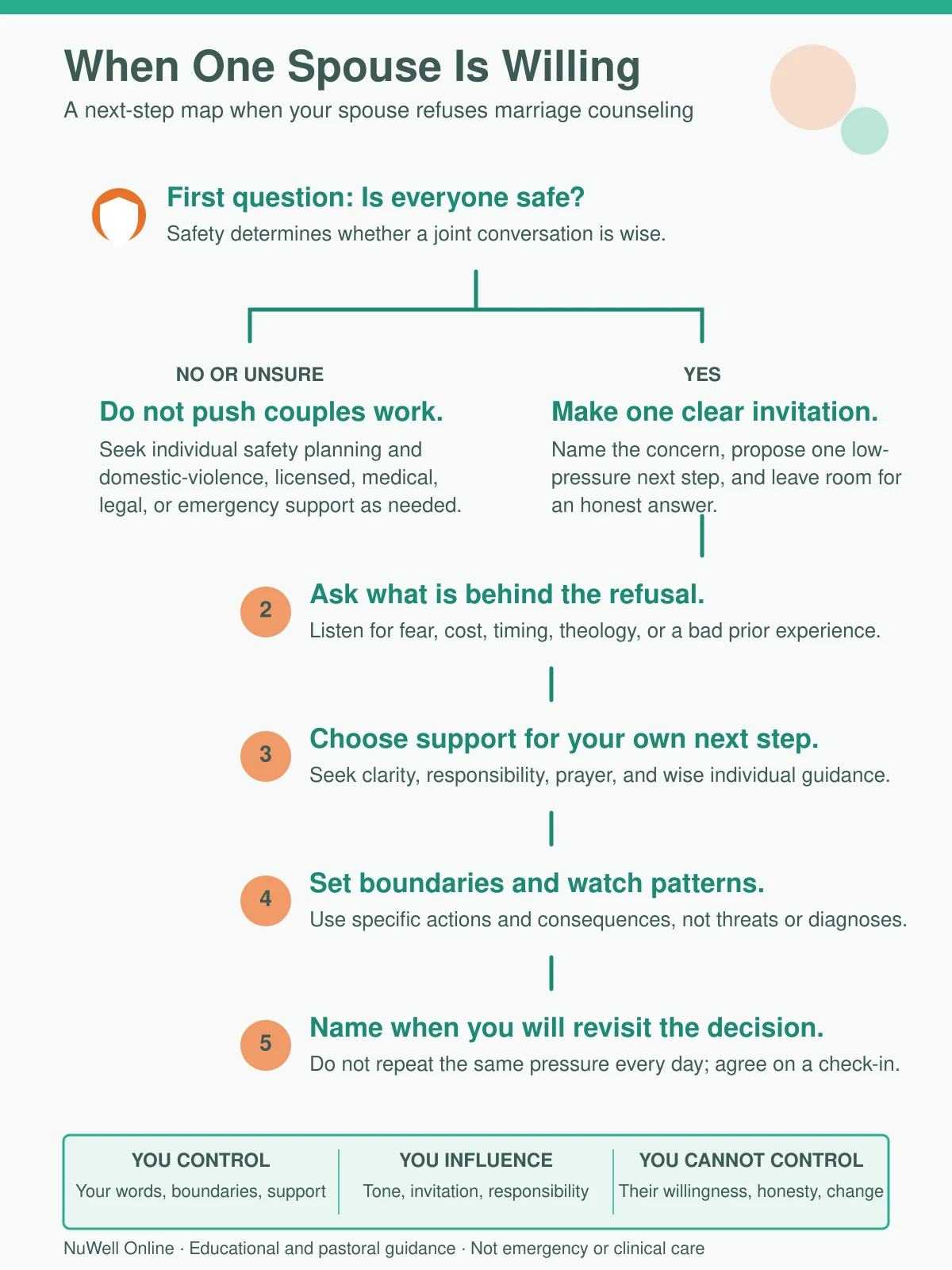
Put simply, the map above works like this: begin by asking whether everyone is safe. If safety is uncertain, do not push couples work; seek individual and specialized guidance. If both spouses can speak, pause, disagree, and choose freely, make one clear invitation. Ask what is behind the refusal. Seek support for your own next step. Set boundaries around observable behavior. Agree on when you will revisit the decision.
Make One Invitation Without Pressure
A clear invitation names the concern, the hoped-for purpose, and a small next step. It does not recruit God, the children, or other people to corner your spouse.
Try saying“I do not want to keep repeating this pattern. I want us to have a place where both of us can speak and be heard. Would you be willing to have one fit conversation with a qualified provider, then decide together whether to continue? If not, will you tell me what concerns you about it?”
Avoid listing every failure or saying, “A good Christian spouse would go.” Spiritual pressure can win reluctant compliance without creating honest participation.
Offer choices that preserve agency: pastoral or licensed care, online or local support, a preferred practitioner, or one fit conversation. NuWell’s Christian marriage counseling and coaching page explains the option, but couples work requires voluntary participation and mutual safety.
Set a time to revisit the answer rather than asking every day. For example: “I will give this space. Can we talk again next Sunday evening?” A scheduled return communicates that the issue matters without turning each interaction into a campaign.
What You Can Do When Your Spouse Will Not Go
Seek clarity for yourself
Individual support cannot turn one person into a couple. It can help you separate facts from fears, examine your conduct, and choose an appropriate boundary or referral. The right support may be pastoral, licensed, medical, legal, substance-use, or domestic-violence care.
Pastoral experience: In pastoral conversations, we often hear a willing spouse arrive with two burdens: the original marriage problem and the belief that nothing can change unless the other person joins a session. The tone shifts when we distinguish “I cannot repair this marriage alone” from “I have no faithful choices.” That distinction does not promise reconciliation. It helps the person identify what truth, responsibility, boundary, support, or safety step remains theirs today.
Own your part without carrying both parts
Name your behavior concretely. “I raised my voice and kept pressing after you asked for ten minutes” is more useful than “I am the problem.” Responsibility should be accurate, not totalizing. You are not responsible for making your spouse honest, sober, nonviolent, faithful, or willing to seek help. If an apology is part of your next step, see how to apologize to your spouse without pressuring a response.
Set a boundary around behavior, not attendance
A boundary describes what you will do in response to a specific situation. It is not a threat designed to force a session.
- “If shouting starts, I will end the conversation and return at the agreed time.”
- “I will not discuss finances without access to accurate account information.”
- “I will not cover for substance use or deception.”
- “If I feel unsafe, I will leave and contact appropriate support.”
When repeated deception is the central concern, see NuWell’s guide to rebuilding trust after repeated lying. Trust grows through truth and observable follow-through, not through attendance alone.
Watch the pattern over time
One refusal is information, not a complete verdict on the marriage. Look at what follows. Does your spouse offer another constructive step, engage the concern at home, reconsider after reviewing options, or keep agreements? Or do they mock the concern, retaliate, block access to help, recruit spiritual authority to silence you, or punish boundaries? Patterns reveal more than the intensity of one conversation.
What One Willing Spouse Cannot Do
One spouse can change their own words, timing, boundaries, and support. One spouse cannot produce mutual honesty, consent, repentance, or repair.
A small pilot randomized trial studied an online relationship program completed by one partner in distressed heterosexual relationships. Participants showed some gains in individual quality of life, work functioning, and perceived health, but the study did not find significant improvements in relationship functioning, depression, or anxiety. The sample was small, and it excluded recent intimate-partner violence, moderate-to-severe suicidal thoughts, recent affairs, and people who had decided to separate. It should not be treated as a promise for a particular marriage. Its modest lesson fits common sense: individual work may help a willing spouse function and decide more clearly, but changing a relationship is harder when only one person participates.1
Be cautious with claims that your personal growth will naturally make your spouse join, save the marriage, or “shift the whole dynamic.” Your conduct matters. It is not control over another person.
When Refusal Is Part of Fear or Control
Ordinary reluctance, avoidance, or disagreement is not automatically abuse. Abuse is also not a mutual communication cycle. Threats, intimidation, stalking, forced sex, physical violence, control of money or transportation, isolation, monitoring, destruction of property, threats involving children or pets, and spiritual pressure backed by retaliation require a safety response.
The National Domestic Violence Hotline does not recommend couples counseling in an abusive relationship. Joint sessions can expose disclosures that are later used against the person being harmed, and couples work cannot correct an unequal power structure by treating abuse as a shared relationship problem.2
In immediate danger, call 911.
If you are afraid of what will happen after asking for help, contact a domestic-violence advocate from a safer device when possible. In the United States, call the National Domestic Violence Hotline at 800-799-SAFE (7233), text START to 88788, or chat at thehotline.org. For suicide, self-harm, emotional distress, or an alcohol or drug-use crisis, call or text 988 or chat at 988lifeline.org. The 988 Lifeline is available 24/7.4 NuWell is not an emergency service.
A Biblical Posture: Truth Without Control
Christian hope does not require pretending that one person can manufacture a mutual outcome. Romans 12:18 says, “If it is possible, as far as it depends on you, live at peace with everyone” (NIV). The phrases “if it is possible” and “as far as it depends on you” hold responsibility and limits together. You can pursue peace faithfully without claiming power over another person’s choices.
James 1:19 calls believers to be quick to listen, slow to speak, and slow to anger. That posture supports a calm invitation and real curiosity about resistance. It does not require endless listening to threats, degradation, or manipulation.
Ephesians 4:25–32 joins truthful speech, restrained anger, responsible conduct, grace, kindness, and forgiveness. In marriage, prayer and forgiveness must not replace truth, repentance, restitution, boundaries, or wise outside help. Forgiveness is not automatic reconciliation; reconciliation is not automatic trust; and restored access should not run ahead of safety and observable change.
Use the RESTORE Path as a Personal Map
NuWell’s RESTORE Path is flexible pastoral guidance, not a rigid protocol and not a guarantee that your spouse will participate.
- Recognize the wound. Name the marriage concern and what refusal adds.
- Establish safety. Ask whether both people can disagree and seek help without fear.
- Separate truth from distortion. Reject “I can fix both of us” and “Going alone means giving up.”
- Tend what was wounded. Make room for grief, anger, confusion, and prayer.
- Orient identity in Christ. Your worth is not measured by your power to produce another person’s response.
- Rebuild healthy patterns. Practice truthful speech, responsible pauses, boundaries, counsel, and follow-through.
- Engage the life God intended. Take the next faithful step while the larger outcome remains unresolved.
Choose the Right Kind of Support
NuWell offers online pastoral counseling and Christian life coaching across the United States. Pastoral counseling may fit when you want non-clinical, Scripture-grounded support for discernment, prayer, responsibility, relational patterns, and practical next steps. You may meet the NuWell care team before deciding.
Christian life coaching is generally a better fit for stable, forward-focused goals than for active marital crisis, trauma symptoms, abuse, addiction, or safety concerns. Licensed mental-health care may be the better next step when clinical assessment, diagnosis, psychotherapy, or treatment is needed. NIMH describes psychotherapy as treatment aimed at helping a person identify and change troubling emotions, thoughts, and behaviors, usually with a licensed mental-health professional.3 Medical, substance-use, domestic-violence, legal, or emergency support may also be necessary.
NuWell’s pastoral counseling and Christian life coaching are non-clinical. They do not provide diagnosis, psychotherapy, clinical treatment, domestic-violence intervention, or emergency care.
Related reading: If the trust breach involves hidden debt, accounts, or spending, see financial infidelity in marriage for first steps you can take on your own. If you are already separated, see how to reconcile a marriage after separation.
Related reading: If hidden contact with someone outside the marriage is part of the picture, read Emotional Affair in Marriage: Signs and What to Do Next.
Related reading: Spiritual abuse in marriage: when Scripture is used to control you
Frequently Asked Questions
Can I go to marriage counseling alone?
You can seek individual support for your own clarity, choices, behavior, boundaries, and safety. Be precise about the service: individual pastoral counseling is not couples therapy, and an individual provider cannot assess or treat a spouse who is not present. Individual work may help you decide and function more clearly, but it cannot guarantee relationship repair.
Can one spouse save a marriage?
One spouse can make meaningful changes and stop participating in some unhealthy patterns. A marriage, however, is relational. Mutual honesty, consent, repentance, repair, and trust cannot be supplied by one person for both. Avoid any provider who guarantees that your change will save the marriage.
How do I ask again without nagging?
Choose a calm time, name one specific concern, propose one small next step, ask what makes help difficult, and agree on a date to revisit the question. Do not repeat the request during every conflict or use Scripture, children, relatives, or church leaders as leverage.
What if my spouse refuses help and I feel afraid?
Treat fear and retaliation as safety information, not merely reluctance. Do not push a joint session when coercive control, threats, stalking, forced sex, or violence may be present. Seek individual safety planning and specialized support. Call 911 in immediate danger; in the United States, contact the National Domestic Violence Hotline at 800-799-SAFE (7233), text START to 88788, or visit thehotline.org.
Find Your Best Next Step
You do not need to win an argument about counseling today. Start with the next truthful question: Is everyone safe? Then make one clear invitation, listen for the real objection, and choose support for the decisions that remain yours.
Talk with our care team, explore your options, and see whether NuWell is the right fit, without pressure or obligation.

This article was researched with the help of AI and reviewed and edited by Stephen Luther, MEd, MSEd, LPC, for accuracy, Scripture references, and faithfulness to NuWell’s non-clinical scope.
Stephen Luther, MEd, MSEd, LPC, is Executive Director and Founder of Grace Christian Counseling and a licensed professional counselor in that separate licensed clinical practice. He holds a master’s degree in Education and a master’s degree in Marriage and Family Therapy from Duquesne University and has helped children, adolescents, and adults since 1997. His licensed clinical role at Grace Christian Counseling is distinct from NuWell’s non-clinical pastoral counseling and Christian life coaching services.
Scope note: This article provides educational and pastoral information. It is not diagnosis, psychotherapy, clinical treatment, legal advice, domestic-violence intervention, or emergency care. NuWell provides non-clinical pastoral counseling and Christian life coaching. Seek licensed mental-health, medical, substance-use, domestic-violence, legal, or emergency support when those needs are present.
Sources
- Nowlan, K. M., Roddy, M. K., & Doss, B. D. (2017). The online OurRelationship program for relationally distressed individuals: A pilot randomized controlled trial. Couple and Family Psychology, 6(3), 189–204.
- National Domestic Violence Hotline. Should I Go to Couples Therapy With My Abusive Partner? and Get Help.
- National Institute of Mental Health. Psychotherapies.
- 988 Suicide & Crisis Lifeline.
