

Biblical Restoration Care
You replay the conversation and know you were wrong. An apology may be needed. But within minutes, a specific regret becomes a sweeping verdict: I always ruin things. God must be tired of me. If people knew the real me, they would leave. You want to respond faithfully, yet you cannot tell whether this heaviness is the Holy Spirit’s conviction or shame wearing religious language.
Quick answerIn Christian shame vs conviction, conviction brings a specific action into the light and calls you toward confession, repair, and God’s mercy. Shame turns a failure, wound, or accusation into a global verdict about your worth and pushes you toward hiding, despair, or frantic self-punishment. Feelings alone are not an infallible spiritual test. Discern the message by Scripture, truth, fruit, wise counsel, and the next action it demands.
Christian Shame vs Conviction: What Each One Does
Psychological research commonly distinguishes guilt focused on behavior, such as “I did something wrong,” from shame focused on the whole self, such as “I am wrong.” The American Psychological Association describes the same basic distinction. A meta-analysis of 108 studies found that shame had a stronger association with depressive symptoms than guilt did, while cautioning that the data were correlational and could not establish cause. Those findings are useful, but they do not define the Holy Spirit’s work or settle a theological question.
Biblically, conviction is not mere discomfort and shame is not simply any painful awareness of sin. God may expose what is true, and that truth can grieve us. Paul distinguishes a grief that produces repentance from a grief that leads toward death in 2 Corinthians 7:8-11. The difference is not that one always feels gentle. The difference includes where the message points and what it produces.
| Discernment point | Shame or condemnation often sounds like | Conviction tends to do |
|---|---|---|
| Focus | “You are disgusting, hopeless, or disqualified.” | Names a concrete action, omission, belief, or pattern that needs truth and change. |
| Direction | Drives secrecy, isolation, defensiveness, or self-punishment. | Invites honest confession, responsibility, repair, and renewed fellowship with God. |
| Hope | Treats failure as final and grace as unavailable. | Takes sin seriously while keeping mercy, repentance, and growth in view. |
| Responsibility | May blame you for another person’s choices or demand endless penance. | Clarifies what is actually yours to own and what is not. |
| Fruit | Produces chronic hiding, paralysis, contempt, or fear-based compliance. | Moves toward truthful action, humility, appropriate restitution, and changed patterns over time. |
This is a discernment aid, not a diagnosis or a mechanical formula. Some people feel little emotion while avoiding responsibility. Others experience intense fear because of trauma, scrupulosity, depression, or messages learned in an unsafe church or family. A calm feeling does not prove a choice is right, and an anxious feeling does not prove God is condemning you. If the same fear keeps returning no matter how often you confess, read our guide to scrupulosity versus conviction.
Five Questions to Test the Message
When the inner accusation is loud, slow the process down. Write the message in one sentence, then ask:
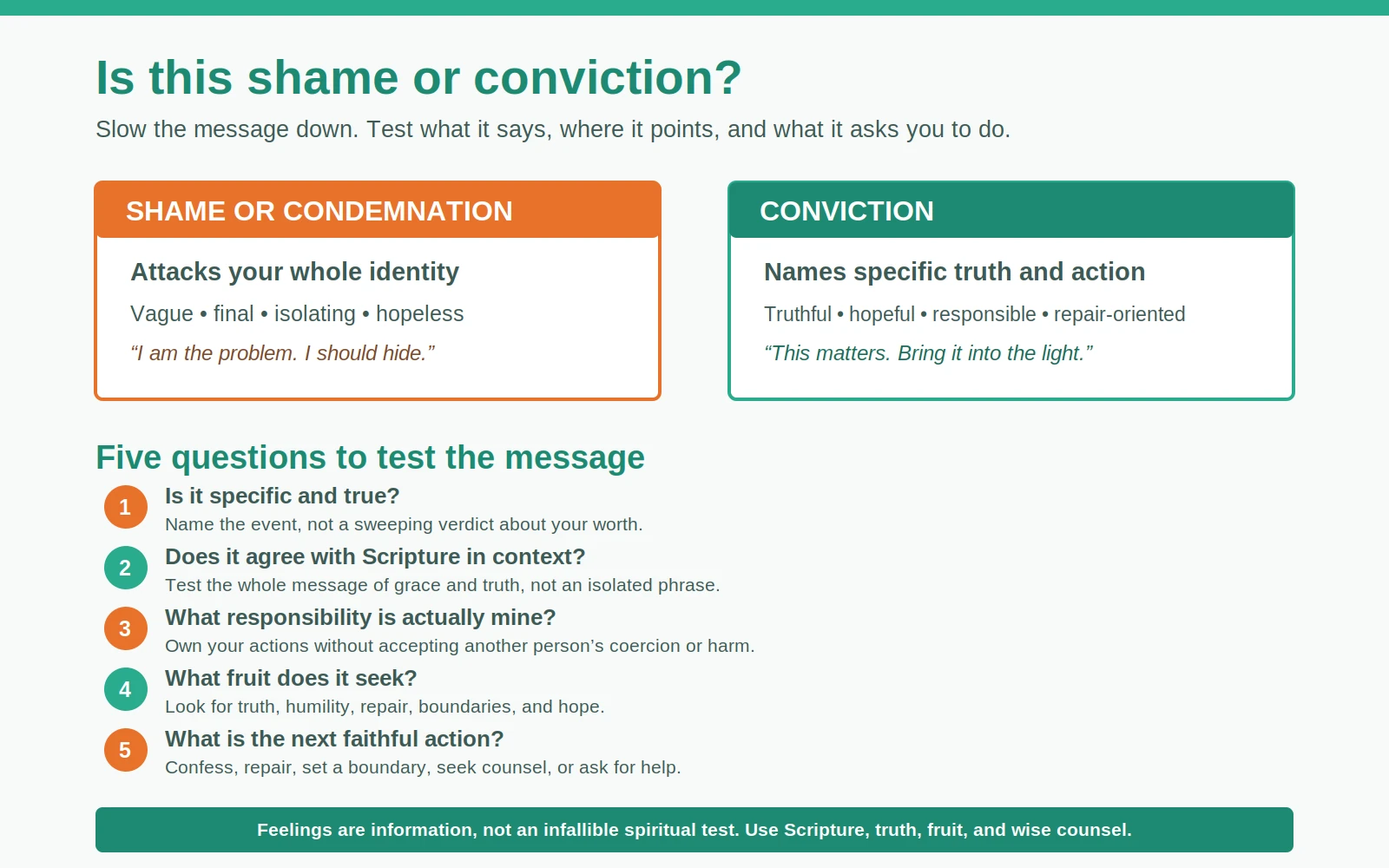
- Is it specific and true? “I spoke dishonestly” can be examined. “I ruin everything” is a global verdict that cannot guide a faithful response.
- Does it agree with Scripture in context? Test the claim against the whole gospel, not a verse isolated from its audience and purpose. Romans 8:1 says, “There is now no condemnation for those who are in Christ Jesus” (NIV). Grace does not erase responsibility; it changes the ground on which responsibility is faced.
- Does it distinguish my responsibility from someone else’s? You may need to own a harsh word. You do not need to accept blame for another person’s threats, violence, coercion, betrayal, or refusal to repent.
- What fruit does it seek? A trustworthy correction moves toward truth, confession, repair, boundaries, and a changed pattern. Shame often demands hiding, appeasing, or proving your worth.
- What is the next faithful action? Conviction becomes concrete: tell the truth, apologize without excuses, return what was taken, seek accountability, set a boundary, or ask for qualified help.
Pastoral experience: In pastoral conversations, we often hear Christians describe a small, specific failure that quickly expands into a total verdict about their faith or worth. The turning point is usually not pretending the failure did not matter. It is separating what needs honest ownership and repair from the sweeping accusation that they are beyond God’s mercy.
A Practice You Can Use This Week
Put the accusation on paper
Write the exact sentence rather than wrestling with a cloud of dread. Underline any absolute words such as always, never, everyone, or unforgivable. Ask what verifiable event sits underneath the verdict.
Separate fact, interpretation, and responsibility
Make three short lines: What happened? What am I assuming it means about me? What action is actually mine to take? This protects you from two opposite errors: minimizing real harm and accepting responsibility that belongs to someone else.
Bring the specific truth to God
Confession is honest agreement with God, not a performance of self-hatred. Name the action without euphemism. Receive forgiveness on the basis of Christ, not the intensity of your remorse. If no sin is actually identifiable, ask whether the pressure came from fear, perfectionism, manipulation, or an old wound.
Make proportionate repair
If you harmed someone, offer an apology that names the behavior, its impact, and the change you intend to make. Restitution may be appropriate. Do not use “God forgave me” to demand immediate reconciliation, restored trust, or renewed access. Forgiveness is not reconciliation, and reconciliation is not restored trust.
Invite one safe person into the process
Choose someone who can hold grace and truth together and who will not use your vulnerability to control you. A mature pastor, mentor, pastoral counselor, or licensed clinician can help you notice patterns that are difficult to see alone. If spiritual authority was part of the harm, seek support outside the leader or system involved.
A Biblical Posture: Grace That Tells the Truth
Jesus does not treat sin as harmless, and He does not reduce a person to the worst thing they have done. In John 21, Peter’s denial is not ignored, yet Jesus restores relationship and calls him into faithful responsibility. In Psalm 51, David does not avoid the truth about his sin. He asks God for cleansing and a renewed, steadfast spirit. Biblical repentance turns toward God and toward repair; it is not endless self-condemnation.
Your identity in Christ does not make choices irrelevant. It means failure is faced from a secure place: known, accountable, invited to repent, and not required to manufacture a punishment Christ never asked you to carry.
How the RESTORE Path can support discernment
NuWell’s RESTORE Path is a flexible pastoral map, not a rigid protocol. For this question, four movements may be especially useful:
Recognize the wound.
Notice where failure, rejection, or religious pressure became an identity verdict.
Separate truth from distortion.
Name the specific truth without accepting exaggeration, false blame, or condemnation.
Orient identity in Christ.
Receive grace as the ground for honest responsibility, not an excuse to avoid it.
Rebuild healthy patterns.
Practice confession, repair, boundaries, and accountable action until they become more familiar than hiding.
Shame can also distort ordinary questions. If false guilt makes every limit feel selfish, see what the Bible says about selfishness. If the same shaming message keeps returning, NuWell’s guide to spiritual strongholds offers a calm practice for testing it.
When the Message Is Coercion, Abuse, or Crisis
Not every religious accusation is conviction. A spouse, parent, pastor, or ministry may use words such as “rebellious,” “unsubmissive,” or “unforgiving” to pressure someone into silence, secrecy, unsafe contact, money, sex, labor, or loyalty. That is not a communication cycle for both people to fix. Coercive control, threats, stalking, intimidation, and violence require safety-focused support, not joint confession or couples work that could increase danger.
If the pressure came from a pastor or ministry leader, our guide to the signs of a dangerous pastor can help you tell spiritual coercion apart from healthy correction.
You may forgive without reconciling, restore trust, or give renewed access. If abuse or spiritual manipulation may be present, review NuWell’s resources on spiritual trauma and religious manipulation and forgiveness and boundaries, and seek an advocate or licensed trauma-informed clinician.
In the United States, call 911 for immediate danger. The National Domestic Violence Hotline is available at 800-799-SAFE (7233), by texting START to 88788, or at thehotline.org. If shame is accompanied by thoughts of suicide, self-harm, or an emotional crisis, call or text 988 or use 988lifeline.org. These resources were reverified September 30, 2026.
Which Kind of Support Fits?
NuWell’s online pastoral counseling may fit when you want non-clinical Biblical guidance and practical support for shame, spiritual confusion, relational patterns, or a faithful next step. Christian life coaching may fit when you are stable, can define a forward-looking goal, and want structure and accountability. You can also meet the NuWell care team before deciding.
Licensed mental-health care may be the better next step when shame is persistent or severe; when it occurs with depression, panic, trauma symptoms, obsessive religious fears, eating concerns, substance use, self-harm, or suicidal thoughts; or when you need diagnosis or psychotherapy. Medical, substance-use, domestic-violence, and emergency services should be used when those needs are primary. NuWell does not replace them.
Frequently Asked Questions
Can conviction feel painful?
Yes. Seeing the truth about harm can bring grief, sorrow, or discomfort. Pain alone does not identify the source. Look for specificity, agreement with Scripture in context, proportionate responsibility, hope, and a path toward confession and repair.
Is all guilt unhealthy for Christians?
No. Guilt can accurately signal that a behavior violated God’s commands or harmed someone. It becomes unhelpful when it is vague, exaggerated, attached to what you could not control, or used to declare your whole identity condemned.
What if I confessed but still feel ashamed?
Feelings can lag behind truth. Continue practicing honest repair, receive grace without repeated self-punishment, and share the pattern with a safe person. Persistent or severe shame may deserve licensed mental-health assessment, especially when depression, trauma symptoms, obsessive fears, or self-harm are present.
Does forgiving someone mean I must trust them again?
No. Forgiveness, reconciliation, trust, and access are related but distinct. Trust is rebuilt through truth, repentance, safety, and consistent behavior over time. In abusive situations, distance and protective boundaries may remain necessary.
Tell the Truth Without Turning It Into Your Identity
You do not need to choose between minimizing what happened and condemning yourself. Christian conviction brings truth into the light so a faithful response becomes possible. Shame tries to make the failure, wound, or accusation the final word about who you are. Grace lets you own what is yours, refuse what is not, make repair where possible, and return to God without hiding.
Talk with our care team, explore your options, and see whether NuWell is the right fit—without pressure or obligation.

This article was researched with the help of AI and reviewed and edited by Stephen Luther, MEd, MSEd, LPC, for accuracy, Scripture references, and faithfulness to NuWell’s non-clinical scope.
Stephen Luther, MEd, MSEd, LPC, is Executive Director and Founder of Grace Christian Counseling, where he serves in a licensed clinical role in Pennsylvania. He holds master’s degrees in Education and Marriage and Family Therapy and has helped children, adolescents, and adults since 1997. NuWell’s online pastoral counseling and Christian life coaching are separate, non-clinical services; Stephen’s LPC credential does not make NuWell licensed psychotherapy.
Scope note: This article provides educational and pastoral information. It is not diagnosis, psychotherapy, treatment, emergency care, or individualized professional advice.
Sources
- American Psychological Association. What’s the difference between guilt and shame?
- Kim S, Thibodeau R, Jorgensen RS. Shame, guilt, and depressive symptoms: a meta-analytic review. Psychological Bulletin. 2011;137(1):68-96.
- 988 Suicide & Crisis Lifeline. Contact and availability information reverified September 30, 2026.
- National Domestic Violence Hotline. Contact and safety information reverified September 30, 2026.
