

What Does the Bible Say About Selfishness in Marriage as a Threat to Unity?
Marriage is designed by God to be a harmonious sanctuary of unity and mutual growth. However, when self-centeredness enters the dynamic, it breaks down trust and emotional safety. To understand what does the bible say about selfishness in marriage, we must look closely at how God built the marital relationship to reflect His covenant love.
At NuWell, we have seen how subtle, unchecked self-interest gradually creates emotional distance between partners. Rather than standing side-by-side to handle life’s pressures, spouses operating in self-centeredness begin to view each other as competitors or servants. Overcoming this requires understanding what the Bible says about selfishness and returning to God’s original structural design for covenant relationships.
The “One Flesh” Covenant vs. Self-Centeredness
In Genesis 2:24, God establishes the baseline for marital union: “Therefore a man shall leave his father and his mother and hold fast to his wife, and they shall become one flesh.” Jesus affirms this foundational design in Matthew 19:4-6, emphasizing that what God has joined together, no person should separate.
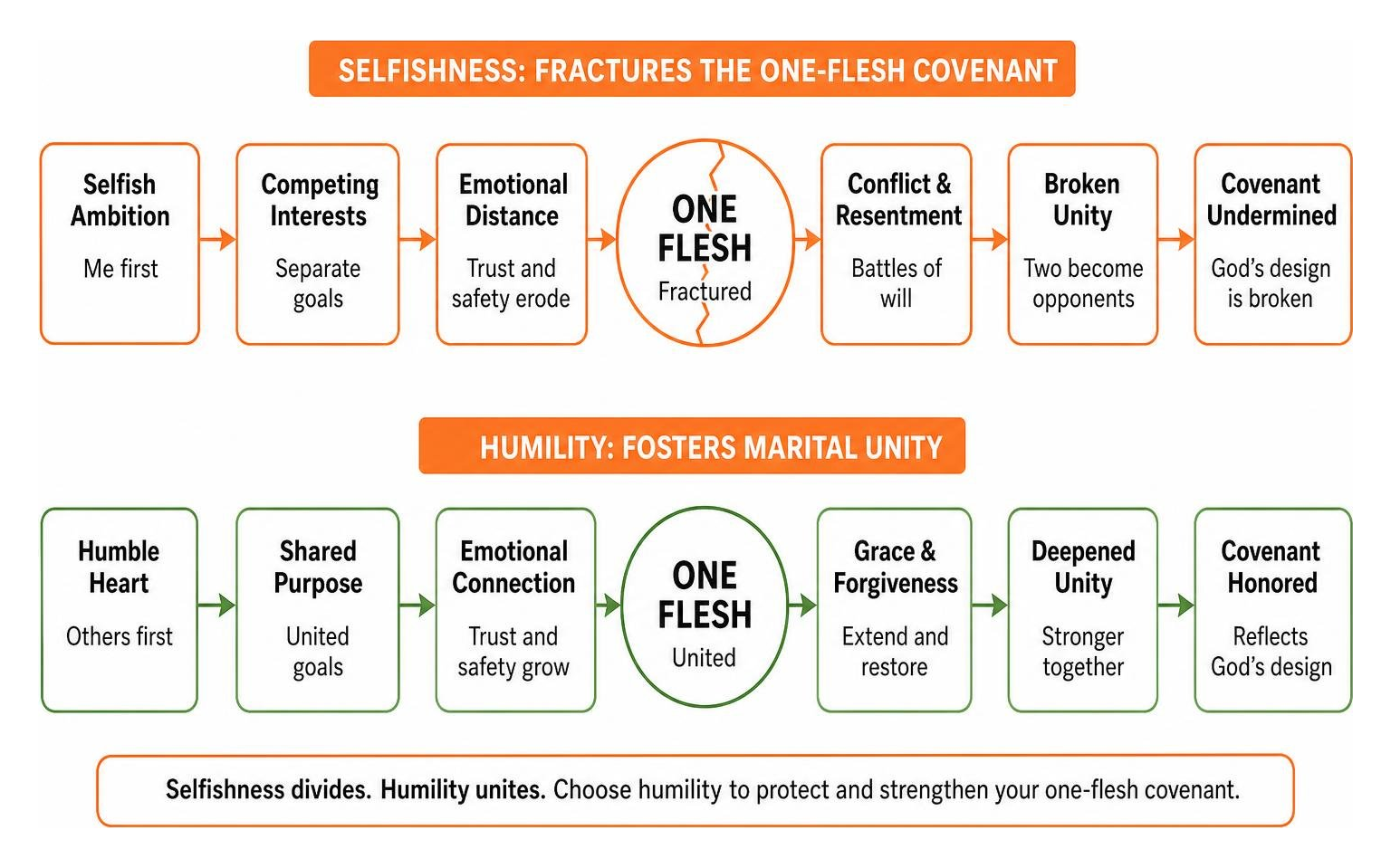
Selfishness inherently undermines this union because it demands that two remain separate individuals competing for their own rights. When you act out of self-interest in a “one flesh” relationship, you are essentially hurting yourself. Selfish behavior destroys marital cohesion, turning a spiritual alliance into a battle of wills.
Root Causes: Selfish Ambition and Pride in Relationship
Scripture pinpoints the core drivers behind marital discord. James 3:16 reminds us, “For where jealousy and selfish ambition exist, there will be disorder and every vile practice.” When personal desires override the needs of the relationship, peace collapses.
Philippians 2:3-4 directly addresses this spiritual conflict: “Do nothing from selfish ambition or conceit, but in humility count others more significant than yourselves. Let each of you look not only to his own interests, but also to the interests of others.”
Pride convinces us that our comfort, schedule, opinions, and emotional preferences matter more than our spouse’s. Overcoming this trap requires learning to identify me, myself, and I: overcoming the trap of selfish ambition so that humility can take root.
Biblical Love vs. Selfishness: What Scripture Teaches

The culture often defines love as a feeling based on what we receive. Scripture defines love as a deliberate, self-sacrificing choice to seek the ultimate good of another. Understanding this contrast is central to evaluating what the Bible actually says about being selfish.
Understanding Agape Love vs. Self-Seeking Motives (1 Corinthians 13)
1 Corinthians 13:4-7 paints the definitive biblical picture of love. Verse 5 contains a vital Greek phrase: ou zetei ta eautes, which translates literally to “it does not seek its own things.”
To break this down further, biblical charity avoids four distinct traps:
- Not self-seeking: It does not enter marriage merely for what it can gain.
- Not self-serving: It does not use the spouse as a tool for personal convenience.
- Not self-indulging: It does not prioritize personal pleasure over the spouse’s well-being.
- Not self-focused: It is actively attentive to the partner’s emotional and practical world.
Christlike servanthood rejects the transactional view of relationship and replaces it with unconditional care modeled by Jesus (Mark 10:45).
Healthy Self-Interest vs. Sinful Selfishness
It is important to distinguish between sinful selfishness and biblical self-care or healthy self-interest. Scripture does not command us to erase our personality or neglect basic health.
Ephesians 5:28-29 states: “In the same way husbands should love their wives as their own bodies. He who loves his wife loves himself. For no one ever hated his own flesh, but nourishes and cherishes it…”
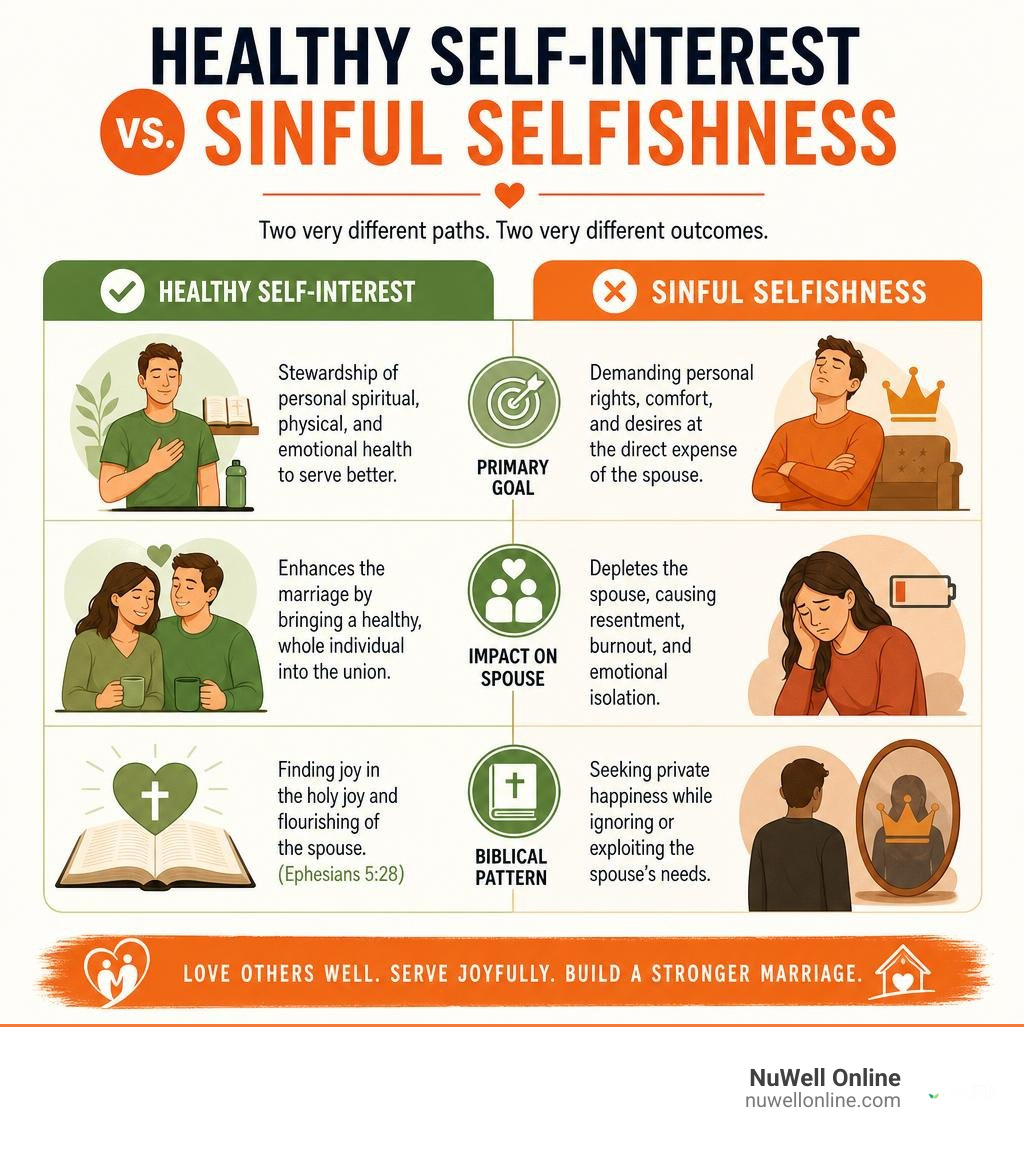
| Aspect | Healthy Self-Interest | Sinful Selfishness |
|---|---|---|
| Primary Goal | Stewardship of personal spiritual, physical, and emotional health to serve better. | Demanding personal rights, comfort, and desires at the direct expense of the spouse. |
| Impact on Spouse | Enhances the marriage by bringing a healthy, whole individual into the union. | Depletes the spouse, causing resentment, burnout, and emotional isolation. |
| Biblical Pattern | Finding joy in the holy joy and flourishing of the spouse (Ephesians 5:28). | Seeking private happiness while ignoring or exploiting the spouse’s needs. |
As Christian thinkers have observed, pursuing your own delight through making your spouse joyful is not sinful selfishness—it is the essence of marital unity.
How Selfishness Manifests in Roles and Marital Intimacy

Selfishness is rarely just a theoretical concept; it shows up in daily home life, chore distribution, decision-making, and physical intimacy.
What Does the Bible Say About Selfishness in Marriage in the Role of a Husband?
Scripture gives clear, weighty instructions to husbands regarding servant-leadership. Ephesians 5:25 mandates: “Husbands, love your wives, as Christ loved the church and gave himself up for her.”
A husband’s biblical authority is never a license for self-indulgence, laziness, or emotional domination. Colossians 3:19 adds, “Husbands, love your wives, and do not be harsh with them.”
At NuWell, we often remind husbands that emulating Christ means washing feet, not issuing demands. When a husband neglects household help, makes unilateral financial choices, or uses guilt to manipulate his wife, he operates in direct opposition to God’s standard. For deeper insight into balancing these calls, read our guides on submission, love, and sanity: navigating biblical roles in marriage and balancing authority and submission in Christian marriage.
What Does the Bible Say About Selfishness in Marriage Regarding Sexual Intimacy?
Sexual intimacy in marriage is meant to be a holy expression of mutual giving. 1 Corinthians 7:3-5 addresses physical mutuality directly:
“The husband should give to his wife her conjugal rights, and likewise the wife to her husband. For the wife does not have authority over her own body, but the husband does. Likewise the husband does not have authority over his own body, but the wife does.”
Selfishness in the bedroom can manifest in two opposing extremes:
- Demanding or coercive behavior: Forcing or pressuring a spouse into intimacy without regard for their emotional safety, exhaustion, or comfort.
- Withholding intimacy: Using physical affection as a weapon, reward, or bargaining chip to control the partner.
Biblical intimacy requires mutual consent, deep tenderness, and a commitment to honor one another’s emotional and physical boundaries.
Overcoming Selfishness: Biblical Principles and Practical Action
Recognizing patterns of self-centeredness is the first step toward spiritual restoration. Transforming these habits requires intentional practical steps anchored in God’s Word.
Forgiveness, Records of Wrongs, and Addressing Ongoing Harm
1 Corinthians 13:5 notes that true love “keeps no record of wrongs.” In healthy marriages, this means letting go of settled past grievances rather than bringing them up during arguments as leverage.
However, keeping no record of wrongs does not mean ignoring active, ongoing sin or mistreatment. There is a profound theological difference between forgiving isolated human mistakes between equals and enduring continuous emotional abuse or unrepentant harm.
For instance, in 2 Timothy 4:14, Paul explicitly recorded the harm done by Alexander the coppersmith to protect others. Documenting patterns of unrepentant harm or seeking help is wise and necessary for establishing safety. For structural help navigating relationship hurdles, explore our resource on marriage conflict resolution.
Daily Steps to Cultivate Servanthood and Christlike Unity
To shift a culture of self-centeredness into mutual care, commit to these practical steps:
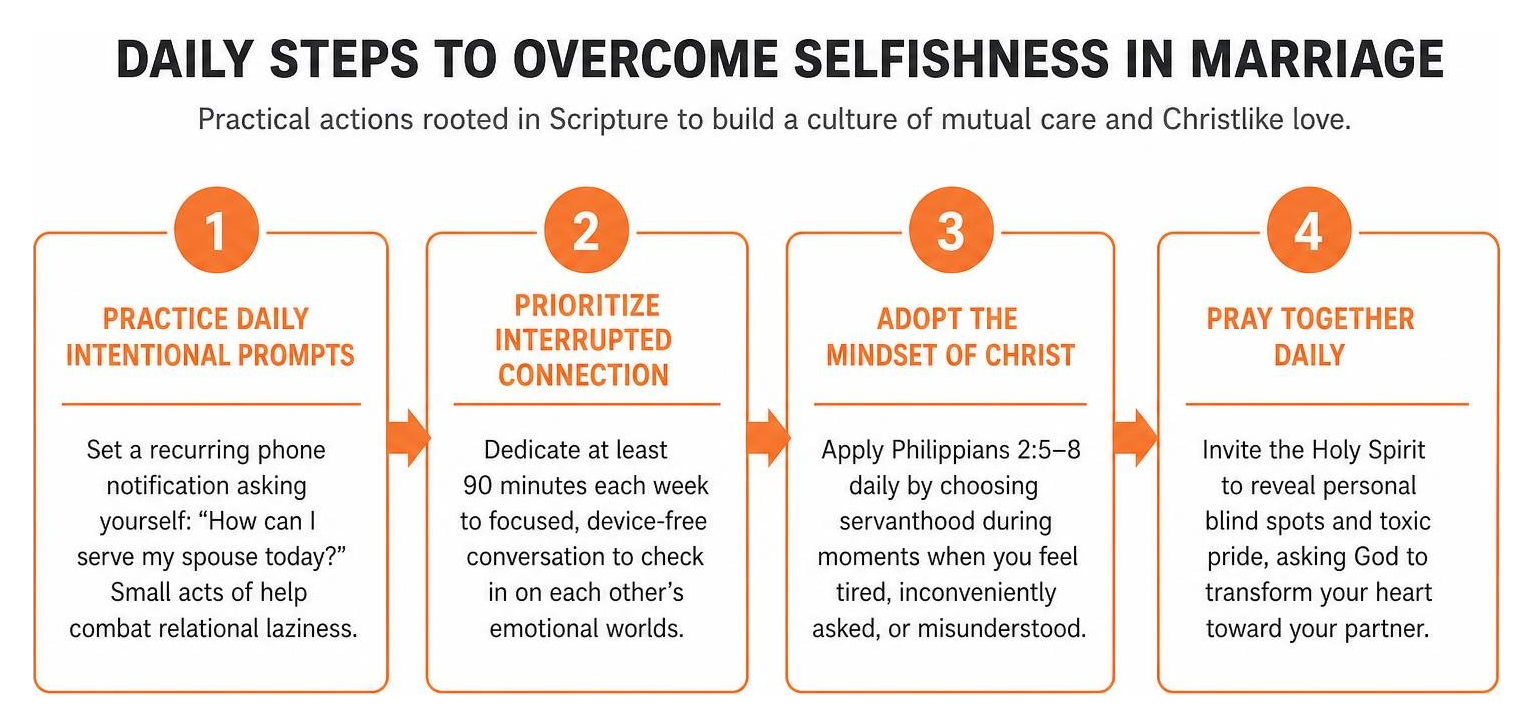
- Practice daily intentional prompts: Set a recurring phone notification asking yourself: “How can I serve my spouse today?” Small acts of help combat relational laziness.
- Prioritize uninterrupted connection: Dedicate at least 90 minutes each week to focused, device-free conversation to check in on each other’s emotional worlds.
- Adopt the Mindset of Christ: Apply Philippians 2:5-8 daily by choosing servanthood during moments when you feel tired, inconveniently asked, or misunderstood.
- Pray together daily: Invite the Holy Spirit to reveal personal blind spots and toxic pride, asking God to transform your heart toward your partner.
Frequently Asked Questions About Selfishness in Marriage
Is it selfish to express personal needs in a Christian marriage?
No. Expressing personal needs, emotional state, or physical fatigue with humility is a healthy part of biblical vulnerability. Asking for support allows your spouse the opportunity to practice Christlike servanthood. It only becomes selfish when needs are expressed through demands, manipulation, or anger.
How should a spouse respond to a continuously selfish partner biblically?
First, avoid reacting with passive-aggressive bitterness or retaliatory self-centeredness. Speak truth in love clearly (Proverbs 15:1), set healthy personal boundaries, and focus on maintaining your own spiritual walk. If the behavior persists without repentance, follow the wisdom of Matthew 18 by involving trusted pastoral leadership or professional Christian counselors.
Does 1 Corinthians 13:5 mean you should ignore ongoing mistreatment?
No. Loving by not keeping a record of offenses refers to releasing bitterness over confessed and settled mistakes. It is not a command to remain silent in the face of ongoing pattern abuse, severe neglect, or intimidation. Speaking up brings deeds to the light and invites genuine accountability and truth.
Conclusion
Overcoming self-centered habits in a marriage is rarely quick, but with God’s grace, complete heart transformation is entirely possible. Moving from self-protection to sacrificial love invites God’s peace and restoration into your home. You and your spouse were created for more than constant friction—you were designed to mirror Christ’s love together.
At NuWell, our certified Christian life coaches and licensed pastoral counselors specialize in helping couples identify core patterns, heal lingering wounds, and establish healthy biblical dynamics. We invite you to explore our faith-based virtual care offerings:
- Book a confidential session with our Pastoral Counseling team.
- Learn more about personalized coaching through our Christian Life Coaching program.
- Begin your steps toward healing by visiting Your Journey today.
This article was researched with AI and heavily edited by Jordan Oliver for accuracy and relevance.
Jordan is an author, ordained minister, and online host for His Glory TV, sharing biblically grounded insights on faith, prayer, and spiritual growth. She is the co-founder of Triple-Braided Cord Co., an intercessory prayer and healing ministry inspired by Ecclesiastes 4:12.
Jordan holds a Bachelor’s degree in Communications and Religious Studies from High Point University and is a certified Spiritual Life Coach through iCoachLife in Nashville, Tennessee. Drawing from her ministry, coaching, and academic experience, she creates trustworthy, faith-based content that helps readers grow in their relationship with God. Learn more about Jordan here.
