

Why So Many Couples Struggle to Understand Biblical Marriage Roles
Husband and wife biblical roles are one of the most searched — and most misunderstood — topics in Christian marriage today.
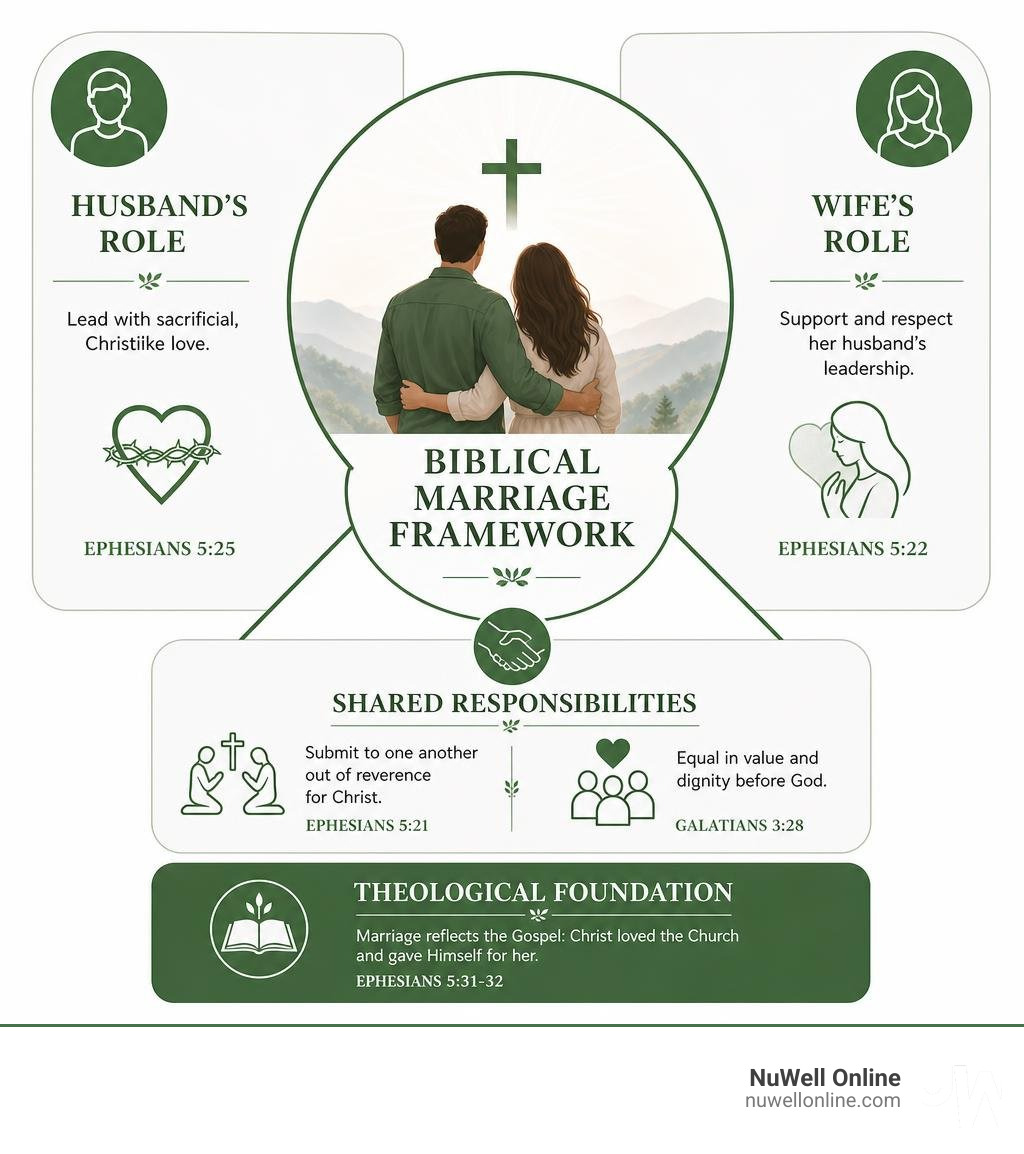
Here is a quick summary of what the Bible teaches:
| Spouse | Core Calling | Key Scripture |
|---|---|---|
| Husband | Lead with sacrificial, Christlike love | Ephesians 5:25 |
| Wife | Support and respect her husband’s leadership | Ephesians 5:22 |
| Both | Submit to one another out of reverence for Christ | Ephesians 5:21 |
| Both | Equal in value and dignity before God | Galatians 3:28 |
These roles are not about power. They are about purpose — a design that reflects the relationship between Christ and His Church.
Yet for many couples, these passages trigger confusion, hurt, or conflict. Words like “submission” and “headship” carry baggage. Culture pulls one direction. Well-meaning but incomplete teaching pulls another.
One pastoral counseling insight captures it well: you can trace almost every marriage problem back to a misunderstanding or misapplication of biblical roles. That is not an overstatement. At NuWell Online, we have seen this pattern again and again — couples who love each other deeply but are working from broken or incomplete frameworks of what God actually designed marriage to look like.
This guide is here to change that. We will walk through what Scripture actually says, what it does not say, and how to live it out with grace, clarity, and confidence.
Essential husband and wife biblical roles terms:
- biblical responsibilities of a husband
- biblical role of a husband
- characteristics of a good husband according to the bible
The Foundation of Husband and Wife Biblical Roles
To understand God’s design for marriage, we must go back to the beginning. Before the Fall introduced friction, blame, and power struggles into human relationships, God established a beautiful order in Genesis.
Scripture teaches that men and women are created equal in value, dignity, and essence. Genesis 1:27 states, “So God created mankind in his own image, in the image of God he created them; male and female he created them.” Both carry the divine spark. Both are called to be caretakers of creation. In the eyes of their Creator, there is absolutely no hierarchy of worth.
Yet, equal value does not mean identical function. God designed men and women with distinct, complementary roles. This is what theologians call complementarianism — the belief that God created men and women with unique and complementary souls, physicalities, and callings that fit together to form a beautiful whole. As explored in the theological essay Glorious, Obvious Difference: The Complementary Souls of Men and Women | Desiring God, these differences are not superficial. They are rooted in the very soul, designed to help couples navigate life’s mission together.
The ultimate model for this relationship is the Trinity. God the Father, God the Son, and God the Holy Spirit are perfectly equal in power, glory, and essence. Yet, within the Trinity, there are distinct roles and a willing submission. Jesus, while being fully God, submits to the will of the Father (Luke 22:42). This demonstrates a profound truth: submission does not imply inferiority. If God the Son can submit to God the Father without losing an ounce of His infinite worth and dignity, then a wife’s submission to her husband is never a sign of lesser value.
When starting a new life together, understanding this foundation is crucial. If you are in the early stages of your relationship, establishing these principles early on can prevent years of unnecessary conflict. For practical advice on building this foundation, read our guide on Tips for a New Christian Marriage.
The Husband’s Calling: Sacrificial Love and Christlike Headship
In many modern discussions, the concept of “headship” is treated with suspicion. It is often equated with dominance, control, or a license for a husband to act like a domestic dictator. However, the biblical definition of headship is the exact opposite of self-serving power.
According to Ephesians 5:25, “Husbands, love your wives, just as Christ loved the church and gave himself up for her.” The standard for a husband’s leadership is the cross. It is a calling to radical, self-sacrificing servant leadership. Jesus did not come to be served, but to serve, and He modeled this by washing His disciples’ feet.
A husband is called to be the “garden-keeper” of his home. Just as God placed Adam in the Garden of Eden to cultivate and protect it, a husband is called to cultivate his wife’s gifts, protect her heart, and provide a safe environment where she can flourish. His authority is not given for his own comfort, but for her protection and sanctification.
When a husband leads this way, he values his wife’s wisdom and actively seeks her counsel before making decisions. He does not lead by demanding obedience, but by demonstrating love.
To help men step into this high calling, we have put together The Definitive Guide to Biblical Role of a Husband and explored how to look to Jesus Christ: The Ultimate Role Model for a Christian Husband.
Understanding Headship in Husband and Wife Biblical Roles
True biblical headship is defined by responsibility, not privilege. A husband is spiritually accountable to God for the physical, emotional, and spiritual well-being of his family.
Part of this responsibility is what Scripture describes as “washing her with the washing of water by the word” (Ephesians 5:26). This does not mean lecturing her or using Scripture as a weapon. Instead, it means leading by example in prayer, kindness, and spiritual growth. It means cherishing her—treating her as a precious, irreplaceable treasure rather than a helper who merely keeps the household running.
A godly husband protects his wife’s dignity. He never belittles her, especially in front of others or their children. He seeks to understand her unique emotional and physical needs, dwelling with her “with understanding” (1 Peter 3:7). To learn more about how to live out these daily responsibilities, see our article on How to Be a Godly Partner with These Biblical Responsibilities of a Husband.
Practical Ways Husbands Can Lead with Tenderness
At NuWell Online, we have found that many husbands want to lead well but simply do not know how to do so practically. Here are a few ways to lead with tenderness:
- Practice Active Listening: Do not rush to fix her problems. Validate her emotions first, and make her feel heard and safe.
- Create Emotional Safety: Ensure your tone and body language communicate warmth and patience, even during disagreements.
- Initiate Spiritual Intimacy: You do not need to be a theology scholar. Simply ask, “How can I pray for you today?” and pray together.
- Seek Her Counsel: Before making major decisions, ask for her perspective and value her intuition as a vital asset to your partnership.
The Wife’s Calling: Respect, Support, and Biblical Submission
Just as the husband’s role has been distorted, the wife’s calling to submission has often been misunderstood or even weaponized. True biblical submission is not a call to passivity, silence, or blind obedience. It is an active, intelligent, and voluntary choice to support and respect her husband’s leadership.
Scripture describes the wife as a “helper” (Genesis 2:18). In our modern language, the word “helper” can sound subordinate—like an assistant. But in the original Hebrew, the word used is ezer. This word is used over twenty times in the Old Testament, and most of those times it refers to God Himself as Israel’s helper in times of desperate need. An ezer is not a passive subordinate; she is a strong, life-giving presence who brings vital resources, strength, and wisdom to the relationship.
The Proverbs 31 woman is a beautiful example of this. She is not timid or silent. She is an entrepreneur, a manager, a wise teacher, and an active participant in her community. Her husband trusts her completely because her strength and dignity build up their family.
Living this out requires a careful balance of authority and respect. To explore how to navigate this dynamic in your own relationship, read our guide to what biblical submission does and does not mean.
Demystifying Submission in Husband and Wife Biblical Roles
The Greek word for submission in the New Testament is hupotasso, which is a military term meaning “to arrange under.” In a marriage context, it refers to a voluntary alignment. A wife chooses to yield to her husband’s leadership out of reverence for Christ, not because she is forced to, and not because she is less capable.
Submission is an act of strength, not weakness. It takes immense emotional maturity and faith in God to trust a husband’s leadership, especially when he is imperfect. It is not an abandonment of her intellect or voice. A godly wife uses her gifts, speaks her mind with grace, and actively shapes the direction of the home alongside her husband.
Practical Ways Wives Can Show Respect and Support
Respect is a powerful motivator for men. In fact, research indicates that many husbands value respect even more than feeling loved in moments of conflict. Here are practical ways to show respect:
- Offer Words of Affirmation: Notice his efforts and verbalize your appreciation for his hard work and leadership.
- Provide Constructive, Gentle Feedback: Speak your mind without nagging or public criticism. Share your perspective privately and with kindness.
- Align on a Shared Vision: Work together to set goals for your family, finances, and faith, and actively help carry them out.
- Protect His Reputation: Speak highly of your husband to your friends, family, and children.
Navigating Shared Responsibilities and Resolving Conflict
While husbands and wives have distinct roles, they share a vast number of responsibilities. They are called to follow Christ together, prioritize one another above all other human relationships, protect their marriage covenant, and invest in a godly community.
To understand how these roles function in everyday life, it helps to look at the difference between a contract marriage and a covenant marriage:

| Aspect | Contract Marriage | Covenant Marriage |
|---|---|---|
| Foundation | Based on performance (“If you do your part, I’ll do mine”) | Based on a sacred vow and unconditional commitment |
| Focus | Rights, expectations, and keeping score | Sacrificial service, forgiveness, and grace |
| Goal | Personal happiness and self-fulfillment | God’s glory, mutual holiness, and spiritual friendship |
| Conflict Resolution | Blame, withdrawal, or demands | Humility, active listening, and restoration |
In a covenant marriage, even physical intimacy is viewed as a sacred, mutual gift rather than a transactional duty. To build a healthy foundation in this area, you can read our resource on Sex and Christian Marriage.
When conflicts inevitably arise, couples need healthy tools to resolve them without damaging their bond. For practical, faith-based strategies, check out our guide on Marriage Conflict Resolution.
Handling Disagreements within Biblical Roles
What happens when a husband and wife cannot agree on a major decision?
First, the goal should always be consensus. A couple should pray, study Scripture, and talk through the issue patiently. In a healthy marriage, “executive decisions” are incredibly rare. However, if a stalemate is reached and a decision must be made, biblical headship means the husband carries the responsibility of making the final call.
This is not a license for him to get his way. He must make the decision that best serves his wife and family, even at personal cost to himself. A wise husband will also recognize that if his wife has serious reservations, it is often a sign to wait and pray more. For tools on planning your future together with faith, read about Vision Boards and Vows: Planning Your Future Together with Faith.
When a Spouse is Not Acting in a Godly Way
One of the most common questions we receive is: What should a wife do if her husband is acting in an ungodly, irresponsible, or abusive manner?
Biblical submission never means condoning sin, enduring abuse, or participating in harmful behavior. A wife’s primary allegiance is always to Jesus Christ. If a husband asks her to do something sinful, she must refuse in obedience to God. If there is abuse, safety is the immediate priority. Physical, emotional, or sexual abuse is a violation of the marriage covenant, and seeking safety and professional help is the godly response.
At NuWell Online, we provide a safe, compassionate space to help couples navigate these painful seasons. If your marriage is facing deep hurts or destructive patterns, consider exploring our resources on Faith-Based Relationship Therapy and Healing Hearts with Higher Help.
Frequently Asked Questions about Biblical Marriage
What does the Hebrew word ‘ezer’ (helper) mean for a wife’s role?
As mentioned earlier, ezer is a term of strength, not subordination. It implies a strong ally who brings vital rescue, support, and resources to a partnership. It shows that a wife’s role is powerful, active, and essential to the survival and flourishing of the family.
Is a wife responsible for her husband’s sexual purity?
No. Scripture is clear that every individual is personally accountable for their own purity and choices (1 Corinthians 6:18-20; James 1:13-15). While spouses are called to love and serve each other intimately, a wife is never responsible for her husband’s sexual sins, including pornography or infidelity.
How do nominal vs. active church attendance statistics impact Christian marriages?
The data reveals a stark contrast between those who simply call themselves Christians and those who actively practice their faith:
- Active Churchgoers: Evangelical husbands who attend church regularly report the highest levels of marital happiness, and their wives report the highest levels of satisfaction with how they are treated. These fathers are highly engaged with their children and have the lowest rates of divorce and domestic violence of any group in America.
- Nominal Christians: Husbands who identify as Christian but do not regularly attend church actually have the highest rates of divorce and domestic violence of any demographic—even higher than secular couples. Their wives report the lowest levels of satisfaction and engagement.
This highlights that simply wearing the label of “Christian” without living out a vibrant, community-supported faith can lead to brokenness, while actively pursuing Christ together leads to flourishing.
Conclusion

Navigating husband and wife biblical roles is not about fitting into rigid, cultural stereotypes. It is about stepping into a life-giving, God-designed rhythm of mutual love, respect, and service. It is about reflecting the beautiful, self-sacrificing love of Jesus to a world that desperately needs to see it.
If your marriage is feeling stagnant, confused, or broken, you do not have to navigate this journey alone. At NuWell Online, we integrate Biblical truths with evidence-based practices to help couples experience holistic spiritual and emotional healing. Whether you need Christian pastoral counseling, Christian life coaching, or Christian marriage therapy, our certified and licensed team is here to support you in North Huntingdon, PA, and online.
You were created for more than just surviving. Let us help you build a marriage that flourishes.
Book a session with NuWell Online today to start your journey toward healing and wholeness.
This article was researched with AI and heavily edited by Jordan Oliver for accuracy and relevance.
Jordan is an author, ordained minister, and online host for His Glory TV, sharing biblically grounded insights on faith, prayer, and spiritual growth. She is the co-founder of Triple-Braided Cord Co., an intercessory prayer and healing ministry inspired by Ecclesiastes 4:12.
Jordan holds a Bachelor’s degree in Communications and Religious Studies from High Point University and is a certified Spiritual Life Coach through iCoachLife in Nashville, Tennessee. Drawing from her ministry, coaching, and academic experience, she creates trustworthy, faith-based content that helps readers grow in their relationship with God. Learn more about Jordan here.
