

What Is the Biblical Role of a Husband? (A Quick Answer)
What is the biblical role of a husband is one of the most searched questions among Christian men who genuinely want to lead their families well — and for good reason. Scripture doesn’t leave men guessing.
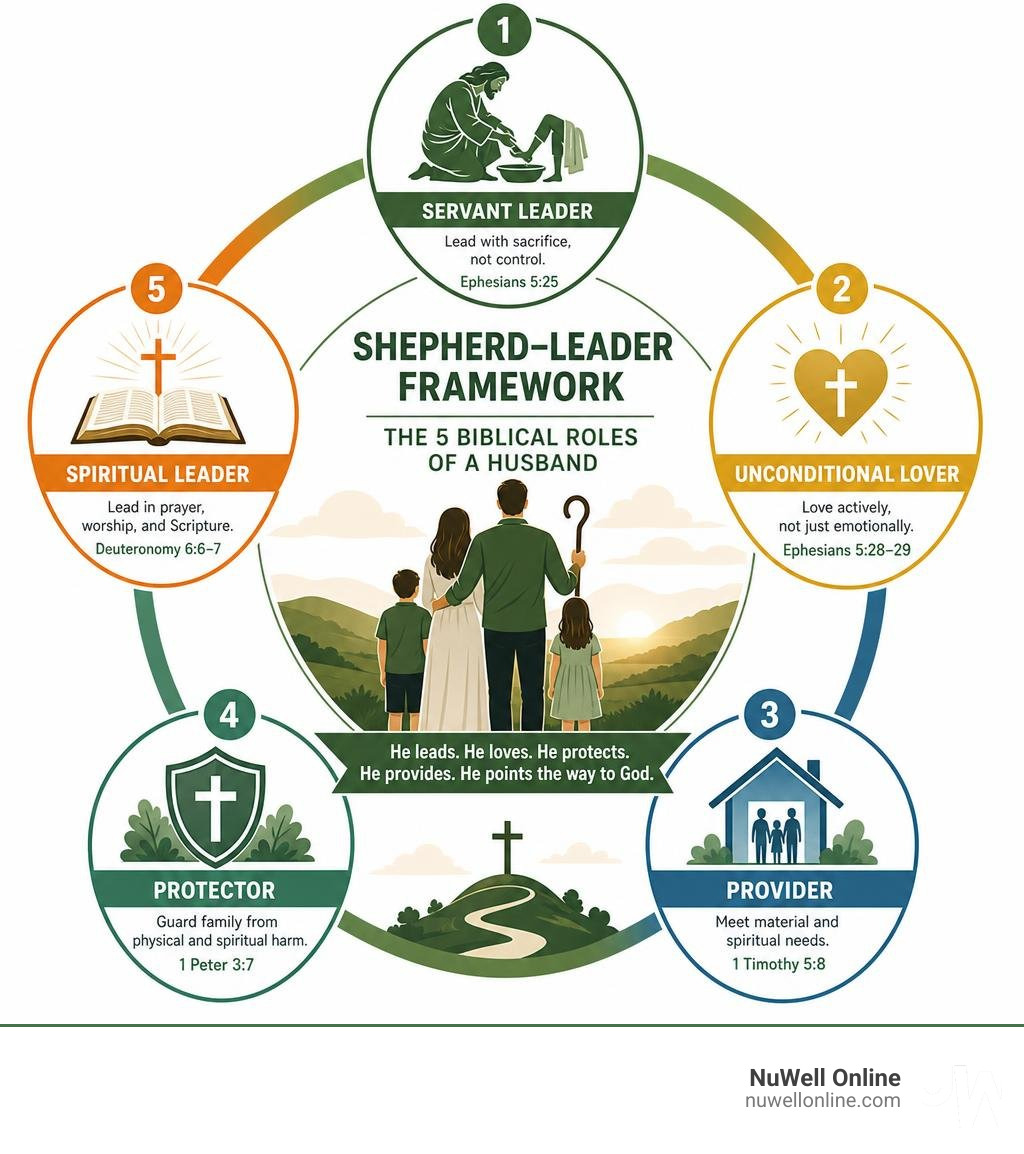
Here is a clear, at-a-glance summary:
| Biblical Role | Core Responsibility | Key Scripture |
|---|---|---|
| Servant Leader | Lead with sacrifice, not control | Ephesians 5:25 |
| Unconditional Lover | Love actively, not just emotionally | Ephesians 5:28-29 |
| Provider | Meet material and spiritual needs | 1 Timothy 5:8 |
| Protector | Guard family from physical and spiritual harm | 1 Peter 3:7 |
| Spiritual Leader | Lead in prayer, worship, and Scripture | Deuteronomy 6:6-7 |
In short: a husband is called to imitate Christ — to lead by serving, love by sacrificing, and shepherd his family toward God.
But knowing the list and living it out are two very different things.
Many Christian men feel genuine pressure here. Some swing toward passivity, quietly stepping back from leadership because they don’t know where to start. Others overreach, confusing authority with control. Both miss the mark.
At NuWell Online, we have walked alongside many husbands who deeply love their wives but feel stuck — unsure how to lead spiritually, how to love sacrificially when the marriage feels dry, or how to protect their family in an increasingly complex world.
The good news? The Bible gives a remarkably clear and life-giving model. It centers not on a boardroom or a throne, but on a cross.
This guide walks through what Scripture actually says about a husband’s role — from headship and sacrificial love to provision, protection, and spiritual leadership — and how you can begin living it out in practical, daily ways.
What is the biblical role of a husband terms made easy:
Defining What Is the Biblical Role of a Husband

To understand what is the biblical role of a husband, we must first strip away both modern cultural assumptions and historical distortions. Throughout history, the concept of a husband has frequently been reduced to either a rigid, authoritarian master or a passive roommate. Neither of these models reflects the heart of God.
In the Old Testament context, the husband was recognized as the foundational head of the household, a role deeply tied to the preservation of the family covenant. As explored in the Husband – Meaning & Verses | Bible Encyclopedia | Bible Study Tools, the biblical household carried a distinctively religious character, where the husband served as a spiritual steward.
However, Jesus radically redefined this concept of headship. He demonstrated that true biblical headship is not about demands, dominance, or personal privilege. Instead, it is a covenantal calling to servant leadership. In a Christian marriage, the husband’s authority is defined entirely by his willingness to lay down his life, his preferences, and his comforts for the sake of his wife.
To truly understand how this dynamic works within the covenant of marriage, we must look at how God designed the relationship from the beginning. You can read more about this foundational structure in The Definitive Guide to Biblical Role of a Husband. When a man embraces this covenant, he transitions from living for himself to cultivating an environment where his wife and children can truly flourish.
Spiritual Leadership: What Is the Biblical Role of a Husband in the Home?
Many men hear the phrase “spiritual leader” and instantly feel unqualified. They assume they need a seminary degree or a perfectly polished prayer life to lead their home. But biblical spiritual leadership is much more about consistent, humble direction than it is about theological perfection.
A 2021 Pew Research Center survey found that 64% of married Christian adults believe the husband should be the spiritual leader of the household, while 34% believe spiritual leadership should be shared equally. Yet, there is often a gap between belief and practice. According to a 2022 Barna Group study, 58% of practicing Christian husbands report regularly leading family prayer or devotional time, compared to only 32% of non-practicing Christian husbands.
True spiritual leadership means taking the initiative to set a God-honoring direction for the family. It is modeled directly after Christ, who is the ultimate shepherd of our souls. To learn more about this model, see Jesus Christ: The Ultimate Role Model for a Christian Husband.
As a husband, you are called to serve as the primary spiritual encourager or “pastor” of your home. This does not mean you dictate every theological thought, but rather that you actively cultivate a healthy environment where spiritual growth is natural. For a detailed breakdown of what this looks like in daily practice, you can read What it Does – and Doesn’t – Mean That the Husband Is the Spiritual Leader of the Home – Topical Studies | Bible Study Tools.
Here are a few practical, daily habits of a spiritual leader:
- Initiating Prayer: Don’t wait for your wife to suggest praying together. Take her hand before bed or during a stressful moment and lift your concerns to God.
- Leading in Family Worship: Establish a simple routine of reading a passage of Scripture together, whether at the dinner table or during a quiet evening.
- Modeling Repentance: A godly spiritual leader is not a perfect man; he is a repenting man. Be the first to say, “I was wrong. Will you forgive me?”
- Prioritizing Church Community: Take the lead in gathering your family to worship with a faithful local church body.
Sacrificial Love: What Is the Biblical Role of a Husband According to Ephesians 5?
In Ephesians 5:25, the Apostle Paul issues a radical command: “Husbands, love your wives, as Christ loved the church and gave himself up for her.”
The word used for love in this passage is agapao (or agape). This is not a passive, emotional feeling that relies on favorable circumstances or a spouse’s flawless behavior. It is an intentional, unconditional, and self-sacrificial choice to seek the ultimate good of another person. It is a love that acts, even when it costs something.
To love your wife as Christ loved the church means you are committed to her sanctification, her joy, and her overall well-being. In Ephesians 5:29, Paul explains that a husband must “nourish and cherish” his wife, just as Christ does the church.
- To Nourish (Ektrepho): This means to feed, supply, and provide what is necessary for growth. Spiritually and emotionally, you are called to supply your wife with encouragement, validation, and the life-giving truth of God’s Word.
- To Cherish (Thalpo): This literally means “to warm” or to treat with tender care, like a mother bird warming her young. It involves speaking gentle words, offering physical affection, and ensuring she feels deeply secure in your love.
At NuWell Online, we have seen how marriages are transformed when husbands shift from demanding their rights to actively practicing these truths. If you want to explore how to put these principles into action, check out How to Be a Godly Partner with These Biblical Responsibilities of a Husband.
The Dual Mandate: Provider and Protector
The biblical role of a husband also carries a dual mandate: to provide and to protect. In Genesis 2:15, God placed Adam in the Garden of Eden to “work it and keep it.” This original mandate highlights a man’s calling to cultivate and guard his surroundings.
For a husband, this means stepping into the daily responsibility of ensuring his family is safe, sustained, and positioned to thrive. This is not a secondary option; it is a non-negotiable aspect of godly manhood. To learn more about how this mandate shapes modern Christian masculinity, read Godly Husband Characteristics: A Scriptural Roadmap for Modern Men and explore the insights in Christ-Like Shepherd: The Role Of A Godly Husband.
Providing for the Family’s Total Well-Being
When we think of “provision,” we often think strictly of financial income. While working diligently to meet the material needs of your household is a vital biblical duty—1 Timothy 5:8 warns that if anyone fails to provide for his relatives, he has denied the faith and is worse than an unbeliever—true provision goes far deeper.
A husband is called to provide for his family’s total well-being, which includes:
- Emotional Provision: Cultivating a safe emotional environment where your wife feels heard, respected, and understood. This requires active listening, empathy, and undivided attention.
- Spiritual Provision: Ensuring your household is nourished with God’s Word and that your wife has the time and space to nurture her own relationship with Christ.
- Relational Provision: Investing quality time into your marriage. This means planning consistent date nights, engaging in deep conversations, and protecting your relationship from the distractions of busy schedules.
To truly understand the weight of these responsibilities, we must recognize the True Value of Relationships as God designed them. When a husband provides a stable, consistent, and dependable environment, his wife can rest in security, knowing she is supported in every area of life.
Protecting the Home from Spiritual and Physical Threats
Protection is more than just locking the front door at night or standing between your family and physical danger. In a modern context, the greatest threats to our homes are often spiritual, emotional, and moral.
A godly husband protects his home by:
- Guarding Purity: Setting healthy boundaries around what enters the home through media, technology, and outside influences.
- Defending the Peace: Refusing to allow bitterness, unresolved anger, or harsh words to take root in the household.
- Engaging in Spiritual Warfare: Interceding for his wife and children daily through prayer, standing against spiritual division, and maintaining a culture of grace.
This protective strength is never domineering or aggressive; rather, it is power under control, used to shield and serve. For an in-depth look at how to balance this protective authority with a spirit of humility, see Balancing Authority and Submission in Christian Marriage.
Overcoming Misconceptions and Resolving Marital Conflict

No marriage is immune to disagreement or tension. However, when we fail to understand what is the biblical role of a husband, conflict can easily spiral into destructive patterns. At NuWell Online, we have found that many marital struggles stem from a misunderstanding of headship, combined with the universal human struggle against selfishness.
To build a resilient marriage, couples must learn biblical principles of Marriage Conflict Resolution and address the root issues of pride and self-centeredness. If you are struggling with these dynamics, we encourage you to read about What Does the Bible Say About Selfishness to gain scriptural clarity on overcoming personal pride.
Correcting Distortions of Biblical Headship
One of the greatest obstacles to a healthy Christian marriage is the distortion of headship. True biblical headship is never synonymous with dictatorship, micromanagement, or unilateral decision-making.
Scripture teaches that men and women are created with equal worth and dignity, both bearing the image of God (Galatians 3:28). For a beautiful exploration of how these roles complement one another without diminishing the value of either spouse, read What Are the Biblical Roles of Husband and Wife?.
To help clarify this distinction, consider the differences between worldly and biblical headship:
| Worldly Headship (Distorted) | Biblical Headship (Christ-Like) |
|---|---|
| Demands submission and respect | Earns respect through sacrificial love and service |
| Uses authority for self-interest | Uses authority to protect and uplift the family |
| Focuses on power, control, and being right | Focuses on humility, listening, and seeking counsel |
| Treats the wife as a subordinate | Treats the wife as a precious, equal fellow-heir |
| Reacts with anger, harshness, or bitterness | Leads with patience, gentleness, and grace |
Navigating Resistance and Family Conflict
What happens when a husband attempts to lead, but his wife is resistant, or the family faces intense conflict? The natural human reaction is often to shut down, withdraw in passivity, or push back with anger.
Scripture calls husbands to a different path: patient endurance and gentle leadership. When tension arises, a husband must resist the temptation to dominate or force compliance. Instead, he should practice active listening, seek to understand his wife’s fears or reservations, and lead with a gentle spirit.
At NuWell Online, we have walked alongside many couples in North Huntingdon, PA, helping them navigate these exact challenges. To understand how to approach these difficult seasons constructively, read What Does the Bible Say About Family Conflict.
Frequently Asked Questions About a Husband’s Biblical Role
Does a husband’s treatment of his wife affect his relationship with God?
Yes, absolutely. Scripture makes a direct, sobering connection between a husband’s treatment of his wife and his personal spiritual life.
In 1 Peter 3:7, Christian husbands are commanded to live with their wives in an understanding way, showing honor to them so that their “prayers may not be hindered.” If a husband is harsh, neglectful, or bitter toward his wife, his communication with God is directly impacted. God takes the care of His daughters seriously; a man cannot be in right relationship with God while mistreating the woman God entrusted to his care.
Is a wife responsible for her husband’s sexual purity?
No. While Scripture encourages mutual intimacy and physical affection within the covenant of marriage to guard against temptation, a husband is solely and directly accountable before God for his own thoughts, eyes, and actions.
1 Corinthians 6:18 issues a direct command to “flee from sexual immorality.” The responsibility to guard one’s heart and eyes rests entirely on the individual being tempted. A wife is never to blame for her husband’s struggle with lust or sexual sin. To learn more about building a healthy, holy, and mutually respectful physical relationship, you can read Sex and Christian Marriage.
How can a husband lead if he is not a natural leader?
Leadership is not a personality trait; it is a spiritual stewardship. God does not call the equipped; He equips the called. If you feel naturally passive or unqualified to lead, take heart. God’s grace is entirely sufficient, and leadership can be learned step-by-step.
Start small: pray with your wife for two minutes before bed, ask for her input on family decisions, and model a consistent attitude of gratitude and repentance. If you are early in your marital journey, you can find practical guidance in Tips for a New Christian Marriage.
Conclusion: Stepping Into Your Calling
Stepping into the biblical role of a husband is a lifelong journey of sanctification. It is a calling that requires daily surrender, practical steps, and reliance on the Holy Spirit. But you do not have to walk this path alone.
Research from the Institute for Family Studies (2020) indicates that marriages where husbands actively participate in spiritual leadership report 25% higher marital satisfaction rates compared to those where spiritual leadership is absent. Furthermore, data from the National Survey of Family Growth shows that households where husbands report regular church attendance and spiritual leadership have a 30% lower divorce rate. The investment you make in your spiritual role has profound, real-world benefits for your family’s future.
At NuWell Online, based in North Huntingdon, PA, we are dedicated to helping men and couples find healing, wholeness, and spiritual alignment. Whether you are navigating deep marital wounds, seeking to strengthen your communication, or looking for practical guidance as a leader, our licensed pastoral counselors and certified Christian coaches are here to support you.
You were created for more than a surviving marriage—you were created for a thriving, Christ-centered covenant.
If you are ready to take the next step toward a stronger, healthier marriage, we invite you to Book a Pastoral Counseling Session with us today. Let us help you step confidently into the calling God has placed on your life.
This article was researched with AI and heavily edited by Jordan Oliver for accuracy and relevance.
Jordan is an author, ordained minister, and online host for His Glory TV, sharing biblically grounded insights on faith, prayer, and spiritual growth. She is the co-founder of Triple-Braided Cord Co., an intercessory prayer and healing ministry inspired by Ecclesiastes 4:12.
Jordan holds a Bachelor’s degree in Communications and Religious Studies from High Point University and is a certified Spiritual Life Coach through iCoachLife in Nashville, Tennessee. Drawing from her ministry, coaching, and academic experience, she creates trustworthy, faith-based content that helps readers grow in their relationship with God. Learn more about Jordan here.
