

The family group chat goes quiet after one sharp message. A visit ends with everyone replaying what was said. A disagreement about caregiving, money, parenting, faith, or the holidays reopens ten years of hurt. You want peace, but you do not want “keeping the peace” to mean pretending nothing happened. So what does the Bible say about family conflict, and what does a faithful next step look like?
Family relationships and Biblical restoration
Quick answerThe Bible does not promise conflict-free families. It calls Christians to examine themselves honestly, listen before reacting, speak truth without contempt, take responsibility for harm, forgive without denying reality, and pursue peace as far as it depends on them. Biblical peace is not forced agreement, automatic reconciliation, or continued access for someone who is unsafe. When fear, threats, coercion, stalking, sexual harm, or violence are present, safety and specialized help come before a family meeting.
Biblical Family Conflict: A Pattern, Not an Identity
Family conflict can involve different expectations, accumulated hurts, unclear roles, stressful transitions, or a pattern in which each person’s self-protection makes the other more reactive. One relative presses, another withdraws, and the original question disappears beneath accusation, silence, or old history.
That is not a diagnosis. A difficult relative is not automatically a narcissist, villain, or abuser. One argument does not define a family, and motive cannot be read from a distance. Name observable behavior and its effect before applying a label.
Conflict itself is not always harmful. A 2026 synthesis of 23 studies found that constructive conflict between parents was associated with better outcomes for children, including greater emotional security, although results varied and cannot predict any one child’s outcome.1 The better question is not whether your family disagrees, but whether people remain free to disagree, repair harm, and keep children out of adult conflict.
Pastoral experience: In pastoral conversations, we often hear that a family is arguing about today’s event and about years of feeling overlooked or blamed. A useful first shift is smaller than full reconciliation: name one behavior, one impact, and one request. That does not guarantee repair, but it makes the next conversation more truthful and easier to evaluate.
What Does the Bible Say About Family Conflict?
Start with your own responsibility, not total blame
Jesus’ plank-and-speck image in Matthew 7:3–5 calls for self-examination before correction. Ask, “What is mine to confess, clarify, or change?” Humility owns your part; false guilt makes you responsible for everyone. James points to desires that battle within us (James 4:1–2). A good desire can harden into a demand to be consulted, obeyed, or proven right. Naming it helps you address the issue instead of attacking character.
Listen slowly and speak truthfully
James 1:19 tells believers to be “quick to listen, slow to speak and slow to become angry” (NIV). Listening is not agreement; it means hearing a concern accurately enough to state it fairly. Ephesians 4 joins speaking the truth with words that build others up. Try: “I want to understand what you hoped would happen. Then I need to explain what I can and cannot agree to.” If anger is your own recurring struggle, see our practical Christian anger plan.
Repair requires more than a peaceful feeling
Biblical repair includes confession, apology, appropriate restitution, changed conduct, and patient rebuilding of trust. Ephesians 4:26 warns against letting anger settle into ongoing sin; it does not require finishing an intense conversation before bed. A responsible pause includes a time to return.
Colossians 3:12–15 calls God’s people toward compassion, kindness, humility, gentleness, patience, forgiveness, and peace. These virtues shape how Christians handle conflict. They do not erase consequences. Forgiveness is not the same as reconciliation, reconciliation is not the same as restored trust, and restored trust does not automatically require the same access as before. Our guide to forgiveness as a Christian explores that distinction.
Pursue peace without trying to control the result
Romans 12:18 says, “If it is possible, as far as it depends on you, live at peace with everyone” (NIV). You are responsible for peace-seeking conduct, not for making another person listen, change, or reconcile. Faithfulness may mean a conversation, a boundary, distance, or accepting that repair is not presently mutual.
We offer non-clinical online pastoral counseling and Christian life coaching across the United States. Talk with our care team about the kind of support that fits your situation.
A Practical Plan for Biblical Family Conflict This Week
Describe one event without a label
Write what a camera might record: “My brother raised his voice, called me selfish, and left while I was speaking.” Specific language clarifies responsibility without arguing about identity.
Check freedom and safety
Ask whether each person can say no, request time, leave, seek advice, and disagree without punishment. Notice threats involving money, housing, children, reputation, church standing, or physical safety. If freedom is restricted, seek independent guidance before a conversation.
Separate the present issue from the whole history
Choose one question and save older concerns for later. Trying to resolve every wound at once makes accountability less precise.
Prepare a truthful opening
Use four parts: observation, impact, ownership, and request.
“When plans changed without telling me, I felt dismissed and had to rearrange childcare. I also sent an angry message, and that was wrong. Next time, will you call me before changing the schedule?”
An apology for your part should not be used as leverage to extract an apology from someone else.
Plan a pause and a return
Decide what you will do if insults begin: “I am going to pause now. I will text tomorrow morning about a time to continue.” A pause protects the conversation; punitive silence does not. For spouses resolving one mutually safe decision, use our guide to Biblical conflict resolution in marriage. If the same marital cycle keeps returning, read why the same argument keeps returning.
Review fruit, not promises
Afterward, ask: Was the concern heard? Did each person own specific behavior? Was the agreement kept? Repair is shown through follow-through, not one dramatic conversation.
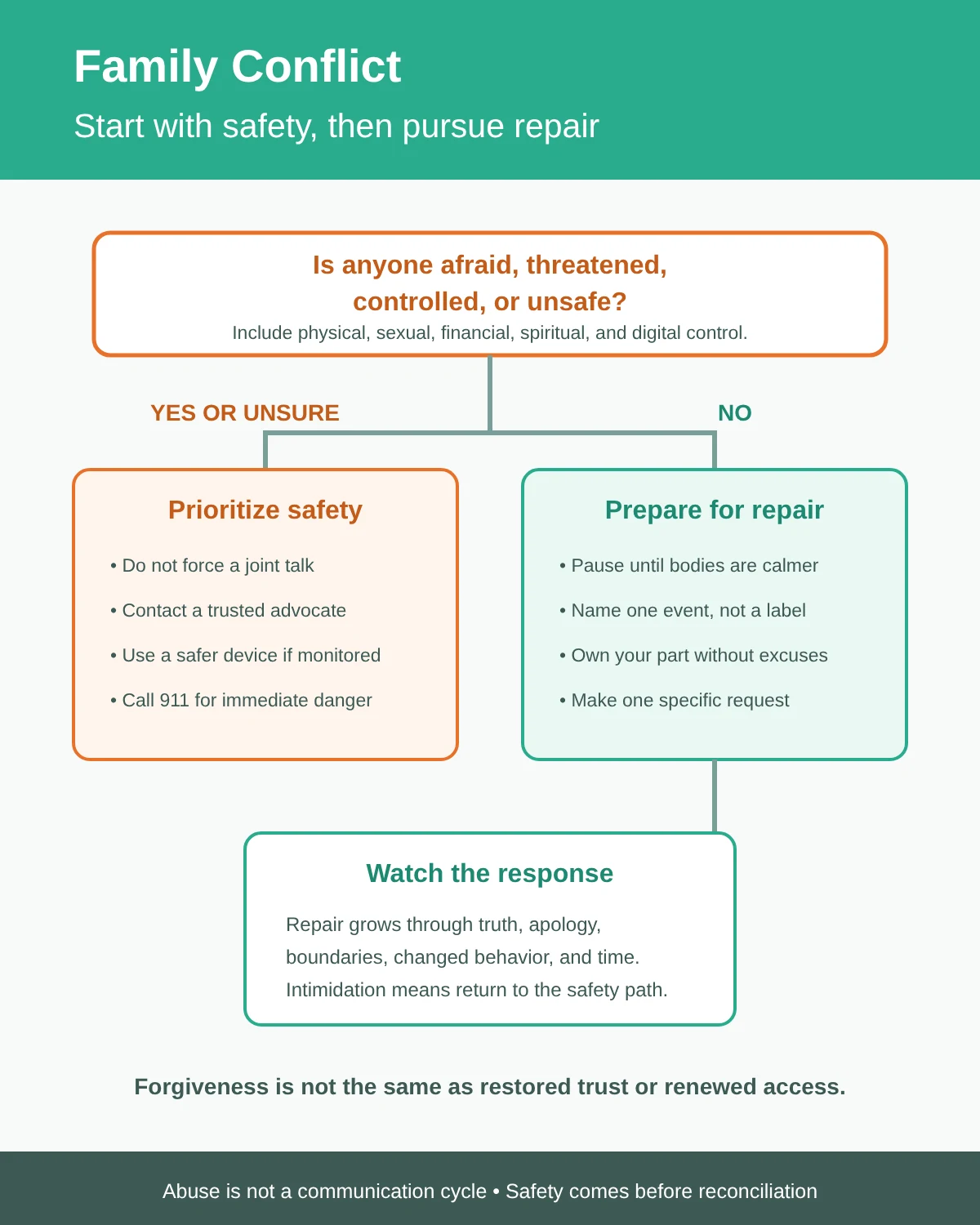
When Family Conflict Is More Than a Communication Problem
Ordinary conflict involves people who retain meaningful freedom, even when they are defensive or unskilled. Coercive control or abuse uses fear, threats, surveillance, isolation, humiliation, financial control, sexual coercion, stalking, physical force, destruction of property, or spiritual pressure to restrict another person’s choices. Nothing the Bible says about family conflict requires you to stay in danger.
Submission, honor, forgiveness, and family unity must never bypass safety, reporting, accountability, or consequences. No Biblical interpretation permits cruelty, forced sex, violence, or domination. Adult children can use our guide to Christian boundaries with controlling parents. If Scripture or church authority is being used to control, see when spiritual authority becomes coercive.
Safety Comes Before a Family Meeting
Abuse is not a communication cycle. Do not pursue a family meeting, couples work, mediation, or confrontation when coercive control, threats, or violence may be present; a shared session can increase retaliation. Seek individual help from a domestic-violence advocate or qualified professional outside the controlling person’s influence. The Hotline also offers an online safety planning tool.2
In immediate danger in the United States, call 911.
For suicidal thoughts, self-harm, emotional distress, or a substance-use crisis, call or text 988 or chat at 988lifeline.org. It is free, confidential, and available 24/7. NuWell is not an emergency service.
For domestic-violence support, call 800-799-SAFE (7233), text START to 88788, or chat at TheHotline.org. If your device may be monitored, use a safer device when possible.
How the RESTORE Path Guides Christian Family Conflict Resolution
The NuWell RESTORE Path is a flexible pastoral map, not a rigid protocol or a promised outcome. Five movements are especially relevant here:
- Recognize the wound: Name the behavior, impact, and unresolved hurt without reducing anyone to a label.
- Establish safety: Ask whether honesty, disagreement, privacy, and outside help are genuinely permitted.
- Separate truth from distortion: Test beliefs such as “Peace means nobody may be upset” or “Forgiveness means access must be restored now.”
- Tend what was wounded: Make room for grief, anger, disappointment, and the family relationship you hoped to have.
- Rebuild healthy patterns: Practice specific requests, responsible pauses, clear boundaries, apology, repair, and review.
Prayer and Scripture can steady each movement. They should never replace an apology, a report, medical or licensed care, a safety plan, or changed behavior.
When Outside Support May Help With Biblical Family Conflict
Online pastoral counseling may fit when everyone is safe and you want Biblical discernment, help preparing a conversation, or support with forgiveness and boundaries. Learn more about our pastoral support for family conflict, or see how our online process works.
Licensed mental-health care may fit when symptoms or daily functioning are significantly affected, or when you need assessment, psychotherapy, or a treatment plan. For licensed Christian counseling, we refer to our partners at Grace Christian Counseling. Medical, substance-use, domestic-violence, legal, child-protection, or emergency services may fit when those needs are present.
Related reading: When conflict ends in lost contact with a grown son or daughter, see When Your Adult Child Cuts You Off: A Christian Parent’s Next Step. If the holidays leave you feeling isolated rather than in conflict, see a Christian plan for holiday loneliness.
Related reading: For holiday tension with a teenager, see How to Help Your Teen Engage With Christmas. For seasonal overload, read Christian Holiday Stress: A Practical Plan for Peace and Wise Limits.
Frequently Asked Questions
Does the Bible say Christians should avoid all family conflict?
No. Scripture calls Christians to peace, but peace is not avoidance or false agreement. A respectful disagreement may be necessary to tell the truth, protect a boundary, make a responsible decision, or address harm. The goal is faithful conduct during conflict, not a family that never disagrees.
Does forgiveness require family reconciliation?
No. Forgiveness, reconciliation, trust, and access are related but distinct. Reconciliation requires truthful participation from more than one person. Trust grows through accountable conduct over time. A Christian can reject revenge and remain open to repair while keeping necessary boundaries.
When should a Christian family seek counseling?
Consider outside support when the same conflict keeps returning, conversations end in contempt or silence, children are being drawn into adult disputes, or the family cannot make and keep a workable agreement. Joint pastoral support may fit only when everyone can speak and choose freely. Abuse, coercive control, threats, or violence call for individual safety-focused and specialized help instead.
How can parents protect children during family conflict?
Keep children out of adult alliances, do not use them as messengers or confidants, avoid asking them to choose sides, and explain in age-appropriate language that the conflict is not their fault. Let them see calm repair when it is safe. Seek licensed support if a child shows persistent distress or changes in daily functioning.
Find Your Best Next Step
You do not have to settle the future of the entire family this week. Name one event clearly. Check freedom and safety. Own what is yours, make one specific request, and watch whether words are followed by responsible action. What the Bible says about family conflict holds grace and truth together, and it does not demand a guaranteed reconciliation.
You can meet the NuWell care team, talk with us, and see whether NuWell is the right fit without pressure or obligation.

This article was researched with the help of AI and reviewed and edited by Stephen Luther, MEd, MSEd, LPC, for accuracy, Scripture references, and faithfulness to NuWell’s non-clinical scope.
Stephen Luther, MEd, MSEd, LPC, is Executive Director and Founder of Grace Christian Counseling and a licensed professional counselor. He holds a master’s degree in Education and a master’s degree in Marriage and Family Therapy from Duquesne University and has helped children, adolescents, and adults since 1997. His licensed clinical role at Grace Christian Counseling is separate from NuWell’s non-clinical pastoral counseling and Christian life coaching services.
Scope note: This article is educational and pastoral; it is not diagnosis, psychotherapy, clinical treatment, medical or legal advice, domestic-violence intervention, or emergency care. NuWell provides non-clinical pastoral counseling and Christian life coaching.
Sources
- Zhang, X., & Wu, Q. (2026). Constructive interparental conflict and children’s outcomes: A systematic research synthesis. Journal of Marital and Family Therapy, 52(2), e70135.
- National Domestic Violence Hotline. TheHotline.org and Safety Planning Tool. Accessed October 12, 2026.
- 988 Suicide & Crisis Lifeline. About 988. Accessed October 12, 2026.
