

Faith and everyday life
You agree to one more favor even though you are exhausted. Later, resentment rises. Then you wonder whether saying no would have been selfish. Or perhaps the problem runs the other way: your plans, comfort, or need to be right keep taking priority, and the people closest to you are carrying the cost.
If you are asking what does the Bible say about selfishness, the answer is more freeing than a list of rules. Scripture confronts self-centeredness directly, but it never asks you to pretend you have no needs, limits, or worth.
Quick answerBiblical selfishness is not the same as having needs, resting, or setting a wise boundary. It is a self-centered posture that places personal advantage, comfort, control, or recognition above love for God and neighbor. Scripture calls Christians toward humility and generous concern for others without requiring self-erasure or unsafe access.
What Selfishness Is and What It Is Not
Selfishness is a pattern of treating the self as the final authority. It may show up as entitlement, using people, refusing responsibility, hoarding time or resources, controlling every outcome, or protecting an image at someone else’s expense. Sometimes it is loud. More often it hides behind respectable language such as “I am just being honest,” “I deserve this,” or “God told me,” while avoiding the impact on other people.
Selfishness is not a diagnosis or a fixed identity. Calling someone “a selfish person” can become a shortcut that ends curiosity and repair. A behavior can be self-serving without proving that every motive is corrupt. Honest discernment asks what happened, who was affected, what responsibility is mine, and what loving action is now required.
Selfishness is also not identical to self-care. Jesus invited his tired disciples to “come with me by yourselves to a quiet place and get some rest” (Mark 6:31, NIV), and he often withdrew to pray (Luke 5:16). Sleep, medical care, time with God, recreation, grief, and limits can be faithful stewardship. If rest itself stirs up guilt, NuWell’s guide to feeling guilty for self-care goes deeper. The better question is not “Did I put myself first?” but “What is motivating this choice, and does it honor God, my responsibilities, my neighbor, and the limits of being human?”
Pastoral experience: A recurring, non-identifying pattern in pastoral conversations is that some conscientious Christians label every limit selfish, while people who habitually demand access label other people’s limits unloving. Both distortions become clearer when the focus moves from guilt or accusation to motive, impact, responsibility, and fruit.
Read Philippians 2 in Its Full Direction
Philippians 2:3-4 (NIV)“Do nothing out of selfish ambition or vain conceit. Rather, in humility value others above yourselves, not looking to your own interests but each of you to the interests of the others.”
Paul does not present humility as humiliation. The movement of Philippians 2 is toward Christ, who does not exploit his status but serves in love. “Value others above yourselves” is not permission for another person to degrade you. It describes a willing posture of service, not coerced submission to sin or harm. Many translations, such as the ESV, render verse 4 “not only to his own interests, but also to the interests of others,” which reflects Paul’s aim: widening concern, not erasing the self. For a verse-by-verse look, see NuWell’s guide to Philippians 2:3-4.
The passage also speaks to a church community, not merely an isolated individual. Mutual concern is the aim. When only one person is expected to sacrifice while another remains unaccountable, the relationship is not reflecting the shared life Paul describes.
James 3:13-18 adds a useful test. Selfish ambition produces “disorder and every evil practice,” while the wisdom from heaven is “peace-loving, considerate, submissive, full of mercy and good fruit, impartial and sincere” (James 3:16-17, NIV). That does not mean every disagreement proves selfishness. It means we can examine what a pattern consistently produces. Does it make room for truth, repentance, and the good of others, or does it protect one person’s power?
Selfishness, Stewardship, and Self-Neglect
Three patterns are often confused:
Discounts others
I protect my comfort or advantage while discounting another person’s legitimate good.
Cares faithfully
I care for the life, responsibilities, relationships, and limits God has entrusted to me so I can act faithfully.
Abandons the self
I repeatedly abandon legitimate needs, responsibilities, or safety to avoid disapproval, conflict, or guilt.
Look at the fruit
No single choice settles it. Ask what the pattern consistently produces over time.
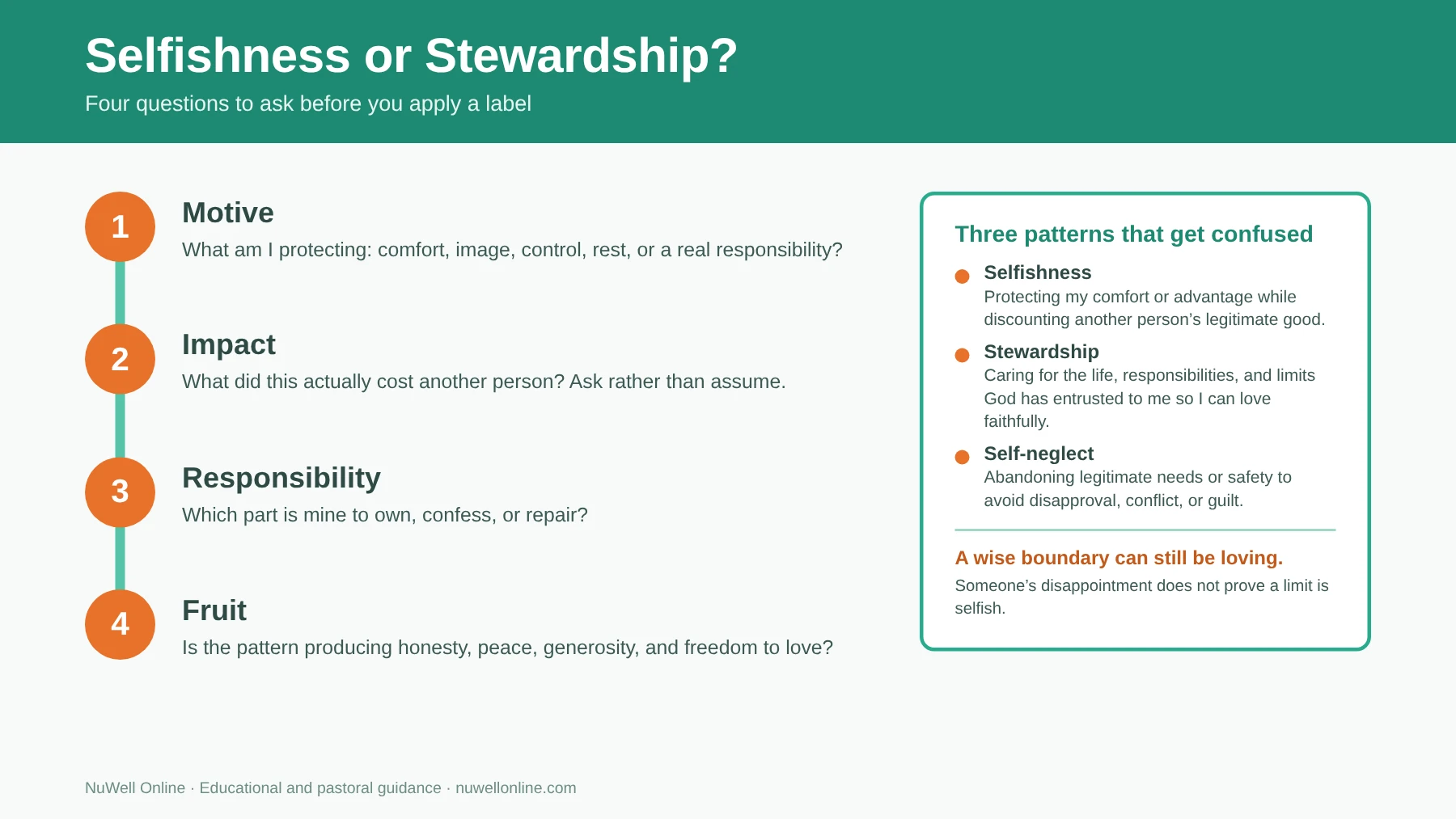
The infographic turns that distinction into four questions: What is my motive? What is the likely impact? Which responsibility is mine? What fruit is this choice producing? No single question settles every case, but together they slow down impulsive guilt and defensive self-justification.
Biblical Restoration Care begins by Recognizing the wound and Separating truth from distortion. If earlier relationships taught you that love means never saying no, that distortion needs attention. If disappointment trained you to grab control before anyone can let you down, that wound deserves honest care too. Grace does not excuse harm; it makes truthful repentance possible, and a secure identity in Christ makes it possible to admit fault without collapsing.
A Practical Sequence for This Week
Name one concrete moment
Avoid global labels. Write: “I interrupted three times,” “I agreed and then punished the person with silence,” or “I spent shared money without discussing it.” Specificity creates a path to repair.
Ask what you were protecting
Was it comfort, image, control, safety, rest, or a real responsibility? The same outward “no” can come from wise stewardship or cold indifference.
Measure impact without mind-reading
What did your action actually cost another person? Ask rather than assume. Listening is not the same as agreeing with every interpretation.
Separate conviction from shame
Conviction names a truthful next step. Shame says your failure is your identity. Confess what is yours without accepting accusations that are vague, manipulative, or false. NuWell’s article on Christian shame vs conviction explores this difference.
Repair where needed
Repairs“I made that decision without you, and it cost us both. I’m sorry. Next time I will ask first.”
Deflects“I’m sorry, but you never tell me what you want.”
A useful apology names the action and impact, takes responsibility without a “but,” and states one change you will practice. Restitution may be appropriate when time, money, trust, or opportunity was taken.
Practice one hidden act of love
Choose service that does not earn applause. Also choose one honest limit where resentment has replaced willing love.
Review the fruit
At week’s end, ask whether the pattern produced greater honesty, peace, generosity, responsibility, and freedom to love. This reflects Rebuild healthy patterns and Engage the life God intended. Change becomes credible through repeated action, not a dramatic promise.
When Someone Calls Your Boundary Selfish
A boundary identifies what you will do to protect responsibility, health, truth, or safety. It is not a tool for punishing another person. The other person may still dislike the limit.
Boundary“I will continue this conversation when we can speak without insults.”
Boundary“I cannot lend money, but I can help you find another resource.”
Selfishness can also take specific shapes in marriage, which NuWell addresses in what the Bible says about selfishness in marriage.
Selflessness Is Never a Reason to Accept Harm
Do not use “selflessness” to pressure a spouse, child, congregant, or friend into unwanted sexual contact, financial access, secrecy, unsafe reconciliation, or continued exposure to threats. Forgiveness is not reconciliation. Reconciliation is not restored trust. Personal restoration never requires renewed access to an unsafe person.
If a relationship includes coercive control, threats, stalking, or physical or sexual violence, prioritize individual safety planning rather than joint counseling.
In immediate danger, call 911.
The National Domestic Violence Hotline offers 24/7 help at 800-799-SAFE (7233), by texting START to 88788, or at thehotline.org. For suicide, self-harm, or emotional crisis, call or text 988. NuWell is not an emergency service.
When NuWell May Fit
NuWell’s online pastoral counseling or Christian life coaching may fit when you want non-clinical, Scripture-grounded support to examine motives, practice boundaries, repair relational habits, and take accountable next steps. A care conversation can help determine whether pastoral counseling or coaching better matches your goals.
Choose licensed mental-health care when depression, anxiety, trauma symptoms, compulsive behavior, or impaired daily functioning needs assessment or treatment. Seek medical care for physical concerns. Use domestic-violence or emergency services when safety is at risk. NuWell does not provide diagnosis, psychotherapy, medical treatment, or emergency response.
Frequently Asked Questions
Is it selfish to say no?
Not automatically. A no can protect a responsibility, a limit, or a safety need. It becomes self-serving when it dismisses legitimate responsibilities or another person’s good simply to preserve comfort, power, or advantage.
Does putting others first mean ignoring my needs?
No. Philippians 2:4 calls believers to look beyond their own interests to the interests of others; it corrects self-centeredness rather than commanding self-neglect. Jesus invited tired disciples to rest and taught us to love our neighbor as ourselves. Wise stewardship and neighbor-love belong together.
How do I know whether I need an apology or a boundary?
Sometimes you need both. Apologize for your action when you caused harm. Set a boundary around behavior you cannot responsibly participate in. Do not apologize merely for having a legitimate limit.
A Faithful Next Step
The Bible’s answer to selfishness is not self-hatred. It is life reordered around Christ: secure enough to listen, humble enough to repent, wise enough to steward what God has entrusted, and free enough to love without control or resentment. Choose one specific moment this week, tell the truth about it, and practice one visible change.
Talk with NuWell’s care team about whether online pastoral counseling or Christian life coaching fits the pattern you want to change, without pressure or obligation.
You can also see how NuWell’s process works.

This article was researched with the help of AI and reviewed and edited by Stephen Luther, MEd, MSEd, LPC, for accuracy, Scripture references, and faithfulness to NuWell’s non-clinical scope.
Stephen Luther, MEd, MSEd, LPC, is Executive Director and Founder of Grace Christian Counseling and a licensed professional counselor. He holds a master’s degree in Education and a master’s degree in Marriage and Family Therapy from Duquesne University and has helped children, adolescents, and adults since 1997. His licensed clinical role at Grace Christian Counseling is separate from NuWell’s non-clinical pastoral counseling and Christian life coaching services.
Scope note: This article is educational and pastoral. It is not diagnosis, psychotherapy, medical treatment, individualized professional advice, or emergency care. NuWell provides non-clinical pastoral counseling and Christian life coaching.
Sources
- Philippians 2:1-11, New International Version.
- James 3:13-18; Mark 6:31; Luke 5:16; Mark 12:31 (NIV).
- Philippians 2:4, English Standard Version, for the “not only… but also” rendering.
- National Domestic Violence Hotline. Get Help.
- 988 Suicide & Crisis Lifeline.
