

The Trap Most of Us Don’t See Coming
Selfish ambition is one of the most subtle — and destructive — forces a person can face. It doesn’t always look like greed or pride. Sometimes it looks like drive, determination, or even leadership. And that’s exactly what makes it so dangerous.
Here’s a quick answer if you need it:
Selfish ambition (Greek: eritheia) is the self-centered pursuit of personal gain, recognition, or status — often at the expense of others. The Bible contrasts it directly with humility and warns that it produces disorder, broken relationships, and spiritual harm (Philippians 2:3, James 3:14-16).
What you need to know at a glance:
- What it is: Putting your own advancement, fame, or desires above God and others
- What the Bible calls it: Earthly, unspiritual, and even demonic (James 3:15)
- What it produces: Disorder, envy, moral compromise, and relational damage
- What it’s not: All ambition is not selfish — motivation is what matters
- The antidote: Humility modeled after Jesus (Philippians 2:5-8)
We live in a culture that celebrates hustle, personal branding, and winning at all costs. “Take care of yourself first” is practically a cultural motto. But beneath the surface, many people quietly feel the emptiness that comes from climbing a ladder that’s leaning against the wrong wall.
At NuWell Online, we’ve walked alongside many faith-seeking adults who arrived burned out, relationally fractured, or spiritually hollow — often without realizing that a self-centered drive had been quietly doing the damage all along.
This guide explores what the Bible actually teaches about selfish ambition, why it’s so hard to spot in ourselves, and — most importantly — how you can move toward the freedom, wholeness, and purpose God designed you for.
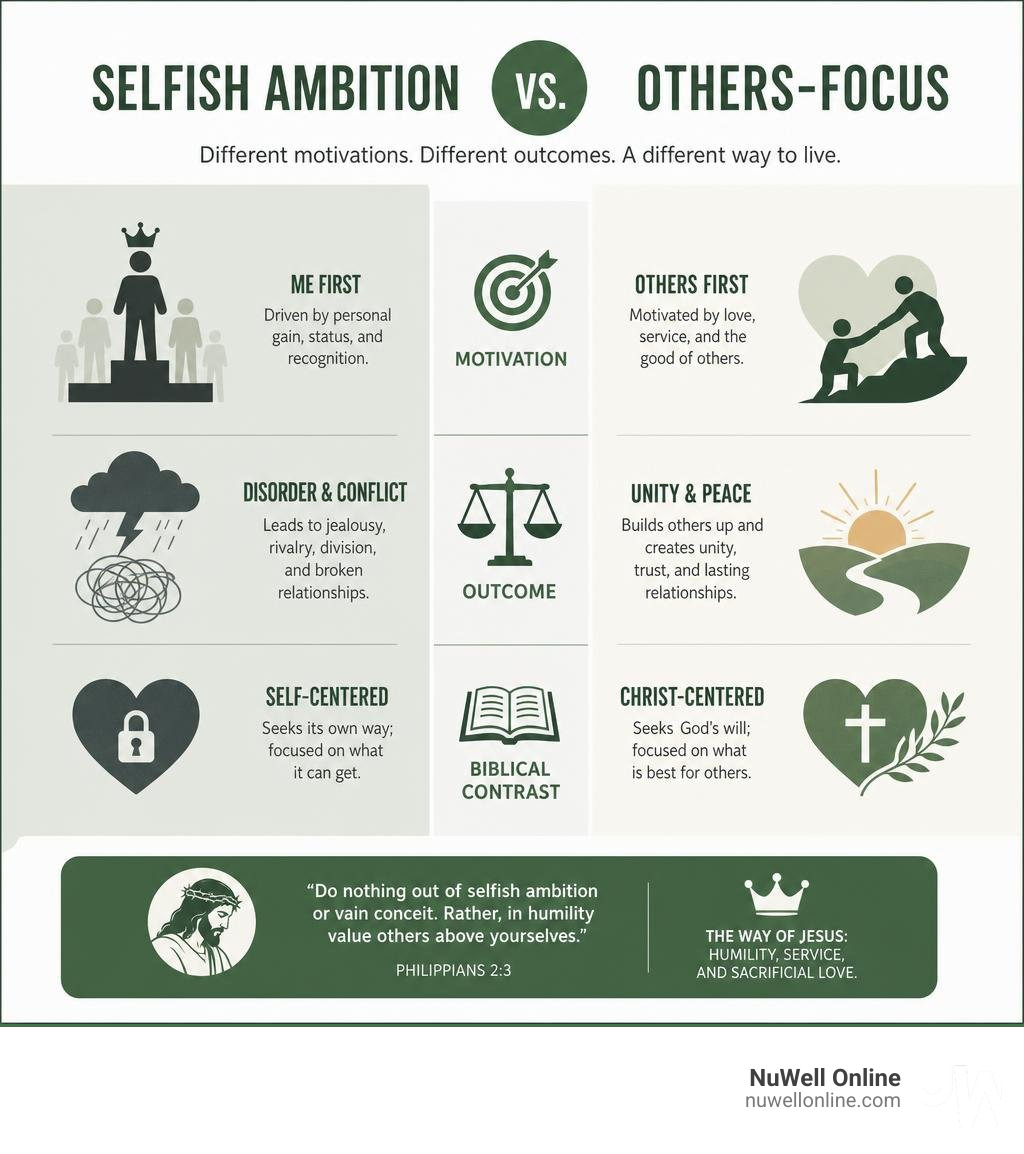
What is Selfish Ambition? Biblical Definition vs. Humility
To understand how to overcome this trap, we have to look closely at what the Bible actually says. In the New Testament, the Apostle Paul issues a direct challenge to our natural human tendencies:
“Do nothing out of selfish ambition or vain conceit. Rather, in humility value others above yourselves, not looking to your own interests but each of you to the interests of the others.” (Philippians 2:3-4)
To unpack this, we must look at the original Greek word Paul used for selfish ambition: eritheia.
Historically, eritheia did not start as a word about ambition at all. It originally referred to a day-laborer working strictly for hire—someone only interested in their own pay, with no loyalty to the work or the community. Over time, it evolved to describe a “party spirit,” self-promotion, and the kind of spineless political campaigning where a person does whatever it takes to get elected.
In a biblical context, eritheia is a contentious, self-seeking drive that places personal recognition and advancement above everything else. It is closely paired with “vain conceit” (kenodoxia), which translates literally to “empty glory.” It is the pursuit of applause that has no lasting substance.
When we operate out of eritheia, we treat other people as stepping stones rather than as image-bearers of God. To dive deeper into how Scripture categorizes these self-focused behaviors, you can read our detailed guide on What the Bible Actually Says About Being Selfish as well as our foundational study on What Does the Bible Say About Selfishness.

The Biblical Warning Against Selfish Ambition in James 3
If we think selfish ambition is simply a minor personality flaw or a necessary evil for career success, the Apostle James provides a sobering reality check. He writes:
“But if you harbor bitter envy and selfish ambition in your hearts, do not boast about it or deny the truth. Such ‘wisdom’ does not come down from heaven but is earthly, unspiritual, demonic. For where you have envy and selfish ambition, there you find disorder and every evil practice.” (James 3:14-16)
James pulls no punches here. He traces the spiritual lineage of self-centered drive and labels it “earthly, unspiritual, demonic.”
Why such harsh language? Because selfish ambition is rooted in the same pride that led to the fall of creation—the desire to be our own god, to rule our own kingdoms, and to place our desires above the Creator’s.
When we allow this mindset to take root, it acts as a spiritual contaminant. As noted in pastoral reflections on the topic, this attitude introduces chaos into our homes, churches, and workplaces. For a deeper look at this dynamic, read these Thoughts on Jealousy and Selfish Ambition – Covenant Life Fellowship. Where self-promotion rules, peace and unity are quickly destroyed, leaving behind a wake of relational “disorder and every evil practice.”
Jesus as the Ultimate Model of Humility
The ultimate weapon against selfish ambition is not simply trying harder to be nice; it is looking directly at the person of Jesus Christ.
Immediately after telling the Philippians to do nothing out of self-interest, Paul points them to the ultimate example of self-emptying love:
“In your relationships with one another, have the same mindset as Christ Jesus: Who, being in very nature God, did not consider equality with God something to be grasped; rather, he made himself nothing by taking the very nature of a servant, being made in human likeness.” (Philippians 2:5-7)
Think about the profound irony of this. The only person in human history who actually deserved all the glory, status, and power in the universe willingly chose to lay it down. Jesus did not claw His way to the top. He descended to the bottom.
We see this beautifully illustrated when He washed His disciples’ dirty feet—taking the job of the lowest servant—and ultimately when He submitted to death on a Roman cross. He chose inconvenience, suffering, and sacrifice so that we could experience life and reconciliation.
As highlighted in the guide Do Nothing Out of Selfish Ambition, when we truly grasp the depth of Christ’s self-sacrificial love, our desperate need to promote ourselves begins to fade. We no longer have to fight for our own recognition because we are already fully known, loved, and secured by God.
The Double-Edged Sword: Healthy Ambition vs. Self-Centered Drive
Does this mean all ambition is sinful? Should Christians abandon all goals, career aspirations, and desires for growth?
Absolutely not. Ambition itself is not the problem; the problem is the heart motivation behind it.

When we face choices about our future, our careers, and our callings, we often stand at a crossroads. This dilemma is beautifully captured in our reflection on The Road Not Taken. To help distinguish between a healthy, God-honoring drive and a destructive, self-centered one, consider this comparison:
| Dimension | Godly Ambition | Selfish Ambition |
|---|---|---|
| Primary Focus | The glory of God and the good of others | Personal advancement, status, and wealth |
| Source of Worth | Secure identity in Christ | External achievements and public recognition |
| View of Others | Partners to serve and elevate | Competitors to defeat or tools to use |
| Response to Failure | An opportunity for grace, learning, and growth | A terrifying threat to identity and self-worth |
| Relational Fruit | Peace, order, trust, and deep unity | Conflict, jealousy, suspicion, and isolation |
In classical virtue ethics, thinkers have long debated where ambition fits. From an ethical standpoint, ambition is a character trait that can be evaluated as a virtue or a vice depending on whether it is directed at the right objects, at the right time, and in the right manner. You can explore this academic perspective further in Ambitions | Ethical Theory and Moral Practice | Springer Nature Link.
When our drive is rightly ordered, it becomes a beautiful tool for kingdom impact. When it becomes disordered, it turns into a toxic trap.
The Roots of Selfish Ambition: Extrinsic vs. Intrinsic Motivation
Modern psychological research aligns remarkably well with these ancient biblical truths. Groundbreaking studies from the Stanford Graduate School of Business have explored the “double-edged sword” of ambition, specifically distinguishing between extrinsic and intrinsic motivators.
- Extrinsic Ambition: Driven by external rewards such as status, power, fame, and wealth.
- Intrinsic Ambition: Driven by internal values such as autonomy, personal growth, mastery, and solving meaningful problems.
The research reveals a startling connection between extrinsic ambition and ethical failure. Ambitious individuals focused heavily on status and wealth are significantly more likely to take ethical shortcuts.

According to the Stanford research, extrinsically motivated individuals showed a much higher willingness to engage in unethical behaviors, such as:
- Misrepresenting qualifications on job applications.
- Lying about performance or outcomes for personal gain.
- Selling products with known, undisclosed defects.
You can read the full insights in the Research reveals relationship between ambition and unethical behavior | Stanford Report and the academic publication Ambition as a Doubled-Edged Sword: Career Success and Unethical Behavior | Stanford Graduate School of Business.
This research confirms what Scripture has warned for millennia: when our primary goal is to elevate ourselves, our integrity is almost always the first casualty.
The Cost of Disordered Drive: Impact on Character, Leadership, and Relationships
When selfish ambition becomes the driving force of our lives, the damage is rarely confined to our professional careers. It acts like a slow-moving poison that erodes our character, fractures our relationships, and leaves our souls feeling deeply insecure.
At NuWell Online, we have seen this dynamic play out in the lives of many high-achieving leaders. They climb to the top of their fields, only to find that the view is incredibly lonely and the success feels entirely empty. This occurs because selfish ambition demands a toll that our souls were never designed to pay.
In his insightful analysis, leadership expert Carey Nieuwhof outlines several diagnostic signs that a leader’s drive has become toxic. You can read his full article, 10 Signs Your Leadership Is Driven By Selfish Ambition – CareyNieuwhof.com, but several key warning signs include:
- Your worth is tied entirely to results: You are only as good as your last win. If things go well, you feel like a god; if things fail, you feel completely worthless.
- Failure is absolutely terrifying: Because your identity is wrapped up in your achievements, a setback feels like an existential threat rather than a normal part of life.
- You use people to get ahead: You stop seeing people as individuals to love and start seeing them as resources to manage or stepping stones to your next opportunity.
- You struggle to share credit: You find it difficult to celebrate others’ success because, in your mind, their win somehow diminishes yours.
- You suffer from chronic insecurity: No matter how much you achieve, it is never enough. You are constantly looking over your shoulder, comparing yourself to others, and worrying that you will be exposed.
This constant striving creates what philosophers call “vainglory”—a disordered desire for honor that makes public recognition the ultimate goal. As explored in Understanding Selfish Ambition and Why Success Feels Empty, pursuing honor for its own sake is like eating food with zero nutritional value. It might satisfy your hunger for a moment, but eventually, you will starve.
Biblical Examples of Disordered Ambition
The pages of Scripture are filled with tragic warnings of individuals who allowed selfish ambition to dictate their choices. Their stories serve as powerful lessons for us today:
- Cain: Driven by jealousy and a desire for personal favor, his self-centered anger led him to murder his brother, Abel (Genesis 4).
- King Saul: Instead of leading God’s people with humility, Saul became obsessed with protecting his own throne and reputation. His fear of losing power drove him to hunt David, ignore God’s commands, and ultimately destroy his own legacy.
- Haman: His desperate need for public worship and honor blinded him to his own wickedness, leading him to plot the destruction of an entire people—only to end up executed on the very gallows he built for another (Esther 7).
- James and John: Even Jesus’ closest disciples were not immune. The “Sons of Thunder” pulled Jesus aside to ask for the highest positions of honor in His kingdom, completely missing His teachings on suffering and sacrifice. As detailed in the sermon study Selfish Ambition, their self-serving request caused immediate division and indignation among the other disciples.
In every single case, the pursuit of self-elevation led directly to fall, isolation, and ruin.
Overcoming Self-Centered Drive: Practical Steps to Cultivate a Servant’s Heart
If you recognize these patterns of selfish ambition in your own life, take heart. You are not stuck in this cycle. Through the power of the Holy Spirit and intentional, grace-filled practices, you can experience deep healing and transformation.
The journey toward a healthy, rightly ordered drive begins with a willing heart. At NuWell Online, we often help clients navigate these shifts by teaching them how to integrate biblical truth with practical tools for Making Godly Decisions.
Here are several daily practices you can implement to break the grip of self-centered drive and cultivate a genuine servant’s heart:
- Practice “Obscurity Exercises”: Do excellent work that absolutely nobody will see or praise you for. Clean the breakroom, help a neighbor, or complete a task at work and intentionally let someone else take the credit. This breaks the power of needing external validation.
- Celebrate Others Publicly: Force yourself to actively and enthusiastically praise the achievements of your peers, especially when you feel a twinge of jealousy. Pushing others into the spotlight is a powerful antidote to envy.
- Audit Your Motivations: Before taking on a new project, promotion, or public role, ask yourself: “Would I still want to do this if my name was never attached to it?”
- Own Your Mistakes Instantly: When you fail or make a mistake, resist the urge to spin the narrative or defend your reputation. Practice saying, “I was wrong, and I am sorry.”
- Invest in Depth Over Breadth: Instead of trying to expand your network, influence, or platform, focus on deepening your relationship with God and serving the specific people He has already placed in your immediate circle.
How to Overcome Self-Centered Drive and Walk in Godly Ambition
True freedom doesn’t mean killing your passion; it means redirecting it. When we surrender our personal kingdoms to God, we stop striving for our own glory and begin working for His.
This requires a fundamental shift from a “me-first” mentality to a “kingdom-first” mentality. When we walk in the Spirit, we allow the life of Christ to live through us. We work heartily, as for the Lord and not for human approval (Colossians 3:23).
As the resource Do Nothing Out of Selfish Ambition reminds us, we do not have to exhaust ourselves trying to build our own platforms. We can rest in the knowledge that God is the one who establishes our steps, guides our paths, and invites us to join Him in His work.
Frequently Asked Questions about Self-Centered Drive
What is the difference between healthy ambition and self-centered drive?
The difference lies entirely in the motivation of the heart. Healthy (or godly) ambition is driven by a desire to use your God-given gifts to serve others, solve meaningful problems, and bring glory to God. Self-centered drive is motivated by a fear of insignificance, a need for control, and a desire to accumulate personal status, wealth, or praise.
Why does the Bible describe self-centered drive as demonic?
In James 3:15, selfish ambition is described as “demonic” because it mirrors the original sin of Satan—rebellion against God’s authority driven by a desire for self-elevation. It produces division, pride, and chaos, which directly oppose the peace, unity, and order of God’s kingdom.
How can I tell if my career goals are driven by self-centered drive?
Ask yourself a few diagnostic questions:
- How do I handle failure? If a setback leaves you feeling completely worthless or deeply angry, your identity may be tied to your achievements.
- How do I view my coworkers? Do you see them as allies to support, or as competitors you need to outperform?
- Do I struggle to say no? If you accept every opportunity at the expense of your health, family, and spiritual life, you may be chasing validation rather than following God’s calling.
Conclusion: Finding True Rest and Wholeness
Overcoming the trap of selfish ambition is not a one-time decision; it is a daily journey of surrendering our desires to the One who loves us perfectly. When we let go of the exhausting need to prove ourselves, we finally make room to receive the peace, joy, and purpose that only God can provide.
At NuWell Online, located in North Huntingdon, PA, we are deeply committed to helping you find this healing and wholeness. Our faith-based online pastoral counseling and Christian life coaching services are specifically designed to integrate biblical truths with evidence-based practices, guiding you toward a life of genuine spiritual-emotional freedom.
You don’t have to carry the heavy burden of self-promotion anymore. Let us walk alongside you as you discover what it means to live, work, and lead with a quiet, secure, and servant-hearted confidence.
Begin your journey toward spiritual wholeness with NuWell Online today.
This article was researched with AI and heavily edited by Jordan Oliver for accuracy and relevance.
Jordan is an author, ordained minister, and online host for His Glory TV, sharing biblically grounded insights on faith, prayer, and spiritual growth. She is the co-founder of Triple-Braided Cord Co., an intercessory prayer and healing ministry inspired by Ecclesiastes 4:12.
Jordan holds a Bachelor’s degree in Communications and Religious Studies from High Point University and is a certified Spiritual Life Coach through iCoachLife in Nashville, Tennessee. Drawing from her ministry, coaching, and academic experience, she creates trustworthy, faith-based content that helps readers grow in their relationship with God. Learn more about Jordan here.
