

Faith and trauma
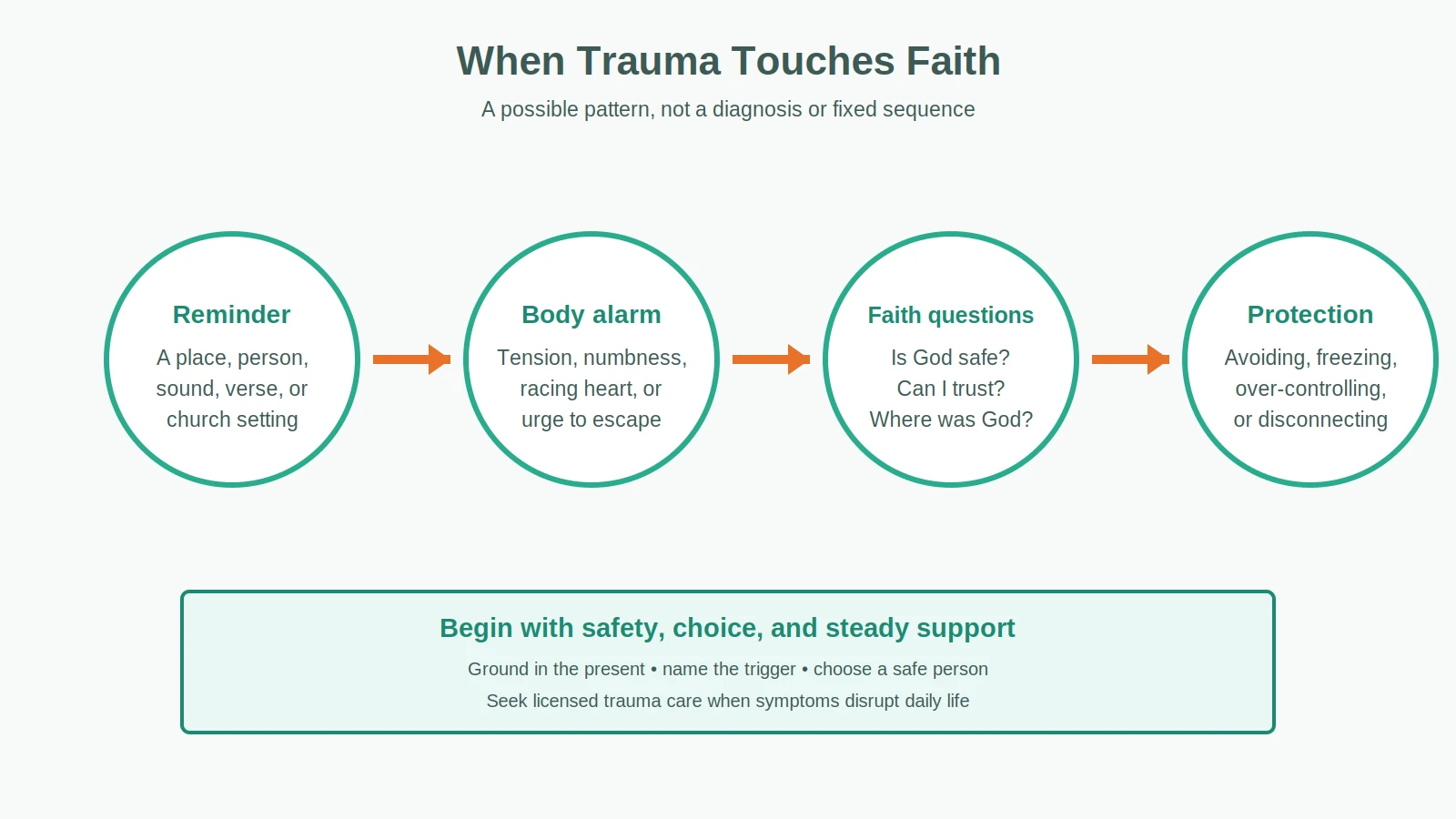
You may still believe in God and yet freeze when you try to pray. Worship music may stir grief instead of comfort. A Bible passage that once felt steady may now sound distant, or a church doorway may make your body tense before you can explain why.
If this is familiar, you are not necessarily losing your faith. You may be noticing how trauma affects faith: a deeply distressing experience can change how safety, trust, closeness, authority, and hope feel. Because Christian faith involves relationship, trust, community, memory, and the body, the effects of trauma can show up there too.
Quick answerYes. Trauma can affect concentration, trust, emotional connection, sleep, relationships, and a person’s sense of safety. Those effects may make prayer, Scripture, worship, or Christian community feel difficult or unfamiliar. That response is not a diagnosis, a fixed spiritual identity, or proof that you have failed God.
Faith after trauma may need honesty, safety, time, wise support, and room for lament. Pastoral care can help with spiritual questions and Biblical discernment. Persistent or severe trauma symptoms may require licensed mental-health care, and immediate danger or crisis requires emergency support.
Why Faith Can Feel Different After Trauma
The Substance Abuse and Mental Health Services Administration describes trauma as resulting from events or circumstances experienced as harmful or threatening that can have lasting effects on a person’s functioning and mental, physical, social, emotional, or spiritual well-being. That definition leaves room for an important truth: trauma does not affect every person in the same way.
The phrase “trauma affecting faith” names a possible pattern. It does not diagnose post-traumatic stress disorder, establish why every spiritual struggle occurs, or make trauma the whole of your identity.
Trust may feel risky, even in prayer
Trauma can teach a person to watch for danger. When the harm involved betrayal, abandonment, coercion, or someone with authority, language about trust and surrender may become especially difficult.
A Christian may agree intellectually that God is good while feeling unable to relax in His presence. Another may fear that honest anger will lead to punishment. Someone harmed by a religious leader may struggle to distinguish God’s authority from the leader’s misuse of authority.
These responses should not be shamed as rebellion. They are invitations to slow down and discern what happened, what you were taught, and what is true about God.
Spiritual practices may become harder
Prayer requires attention. Reading Scripture requires enough concentration to remain with the words. Corporate worship involves sound, people, space, and vulnerability. Trauma-related distress can interfere with each of those capacities.
A shorter prayer may be more honest than forcing a long devotional routine. Listening to one Psalm may be more accessible than completing several chapters. Sitting near an exit at church, attending online for a season, or meeting with one safe believer may be a wise accommodation rather than a spiritual defeat.
These are practical pastoral suggestions, not trauma treatment. They should support safety and agency, not become another standard by which to judge yourself.
Questions about God may become sharper
After suffering, Christians often ask: Where was God? Why did He allow this? Can I trust Him? Did I do something wrong?
The Bible does not hide such questions. Psalm 13 asks how long God will seem distant. Psalm 22 opens with a cry of abandonment that Jesus later takes on His lips at the cross. In Gethsemane, Jesus names deep sorrow and brings His desire honestly to the Father in prayer (Mark 14:32-36).
Biblical lament is not unbelief dressed up in religious language. It is truthful speech directed toward God. It refuses both despair and denial.
Romans 8:28 should not be used to hurry someone past grief or to call evil good. In context, Romans 8 also speaks of groaning, weakness, hope, and the Spirit’s help when words fail. Christian hope does not require pretending that what happened was acceptable.
Pastoral experience: In pastoral conversations, we often hear individuals describe a confusing split: “I still believe, but I do not feel close to God.” Some can discuss theology clearly while prayer, worship, or church participation feels unsafe in their bodies. The recurring need is not a lecture about trying harder. It is a patient space to name the wound, separate God’s character from what happened, and choose one honest next step without pressure.
Six Faith-Sensitive Steps You Can Use This Week
These practices are not a cure or a substitute for professional treatment. They are small ways to respond with care and clarity.
Orient yourself to the present
Before asking a large spiritual question, notice where you are now. Place both feet on the floor. Name five things you can see. Notice whether the room is safe. Take an unforced breath.
You are not trying to erase the past. You are helping your attention return to the present so you can decide what you need.
Name the spiritual effect without judging it
Complete one sentence:
- “Since what happened, prayer feels…”
- “The belief I am struggling to trust is…”
- “The church situation I now avoid is…”
- “What I wish a safe Christian understood is…”
Use plain language. “I feel numb” is enough. So is “I am angry,” “I am confused,” or “I do not know.”
Choose lament before explanation
Select a lament Psalm such as Psalm 13, 22, 42, or 77. Read slowly and notice where the writer remembers God without concealing distress.
You might pray: “God, I do not know how to understand this. Help me tell the truth in Your presence.” A prayer does not need to feel peaceful to be faithful.
Make one spiritual practice smaller
If a former routine overwhelms you, reduce its size without turning it into a test.
Read one verse. Sit quietly for two minutes. Ask a trusted person to pray without touching you. Listen to worship music at a low volume. Attend a small gathering instead of a crowded service.
The goal is not to prove devotion. It is to make room for honest connection at a pace that respects your current capacity.
Identify one safe person and one boundary
A safe person listens without demanding details, forcing forgiveness, defending the person who caused harm, or claiming to know exactly what God is doing.
A boundary might sound like:
- “I am not ready to discuss reconciliation.”
- “Please ask before praying with your hand on me.”
- “I will not meet alone with that leader.”
- “I need licensed support for this part of my experience.”
- “I am taking time before returning to that church.”
Forgiveness is not reconciliation. Reconciliation is not restored trust. Boundaries can remain necessary even when forgiveness is part of your spiritual journey.
Decide what level of care fits now
Ask whether your main need is spiritual discernment, forward-focused growth, or clinical care.
If your primary questions concern God, Scripture, faith, identity, lament, or wise spiritual boundaries, pastoral support may fit. If you are stable and ready to pursue goals, habits, purpose, or a new season, coaching may help.
If you experience intrusive memories, nightmares, panic, dissociation, severe depression, thoughts of self-harm, substance misuse, or significant disruption to daily life, seek assessment from a licensed mental-health professional. Medical symptoms should be discussed with an appropriate healthcare professional.
A Biblical Restoration Care Perspective
NuWell’s RESTORE Path is a flexible pastoral map, not a clinical protocol or a promise that every person will move in a straight line.
- Recognize the wound. Name what happened and how it affected your faith without making the wound your identity.
- Establish safety. Consider physical, relational, emotional, and spiritual safety before pressing toward disclosure or reconciliation.
- Separate truth from distortion. Examine messages such as “God caused this because I lacked faith” or “a faithful Christian must immediately trust again.”
- Tend what was wounded. Make room for grief, lament, wise support, and appropriate professional care.
- Orient identity in Christ. Remember that suffering, numbness, or another person’s actions do not determine your worth before God.
- Rebuild healthy patterns. Practice truthful prayer, safe connection, boundaries, and steady follow-through.
- Engage the life God intended. Move toward faithful participation and purpose at a pace that does not deny safety or reality.
Scripture can guide this movement without being used as a shortcut. Elijah’s story in 1 Kings 19, for example, includes rest, food, God’s gentle presence, honest conversation, and renewed direction. The passage is not a trauma-treatment manual, but it shows that God’s care is not limited to giving a command or correcting a thought.
Safety, Abuse, and Crisis Boundaries
Trauma is not always caused by abuse, and a painful faith struggle is not automatic proof of spiritual abuse. Abuse involves patterns such as coercion, threats, violence, exploitation, isolation, or the misuse of power and control.
If another person is threatening, controlling, stalking, coercing, or hurting you, the concern is not simply a shared communication problem. Do not use couples work as the first response when abuse may be present. Seek individual safety planning and qualified support.
If you are in immediate danger or need urgent police, fire, or medical help, call 911.
For suicidal thoughts, emotional distress, or a mental health or substance-use crisis, call or text 988 or visit https://988lifeline.org/. The 988 Suicide & Crisis Lifeline is available 24/7.
For confidential domestic-violence support and safety planning, call the National Domestic Violence Hotline at 1-800-799-SAFE (7233), text START to 88788, or visit https://www.thehotline.org/. If your internet use may be monitored, use a safer device when possible.
Choosing the Right Kind of Support
NuWell provides online pastoral counseling and Christian life coaching across the United States.
Pastoral counseling may fit
When you want non-clinical support for spiritual questions, Biblical discernment, lament, shame, boundaries, relationship patterns, or rebuilding spiritual confidence.
Christian life coaching may fit
When you are sufficiently stable and want forward-focused support with goals, habits, purpose, leadership, or faithful next steps.
Licensed or medical care may fit better
When you need diagnosis, psychotherapy, trauma treatment, medication assessment, substance-use treatment, or support for severe or persistent symptoms. Some people benefit from pastoral support alongside licensed care, with each provider staying within an appropriate role.
Frequently Asked Questions
Can trauma make me lose my faith?
Trauma can make faith feel distant, confusing, or unsafe, but no single response is inevitable. Spiritual numbness or difficult questions do not automatically mean you have rejected God. Give yourself room for honesty, safety, and appropriate support.
Is questioning God after trauma a sin?
Scripture contains faithful people bringing grief, protest, confusion, and unanswered questions to God. Biblical lament is honest prayer, not a demand to suppress pain. Questions can be brought to God without pretending that harm was good.
Do I have to forgive before I can heal?
Psychological healing models do not universally require forgiveness, and pressure to forgive can be harmful. Within Christian pastoral care, forgiveness should not be confused with excusing wrongdoing, abandoning justice, reconciling immediately, or restoring access. Safety and agency still matter.
Can pastoral counseling treat PTSD?
No. NuWell’s pastoral counseling is non-clinical and does not diagnose or treat PTSD. A licensed mental-health professional can assess symptoms and provide trauma-focused treatment. NuWell may support spiritual questions alongside licensed care when appropriate.
You Do Not Have to Force Faith to Feel Normal
Trauma can change the way prayer, worship, trust, and Christian community feel. That does not make the change permanent, and it does not make you spiritually defective.
Begin with what is honest. Establish safety. Let Scripture give you language for lament as well as hope. Ask for the kind of help your situation actually requires.
Talk with NuWell’s care team, explore your options, and see whether pastoral counseling or Christian life coaching may fit, without pressure or obligation.
Want to know who you would be talking with? Meet NuWell’s care team.

Stephen Luther, MEd, MSEd, LPC, is the founder and Executive Director of Grace Christian Counseling, where he serves in a licensed clinical role and has worked with children, adolescents, adults, and families since 1997. He also contributes leadership and educational insight to NuWell Online. NuWell’s pastoral counseling and Christian life coaching are non-clinical services and are distinct from Stephen’s licensed practice at Grace Christian Counseling.
Scope note: This article offers educational and pastoral information. It is not diagnosis, psychotherapy, clinical treatment, medical advice, or emergency care.
Sources
- Substance Abuse and Mental Health Services Administration, “Trauma and Violence: What Is Trauma and Its Effects?”
- U.S. Department of Veterans Affairs, National Center for PTSD, “Avoidance”: https://ptsd.va.gov/PTSD/understand/what/avoidance.asp
- American Psychological Association, The Healing Guide: https://www.apa.org/topics/trauma/healing-guide.pdf
- Kanter and Wortham, “Forgiveness and Adverse Childhood Experiences: A Scoping Review,” Trauma, Violence, & Abuse (2026): https://pubmed.ncbi.nlm.nih.gov/41618583/
