

Why Bible Verses About Husbands Role Matter in Daily Marriage
The Bible calls a husband to lead through Christlike love, not control. The clearest Bible verses about husbands role show a man who serves, protects, provides, listens, and helps his family follow Jesus.
Four passages offer a strong starting point:
- Ephesians 5:25 – Love your wife with the self-giving love Christ showed the church.
- Ephesians 5:23 – Treat headship as accountable, humble stewardship under Christ.
- Colossians 3:19 – Love your wife and reject harshness or bitterness.
- 1 Peter 3:7 – Live with understanding and show her honor as a co-heir of God’s grace.
Biblical husbandhood is not about having the final word or carrying every burden alone. It is about taking responsibility for the good of your home while treating your wife with dignity, patience, and care. In practice, that can mean praying together, asking before assuming, making room for her wisdom, owning mistakes, and choosing a gentle answer when conflict rises.
These verses also point to hope. No husband loves perfectly, but through Christ, men are created for more than passivity, anger, or fear. They can grow toward healing, wholeness, and faithful service in their marriage and family.

Bible verses about husbands role vocabulary:
- biblical responsibilities of a husband
- characteristics of a good husband according to the bible
- what is the biblical role of a husband
Essential Bible Verses About Husbands Role in Leadership and Headship

When Scripture addresses marital order, it presents leadership through the lens of redemptive stewardship rather than social dominance. The full context of Ephesians 5:22-6:4 ESV text reveals that a husband’s headship is inextricably linked to self-sacrifice, spiritual nurture, and ultimate accountability before God. Exploring the biblical role of a husband requires understanding that biblical leadership is never self-serving; it exists to cultivate the flourishing of his wife and household.
At NuWell, we have found that many men feel paralyzed between two cultural extremes: passive disengagement on one side and heavy-handed control on the other. Scripture offers a liberating path forward. True headship is not a badge of privilege—it is a calling to take initiative in loving, protecting, and shepherding.
Ephesians 5:23 and the Meaning of Christ-Centered Headship
“For the husband is the head of the wife even as Christ is the head of the church, his body, and is himself its Savior.” — Ephesians 5:23 (ESV)
With 3,258 helpful votes in online biblical study communities, Ephesians 5:23 establishes a direct comparison between a husband’s domestic role and Christ’s redemptive headship over the Church. Christ did not exercise His authority through authoritarian decrees or emotional intimidation; He exercised it through foot-washing humility and bodily sacrifice on the cross.
Biblical headship means accepting responsibility for the spiritual and emotional climate of the home. It requires balancing authority and submission in marriage by recognizing that both partners submit first to Christ (Ephesians 5:21). A godly husband does not demand obedience like a military commander. Instead, he creates an environment where his wife feels completely secure, respected, and valued as an equal partner and co-heir.
1 Corinthians 11:3 and Divine Accountability
“But I want you to understand that the head of every man is Christ, the head of a wife is her husband, and the head of Christ is God.” — 1 Corinthians 11:3 (ESV)
Paul establishes a divine chain of accountability that completely dismantles male entitlement. A husband is not the supreme authority of his home; he is a servant-leader under the direct authority of Jesus Christ. Just as Christ submitted to the Father while remaining equal in divine essence, a husband’s leadership operates within absolute submission to Jesus.
When men reflect on godly husband characteristics, this verse serves as a sober reminder: every decision, tone of voice, and reaction toward one’s spouse is observed by the Lord. Spiritual authority without personal submission to Christ quickly degenerates into fleshly pride.
Scriptural Call to Sacrificial and Christlike Love
The primary command given to husbands in the New Testament is not to rule, manage, or correct—it is to love. Specifically, Scripture uses the Greek word agape, denoting an unconditional, covenantal, and self-sacrificing devotion that seeks the highest good of the beloved.
To understand this standard, we must look at how Paul frames it in the Ephesians 5:25-26 passage:
“Husbands, love your wives, as Christ loved the church and gave himself up for her, that he might sanctify her, having cleansed her by the washing of water with the word.”
Ranked as the single most helpful passage on a husband’s duties with 3,967 votes, Ephesians 5:25 leaves no room for ambiguity. A husband is called to mirror Jesus Christ as the ultimate role model by laying down his personal preferences, comfort, and ego for his wife’s welfare.
| Dimension | Worldly Dominance & Control | Christlike Sacrificial Love |
|---|---|---|
| Source of Identity | Ego, pride, cultural power | Secure sonship in Jesus Christ |
| Primary Goal | Self-gratification, demanding compliance | Sanctification, security, and spouse’s flourishing |
| Response to Needs | Expects to be served first | Actively seeks ways to serve and wash feet |
| Handling Differences | Anger, emotional stonewalling, harshness | Empathy, active listening, gentle answers |
| View of the Wife | Subordinate or helper for his personal agenda | Co-heir of grace, cherished as his own body |
Foundational Bible Verses About Husbands Role in Loving and Sacrificing

“In the same way husbands should love their wives as their own bodies. He who loves his wife loves himself. For no one ever hated his own flesh, but nourishes and cherishes it, just as Christ does the church.” — Ephesians 5:28-29 (ESV)
Paul uses two profound Greek verbs to describe how a husband cares for his wife:
- Nourish (ektrepho): To feed, sustain, and provide everything necessary for physical, emotional, and spiritual growth.
- Cherish (thalpo): To warm, comfort, foster, and protect with tender affection.
A husband naturally tends to his own physical body—when he is hungry, he eats; when he is in pain, he seeks relief. Loving his wife as his own body means extending that same instinctive vigilance to her emotional safety, spiritual health, and relational joy. At NuWell, we have seen marriages radically transform when husbands intentionally focus on overcoming selfishness in marriage by prioritizing their spouse’s well-being above their own hobbies, routines, and leisure.
Colossians 3:19 and Eliminating Harshness in Marriage
“Husbands, love your wives, and do not be harsh with them.” — Colossians 3:19 (ESV)
Earning 3,908 helpful votes, Colossians 3:19 directly forbids harshness (pikraino—meaning to become bitter, sharp, or resentful). A husband’s strength should be a safe harbor for his wife, not a weapon that inflicts emotional bruising.
Harshness often manifests in subtle ways: a dismissive tone, sarcasm, silent treatment, or an impatient response when stress runs high. Paul warns husbands that bitterness poisons marital intimacy. When frustration arises, men must apply biblical wisdom for anger issues, bringing their emotional reactions under the guidance of the Holy Spirit to maintain a climate of tenderness.
Biblical Mandate for Providing, Protecting, and Pastoring the Home
From the Garden of Eden, God assigned man the mandate to shamar (guard, protect) and abad (work, cultivate) the home (Genesis 2:15). A godly husband functions as a loving provider, vigilant protector, and domestic pastor.
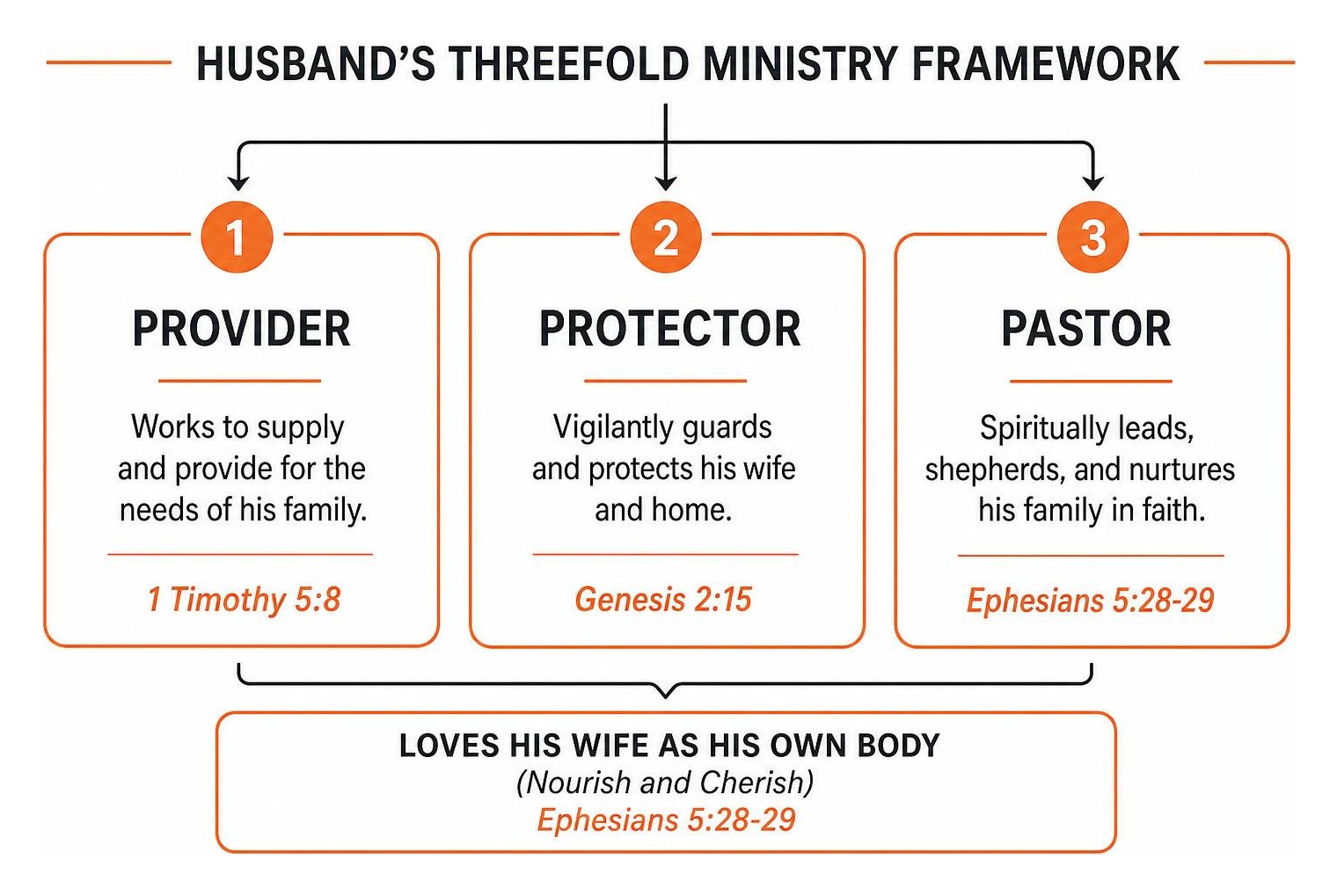
Understanding how to be a Christ-like shepherd in your marriage requires embracing each of these responsibilities with humble diligence.
Key Bible Verses About Husbands Role as Protector and Provider
“But if anyone does not provide for his relatives, and especially for members of his household, he has denied the faith and is worse than an unbeliever.” — 1 Timothy 5:8 (ESV)
With 3,275 helpful votes, 1 Timothy 5:8 presents an urgent biblical charge. Diligent labor to meet the physical and material needs of one’s family is a fundamental mark of genuine faith.
However, biblical provision extends far beyond financial stability. A godly husband provides:
- Material and Physical Security: Working diligently to supply food, shelter, and financial stewardship.
- Emotional and Psychological Safety: Shielding his wife and children from unnecessary distress, toxic influences, and neglect.
- Spiritual Grounding: Leading family devotions, cultivating shared prayer habits, and walking in integrity.
Living out the biblical responsibilities of a godly partner means recognizing that providing money while withholding affection and spiritual presence falls far short of God’s design.
Ephesians 6:4 and Spiritual Discipleship of Children
“Fathers, do not provoke your children to anger, but bring them up in the discipline and instruction of the Lord.” — Ephesians 6:4 (ESV)
A husband’s role as head of the household directly shapes his identity as a father. Paul instructs fathers to avoid provoking their children—warning against unreasonable demands, harsh punishments, hypocritical standards, or emotional absence.
Instead, fathers are called to active, tender discipleship. By applying practical tips for biblical parenting, a man helps his children encounter the goodness and love of God the Father through his own consistent character.
Walking in Gentleness, Understanding, and Conflict Resolution
Marital harmony is tested during disagreements. Scripture provides practical guidance for husbands to handle conflict with grace, humility, and proactive communication.
1 Peter 3:7: Living with Understanding and Honor
“Likewise, husbands, live with your wives in an understanding way, showing honor to the woman as the weaker vessel, since they are heirs with you of the grace of life, so that your prayers may not be hindered.” — 1 Peter 3:7 (ESV)
Receiving 3,902 helpful votes, 1 Peter 3:7 contains two vital commands and a serious spiritual warning:
- Live with understanding (gnosis): Study your wife. Learn what brings her joy, what drains her energy, and what triggers anxiety. Effective leadership is impossible without deep, empathetic attunement to your spouse.
- Show honor (time): Value her as precious, honoring her insights, intellect, and spiritual contributions. The phrase “weaker vessel” refers to physical vulnerability in the ancient cultural context, never to moral, spiritual, or intellectual inferiority—she is explicitly named an equal co-heir of the grace of life.
- The Warning: Peter warns that mistreating or neglecting one’s wife directly hinders a man’s prayers. God closes His ears to the religious rituals of a husband who treats his wife with contempt or indifference.
Cultivating healthy communication in marriage is not just a psychological recommendation; it is a foundational spiritual discipline.
Colossians 3:13-14 and Practicing Daily Forgiveness
“Bearing with one another and, if one has a complaint against another, forgiving each other; as the Lord has forgiven you, so you also must forgive. And above all these put on love, which binds everything together in perfect harmony.” — Colossians 3:13-14 (ESV)
In any long-term marriage, misunderstandings and offenses will occur. A husband walking in the Spirit chooses not to keep a record of wrongs (1 Corinthians 13:5) or let resentment take root.
When conflict strikes, choosing a soft answer turns away wrath (Proverbs 15:1). By actively resolving marriage conflict biblically and consistently practicing Christian forgiveness, a husband models the same restorative grace he has received from Christ.
Frequently Asked Questions About Biblical Husbandhood
What is the husband’s primary spiritual responsibility according to the Bible?
According to Ephesians 5:25-27, a husband’s primary spiritual responsibility is to shepherd his wife toward spiritual flourishing and sanctification. This involves praying regularly for her, leading the family in Scripture and worship, modeling integrity, and fostering an environment where she can freely exercise her spiritual gifts in service to God.
How does the Bible define a husband’s headship versus worldly dominance?
Worldly dominance relies on coercion, selfish entitlement, and unilateral demands. In contrast, Jesus defined biblical authority in Mark 10:42-45: “Whoever would be great among you must be your servant.” A Christian husband exercises headship through self-sacrificing service, gentle guidance, and putting his family’s needs before his own comfort.
What steps should a Christian husband take when marital conflict persists?
When communication breaks down or deep relational wounds persist, a godly husband should take humble initiative. Steps include:
- Owning his personal shortcomings and repenting of harshness or passivity.
- Practicing active, non-defensive listening to understand his wife’s heart.
- Seeking professional, Christ-centered support through faith-based couples counseling to receive practical, Scripture-rooted guidance for long-term reconciliation.
Conclusion
The high calling outlined in Scripture is not a set of rigid legalistic rules, but an invitation into covenant faithfulness, healing, and wholeness. God never asks a husband to lead, provide, and love in his own human strength. Through the presence of the Holy Spirit and the pattern of Jesus Christ, every man can grow into a loving shepherd and supportive partner.
At NuWell, our team of pastoral counselors and certified Christian coaches is dedicated to integrating biblical truths with evidence-based practices to help couples thrive. Whether you are navigating communication hurdles, rebuilding trust, or seeking to align your home with God’s Word, we are here to walk alongside you.
Take the next step in your marital journey by booking compassionate pastoral counseling with NuWell Online today.
Jordan is an author, ordained minister, and online host for His Glory TV, sharing biblically grounded insights on faith, prayer, and spiritual growth. She is the co-founder of Triple-Braided Cord Co., an intercessory prayer and healing ministry inspired by Ecclesiastes 4:12.
Jordan holds a Bachelor’s degree in Communications and Religious Studies from High Point University and is a certified Spiritual Life Coach through iCoachLife in Nashville, Tennessee. Drawing from her ministry, coaching, and academic experience, she creates trustworthy, faith-based content that helps readers grow in their relationship with God. Learn more about Jordan here.
