

What Does the Bible Say About Warfare?
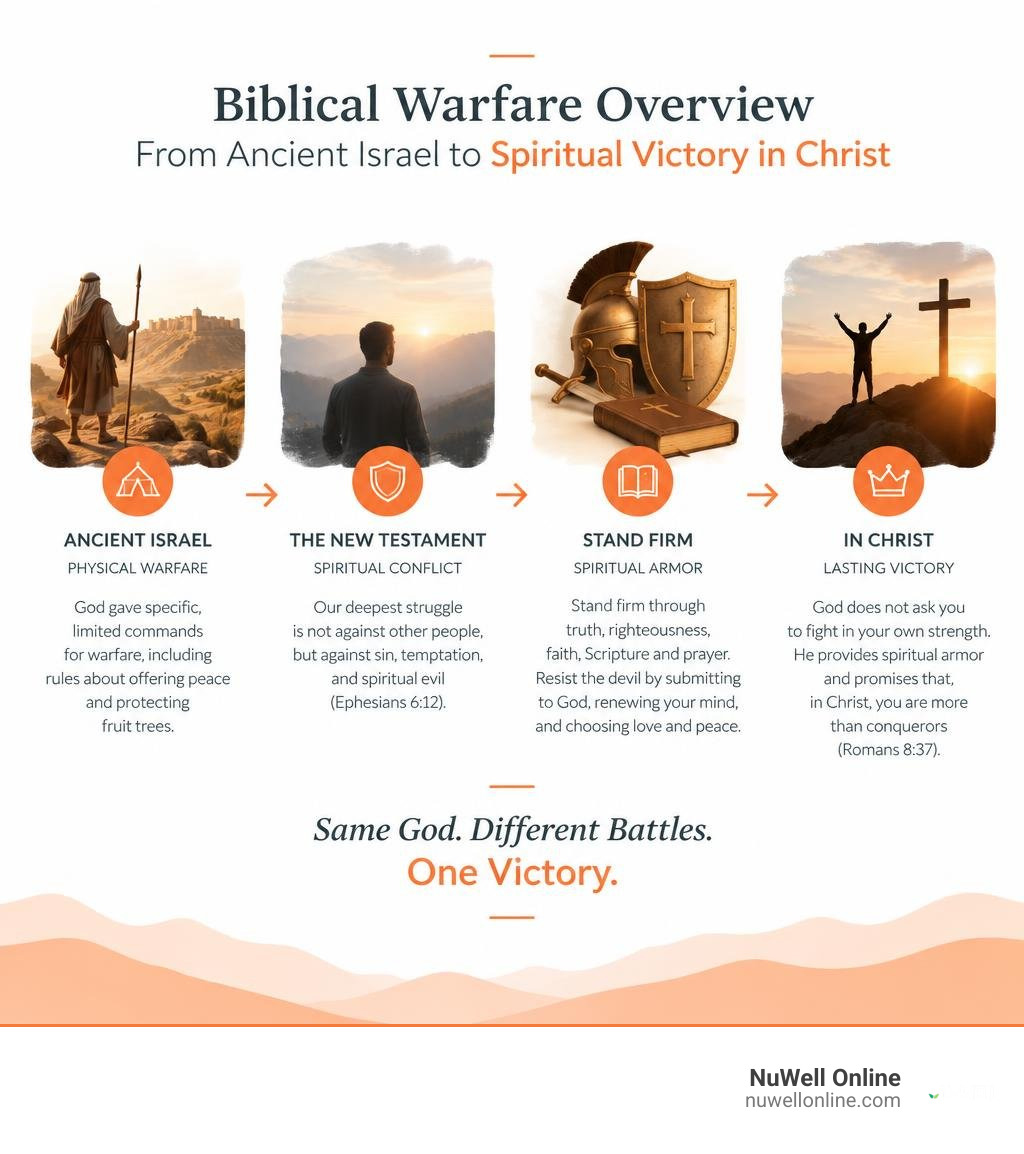
The Bible speaks about both physical war and spiritual conflict. In the Old Testament, God gave ancient Israel specific, limited commands for warfare, including rules about offering peace and protecting fruit trees. In the New Testament, the focus for believers is clear: our deepest struggle is not against other people, but against sin, temptation, and spiritual evil (Ephesians 6:12).
For Christians today, warfare is not a call to harm others. It is a call to stand firm through truth, righteousness, faith, Scripture, and prayer. We resist the devil by submitting to God, renewing our minds, and choosing love and peace even in hard relationships.
If anxiety, grief, anger, or temptation feels like a battle, Scripture offers both honesty and hope. God does not ask you to fight in your own strength. He provides spiritual armor and promises that, in Christ, believers are more than conquerors (Romans 8:37).
This guide explains the Bible’s hard passages about physical war, the believer’s spiritual battle, and the lasting victory Christ has already won.
What does the bible say about warfare terms explained:
What Does the Bible Say About Warfare: Physical vs. Spiritual Realities
To understand the biblical perspective on conflict, we must follow the progressive storyline of Scripture. The biblical narrative moves from the theocratic, physical battles of ancient Israel to the internal, spiritual struggle described by the apostles.
In the Old Testament, God established a physical nation with territorial borders, civil codes, and external enemies. In the New Testament, Jesus inaugurates the Kingdom of God—a global, spiritual kingdom that transcends geographic lines and human governments. Consequently, our weapons and battlefield have changed entirely.
| Dimension | Old Testament Warfare | New Testament Spiritual Warfare |
|---|---|---|
| Primary Domain | Physical, geographic, and national | Spiritual, psychological, and cosmic |
| Primary Enemies | Hostile pagan nations and physical armies | Sin, spiritual strongholds, and demonic forces |
| Mandated Weapons | Swords, spears, shields, and chariots | Truth, righteousness, faith, prayer, and the Word of God |
| Divine Objectives | Protecting the covenant line and judging idolatry | Advancing the Gospel, redeeming souls, and inner transformation |
| Ultimate Outcome | Earthly territory and physical rest in Canaan | Eternal reconciliation with God and total victory in Christ |
What Does the Bible Say About Warfare in the Old Testament?
In ancient Israel, military campaigns possessed deep religious significance. The historical religious significance of warfare reveals that battle was entered through sacrificial rites, priestly exhortation, and seeking the Lord’s presence through the Ark of the Covenant.
God instituted strict ethical boundaries for combat. In Deuteronomy 20-22 ESV – Laws Concerning Warfare, the Lord outlined clear regulations:
- Priestly Encouragement: Priests rallied the men before battle, reminding them not to faint, because God Himself marched with them (Deuteronomy 20:2–4).
- Humane Exemptions: Men who had recently built a house, planted a vineyard, or betrothed a wife were exempted and sent home, as were those overwhelmed by fear (Deuteronomy 20:5–8).
- Mandatory Peace Offers: Israel had to extend terms of peace before laying siege to any distant city (Deuteronomy 20:10).
- Environmental Protections: Soldiers were forbidden from cutting down food-bearing fruit trees during sieges (Deuteronomy 20:19–20).
Ancient warfare was heavily regulated, pointing to a God of justice, compassion, and ultimate sovereignty.
Physical Warfare and the Christian’s Role Under Civil Authority
In the New Testament, the responsibility for physical justice shifts from individual believers to civil governing authorities. Paul writes in Romans 13:1–4 that civil magistrates are established by God to maintain public order and bear the sword against wrongdoing.
Simultaneously, Jesus calls individual disciples to live by the ethics of the Kingdom of God. In the Sermon on the Mount, He commands us to love our enemies, bless those who persecute us, and pursue peacemaking (Matthew 5:38–44). While civil governments possess a legitimate mandate to restrain evil, believers overcome hostility with unexpected grace and radical kindness (Romans 12:20–21).
The Believer’s True Battle: Understanding Spiritual Warfare
The Apostle Paul makes an unambiguous declaration: “For we do not wrestle against flesh and blood, but against the rulers, against the authorities, against the cosmic powers over this present darkness, against the spiritual forces of evil in the heavenly places” (Ephesians 6:12).
Our ultimate adversary is never the difficult spouse, the challenging coworker, or the political opponent. Our real struggle lies within the spiritual realm. Mastering how to spot different types of biblical battles allows us to direct our spiritual energy where it truly belongs rather than attacking fellow image-bearers.

At NuWell, we have seen how emotional and psychological exhaustion often mirrors spiritual oppression. When believers realize their true opponent is spiritual, resentment falls away and true healing begins.
Pulling Down Strongholds and Renewing the Mind
Spiritual conflict takes place primarily in the mind. Paul writes, “For the weapons of our warfare are not of the flesh but have divine power to destroy strongholds. We destroy arguments and every lofty opinion raised against the knowledge of God, and take every thought captive to obey Christ” (2 Corinthians 10:4–5).
A spiritual stronghold is a deceptive mindset, habitual thought pattern, or ungodly belief system contrary to biblical truth. Gaining an understanding of spiritual strongholds biblically helps us dismantle lies such as unworthiness, bitter unforgiveness, or despair.
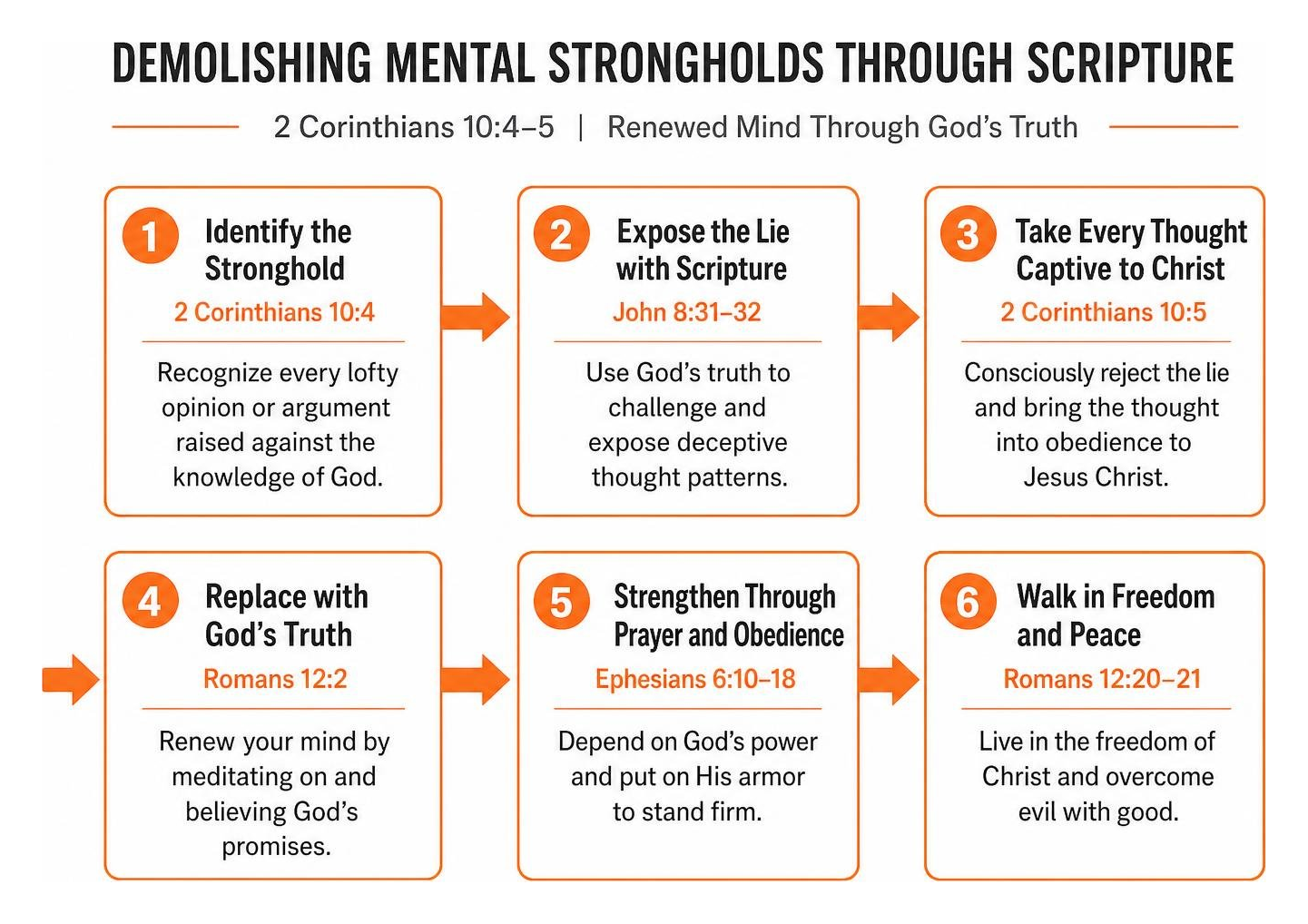
Breaking these patterns requires intentional effort. Practical strategies for winning the war within combine prayer, cognitive renewal, and scriptural meditation to replace toxic internal dialogue with God’s promises.
Equipping the Soul: The Armor of God and Divine Weapons
God does not leave us defenseless in spiritual combat. In Ephesians 6:10–18, Paul uses Roman military armor as a metaphor for spiritual defense:
- The Belt of Truth (Ephesians 6:14): Fastens our life to God’s reality, protecting us from the adversary’s deception.
- The Breastplate of Righteousness (Ephesians 6:14): Guards our heart through Christ’s imputed righteousness, shielding us from accusation and guilt.
- The Shoes of the Gospel of Peace (Ephesians 6:15): Provides stable footing rooted in the reconciliation we have with God.
- The Shield of Faith (Ephesians 6:16): Extinguishes the flaming darts of doubt, condemnation, and anxiety.
- The Helmet of Salvation (Ephesians 6:17): Protects our thoughts, memory, and identity through the certainty of eternal redemption.
- The Sword of the Spirit (Ephesians 6:17): The spoken Word of God—our primary offensive weapon against spiritual deception.
Consistently arming yourself with essential scriptures for spiritual warfare equips your mind and spirit for daily trials.
Strategic Prayer and Wielding the Word
Jesus modeled how to fight spiritual battles during His wilderness temptation (Matthew 4:1–11). When Satan challenged His identity and offered worldly shortcuts, Jesus countered each attack by declaring, “It is written.” He did not enter a debate; He wielded the Word of God with direct authority.

Prayer is the atmosphere in which the armor of God operates. Engaging in effective spiritual warfare prayers is not about reciting formulas. It is about aligning our hearts with the Holy Spirit, lifting Scripture to God, and releasing our burdens into His hands.
Standing Firm: Resisting the Devil and Claiming Final Victory
Scripture provides a clear sequence for overcoming spiritual opposition: “Submit yourselves therefore to God. Resist the devil, and he will flee from you” (James 4:7).
Spiritual authority begins with humble surrender to the Lord. We cannot resist the enemy in our own willpower. When we walk in submission to God, we can stand sober-minded against the enemy’s attempts to bring fear and division (1 Peter 5:8–9).
Our victory is grounded in historical reality:
- Disarmed at the Cross: Jesus disarmed spiritual rulers and authorities, triumphing over them through the cross (Colossians 2:15).
- Overcome by the Lamb: Believers conquer by the blood of the Lamb and the word of their testimony (Revelation 12:11).
- More Than Conquerors: In all trials, distress, and opposition, “we are more than conquerors through him who loved us” (Romans 8:37).
Frequently Asked Questions About Biblical Warfare
What Does the Bible Say About Warfare and Self-Defense?
Scripture distinguishes between malicious violence and the moral duty to protect innocent life. Old Testament civil law recognized defense of the home (Exodus 22:2), and Jesus permitted His disciples to carry defensive provisions (Luke 22:36). While Christians are called to forgive personal insults and avoid private revenge (Romans 12:19), protecting loved ones and the vulnerable from physical harm remains an ethical responsibility.
Why Did God Command War in the Old Testament?
Old Testament battles, such as the conquest of Canaan, were specific historical acts of divine judgment against extreme depravity, child sacrifice, and idolatry (Deuteronomy 9:4–5). These unique events were temporary judgments designed to preserve the covenant lineage through which the Messiah, Jesus Christ, would come to save the world.
What Is the Difference Between Spiritual Attack and Personal Sin?
Not every personal struggle stems directly from demonic activity. Scripture explains that we are often enticed by our own fleshly desires (James 1:14). Personal sin calls for confession, repentance, and behavioral accountability. A spiritual attack, on the other hand, involves external pressure, accusation, and targeted lies designed to alienate us from God’s grace. True spiritual discernment addresses both personal responsibility and the unseen spiritual battle.
Conclusion
The Bible reveals that while earthly conflicts continue, our primary battle is spiritual. In Christ, we are never victims of darkness. We are beloved children of God equipped with divine armor, the Word of God, and the Holy Spirit.
You were created for more than constant anxiety, relational turmoil, or spiritual defeat. If you are navigating intense life transitions, unresolved grief, or mental strongholds, you do not have to walk alone. At NuWell Online, our certified Christian coaches and pastoral counselors integrate biblical truth with practical, research-informed tools for holistic spiritual-emotional healing.
Reach out to schedule your online session for pastoral counseling and spiritual guidance today, and walk forward in the freedom Christ has already secured for you.
This article was researched with the help of AI and reviewed and edited by Jordan Oliver for accuracy, Scripture references, and faithfulness to NuWell’s non-clinical scope.
Jordan is an author, ordained minister, and online host for His Glory TV, sharing biblically grounded insights on faith, prayer, and spiritual growth. She is the co-founder of Triple-Braided Cord Co., an intercessory prayer and healing ministry inspired by Ecclesiastes 4:12.
Jordan holds a Bachelor’s degree in Communications and Religious Studies from High Point University and is a certified Spiritual Life Coach through iCoachLife in Nashville, Tennessee. Drawing from her ministry, coaching, and academic experience, she creates trustworthy, faith-based content that helps readers grow in their relationship with God. Learn more about Jordan here.
