

Christian discernment and care
Someone you love has stopped sleeping. They say they hear a voice, feel watched, or believe ordinary events contain a hidden message. One person calls it spiritual warfare; another says it must be mental illness. You feel pressure to decide, yet choosing too quickly could make things worse.
Quick answerWhen you are wondering about spiritual warfare or mental health, you do not need to prove the cause before you protect the person. Take unusual or frightening changes seriously, respond calmly, check for immediate danger, and seek a prompt assessment from a qualified health or mental-health professional. Prayer and wise pastoral support can accompany that care. This article cannot diagnose a condition or verify demonic causation, and neither can a symptom checklist.
Why the Either-Or Question Can Be Unsafe
Christians believe the spiritual dimension of life is real. Scripture also treats people as embodied beings whose sleep, bodies, relationships, choices, and circumstances matter. Those convictions do not require us to make a supernatural judgment about another person’s symptoms.
The National Institute of Mental Health describes psychosis as symptoms involving some loss of contact with reality. Possible signs include hallucinations, fixed false beliefs, confused speech, difficulty telling reality from fantasy, major sleep disruption, social withdrawal, or a sudden decline in functioning. Sleep deprivation, medication effects, substance use, medical conditions, or several mental-health conditions may be involved. Evaluation belongs to qualified medical and mental-health professionals, not an online article or informal ministry team.
Calling distress “only spiritual” may delay assessment. Calling every spiritual concern “only psychological” may leave a person feeling mocked. A safer response neither dismisses faith nor uses faith to explain away risk.
What This Pattern Is, and What It Is Not
The pattern here is premature spiritual labeling: reaching for a supernatural explanation before gathering basic information about safety, sleep, health, substances, medication, stress, trauma, and day-to-day functioning.
This is not a diagnosis, a fixed identity, proof of weak faith, or proof of spiritual attack. It names a decision error that can push a frightened person toward the wrong help.
A person’s fear and perceptions may feel completely real to them. You do not have to agree with an interpretation to show respect. Avoid arguing, mocking, or reinforcing frightening claims. Say: “That sounds terrifying. I am here. Let’s get help and make sure you are safe.”
Pastoral experience: In pastoral conversations, we often hear families describe the pressure to choose between prayer and professional care. The most constructive shift usually begins when they stop trying to settle the cause in the moment and agree on the next faithful action: lower the fear, protect sleep and safety, invite a qualified assessment, and keep compassionate spiritual support nearby.
A Safe Sequence You Can Use Today
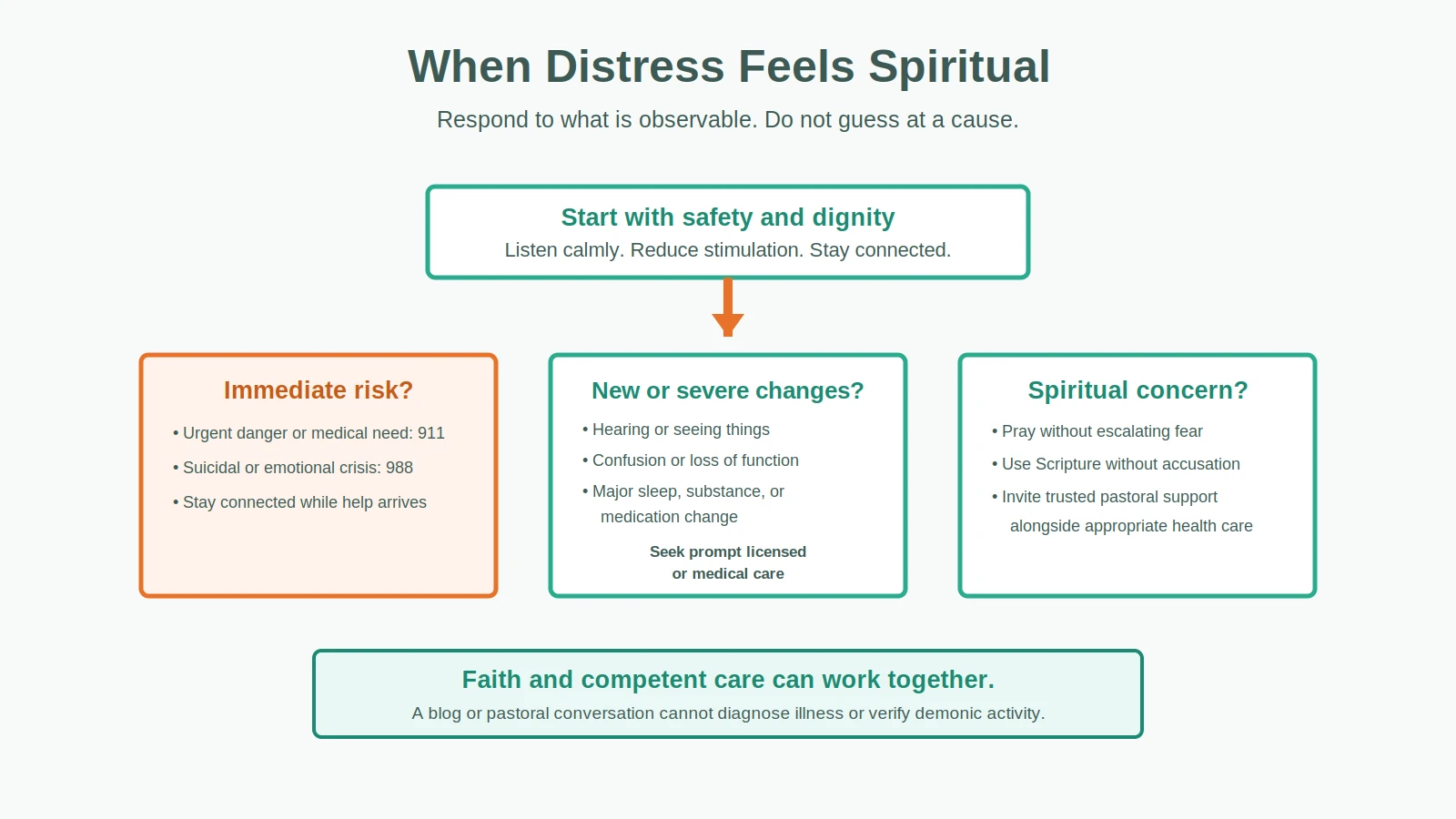
When distress feels spiritual, respond to what is observable. The nearby decision map summarizes the process: begin with safety and dignity; respond urgently to danger; seek prompt licensed or medical assessment for new or severe changes; and include calm pastoral care without replacing health care.
Slow the Room Down
Use a steady voice. Reduce noise, crowds, rapid questions, and physical pressure. Ask what would help the person feel safer. Involve one trusted support person rather than a circle debating what is happening.
Do not stage an intense prayer encounter, demand confession, threaten consequences, record the moment, or call frightening experiences proof of spiritual failure. Dignity is part of faithful care.
Check Immediate Safety
Ask calmly whether the person is thinking about suicide, self-harm, harming someone else, or whether a voice is giving dangerous commands. A clear question helps you understand the urgency.
Notice urgent medical concerns: severe confusion, inability to stay awake, suspected overdose, seizure, injury, extreme agitation, or an abrupt medication- or substance-related change. Do not leave someone alone amid immediate risk.
Gather Facts Without Playing Detective
Write down when the change began and what you can observe. Useful questions include:
- How much has the person slept in the last several nights?
- Have medications, supplements, alcohol, cannabis, or other substances changed?
- Is there fever, pain, a recent injury, pregnancy or postpartum change, or another medical concern?
- Can the person eat, drink, bathe, work, study, and communicate as usual?
- Are they hearing or seeing things others do not, or struggling to tell what is real?
These details help a professional; they are not a home diagnostic test.
Seek the Right Level of Care
New hallucinations, severe paranoia, marked confusion, rapidly declining function, or days with little sleep deserve prompt professional attention. Depending on severity, contact a physician, licensed mental-health professional, urgent behavioral-health service, or emergency department. NIMH emphasizes early care and qualified assessment.
Do not stop psychiatric medication, replace medical care with deliverance ministry, or advise someone to ignore a clinician. Medication decisions belong with the prescriber. A person may seek a competent provider who respects faith without abandoning needed assessment.
Add Pastoral Support Without Asking It to Do Everything
A mature pastor or pastoral counselor can listen, pray, separate God’s character from frightening interpretations, support family communication, and encourage follow-through. SAMHSA and the American Psychiatric Association offer resources for collaboration between faith communities and mental-health care.
Healthy collaboration has boundaries. Pastoral care should not diagnose psychosis, declare a voice supernatural, or promise prayer will remove symptoms. Clinical care cannot settle theology. Each helper should stay within a clear role.
A Biblical Posture for Discernment
Biblical discernment is patient, truthful, and open to wise counsel. First Thessalonians 5:21 says, “Test them all; hold on to what is good” (NIV). Testing is careful evaluation, not panic. Proverbs commends wise counsel, and Scripture’s attention to embodied life shows that faith does not require indifference to physical realities.
Jesus did not treat suffering people as spectacles or use suffering as a shortcut to blame. A Christian response should avoid shame, coercion, sensationalism, and certainty beyond what we know.
Pray simply for protection, wisdom, peace, truthful understanding, and courage to accept help. Use Scripture to emphasize God’s character, not to pronounce a cause. Prayer should lower fear and support wise action.
Three RESTORE Movements That Fit This Moment
NuWell’s RESTORE Path is a flexible pastoral map, not a clinical protocol.
Recognize the wound.
Name the distress without turning it into the person’s identity. The person deserves attention rather than ridicule.
Establish safety.
Address danger, sleep, medical needs, substance exposure, and trusted support before debating meaning.
Separate truth from distortion.
With appropriate helpers, distinguish observable facts from fear, assumptions, shame, and spiritual accusations.
Safety Comes Before Interpretation
Call 911 or go to the nearest emergency department for immediate danger, a life-threatening medical situation, violence, or an inability to keep the person or others safe.
Call or text 988, or use the chat at 988lifeline.org, for suicidal thoughts, self-harm concerns, emotional crisis, or urgent help deciding what to do. The 988 Suicide & Crisis Lifeline is available in the United States 24 hours a day. If the person is frightened by voices, cannot care for basic needs, has not slept for an extended period, or is rapidly losing touch with reality, seek urgent professional assessment even when there is no stated suicidal intent.
Do not gather a crowd, force a religious ritual, confront an alleged spirit, or pressure the person to disclose sin. Do not restrain them unless immediate safety requires it and emergency responders direct you. Threats, isolation, force, humiliation, and demands to stop medical care are not spiritual care.
Where Each Kind of Care Fits
| Need | Best next step |
|---|---|
| Immediate danger, severe medical concern, or violence | 911 or the nearest emergency department |
| Suicidal thoughts, emotional crisis, or urgent support | Call or text 988; use 988lifeline.org chat |
| New hallucinations, paranoia, confusion, major sleep loss, substance-related change, or declining function | Prompt assessment by a medical professional or licensed mental-health professional |
| Ongoing diagnosis, medication, psychotherapy, or treatment | Licensed clinical and medical providers |
| Biblical questions, prayer, shame, spiritual confusion, family support, and help following through on a care plan | Pastoral support alongside appropriate clinical care |
| Stable, forward-looking goals related to habits, purpose, or accountability | Christian life coaching may fit after urgent and clinical needs are addressed |
NuWell provides online pastoral counseling and Christian life coaching, not diagnosis, psychotherapy, medical treatment, or emergency care. NuWell may fit within a broader support team when the need is pastoral. Seeking licensed or medical care is not a failure of faith.
Frequently Asked Questions
Can a pastor tell whether a voice is spiritual or a mental-health symptom?
A pastor can offer Biblical reflection but should not diagnose or claim certainty about supernatural causation. New or disturbing voices warrant qualified assessment. Pastoral support can continue alongside it.
Does seeking psychiatric help show weak faith?
No. Seeking assessment is an act of stewardship when thoughts, perceptions, sleep, or functioning change. Prayer, community, and licensed care do not have to compete.
Should we pray with someone who may be experiencing psychosis?
Prayer may be welcome when it is calm, consensual, and non-accusatory. Ask permission. Avoid dramatic claims or language that reinforces paranoia, and do not let prayer delay urgent evaluation.
What if the person refuses help?
Stay calm, offer choices, involve a trusted person, and contact a local crisis service or 988 for guidance. Call 911 for immediate danger or inability to remain safe. Qualified local responders should guide emergency decisions.
Find Your Best Next Step
You do not have to solve the spiritual warfare or mental health question alone. Begin with the level of care the observable situation requires. Once immediate and clinical needs are addressed, NuWell can offer pastoral space to pray, examine spiritual fears, reconnect with Biblical truth, and build faithful next steps without pressure.
Talk with the care team, explore your options, and see whether NuWell is the right fit—without pressure or obligation.
Before reaching out, you can meet NuWell’s care team or see how the NuWell process works.

This article was researched with the help of AI and reviewed and edited by Stephen Luther, MEd, MSEd, LPC, for accuracy, Scripture references, and faithfulness to NuWell’s non-clinical scope.
Stephen Luther, MEd, MSEd, LPC, is the founder and executive director of Grace Christian Counseling. He is a Pennsylvania Licensed Professional Counselor with master’s degrees in Education and Marriage and Family Therapy and experience serving children, adolescents, and adults since 1997. His licensed clinical role belongs to Grace Christian Counseling. NuWell Online provides separate, non-clinical pastoral counseling and Christian life coaching services.
Scope note: This article is educational and pastoral. It does not provide diagnosis, psychotherapy, medical treatment, emergency care, or a method for verifying demonic causation. It is not individualized advice. Contact qualified local professionals for assessment and treatment; use 911 for immediate danger and 988 for U.S. suicide or emotional-crisis support.
Sources
- National Institute of Mental Health. Understanding Psychosis. Signs, possible causes, assessment, early care, and crisis guidance.
- Substance Abuse and Mental Health Services Administration. Community and Faith Leaders. Guidance for faith communities supporting mental health and connection to care.
- American Psychiatric Association Foundation. Mental Health and Faith Community Partnership. Resources supporting collaboration between faith communities and mental-health professionals.
- 988 Suicide & Crisis Lifeline. Official 988 Lifeline. U.S. call, text, and chat crisis support, available 24/7.

To the nuwellonline.com admin, Your posts are always well researched and well written.
Hi nuwellonline.com administrator, Your posts are always on topic and relevant.