

Why the “Don’t Try to Impress Others” Bible Verse Still Speaks to Us Today
The don’t try to impress others bible verse — Philippians 2:3 — is one of the most direct and convicting passages in the New Testament. Here is what it says:
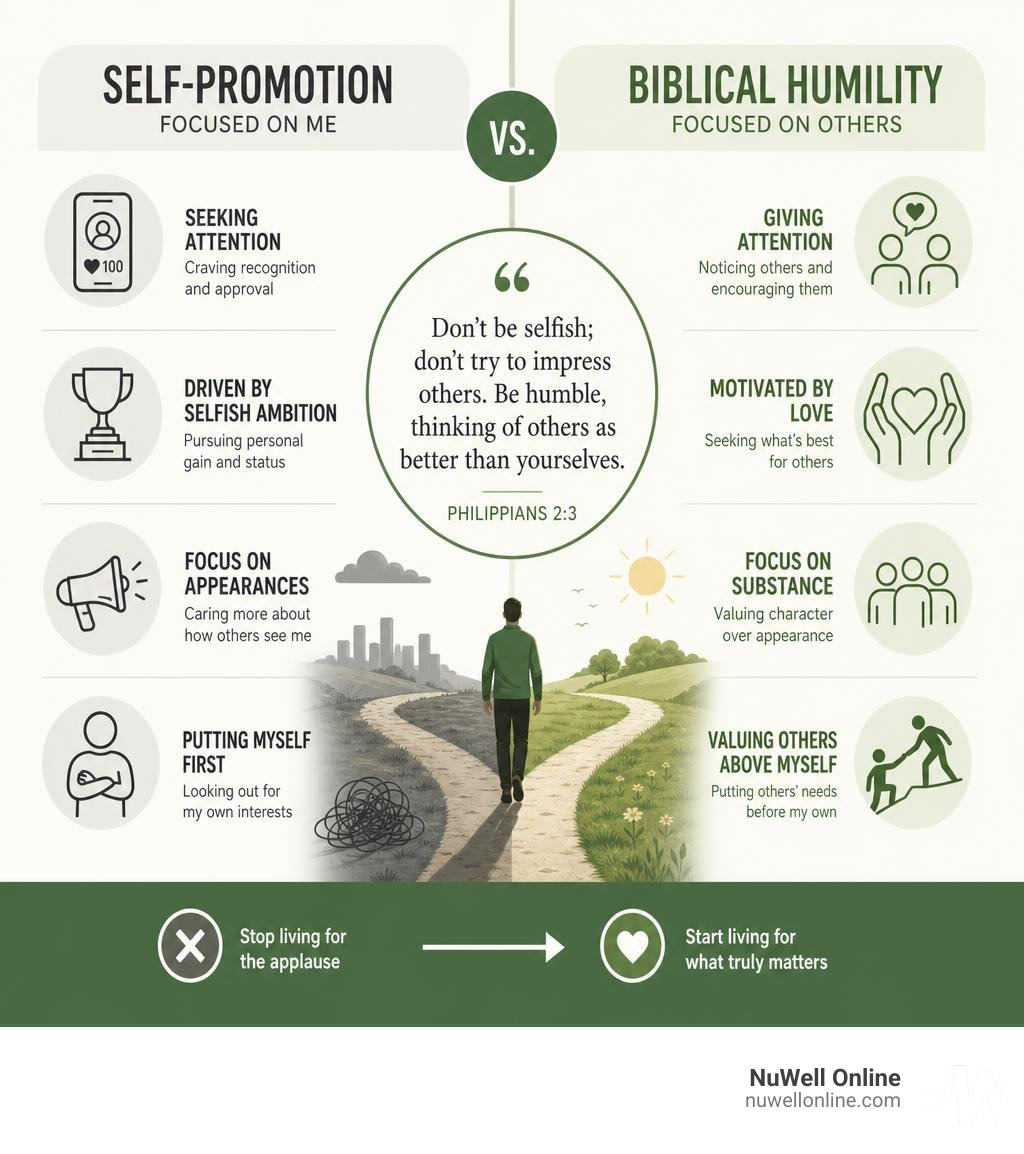
“Don’t be selfish; don’t try to impress others. Be humble, thinking of others as better than yourselves.” — Philippians 2:3, NLT
At a glance — what this verse teaches:
- Don’t act out of selfish ambition — avoid doing things just to get noticed or praised
- Don’t seek to impress others — external approval is not the goal of a Christ-centered life
- Be humble — choose a posture of genuine lowliness, not performance
- Value others above yourself — actively look out for others’ needs, not just your own
This is not just an ancient instruction. It cuts right through the noise of 2026 — a world shaped by social media highlight reels, personal branding, and the constant pressure to stand out.
According to a 2021 Barna Group study on spiritual formation, 67% of Christians report struggling with pride or the desire to impress others. Yet only 23% say they regularly practice humility in daily interactions, per a 2022 Lifeway Research survey. The gap between knowing this verse and living it is wide.
That tension — between who we want to appear to be and who God calls us to be — is exhausting. Many people searching for this verse aren’t just curious about theology. They’re tired. Tired of performing. Tired of needing approval. Tired of the weight that comes with always trying to measure up.
If that’s you, you are not alone — and this guide is for you.
Don t try to impress others bible verse terms to learn:
The Theology Behind the “Don’t Try to Impress Others” Bible Verse
To truly understand the don’t try to impress others bible verse, we have to look closely at the language the Apostle Paul used. In Philippians 2:3 NLT and Philippians 2:3-4 NLT, the Holy Spirit addresses the core motives of our hearts.
When we look at the original Greek text, three key terms stand out:
- Eritheia (Selfish Ambition): This word originally referred to a self-seeking pursuit of political office or power through unfair means. It is a partisan, “me-first” attitude that seeks to build one’s own platform at the expense of others. In Galatians 5:20, Paul actually lists eritheia as one of the works of the flesh.
- Kenodoxia (Empty Pride / Conceit): Translated in older versions as “vainglory,” this word literally means “empty glory.” It is the pursuit of applause and recognition that has no lasting substance. When we try to impress others, we are chasing kenodoxia—an empty vapor that vanishes as soon as the crowd stops looking.
- Tapeinophrosyne (Humility / Lowliness of Mind): This is the antidote. It is a deliberate, thoughtful decision to view ourselves accurately in relation to God and others. It is not self-deprecation or pretending we have no talents; rather, it is a healthy freedom from self-obsession.
When we act out of eritheia and kenodoxia, we fall into patterns of deep spiritual brokenness. If you want to dive deeper into how this impacts our walk with God, you can read our comprehensive guide on What Does the Bible Say About Selfishness.
Understanding the “Don’t Try to Impress Others” Bible Verse in Context
The Apostle Paul wrote his letter to the Philippian church while sitting in a Roman prison. Despite his chains, his primary concern was the health, joy, and unity of the believers in Philippi.
The Greco-Roman culture of the first century was highly competitive. It was built entirely on an honor-shame paradigm. Social status, public boasting, self-promotion, and securing a higher rank were considered essential civic duties. If you didn’t blow your own trumpet, you were considered weak.
Paul’s letter completely flipped this cultural script. In the passage preserved on the Philippians 2:3 Hub, Paul warns that a community built on self-promotion will eventually tear itself apart. When church members are busy trying to impress one another, division, jealousy, and gossip naturally follow. True unity is only possible when we lay down our need for status and choose to serve one another in love.
How Different Translations Render the “Don’t Try to Impress Others” Bible Verse
Reading different translations of this scripture helps us see the different facets of its meaning.
For instance, the paraphrase in Philippians 2:3 MSG brings the verse into sharp, modern focus:
“Don’t push your way to the front; don’t sweet-talk your way to the top. Put yourself aside, and help others get ahead.”
Meanwhile, the standard translations found on the Phil 2:3 Gateway page offer beautiful nuances:
- English Standard Version (ESV): “Do nothing from selfish ambition or conceit, but in humility count others more significant than yourselves.”
- New American Standard Bible (NASB): “Do nothing from selfishness or empty conceit, but with humility of mind regard one another as more important than yourselves.”
- King James Version (KJV): “Let nothing be done through strife or vainglory; but in lowliness of mind let each esteem other better than themselves.”
Whether we call it “empty pride,” “vainglory,” or “sweet-talking our way to the top,” the message is clear: God calls us to step off the performance treadmill.
Why Seeking to Impress Others is Spiritually and Emotionally Harmful

Living a life designed to impress others is like carrying a heavy, invisible backpack filled with rocks. It is exhausting, and eventually, it will break you.
At NuWell Online, we have seen how the pressure to “be enough” drains the soul. When we constantly seek human approval, we are essentially telling God that His love and acceptance are not sufficient. This leads to several destructive outcomes:
- Spiritual Cholesterol: Just as physical cholesterol blocks the flow of blood to the heart, pride and self-promotion block the flow of God’s grace in our lives. James 4:6 warns that God actively opposes the proud.
- Critical Judgments and “Playing God”: When our identity is based on being better than others, we naturally start judging them. We focus on their flaws to make ourselves feel superior. This is what theologians call “playing God”—assuming we can see and judge the motives of another person’s heart.
- Emotional Exhaustion: Trying to maintain a curated, perfect image leads to anxiety, burnout, and deep insecurity. We become terrified that people will see our real, messy selves.
If you are currently struggling with this cycle of performance and pride, we encourage you to read our practical guide on Me, Myself, and I: Overcoming the Trap of Selfish Ambition.
The Danger of Pride and Self-Promotion in Related Scriptures
The warning against self-promotion is a consistent theme throughout the Old and New Testaments.
In the Old Testament, we find wise counsel in Proverbs 25:6:
“Do not demand courtly honors or make much of yourself in the royal presence.”
Other verses remind us of the severe consequences of pride:
- Proverbs 16:18: “Pride goes before destruction, a haughty spirit before a fall.”
- James 4:6: “God opposes the proud but shows favor to the humble.”
- The Example of Diotrephes (3 John 1:9): John warns of a church leader named Diotrephes, “who loves to be first,” showing how a desire for preeminence ruins Christian fellowship.
Instead of seeking human applause, the New Testament urges us to focus on God’s evaluation. Paul writes in 1 Thessalonians 2:4 that we should speak “not to please man, but to please God who tests our hearts.” Likewise, in Galatians 1:10, he asks, “Am I now trying to win the approval of human beings, or of God? … If I were still trying to please people, I would not be a servant of Christ.”
Jesus Christ as the Ultimate Model of Humility
We are not left to figure out humility on our own. Immediately after telling us “don’t try to impress others,” Paul points us to the ultimate example of Jesus Christ in Philippians 2:5-8.
Though Jesus was God Himself, He did not cling to His divine privileges. Instead, He “emptied Himself” by taking the humble position of a servant and being born as a human being. He did not come with a marketing team, a massive public relations strategy, or a desire to build a personal brand.
Jesus washed His disciples’ dirty, dusty feet—a task reserved for the lowest household servants. He walked in simple, quiet obedience all the way to a painful, shameful death on a cross.
As explored in The Importance of Being Impressed Only By What’s Important to God, heaven measures success very differently than our culture does. God is not impressed by our charisma, our social media followers, or our professional platforms. He is moved by our obedience, our intimacy with Him, and our willingness to serve without needing recognition.
Practical Steps to Overcome the Need to Impress and Cultivate Humility
Overcoming the habit of trying to impress others requires intentional, daily practice. It is a process of shifting our foundation from self-reliant performance to a secure identity in Christ.
| Self-Reliant Performance | Christ-Centered Identity |
|---|---|
| Driven by the fear of rejection | Anchored in God’s unconditional love |
| Constantly compares self to others | Rejoices in how God uniquely made others |
| Needs to win every argument and be right | Willing to yield and listen to wise counsel |
| Exhausted by maintaining a perfect image | At peace with being a work in progress |
Here are four practical steps you can take today to cultivate true humility:
- Listen Before You Speak: Instead of waiting for your turn to talk or thinking of how to make yourself sound smart, focus entirely on the other person. Seek to understand them, not to impress them. For more on this, check out our collection of Scriptures on Taming the Tongue.
- Rejoice in Others’ Success: When someone else gets the promotion, the compliment, or the blessing, make a conscious decision to celebrate with them. Envy is the enemy of humility; celebrating others starves our pride.
- Serve Secretly: Do something kind or helpful for someone else and make a pact with yourself not to tell a single soul about it. This breaks the power of wanting human recognition.
- Examine Your Motives Daily: Before you post on social media, share a story, or sign up for a project, ask yourself: Am I doing this to serve, or am I doing this to be seen?
Balancing Healthy Self-Care with Biblical Selflessness
A common misunderstanding of the don’t try to impress others bible verse is that we must completely neglect ourselves, let others mistreat us, or pretend we have no value. This is not what the Bible teaches.
Humility is not thinking less of yourself; it is thinking of yourself less.
At NuWell Online, located in North Huntingdon, PA, we have found that true biblical selflessness must be paired with healthy, God-honoring boundaries. Jesus regularly withdrew from the crowds to rest, pray, and recharge. He cared for His physical and emotional well-being so that He could continue to do the Father’s work.
If you struggle to find this balance, we invite you to read The Road Not Taken, which discusses navigating difficult paths of personal growth and faith.
We cannot cultivate this humility in our own strength. We need the Holy Spirit to transform our hearts, quiet our insecurities, and remind us of our secure identity as God’s beloved children. If you are going through a particularly dry or stressful season, you might also find comfort in our resources like 15 Comforting Bible Verses for Troubled Times or Quick Comfort: Short Bible Verses to Strengthen Your Soul.
Frequently Asked Questions about the “Don’t Try to Impress Others” Bible Verse
What is the main meaning of Philippians 2:3?
The main meaning of Philippians 2:3 is that Christians should reject self-promotion, vanity, and competitive pride. Instead, we are called to embrace a Christlike attitude of humility that values other people and actively looks out for their well-being.
How do we balance putting others first without neglecting our own mental health?
Putting others first does not mean allowing yourself to be abused or burnt out. We practice healthy stewardship of our minds and bodies by setting godly boundaries, resting when needed, and remembering that our primary identity is found in Christ—not in our ability to please everyone around us.
What does the Bible say about seeking approval from people instead of God?
The Bible warns that the “fear of man” is a dangerous trap (Proverbs 29:25). Passages like Galatians 1:10 and 1 Thessalonians 2:4 remind us that we cannot truly serve Jesus Christ if our primary goal in life is to win the applause and approval of other people.
Conclusion
The journey away from people-pleasing and toward biblical humility is not easy, but it is incredibly freeing. When you stop trying to impress others, you are finally free to love them. You no longer have to carry the crushing weight of needing to “be enough” because Jesus has already declared that you are loved, chosen, and valued.
At NuWell Online, we are dedicated to helping you experience this deep, spiritual-emotional healing. We integrate timeless Biblical truths with evidence-based practices to help you find wholeness, ensuring all our care is rooted in Christian principles. Whether you are navigating relational stress, anxiety, or a transition in life, we are here to walk with you.
If you would like professional, faith-based guidance on your journey, we invite you to learn more about our Christian Life Coaching Services or explore our online Pastoral Counseling sessions, which are exclusively Christian-based. You don’t have to carry the burden of performance alone. Let us help you take the next step toward true peace and freedom today.
This article was researched with the help of AI and reviewed and edited by Jordan Oliver for accuracy, Scripture references, and faithfulness to NuWell’s non-clinical scope.
Jordan is an author, ordained minister, and online host for His Glory TV, sharing biblically grounded insights on faith, prayer, and spiritual growth. She is the co-founder of Triple-Braided Cord Co., an intercessory prayer and healing ministry inspired by Ecclesiastes 4:12.
Jordan holds a Bachelor’s degree in Communications and Religious Studies from High Point University and is a certified Spiritual Life Coach through iCoachLife in Nashville, Tennessee. Drawing from her ministry, coaching, and academic experience, she creates trustworthy, faith-based content that helps readers grow in their relationship with God. Learn more about Jordan here.
