

The Ancient Warning That Still Hits Home Today
The biblical command to do not esteem yourself higher than you ought comes from Romans 12:3, where the Apostle Paul writes: “Do not think of yourself more highly than you ought, but rather think of yourself with sober judgment, in accordance with the faith God has distributed to each of you.”
In plain terms, this means:
- Do not overestimate yourself. Your gifts, talents, and achievements come from God’s grace, not your own merit.
- Do not underestimate yourself either. False humility is not the goal.
- Think soberly. Aim for an honest, realistic, grace-based view of who you are.
- Use God’s measure of faith as your standard. Not comparison with others.
This is one of the most practical commands in all of Scripture — and one of the most ignored.
We live in a world that rewards self-promotion. Social media celebrates the loudest voice. Workplaces reward aggressive confidence. Even in churches, spiritual gifts can quietly become a source of status. Paul saw the same dynamic in first-century Rome and issued a direct correction.
The Greek word he used for “sober judgment” is sōphroneō — it literally means soundness of mind. Biblical humility is not self-loathing. It is sanity.
At NuWell Online, we have seen how the absence of this kind of sober self-assessment quietly fuels anxiety, relational breakdown, and spiritual stagnation. The good news? Scripture offers a clear path toward wholeness.
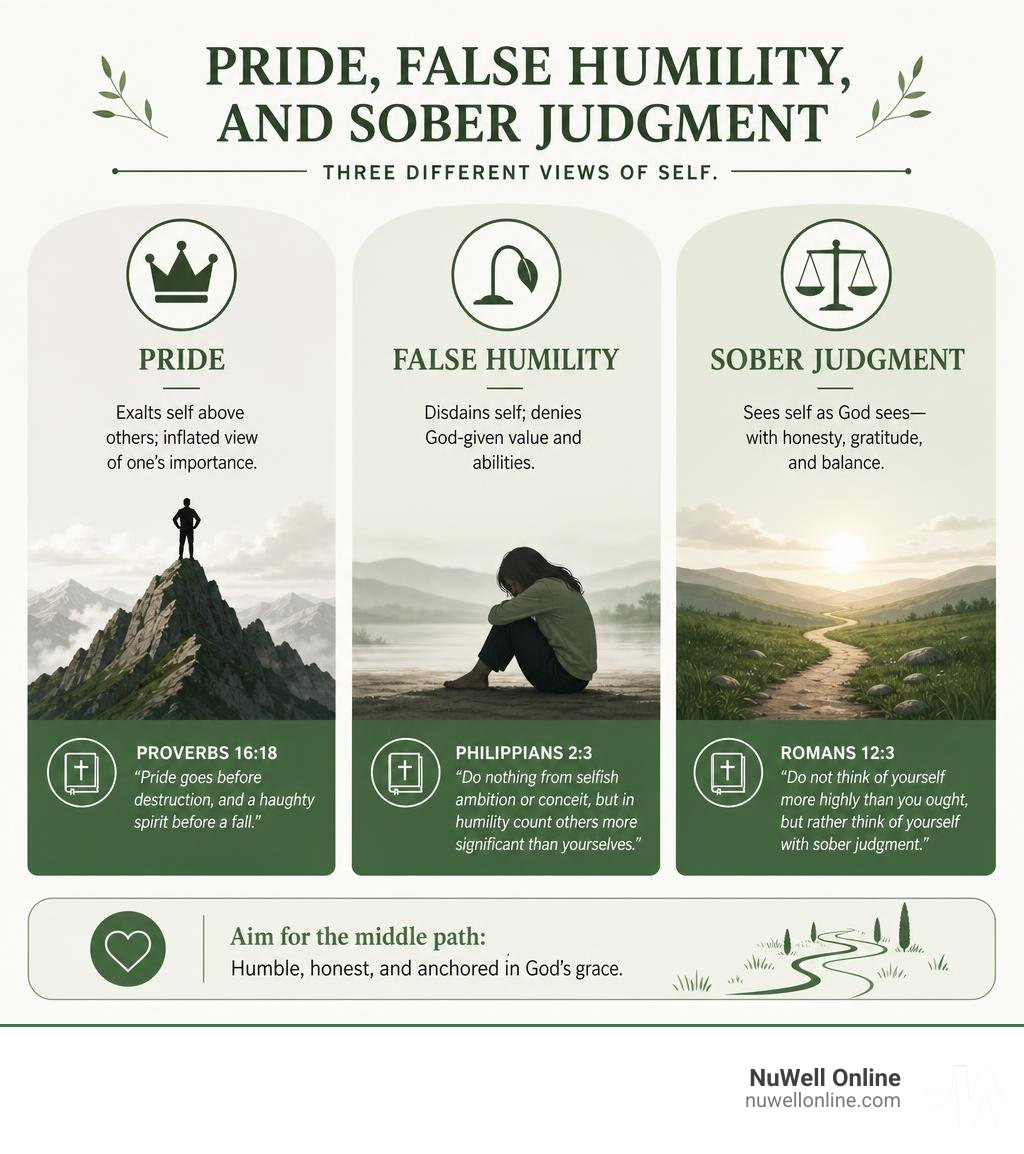
Do not esteem yourself higher than you ought word roundup:
Why Scripture Warns: Do Not Esteem Yourself Higher Than You Ought
To truly understand why the Apostle Paul issued this warning, we have to look at the cultural backdrop of first-century Rome. Roman society was deeply obsessed with social status, honor, pedigree, and public self-promotion. It was a world where your worth was determined by your wealth, your lineage, your rhetorical skill, and your civic standing. The idea of “humility” was not considered a virtue in the Greco-Roman world; rather, it was viewed as a sign of weakness, fit only for those of low birth or slaves.
When Paul wrote his letter to the Roman church, he was addressing a community that was starting to mirror this cultural obsession. Some of the early believers, particularly those with highly visible spiritual gifts like prophecy, teaching, or leadership, began to assume their gifts gave them a position of prominence over others.
Paul, more than any of the other apostles, could have claimed an elite standing in this culture. He was highly educated, possessed an impressive pedigree, and held Roman citizenship. Yet, he chose to view himself as a humble servant saved purely by grace.
In Romans 12:3, Paul makes a countercultural move. He leverages his apostolic authority not to elevate himself, but to level the playing field. He reminds the church that everything they have — every gift, every talent, and every ounce of spiritual maturity — is a direct result of unmerited favor.
When we forget this truth, we fall headfirst into the trap of self-exaltation. We begin to look at our abilities as personal achievements rather than gifts of grace. This is why we are warned to do not esteem yourself higher than you ought. This warning acts as a spiritual and emotional shield against pride, keeping us grounded in our absolute dependence on God.
For a deeper look into how pride and self-seeking can quietly corrupt our hearts, you can explore our guide on Me, Myself, and I: Overcoming the Trap of Selfish Ambition. By understanding that our value is rooted in God’s grace rather than our own performance, we can find relief from the exhausting cycle of self-promotion. To explore this biblical context further, you can read more at Why are we warned, “Do not think of yourself more highly than you ought” (Romans 12:3)? | GotQuestions.org .
What It Means to Think of Yourself with Sober Judgment
What does it actually mean to think of yourself with “sober judgment”? The Greek root word Paul uses is sōphroneō, which translates to having a sound, sane, and balanced mind. It is the opposite of being intoxicated — in this case, being “drunk on yourself” or blinded by your own self-importance.
Sober judgment is not about self-deprecation or pretending you have no talent. It is not about walking around with your head hung low, muttering that you are “nothing.” In fact, false humility is just another form of self-obsession because it keeps the focus entirely on yourself. True sober judgment is simply an honest, accurate, wise, and balanced evaluation of yourself before God. It means seeing yourself exactly as God sees you: a beautifully crafted, highly valued creation who is simultaneously completely dependent on His grace for every breath and ability.

This concept aligns beautifully with modern cognitive psychology. In mental health, realistic self-assessment is recognized as a key component of emotional intelligence and cognitive behavioral health. Conversely, a distorted self-perception often leads to psychological distress.
We can see this play out in a well-known psychological phenomenon called the Dunning-Kruger effect. This cognitive bias states that the less competent a person is in a particular area, the more confident they tend to be in their own abilities. They lack the self-awareness to see their own limitations. Interestingly, cross-cultural studies have shown distinct differences in this dynamic; for instance, American students often self-report incredibly high levels of self-confidence despite having lower objective academic competence when compared to their international peers.
When we lack sober judgment, we fall victim to this exact type of spiritual and emotional blindness. We overestimate our wisdom, dismiss feedback, and live in a state of cognitive distortion.
| Worldly Self-Esteem | Biblical Sober Judgment |
|---|---|
| Focuses on self-promotion and personal glory | Focuses on God’s glory and serving others |
| Measures worth by performance, wealth, and status | Measures worth by Christ’s love and the gift of faith |
| Encourages comparison and competition | Encourages community unity and interdependence |
| Leads to either pride or deep insecurity | Leads to emotional stability and lasting peace |
Sober judgment keeps us anchored. It allows us to acknowledge our strengths with gratitude while remaining fully aware of our limitations. If you want to dive deeper into the biblical text, you can read the passage in various translations at Romans 12:03 – Bible Gateway .
At NuWell Online, we have found that helping clients identify their true, God-given value is the first step toward breaking free from both the exhaustion of overachievement and the pain of low self-esteem. You can read more about building a healthy, grace-based identity in our article What is my identity in Christ.
Why God Gives a Measure of Faith so We Do Not Esteem Yourself Higher Than You Ought
In the second half of Romans 12:3, Paul explains how we are to make this sober self-assessment: “in accordance with the faith God has distributed to each of you.”
This is a profound theological truth. The “measure of faith” acts as both a healthy boundary and a spiritual empowerment. It means that even the very faith we use to believe in God, serve others, and exercise our spiritual gifts is a gift distributed by God Himself.
When we realize that our faith is divinely apportioned, it completely eliminates any basis for boasting. How can we look down on another believer for having “less” faith or a different role when God is the sovereign distributor of both?
This divine distribution is intentional. God does not give everyone the exact same measure of faith or the exact same spiritual gifts. If He did, the church would be a collection of identical, isolated individuals. Instead, God ordains a beautiful diversity within the body of Christ to cultivate a deep, sweet, and necessary interdependence.
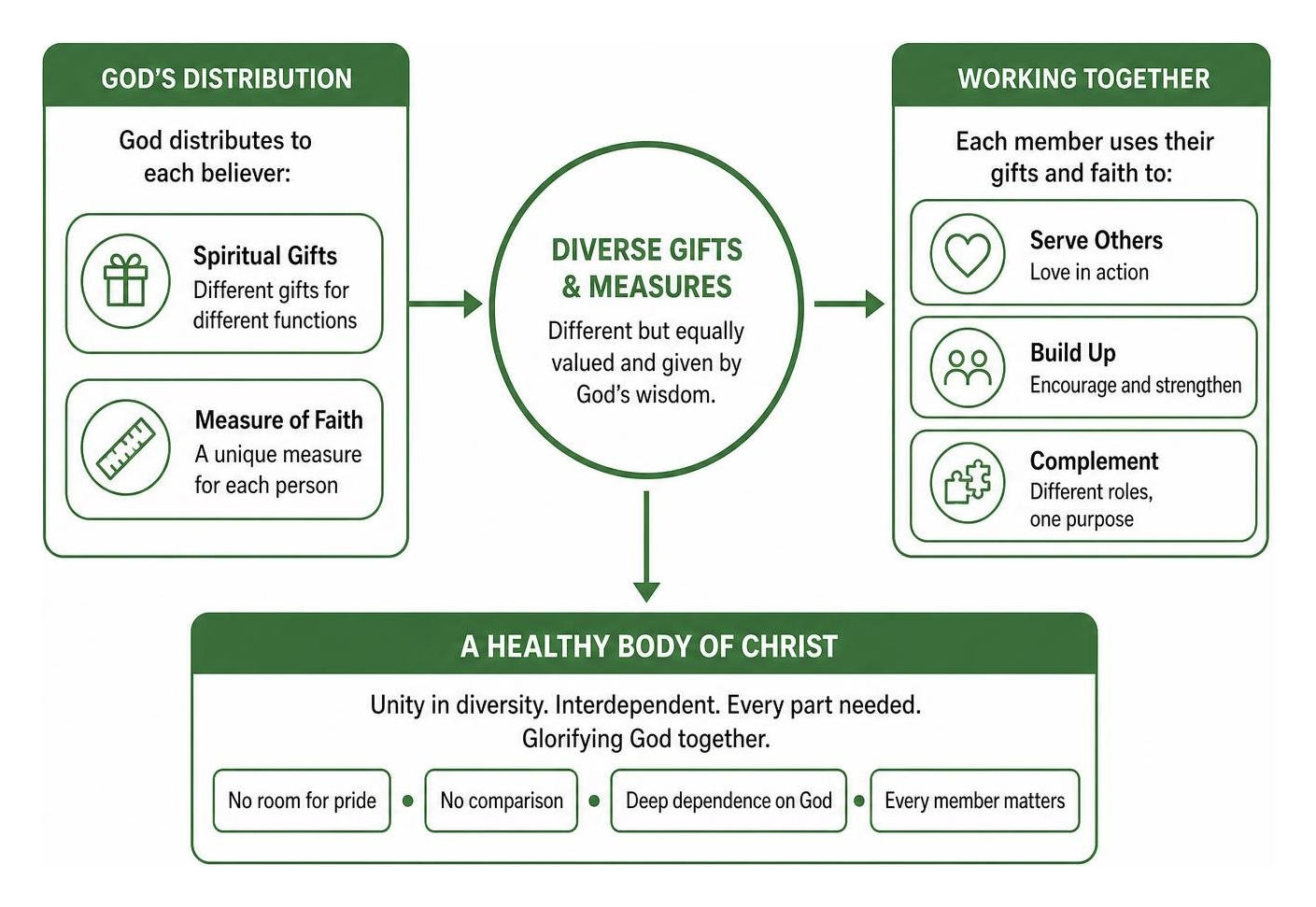
Just like a physical body has many members — eyes, hands, feet — that perform different but equally vital functions, the spiritual body of Christ requires different gifts to function healthily.
- The eye cannot say to the hand, “I don’t need you.”
- The teacher cannot say to the encourager, “My role is more important.”
- The leader cannot function without those who serve behind the scenes.
When we understand our specific “measure of faith,” we are freed from the trap of comparison culture. We no longer have to look at others with envy or feel the need to copy their calling. We can confidently serve within our God-appointed capacity, knowing that our role, however quiet or prominent, is essential to the health of the community.
Understanding the difference between the roles we play and our core identity in Christ is crucial for emotional resilience. To explore this dynamic further, check out our resource on Role vs Identity.
The Dangers of Hyperthinking and the Root of Pride
In the original Greek text of Romans 12:3, Paul engages in a brilliant play on words that is difficult to capture in English. He contrasts phronein (to think) and sōphroneō (to be sober-minded) with hyperphronein.
Hyperphronein literally translates to hyperthinking — over-thinking, or having an inflated, exaggerated, and intoxicated view of oneself.
Hyperthinking is a silent epidemic that ruins relationships, stalls spiritual growth, and creates deep emotional distress. When we engage in hyperthinking, we become what pastoral teacher Paul Tripp calls “glory junkies.” We develop an addiction to self-glory, constantly looking for ways to feed our egos.
At NuWell Online, we have found that hyperthinking typically relies on four “distorted mirrors” to maintain its false reality:
- Knowledge: We confuse intellectual information or theological study with actual spiritual maturity. We assume that because we know the right answers, we are spiritually superior.
- Experience: We assume that our years of experience or “street-level wisdom” mean we have nothing left to learn, leading us to dismiss the input of younger peers or family members.
- Success: We conflate professional achievements, financial stability, or ministry growth with personal holiness, ignoring the quiet drift of our hearts away from God.
- Recognition: We rely on the applause, approval, and recognition of others to define our worth, making us highly defensive when we receive even the mildest constructive feedback.

When we look into these distorted mirrors, we see an aggrandized version of ourselves that we believe deserves to be glorified. This makes us incredibly defensive. Why do we talk too much about ourselves? Why do we get angry when someone challenges our opinions? Because our pride is threatened.
This pride is the root cause of almost every relational conflict, marital disagreement, and church split. It prevents us from listening, makes us slow to apologize, and stops us from seeking help.
Scripture is clear about the devastating impact of selfishness and pride. If you are struggling with relational friction and suspect pride might be playing a role, we encourage you to read What the Bible actually says about being selfish to gain biblical clarity on how to address these heart-level issues.
Cultivating Humility: The Mind of Christ and the Renewal of the Mind
If pride is the disease, how do we find the cure? The ultimate model of biblical humility is found in Philippians 2:5-8, where Paul instructs us to have the same mindset as Christ Jesus:
“Who, being in very nature God, did not consider equality with God something to be used to his own advantage; rather, he made himself nothing by taking the very nature of a servant, being made in human likeness. And being found in appearance as a man, he humbled himself by becoming obedient to death — even death on a cross!”
Jesus, who possessed all authority, glory, and honor, chose to empty Himself. He did not use His divine status for self-promotion. Instead, He put on the apron of a servant and washed His disciples’ dirty feet — including the feet of Judas, who would soon betray Him.
This model of humility is unique to Christianity. It is not about self-deprecation; it is about active, sacrificial service. As the famous saying goes: Humility is not thinking less of yourself, it is thinking of yourself less.
To cultivate this mindset, we must experience a radical renewal of the mind (Romans 12:2). This is where biblical truth and practical, science-informed tools meet. At NuWell Online, we help clients use practical, Scripture-based tools to identify prideful thought patterns and replace them with truth.
When you learn to monitor your thoughts, you can catch yourself when you begin to hyperthink. You can stop comparing, refuse to take offense, and choose to respond with grace. This mental discipline builds profound emotional resilience and relational harmony.
To learn more about how to put this into practice, read our guide on how to Exercise Mental Self-Control.
Daily Practices to Ensure You Do Not Esteem Yourself Higher Than You Ought
Humility is not a one-time decision; it is a daily, active discipline. Here are practical, actionable practices we recommend to our clients at NuWell Online to help keep pride in check and cultivate sober judgment:
- Practice Charitable Judgments: Follow the Golden Rule of cognitive interpretation. Strive to believe the best about others’ motives until you have hard facts to prove otherwise. If a spouse’s or colleague’s behavior can be interpreted in two ways, actively choose the positive interpretation.
- Engage in Active Listening: In professional and personal conversations, resist the urge to formulate your response while the other person is talking. Keep your ears open, ask clarifying questions, and value their perspective.
- Admit Faults Quickly: When you make a mistake, do not make excuses or try to protect your ego. Apologize directly, take responsibility for your part in the conflict, and ask for forgiveness.
- Serve Behind the Scenes: Intentionally look for low-profile, unglamorous ways to serve your family, church, or community without seeking public recognition or applause.
- Establish Healthy Boundaries in the Home: If you are a parent, understand that teaching your children to respect authority and submit to boundaries is not “unkind” — it is a vital spiritual training regimen that builds adult resilience and protects them from the entitlement of pride.
By incorporating these habits into your daily life, you will begin to experience a profound shift in your relationships and your inner peace. For more practical communication tools that foster humility, read our article on Healthy Communication.
Frequently Asked Questions About Biblical Humility
What is the difference between healthy self-worth and pride?
Healthy self-worth is grounded in your identity as a child of God, saved by grace, and uniquely gifted to serve others. It is stable, peaceful, and does not need to put others down to feel secure.
Pride, on the other hand, is fragile and competitive. It relies on constant comparison, performance, and external recognition to feel valuable. While healthy self-worth leads to love and service, pride leads to defensiveness, anxiety, and relational conflict.
How does the gospel transform a culture of pride and revenge?
A beautiful historical example of this occurred in New Zealand in 1835. A 12-year-old Maori girl named Tarore was tragically killed during a raid by a rival tribe. She was buried with her prized possession: a Maori translation of the Gospel of Luke.
The leader of the raiding tribe, Uita, took the book. Although he couldn’t read, a literate slave eventually read the Gospel aloud to him. Hearing the words of Jesus on forgiveness and love completely broke the deeply entrenched Maori culture of pride, tribal warfare, and generational revenge.
Uita was deeply convicted. He sought out Tarore’s father, Ngakuku, to beg for forgiveness. Instead of seeking revenge, Ngakuku embraced Uita in Christian love and forgiveness. This radical act of humility sparked a massive peace revival across the warring tribes, demonstrating that the gospel has the power to dismantle even the most deeply rooted strongholds of pride.
You can read more about the healing power of releasing resentment in our article on Forgiveness as a Christian.
Can you love someone and still not trust them?
Yes. It is a common Christian misconception that loving someone requires immediately and naively trusting them after a major betrayal.
Scripture shows us that while forgiveness is a command that we must extend immediately to release resentment, rebuilding trust is a gradual process that requires a demonstrated track record of trustworthy behavior over time.
Even Jesus did not entrust Himself to everyone because He knew what was in the human heart (John 2:24). Love does not require us to ignore reality or put ourselves in unsafe situations; rather, sober judgment allows us to love others deeply while maintaining wise, healthy boundaries.
Conclusion: Finding Wholeness in True Humility
Learning to do not esteem yourself higher than you ought is not a call to a joyless, self-deprecating life. It is an invitation to true emotional and spiritual freedom.
When we lay down the exhausting burden of self-promotion, comparison, and pride, we find the peace of sober judgment. We are freed to love others sincerely, serve our communities joyfully, and rest securely in our identity in Christ.
At NuWell Online, we are committed to walking alongside you on this journey toward spiritual-emotional wellness. Our team integrates timeless Biblical truths with evidence-based counseling and coaching practices to help you find lasting healing and wholeness.
Whether you are struggling with marital conflict, anxiety, spiritual plateaus, or simply want to cultivate a healthier self-image, we are here to help.
We offer professional online sessions, allowing you to connect with us from the comfort of your home. If you live in the Pennsylvania area, you can also connect with our local ministry efforts. Our physical office is located at:
NuWell Online
8700 Pennsylvania Ave,
North Huntingdon, PA, USA
Are you ready to take the next step on Your Journey toward a healthier, more balanced life? Contact us today to book an online session with one of our pastoral counselors or certified Christian life coaches. Let us help you cultivate the sober judgment and humble confidence that leads to true wholeness.
- Learn more about our Pastoral Counseling Services
- Discover how Christian Life Coaching can help you find your purpose.
- Explore the path of Biblical Selflessness to transform your relationships.
This article was researched with the help of AI and reviewed and edited by Jordan Oliver for accuracy, Scripture references, and faithfulness to NuWell’s non-clinical scope.
Jordan is an author, ordained minister, and online host for His Glory TV, sharing biblically grounded insights on faith, prayer, and spiritual growth. She is the co-founder of Triple-Braided Cord Co., an intercessory prayer and healing ministry inspired by Ecclesiastes 4:12.
Jordan holds a Bachelor’s degree in Communications and Religious Studies from High Point University and is a certified Spiritual Life Coach through iCoachLife in Nashville, Tennessee. Drawing from her ministry, coaching, and academic experience, she creates trustworthy, faith-based content that helps readers grow in their relationship with God. Learn more about Jordan here.
