

Habits and healing
You meant to respond differently. Then criticism, loneliness, an unfinished task, a tempting notification, or fear showed up. Before long, you were hiding, snapping, scrolling, spending, people-pleasing, controlling, or giving up again. Regret followed: “Why do I keep doing this?”
Quick answerA behavior cycle is a repeating sequence in which a situation sets off a familiar meaning, an emotion or body response, an action, and a result. That result can make the same response more likely next time. A Christian can interrupt the cycle by noticing it without self-condemnation, testing the story against truth, tending real pain, choosing one faithful alternative, and practicing it with support. This is a practical map, not a diagnosis or a promise that every pattern changes through willpower.
What Is a Behavior Cycle?
A behavior cycle describes how a response becomes repeated and reinforced. There is no single universal cycle for every problem. Habit research does show that repeated behavior becomes linked to situational cues, so a familiar context can prompt an action with little deliberation.[1] Cognitive approaches also examine how situations, interpretations, emotions, and behavior influence one another.[2]
For everyday reflection, it helps to map five parts:
Situation or trigger
Something happens outside or inside you: a comment, memory, place, time of day, sensation, conflict, opportunity, or feeling. “Trigger” does not automatically mean trauma; it simply names what set this sequence in motion.
Meaning or thought
You interpret what happened, often in one fast sentence: “I am being rejected.” “I have to fix this now.” “I have already failed.” The thought may contain truth, distortion, or both.
Emotion and body response
Fear, anger, shame, sadness, desire, or numbness may arrive with a racing heart, fatigue, restlessness, or shutdown. Feelings offer information, not infallible verdicts. Body responses are not moral failures.
Action or avoidance
You act or avoid: raise your voice, withdraw, hide something, overwork, spend, seek reassurance, open an app, or put off a task. The action still matters even when it happens fast.
Immediate payoff and longer result
The behavior may lower distress, avoid a hard conversation, protect an image, or bring brief comfort. That payoff helps explain the repetition; it does not make harm harmless. Later results may include guilt, distance, lost time, or broken trust, and those results can become the next trigger.
A cycle mapped out
My supervisor asks for a revision. I think, “I am incompetent.” My chest tightens and I feel shame. I avoid the project and scroll. I get ten minutes of relief, then the deadline pressure and the shame grow.
That kind of precision creates more room for a faithful choice than the label “I am lazy.”
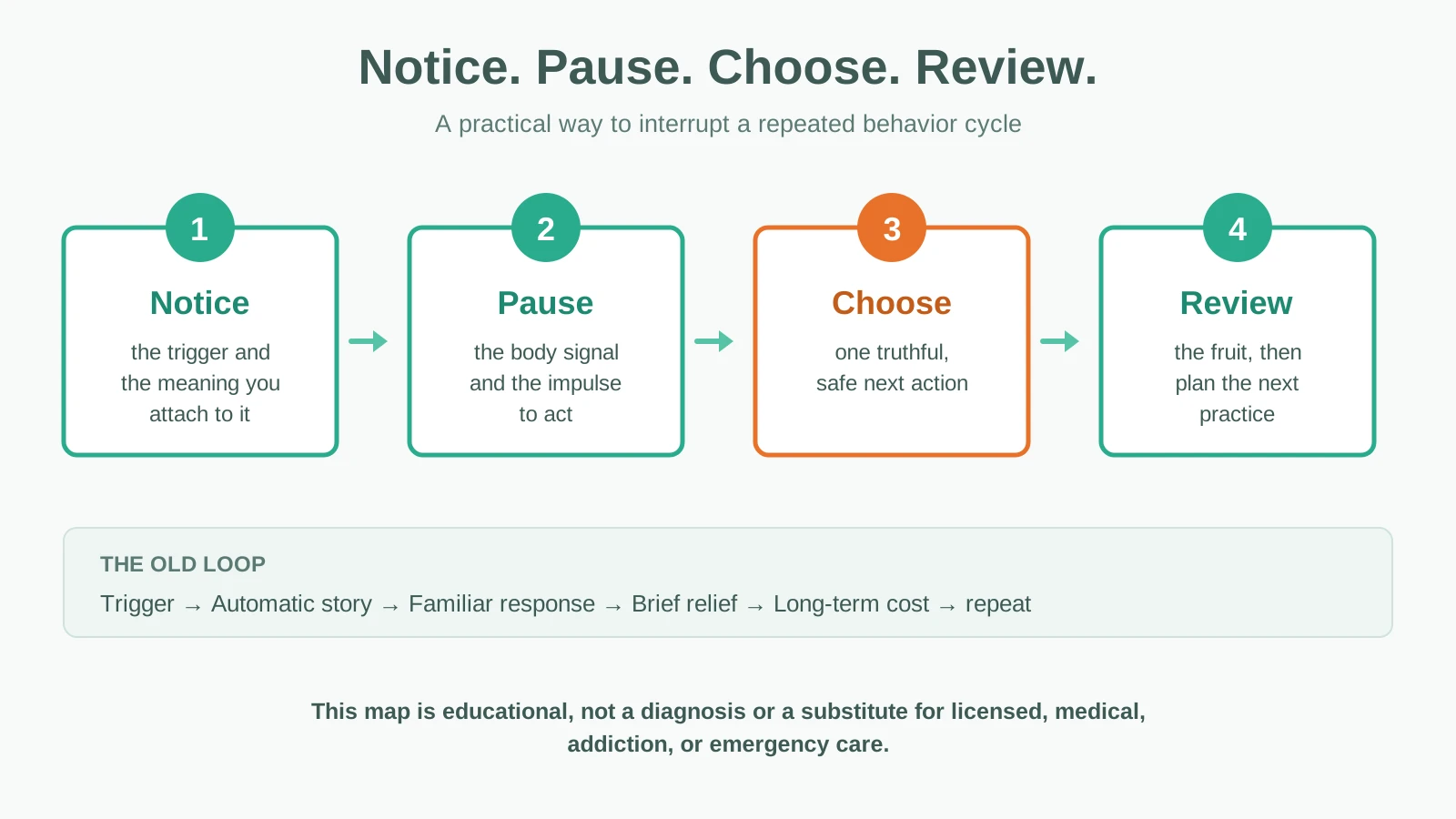
What the Cycle Is Not
A behavior cycle is not a diagnosis, a fixed identity, or proof of spiritual weakness. It does not establish addiction, trauma, compulsion, or any other mental-health condition. Nor is a behavior necessarily sinful because it repeats. Those questions need appropriate moral, pastoral, medical, or clinical assessment.
Pain can help explain a response without excusing harm. Responsibility can be named without making shame the engine of change. Scripture distinguishes godly sorrow that leads toward repentance from worldly sorrow that brings death (2 Corinthians 7:10). Conviction is specific and turns toward truth; condemnation declares that failure is your identity and hope is gone.
This guide is different from NuWell’s article on spiritual strongholds. “Stronghold” is a biblical metaphor that needs careful interpretation. A behavior cycle is a descriptive tool for observing what happens before and after an action. Neither term should be used to frighten, diagnose, or label another person.
Pastoral experience: A recurring, non-identifying pattern in pastoral conversations is that people describe the final action vividly but overlook the few minutes before it. When they slow the sequence down, they often find a painful interpretation, a body signal, and a small moment where support or a different response could enter. That insight does not remove responsibility. It replaces a vague promise to “do better” with a more truthful place to begin.
You do not need a perfect explanation before asking for help
Tell NuWell’s care team the broad pattern and what you hope will change. We can help you consider whether pastoral counseling, coaching, licensed care, or another resource is the most responsible fit.
A Six-Step Practice to Use This Week
Choose one specific pattern. This exercise is for situations where you can reflect and act safely. It is not a safety plan for abuse, severe addiction, self-harm, or a psychiatric emergency.
Record one real sequence
For seven days, write down the situation, meaning, emotion and body response, action, and result. Note the time, place, fatigue, isolation, conflict, or easy access when relevant.
Name the payoff honestly
Ask, “What did this response do for me in the moment?” It may have offered escape, relief, control, approval, stimulation, or protection. Naming the payoff helps you look for a safer response while still taking responsibility for harm.
Test the meaning
Write down the automatic thought, then ask:
- What facts support it?
- What facts complicate it?
- Am I predicting, mind-reading, catastrophizing, or turning one event into an identity?
- What does Scripture say, read in context?
- Is there real danger or harm that should not be spiritually minimized?
Replace distortion with precise truth, not forced positivity: “I made a mistake that I need to correct; it does not erase my dignity or my ability to act responsibly.”
Choose a response small enough to practice
Pick a concrete action close to the decision point: breathe slowly, move the phone, tell the truth, take a walk, ask for a responsible pause, call a support person, or leave an unsafe setting.
Researchers call one useful planning format an implementation intention: linking a recognizable cue to a chosen response in an “if-then” plan. Reviews find these plans can support goal-directed behavior, though results vary by problem, design, and setting.[3] A plan supports action; it is not a guarantee.
Try an if-then plan
“If I notice myself opening social media after a difficult email, then I will put both feet on the floor, name what I am feeling, and work on the reply for five minutes before deciding what comes next.”
Change the environment and invite support
Remove easy access, add a reminder, avoid a high-risk setting, or arrange accountability. Context matters. A pastor, friend, pastoral counselor, coach, physician, licensed clinician, recovery group, or advocate may each play a different role.
Review without hiding or catastrophizing
At the end of the week, ask what cues showed up, what helped, and what needs more support. A lapse is neither proof that change is impossible nor permission to minimize consequences. Confess, repair, adjust, and take the next faithful action.
If the repeating pattern is a couple’s pursue-withdraw loop, NuWell’s guide to the same argument in marriage is a better fit than assuming both spouses play the same role.
Renewal of the Mind Is More Than Positive Thinking
“Do not conform to the pattern of this world, but be transformed by the renewing of your mind.”
Romans 12:2 (NIV)
Romans 12:2 follows Paul’s explanation of God’s mercy and opens his teaching on embodied worship, humility, sincere love, patience, and peace. Renewal is not denying pain or repeating slogans. It is learning to live in response to God’s mercy and truth.
Second Corinthians 10:5 describes taking thoughts captive in the context of Paul confronting arguments raised against the knowledge of God. It should not be used to shame intrusive thoughts or suggest that every unwanted thought is chosen. Philippians 4:8 calls believers to dwell on whatever is true, noble, right, pure, lovely, and admirable, and the first word is “true.” Biblical reflection begins with reality.
Several movements of the NuWell RESTORE Path fit this work:
- Recognize the wound: Notice the sequence and what pain, temptation, belief, or unmet need is present.
- Establish safety: Address danger, coercion, intoxication, access to lethal means, or other urgent risks before ordinary habit work.
- Separate truth from distortion: Test both the automatic story and any spiritual slogan used to avoid reality.
- Tend what was wounded: Make room for grief, rest, medical care, licensed care, confession, restitution, or support as needed.
- Rebuild healthy patterns: Practice the new response repeatedly and review its fruit.
Prayer belongs in this process, but prayer should not replace apology, boundaries, treatment, safety planning, or concrete action.
When This Framework Is Not Enough
Abuse is not a mutual behavior cycle. Threats, intimidation, stalking, monitoring, isolation, financial control, forced or pressured sex, physical violence, or spiritual control require individual safety planning. Do not split responsibility equally or recommend joint counseling where coercive control or violence may be present. The National Domestic Violence Hotline does not encourage anyone in an abusive relationship to seek counseling with their partner.[4]
In immediate danger, call 911.
Contact the National Domestic Violence Hotline at 800-799-SAFE (7233), text START to 88788, or chat at thehotline.org. If your devices may be monitored, use a safer device when possible.
Call or text 988 or visit 988lifeline.org for suicidal thoughts, self-harm, emotional distress, or an alcohol or drug-use crisis.[5] NuWell is not an emergency service.
Seek licensed mental-health care, such as Grace Christian Counseling, when the pattern involves severe depression, panic, trauma symptoms, obsessive thoughts or compulsions, mania, psychosis, eating-disorder behavior, self-harm, or major impairment. Seek specialized substance-use or behavioral-addiction care when use is compulsive, dangerous, escalating, or accompanied by withdrawal or loss of control. Seek medical care for sudden changes in mood or behavior, medication effects, sleep disruption, pain, or other physical concerns.
NuWell’s non-clinical online pastoral counseling may fit when you want Scripture-grounded reflection, prayer, accountability, help naming a pattern, or discernment about a faithful next step. Christian life coaching may fit a stable, present-focused goal involving habits and accountability. Neither service provides diagnosis, psychotherapy, addiction treatment, medical treatment, domestic-violence intervention, or emergency care.
Frequently Asked Questions
Is a repeated behavior always a habit?
No. Repetition alone does not explain why something happens. A response may involve learned cues, a deliberate choice, pressure from the environment, the effects of trauma, a medical issue, a mental-health condition, substance use, or several factors at once. Use the cycle to observe, not to diagnose.
Does “take every thought captive” mean I should be able to stop unwanted thoughts?
No. In 2 Corinthians 10:5, Paul is addressing arguments and claims that oppose the knowledge of God. The verse supports truthful discernment and allegiance to Christ; it should not be turned into blame for intrusive thoughts. Persistent, frightening, or impairing thoughts deserve compassionate licensed assessment.
Can Christian life coaching help me change a behavior cycle?
Coaching may help when you are stable and working on a clear, forward-focused habit or goal. Pastoral counseling may be a better fit for spiritual confusion, shame, forgiveness, or biblical discernment. Licensed, medical, addiction, domestic-violence, or emergency services are more appropriate when those needs are present.
Begin With One Honest Loop
You are more than the behavior you regret. Change begins neither with denial nor with a permanent label, but with truth: what happened, what it meant to you, what you felt, what you did, what it produced, and where a different response can enter. Map one loop this week. Choose one precise truth, one small alternative, and one person who can support your follow-through.
Share the broad concern, without private details, and NuWell’s care team can help you consider a responsible next step.
See how NuWell’s process works.

This article was researched with the help of AI and reviewed and edited by Stephen Luther, MEd, MSEd, LPC, for accuracy, Scripture references, and faithfulness to NuWell’s non-clinical scope.
Stephen Luther, MEd, MSEd, LPC, is Executive Director and Founder of Grace Christian Counseling and a licensed professional counselor. He holds a master’s degree in Education and a master’s degree in Marriage and Family Therapy from Duquesne University and has helped children, adolescents, and adults since 1997. His licensed clinical role at Grace Christian Counseling is distinct from NuWell’s non-clinical pastoral counseling and Christian life coaching services.
Scope note: This article is educational and pastoral. It is not diagnosis, psychotherapy, addiction treatment, medical treatment, individualized professional advice, domestic-violence intervention, or emergency care. NuWell provides non-clinical pastoral counseling and Christian life coaching.
Sources
- Gardner, B. (2015). A review and analysis of the use of “habit” in understanding, predicting and influencing health-related behaviour. Health Psychology Review, 9(3), 277–295.
- Center for Substance Abuse Treatment (1999). Brief Cognitive-Behavioral Therapy, in Brief Interventions and Brief Therapies for Substance Abuse (TIP 34). Cited for its description of how events, thoughts, feelings, and behavior interact; NuWell does not provide CBT.
- Hagger, M. S., & Luszczynska, A. (2014). Implementation intention and action planning interventions in health contexts. Applied Psychology: Health and Well-Being, 6(1), 1–47.
- National Domestic Violence Hotline. Should I Go to Couples Therapy With My Abusive Partner?
- 988 Suicide & Crisis Lifeline.
- The Holy Bible, New International Version: Romans 12:1–2; 2 Corinthians 10:1–6; 2 Corinthians 7:8–11; Philippians 4:4–9.
Scripture quotations taken from The Holy Bible, New International Version® NIV®. Copyright © 1973, 1978, 1984, 2011 by Biblica, Inc.™ Used by permission. All rights reserved worldwide.
