

Divorce, grief, and faith
Divorce can make ordinary life feel unfamiliar. Court dates, bills, parenting schedules, housing, church relationships, and unanswered questions may all demand attention while your heart is still trying to understand what has happened. You may feel grief, anger, relief, shame, fear, or several of them in the same day.
If you are wondering how to cope with divorce as a Christian, start here: those reactions do not define your identity, prove that you have failed spiritually, or tell the whole story of your marriage. They are signals that real losses and changes need attention. The next faithful step may be small: eat, sleep, call a safe person, gather one document, keep one promise to your child, or schedule the right professional conversation.
Quick answerCoping with divorce as a Christian begins with safety and stabilization, not pressure to feel healed. Name the losses, care for basic routines, choose trustworthy support, protect children from adult conflict, and bring grief honestly to God. Forgiveness does not require restored trust, contact, reconciliation, or ignoring legal and safety boundaries.
Divorce Is a Loss, Not a Fixed Identity
Divorce can involve the loss of a relationship, a shared future, routines, community, home, financial stability, and a familiar role. Even when separation is necessary or welcome, grief can still be present. Relief and sorrow are not mutually exclusive.
Not every divorce means both spouses share equal responsibility. Not every painful marriage is abusive, and not every difficult former spouse should be labeled a villain. At the same time, language about mutual mistakes must never flatten coercion, violence, stalking, sexual harm, or deliberate control. Truthful recovery names what happened without turning it into your permanent identity. NuWell’s guide to your identity in Christ may help when divorce feels like a label.
Pastoral experience: The paperwork may move faster than the heart. A person can manage hearings, school pickups, and a new budget while still feeling spiritually disoriented or ashamed. Recovery often begins when the losses are named honestly, responsibility is separated from global self-condemnation, and one manageable next step replaces pressure to feel healed.
What Malachi 2 Actually Says
The often-cited passage is Malachi 2:14–16. In context, the prophet confronts covenant unfaithfulness, treachery, and violence among God’s people. English translations render verse 16 differently, which is one reason it should not be reduced to a slogan aimed at every divorced person.
The passage takes covenant betrayal seriously. It does not authorize a pastor, spouse, or church to shame someone into danger, bypass due process, or pronounce a complete judgment without knowing the facts. A responsible Biblical conversation also considers Jesus’ teaching, 1 Corinthians 7, the full witness of Scripture, the person’s safety, and the limits of the helper’s role. If Scripture or church authority is being used to pressure you, read about spiritual abuse.
2 Corinthians 1:3–4 describes God as the Father of compassion and the God of all comfort (NIV). Comfort does not erase consequences or settle legal questions. It means suffering can be brought honestly before God and held within a community that refuses both condemnation and easy promises.
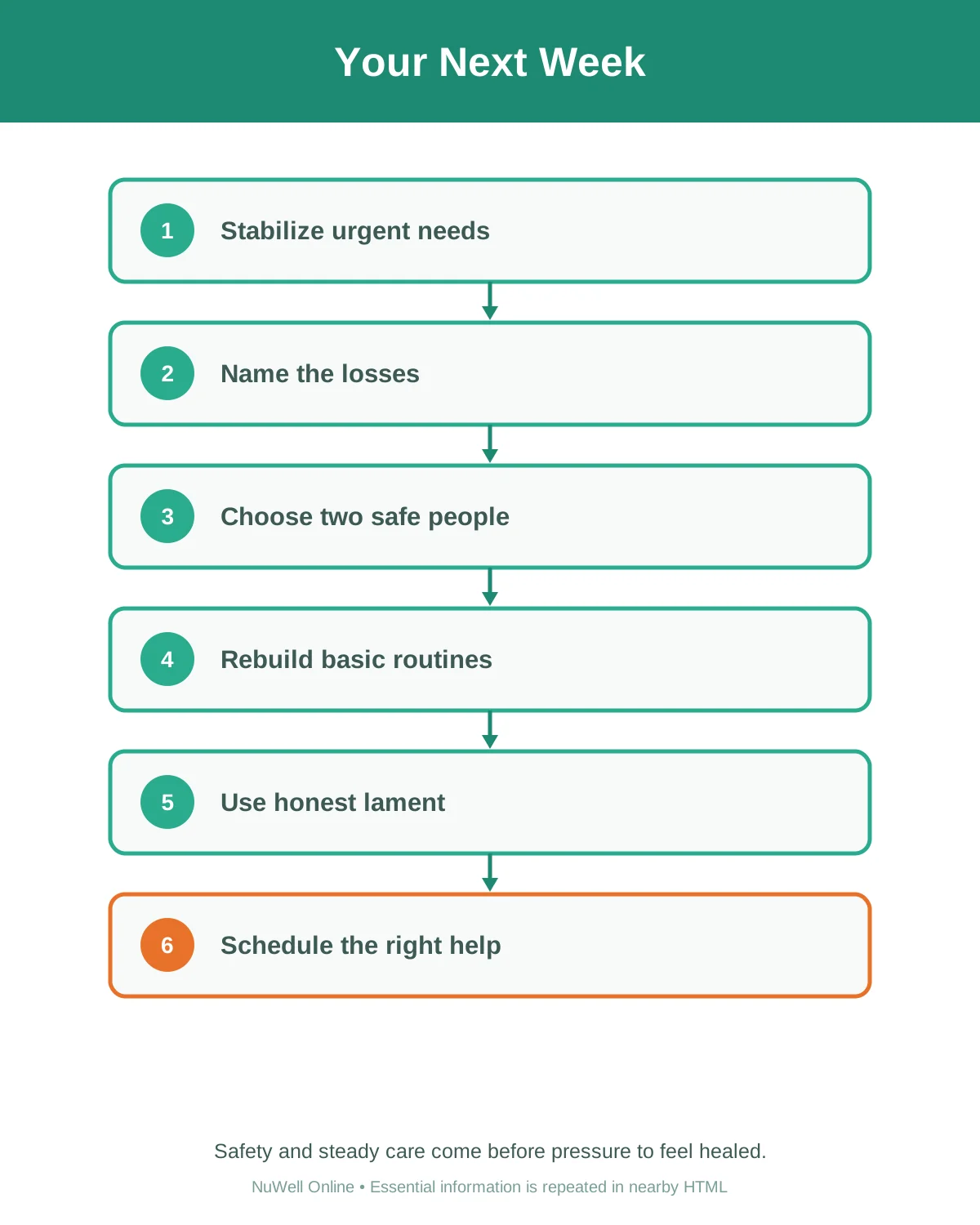
Six Faithful Steps You Can Take This Week
Stabilize what is urgent
Confirm where you and any children will sleep, how you will access medication, food, transportation, money, and essential records, and which deadlines require legal advice. If danger is possible, make plans privately with a domestic-violence advocate rather than announcing them.
Name the losses without grading them
Write what has changed and what you fear may change. Include practical, relational, spiritual, and community losses. Naming grief is not agreeing that every loss was avoidable or that reconciliation is required.
Choose two safe people
Ask one person for emotional presence and another for practical help. Be specific: a ride, a meal, childcare, help organizing documents, prayer, or a weekly check-in. Do not use children as confidants, messengers, or sources of information about the other parent.
Rebuild a basic rhythm
Choose a realistic sleep window, simple meals, movement, medication as prescribed, work priorities, and one calming spiritual practice. Routines do not cure grief, but they reduce the number of decisions your exhausted mind must make.
Use honest lament
The Psalms show people bringing fear, anger, confusion, and hope to God without pretending. Prayer can include “I do not understand,” “Protect us,” “Show me what is true,” and “Help me do the next right thing.” Scripture should not be used to skip apology, boundaries, or legal responsibility.
Schedule the right conversation
A pastoral counselor may help with grief, prayer, shame, identity, and Biblical questions. A licensed clinician may be needed for significant depression, anxiety, trauma symptoms, substance use, sleep disruption, or impaired functioning. A family-law attorney or legal-aid provider should answer state-specific questions about custody, property, support, filing, or protective orders.
When Children Are Part of the Divorce
Children generally need age-appropriate truth, repeated reassurance that the divorce is not their fault, predictable routines, and freedom to love both parents when safe.1 Keep adult accusations, evidence, financial disputes, and legal strategy out of their hearing. Do not ask a child to carry messages or report on the other home.
A simple explanation may be enough: the adults have decided to live in different homes, the child did not cause it, and both adults will keep explaining what happens next. Avoid promises about schedules or outcomes that have not been settled. Let questions return over time; children often understand a major change in layers rather than in one conversation. Special days can be especially hard; NuWell’s article on holidays after divorce offers practical ideas.
Co-parenting advice applies only when contact is safe and consistent with court orders. In coercive or violent situations, parallel parenting, supervised exchange, protective orders, or other arrangements may be necessary; those decisions belong with qualified legal and safety professionals. If a child’s sleep, school functioning, eating, mood, behavior, or safety changes significantly, contact the child’s pediatrician or an appropriately licensed child professional.
Forgiveness, Boundaries, and Reconciliation Are Different
Releases vengeance to God
It is not a demand to deny harm, drop legal protection, or resume contact. Learn why forgiveness is not the same as trust or reconciliation.
Is rebuilt over time
Trust grows through truth and reliable behavior, not through another person’s claim that forgiveness should make consequences disappear.
Requires more than one person
It requires safety, repentance, and participation from both people. Access to you or your children is governed by safety and lawful orders.
You can release vengeance to God while still telling the truth, seeking justice, following an attorney’s advice, and maintaining firm boundaries. Personal restoration does not guarantee restoration of a marriage, household, role, or relationship. If you are not yet divorced and wondering what to do when your spouse will not seek help, that guide addresses the decision point before separation.
When Safety Changes the Plan
Abuse is not a communication cycle. Joint counseling is not the right first step when threats, intimidation, stalking, physical or sexual violence, surveillance, financial control, isolation, or retaliation may be present. Disclosures in a joint session can be weaponized later, and separation can increase danger.2
If you suspect a child is being abused or is in immediate danger, contact 911 or the appropriate child-protection authority. Childhelp can help identify the correct reporting route. Do not investigate or confront a suspected abuser on your own.
In immediate danger, call 911.
In the United States, contact the National Domestic Violence Hotline at 800-799-SAFE (7233), text START to 88788, or chat at thehotline.org. Use a safer device if your activity may be monitored.
For suicidal crisis or emotional distress, call or text 988 or chat at 988lifeline.org. NuWell is not an emergency service.
Choose the Right Kind of Help
Pastoral counseling
May fit when you want non-clinical support for grief, lament, shame versus responsibility, identity in Christ, spiritual pressure, boundaries, and faithful routines. Learn about online pastoral counseling.
Marriage counseling and coaching
For couples who are both safe and want to repair before a final separation, see Christian marriage counseling and coaching.
Licensed, legal, and safety help
Use licensed care for clinically significant symptoms, a physician for medical concerns, an attorney or legal-aid provider for legal questions, and a domestic-violence advocate for safety planning.
Bring one concrete question to each professional. Ask a pastoral counselor how faith and grief can be held honestly. Ask a clinician what symptoms need assessment. Ask an attorney what must happen before a deadline. Ask an advocate how to plan more safely. Clear questions reduce the chance that one helper will drift beyond their role or that spiritual language will be mistaken for legal or clinical guidance. For more on choosing among types of support, see finding grace and truth in Christian counseling on divorce.
Conclusion
Your marital status is not the whole of your identity before God. This week, choose the next step that protects safety, tells the truth, cares for the people entrusted to you, and gives grief room to be real. Recovery is not a straight line, and no pastoral article can promise an outcome. Faithfulness can still be practiced one day at a time.
Frequently Asked Questions
Is it normal to question God during divorce?
Yes. Divorce can disrupt your sense of trust, community, identity, and future. Honest questions are not proof that you have abandoned faith. Bring them to God, a safe pastor or pastoral counselor, and qualified professionals without accepting pressure for a quick spiritual explanation.
Does forgiveness require reconciliation with my former spouse?
No. Forgiveness does not automatically restore trust, require contact, remove consequences, or create reconciliation. Reconciliation requires safety, truth, repentance, and willing participation from more than one person.
Should we attend couples counseling if there is abuse?
No. Joint counseling is not recommended when abuse, threats, or coercive control are present because it can increase danger and treat unequal power as a shared communication problem. Seek private individual support and safety planning first. In immediate danger, call 911. In the U.S., call 800-799-SAFE (7233), text START to 88788, or visit thehotline.org.
When should I seek licensed mental-health care?
Seek licensed care when depression, anxiety, trauma symptoms, panic, sleep disruption, substance use, self-harm thoughts, or impaired daily functioning needs assessment or treatment. For suicide, self-harm, emotional, or substance-use crisis support in the U.S., call or text 988 or use 988lifeline.org.
Find Your Best Next Step
Share what you are facing and ask what kind of support best fits this season.
Talk with our care team, explore your options, and see whether NuWell is the right fit—without pressure or obligation.

This article was researched with the help of AI and reviewed and edited by Stephen A. Luther, MEd, MSEd, LPC, for accuracy, Scripture references, and faithfulness to NuWell’s non-clinical scope.
Stephen A. Luther, MEd, MSEd, LPC, is Executive Director and Founder of Grace Christian Counseling and a licensed professional counselor. He holds a master’s degree in Education and a master’s degree in Marriage and Family Therapy from Duquesne University and has helped children, adolescents, and adults since 1997. His licensed clinical role at Grace Christian Counseling is distinct from NuWell’s non-clinical pastoral counseling and Christian life coaching services.
Scope note: This article is educational and pastoral. It is not diagnosis, psychotherapy, mental-health treatment, legal advice, domestic-violence advocacy, child-protection guidance for a specific case, or emergency care. NuWell provides non-clinical pastoral counseling and Christian life coaching.
Sources
- American Academy of Pediatrics. Adjusting to Divorce. HealthyChildren.org.
- National Domestic Violence Hotline. Get Help. Verified October 15, 2026.
- Malachi 2:14–16 translation comparison, NIV and ESV.
- 988 Suicide & Crisis Lifeline. 988lifeline.org. Verified October 15, 2026.
- Legal Services Corporation. I Need Legal Help.
- Childhelp. Identify Abuse.
- SAMHSA. FindTreatment.gov.

купоны melbet. Click Here:👉 https://mebel-3d.ru/libraries/news/?melbet_2020_promokod_dlya_registracii_besplatno.html