

Faith and emotional health
Your mind will not slow down. You pray, read the familiar verses, and still wake up with your chest tight and your thoughts racing ahead to everything that could go wrong. Then a second worry arrives: If my faith were stronger, would I feel this way?
Looking for Christian counseling for anxiety often starts with that question. The honest answer is hopeful: faith and good care are not rivals, and the right kind of help depends on what you are experiencing.
Quick answerAnxiety is not proof of weak faith. Everyday worry can often be carried through prayer, Scripture, rest, and support. When anxiety is persistent, intense, or interfering with daily life, a licensed counselor or health care provider should assess it, because evidence-based treatment such as cognitive behavioral therapy can help. Pastoral counseling can come alongside that care, but it is not a substitute for it.
Worry, Anxiety, and When It Becomes More
The National Institute of Mental Health puts it plainly: occasional anxiety is a normal part of life. Many people worry about health, money, work, or family. An anxiety disorder is different. With generalized anxiety disorder, for example, a person has trouble controlling worry on most days for at least six months, along with symptoms such as restlessness, fatigue, trouble concentrating, irritability, muscle tension, or sleep problems.
This article cannot diagnose you, and no one should diagnose themselves from a list. The practical point is simpler: if anxiety has become persistent or is affecting sleep, work, school, or relationships, it deserves a proper assessment, not just more effort.
Pastoral experience: A recurring, non-identifying pattern in pastoral conversations is that anxious Christians often carry two burdens: the anxiety itself and the shame of believing it means they are failing God. Separating those two burdens, and letting the right kind of help address each one, frequently brings the first real relief.
What Philippians 4 Does and Does Not Say
Philippians 4:6-7 (NIV)“Do not be anxious about anything, but in every situation, by prayer and petition, with thanksgiving, present your requests to God. And the peace of God, which transcends all understanding, will guard your hearts and your minds in Christ Jesus.”
Paul is not issuing a command to stop feeling something on cue. He is giving anxious people somewhere to go: to God, with specific requests, in every situation. The promise is that God’s peace will guard the heart and mind, a peace that often arrives alongside the anxiety before it replaces it. For a closer look at that question, read is anxiety a lack of faith?
Scripture is honest about anxious believers. The psalmist writes, “When anxiety was great within me, your consolation brought me joy” (Psalm 94:19, NIV), and Peter invites us to “cast all your anxiety on him because he cares for you” (1 Peter 5:7, NIV). Neither verse treats anxiety as disqualifying. Nor does Scripture forbid using wise means, such as rest, counsel, and medical care, while we pray.
Three Kinds of Help, and How They Work Together
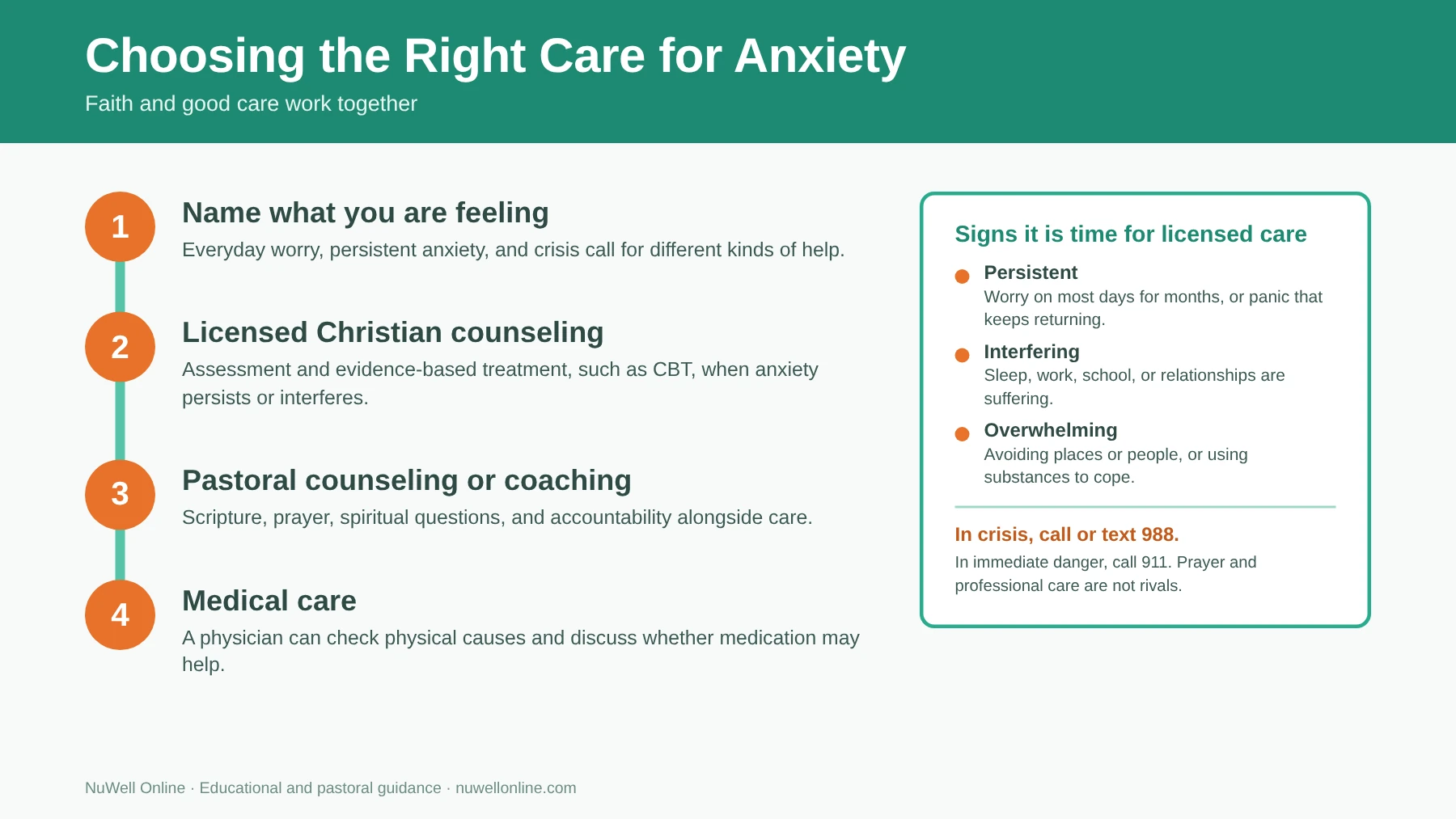
Assessment and treatment
A licensed Christian counselor can assess anxiety and provide evidence-based treatment while respecting your faith. Grace Christian Counseling offers this care.
Spiritual support
Scripture, prayer, spiritual questions, and accountability. Non-clinical, and best alongside licensed care when anxiety is significant.
Forward-focused goals
Habits, routines, and accountability for people who are generally stable and want practical next steps.
Rule out physical causes
A physician can check physical contributors and discuss whether medication may help. Medication is a medical decision, not a spiritual failure.
When to Choose Licensed Christian Counseling
Consider licensed care first when any of these are true:
- Worry or fear shows up on most days and has lasted for weeks or months.
- Panic attacks, constant dread, or physical symptoms of anxiety keep returning.
- You are avoiding people, places, or responsibilities because of anxiety.
- Sleep, work, school, parenting, or your marriage is suffering.
- You are using alcohol, substances, or other behaviors to get relief.
- Anxiety is tangled with depression, trauma, grief, or thoughts of not wanting to live.
According to NIMH, cognitive behavioral therapy (CBT) is a research-supported type of psychotherapy commonly used to treat generalized anxiety disorder. It helps people notice automatic thoughts that are inaccurate or harmful, and practice different responses. Treatment typically involves psychotherapy, medication, or both, depending on a person’s needs and medical situation.
NuWell’s referral for licensed care: Grace Christian Counseling is a licensed Christian counseling practice affiliated with NuWell. Its licensed counselors provide faith-integrated care for anxiety and depression, online in Pennsylvania, West Virginia, Georgia, and Florida, and in person at offices in Western Pennsylvania. Grace is a separate practice from NuWell’s non-clinical services. If you live elsewhere, NuWell’s care team can help you look for a licensed provider near you.
What Pastoral Counseling Can Offer Alongside Care
Anxiety often raises spiritual questions that a treatment plan does not answer: Is God disappointed in me? Why hasn’t prayer taken this away? How do I trust God with what I cannot control? NuWell’s online pastoral counseling offers a place to bring those questions, read Scripture in context, pray, and build steady spiritual practices.
Pastoral counseling does not diagnose or treat anxiety disorders, and it should never be used to talk someone out of medication or professional care. Anxiety is also not automatically a spiritual battle; NuWell’s guide to spiritual strongholds explains why symptoms should not be casually relabeled as spiritual failure.
A Simple Practice for Anxious Moments
These steps are not treatment, but many Christians find them steadying while they seek the right care.
Name it honestly
Say what is happening without judging yourself: “I am anxious about tomorrow’s appointment.” Naming a feeling is not the same as surrendering to it.
Slow your body down
Breathe slowly, loosen your shoulders, and notice where you are. A calmer body often makes clearer thinking and honest prayer possible.
Pray specifically
Try“Lord, here is what I am afraid of. Here is what I need. Thank you for one good thing today. Guard my heart and mind.”
Take one next right step
Choose one small, concrete action within your control: send the email, take a walk, eat a meal, or make the call. Leave the rest for later.
Reach out
Tell a trusted person what you are carrying. If anxiety keeps returning or is getting worse, schedule an assessment with a licensed counselor or your doctor.
Safety and Urgent Care
If anxiety comes with thoughts of suicide or self-harm, or you feel unable to stay safe, reach out now. Sudden or severe physical symptoms, such as chest pain or trouble breathing, need medical attention right away rather than self-assessment.
In immediate danger or a medical emergency, call 911.
For suicide, self-harm, or emotional or substance-use crisis, call or text 988 or chat at 988lifeline.org. NuWell is not an emergency service.
Frequently Asked Questions
Is anxiety a sin or a sign of weak faith?
No. Anxiety is a common human experience, and Scripture shows faithful people carrying it: “When anxiety was great within me, your consolation brought me joy” (Psalm 94:19). Philippians 4:6 invites anxious people to bring everything to God in prayer; it is not a verdict that their faith has failed.
Can Christians take medication for anxiety?
Yes. Medication is a medical decision to make with a qualified provider, not a spiritual failure. The National Institute of Mental Health notes that treatment for generalized anxiety disorder typically involves psychotherapy, medication, or both.
Should I see a pastoral counselor or a licensed counselor for anxiety?
If anxiety is persistent, intense, or interfering with daily life, start with a licensed counselor or health care provider who can assess and treat it. Pastoral counseling can come alongside that care for Scripture, prayer, and spiritual questions.
Does NuWell treat anxiety disorders?
No. NuWell provides non-clinical pastoral counseling and Christian life coaching. For assessment and treatment, NuWell’s care team can point you to Grace Christian Counseling, an affiliated practice with licensed Christian counselors, or to another licensed provider.
You Do Not Have to Carry This Alone
“Come to me, all you who are weary and burdened, and I will give you rest” (Matthew 11:28, NIV). Rest can come through prayer, through people, and through good care. Choosing help is not a lack of faith; it can be an act of it.
Talk with NuWell’s care team about pastoral counseling or coaching, or go directly to Grace Christian Counseling for licensed Christian care.
You can also see how NuWell’s process works.

This article was researched with the help of AI and reviewed and edited by Stephen Luther, MEd, MSEd, LPC, for accuracy, Scripture references, and faithfulness to NuWell’s non-clinical scope.
Stephen Luther, MEd, MSEd, LPC, is Executive Director and Founder of Grace Christian Counseling and a licensed professional counselor. He holds a master’s degree in Education and a master’s degree in Marriage and Family Therapy from Duquesne University and has helped children, adolescents, and adults since 1997. His licensed clinical role at Grace Christian Counseling is separate from NuWell’s non-clinical pastoral counseling and Christian life coaching services.
Scope note: This article is educational and pastoral. It is not diagnosis, psychotherapy, medical treatment, individualized professional advice, or emergency care. NuWell provides non-clinical pastoral counseling and Christian life coaching. Grace Christian Counseling is a separate, licensed practice.
Sources
- National Institute of Mental Health. Generalized Anxiety Disorder: What You Need to Know and Anxiety Disorders.
- Philippians 4:4-9; Psalm 94:19; 1 Peter 5:7; Matthew 11:28 (NIV).
- 988 Suicide & Crisis Lifeline.
- Grace Christian Counseling. Christian Anxiety and Depression Counseling.
