

Faith, purpose, and growth
Many women do not need another inspirational message. They need room to think clearly, name what is not working, decide what faithfulness looks like in this season, and follow through without carrying every expectation at once.
Christian life coaching for women can support that work. A coach does not hand you a secret plan from God or tell you to try harder at every role. A responsible coach helps you clarify a goal, examine obstacles, connect choices with Biblical convictions, design practical steps, and review what you are learning.
Quick answerChristian life coaching for women is a forward-focused partnership that brings Scripture, prayer, reflection, goal setting, and accountability into practical life change. It can fit questions about purpose, habits, boundaries, leadership, work, relationships, transitions, and spiritual growth when you are stable enough for coaching and do not need diagnosis or treatment. It is not psychotherapy, crisis support, or pressure to become an idealized version of a “Biblical woman.”
At NuWell, Christian life coaching is a non-clinical service offered online.
What Christian Life Coaching Is and Is Not
The International Coaching Federation defines coaching as “partnering with clients in a thought-provoking and creative process that inspires them to maximize their personal and professional potential.” Good coaching is collaborative: you bring the agenda, and the coach listens, asks useful questions, helps turn insight into action, and supports accountability.
Christian life coaching adds an explicit Biblical frame. That may include prayer, Scripture, reflection on identity in Christ, discernment of motives, stewardship of gifts, and attention to the fruit a decision produces. A coach should never present personal preferences as God’s command or use Scripture to take control of your choices.
Forward-focused partnership
Clarifying goals, examining obstacles, connecting choices with conviction, building habits and boundaries, and reviewing progress with accountability.
Treatment or a label
Not diagnosis or treatment for depression, anxiety disorders, trauma, eating disorders, or other conditions. Feeling stuck does not mean you are lazy, rebellious, or failing as a Christian woman.
Safety comes first
Coaching can clarify values and boundaries, but it should never turn violence, threats, stalking, sexual coercion, or financial control into a communication problem.
Plan with humility
“In their hearts humans plan their course, but the Lord establishes their steps” (Proverbs 16:9, NIV). Planning and humility belong together.
When Coaching May Be a Good Fit
Coaching may fit when you can take part in reflective, action-oriented work and your main need involves one of these situations:
You are in a transition
A new career, empty nest, relocation, leadership role, relationship change, or return to work can unsettle identity and routine. Coaching helps turn a broad question such as “Who am I now?” into choices you can examine and test.
You are overcommitted and unclear about boundaries
Some women have learned to treat every request as a calling. A coach can help you distinguish generosity from fear-driven agreement, write a clear boundary, and plan how to tolerate another person’s disappointment without becoming harsh. NuWell’s guide to selfishness, self-care, and boundaries explores the Biblical side of that question.
You have a goal but keep losing traction
The obstacle may be an unrealistic plan, divided attention, avoidance, perfectionism, or a goal that does not actually fit your values. Coaching makes the pattern visible and builds a smaller, testable next step.
You want to connect faith with work or leadership
Coaching can create space to think about ambition, service, money, rest, excellence, family commitments, and vocation without reducing “calling” to a job title.
You are rebuilding after a difficult season
Once immediate safety and clinical needs are addressed, coaching may help you rebuild routines, relationships, confidence, and meaningful goals. It should not rush you past grief or treat healing as a productivity project.
Pastoral experience: A recurring non-identifying pattern in pastoral and coaching settings is that women often describe themselves as unmotivated when they are actually carrying too many competing obligations, unclear permission to say no, or a goal shaped more by other people’s approval than by conviction. Another common pattern is waiting for perfect certainty before taking a modest step. Responsible coaching does not declare God’s private will for a client; it helps her test motives, limits, counsel, fruit, and practical consequences with humility.
Four RESTORE Movements for Coaching
NuWell’s RESTORE Path is a flexible pastoral map, not a rigid program. Four movements fit forward-focused coaching especially well.
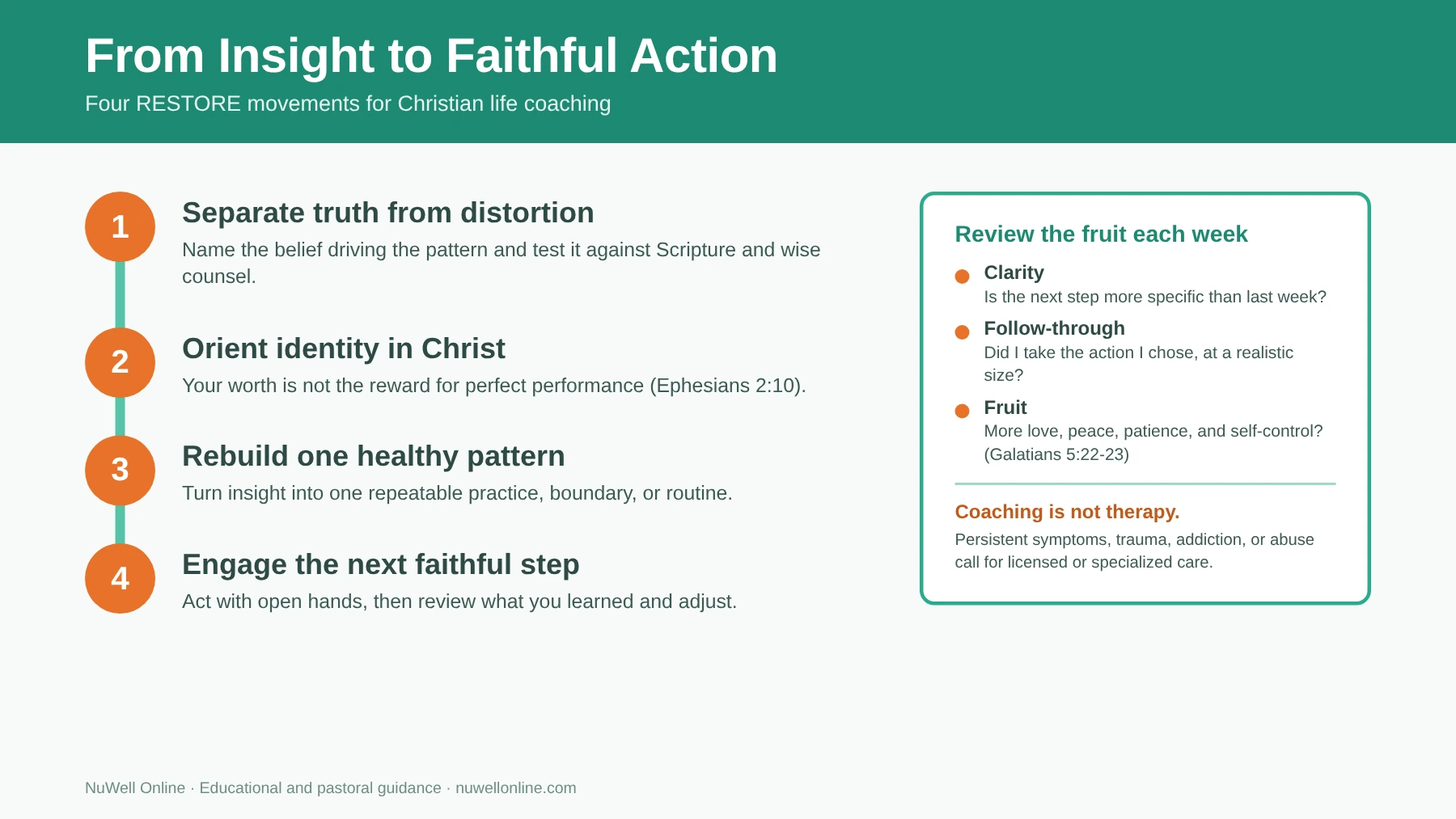
Separate truth from distortion
Distortion“If I disappoint someone, I have failed God.”
Truth“Love sometimes asks me to serve at real cost, and I can weigh it with wisdom.”
Identify the sentence driving the pattern. One is a totalizing fear; the other can be weighed with context, capacity, and wisdom.
Orient identity in Christ
Your worth is not the reward for perfect performance. Ephesians 2:10 says, “For we are God’s handiwork, created in Christ Jesus to do good works, which God prepared in advance for us to do” (NIV). The verse grounds action in grace; it does not require endless output.
Rebuild healthy patterns
Translate insight into a repeatable practice: a protected hour, a prepared boundary phrase, a weekly review, a smaller goal, or one honest conversation. Healthy patterns make faithful intentions easier to live.
Engage the life God intended
Take the next step with open hands. The goal is not control or a guaranteed outcome. It is active stewardship shaped by love, wisdom, courage, and willingness to adjust. When you lack wisdom, James 1:5 invites you to ask God, “who gives generously to all without finding fault.”
What a Coaching Session Can Include
A session should begin with a clear agreement about what you want to accomplish. The coach may ask questions, reflect patterns, use a values or strengths exercise, invite Scripture-based reflection, pray with your consent, and help you design an action. Expect the plan to belong to you. A coach can challenge vagueness and avoidance, but should not become the authority over your relationships, career, church, body, money, or conscience.
Before you begin, ask:
- What training and experience do you have with my type of goal?
- How do you distinguish coaching from pastoral counseling and therapy?
- How will Scripture and prayer be used, and can I express disagreement?
- What are the confidentiality policy and its limits?
- What happens if clinical, medical, abuse, addiction, or crisis needs come up?
- How do we set goals and evaluate whether coaching is useful?
- What are the fees, cancellation terms, and expected length?
You can meet NuWell’s coaches and practitioners, review pricing and financial assistance, and see how the NuWell process works.
A Practical First Week
Day 1: Choose one area
Do not overhaul your entire life. Choose one area where greater clarity would make a real difference: a boundary, morning routine, career decision, ministry commitment, or unfinished conversation.
Day 2: Write the current pattern
Complete“When ___ happens, I tend to ___. I tell myself ___. The result is ___.”
Use observable language rather than condemning labels.
Day 3: Test the belief
Ask what Scripture actually teaches in context, what wise counsel confirms, and what evidence supports or challenges your assumption. Avoid grabbing an isolated verse to force the answer you already want.
Day 4: Define a small outcome
Choose an action you can complete in seven days. “Research three training programs and write my decision criteria” is more useful than “discover my calling.”
Day 5: Remove one obstacle
Put the appointment on the calendar, prepare the boundary statement, silence a distraction, ask for childcare, or reduce the task until it fits your real capacity.
Day 6: Take the step
Act before you feel perfectly certain. Courage is not the absence of discomfort; it is movement with wise preparation and an honest view of risk.
Day 7: Review the fruit
What did you learn? Did the step produce more love, peace, patience, and self-control (Galatians 5:22-23), along with greater clarity? What needs to change next week? Coaching turns this review into a repeatable rhythm.
When Coaching Is Not Enough
Choose licensed mental-health care when persistent or severe symptoms affect sleep, work, eating, self-care, judgment, relationships, or daily functioning. Seek medical care for new or unexplained physical or mood changes and medication questions. Use specialized substance-use care for dependence, withdrawal risk, or recovery treatment.
If threats, stalking, sexual coercion, violence, or coercive control are present, prioritize safety and domestic-violence expertise. Do not use coaching to negotiate access with an unsafe person.
NuWell pastoral counseling may fit better when the central work is spiritual pain, church hurt, grief, relational wounds, or Biblical discernment. The guide to pastoral counseling vs therapy explains these boundaries in more detail.
In immediate danger, call 911.
Domestic-violence support: 800-799-SAFE (7233), text START to 88788, or thehotline.org. Suicidal crisis or emotional distress: call or text 988 or chat at 988lifeline.org. Treatment referrals: FindTreatment.gov or 1-800-662-HELP (4357). NuWell is not an emergency service.
Frequently Asked Questions
Do I need a female Christian life coach?
Not necessarily. Some women prefer a female coach because of comfort, lived experience, or the subject matter. Others work well with a qualified male coach. Fit depends on role clarity, trust, competence, boundaries, Biblical posture, and your informed preference.
Is Christian life coaching the same as discipleship?
They can overlap, but they are not identical. Discipleship centers on following Jesus within the life of the church. Coaching is a structured, goal-oriented partnership. A coach should not replace local church community, pastoral authority, friendship, or spiritual formation.
How do I know whether coaching is helping?
Set a clear outcome at the beginning and review it regularly. Useful signs include greater clarity, completed actions, healthier patterns, more honest decisions, and increased ownership. A dramatic feeling after a session is not the same as durable change.
Take the Next Faithful Step
Christian life coaching for women works best when it is clear, collaborative, Biblically responsible, and honest about its limits. It should help you move from a tangled question to a faithful experiment, not from uncertainty to someone else controlling your life.
Choose one area. Separate truth from distortion. Ground your identity in Christ. Rebuild one pattern. Not sure whether coaching, pastoral counseling, or another level of care fits? NuWell’s care team can help you sort it out.
Learn more about NuWell Christian life coaching.

Stephen Luther, MEd, MSEd, LPC, is Executive Director and Founder of Grace Christian Counseling and a licensed professional counselor. He holds a master’s degree in Education and a master’s degree in Marriage and Family Therapy from Duquesne University and has helped children, adolescents, and adults since 1997. His licensed clinical role at Grace Christian Counseling is separate from NuWell’s non-clinical pastoral counseling and Christian life coaching services.
Scope note: This article is educational and pastoral. It does not provide diagnosis, psychotherapy, medical treatment, legal advice, substance-use treatment, domestic-violence services, or emergency care. NuWell provides non-clinical pastoral counseling and Christian life coaching.
Sources
- International Coaching Federation. ICF Code of Ethics (definition of coaching) and 2025 ICF Core Competencies.
- Proverbs 16:9; Ephesians 2:10; Galatians 5:22-23; James 1:5 (NIV).
- National Institute of Mental Health. Help for Mental Illnesses.
- SAMHSA. 988 FAQs and National Helpline; National Domestic Violence Hotline, Get Help.
