

Grief and loss
The empty side of the bed is only one absence. There may also be one coffee cup, one voice missing from ordinary decisions, and a future that no longer looks the way you planned. Losing a husband or wife can unsettle your routines, your identity, your finances, your faith, and the simple comfort of being known at home.
If you are searching for Bible verses after losing your spouse, you may not need a speech. You may need one true sentence sturdy enough to hold for the next hour.
Quick answerScripture does not tell you to hurry through grief or pretend that faith makes death painless. It gives you words for sorrow, reminds you that God is near, calls the Christian community to practical care, and anchors hope in Jesus’ resurrection. You do not have to feel every promise strongly today for it to remain true.
What Scripture Offers in Spousal Grief
A Bible verse is not a formula for making grief disappear. Grief is not a diagnosis, a spiritual failure, or a fixed identity. It is a human response to losing someone whose life was woven into yours. Numbness, anger, tears, relief, guilt, poor concentration, disrupted sleep, and unexpected laughter can all show up. There is no faithful timetable for feeling “normal” again.
Scripture gives grief a place to speak. The Psalms lament. Jesus weeps. Paul describes sorrow that still holds hope. Revelation looks toward a world where death will finally be gone. Christian hope does not ask you to call death good. It declares that death will not have the final word.
Pastoral experience: A recurring, non-identifying pattern in pastoral conversations is that a grieving spouse may feel pressure to be strong for the children, reassure friends, manage paperwork, and show unshaken faith all at once. Often the more faithful next step is smaller: tell the truth about today, accept one practical kindness, and let one passage become a prayer when your own words run out.
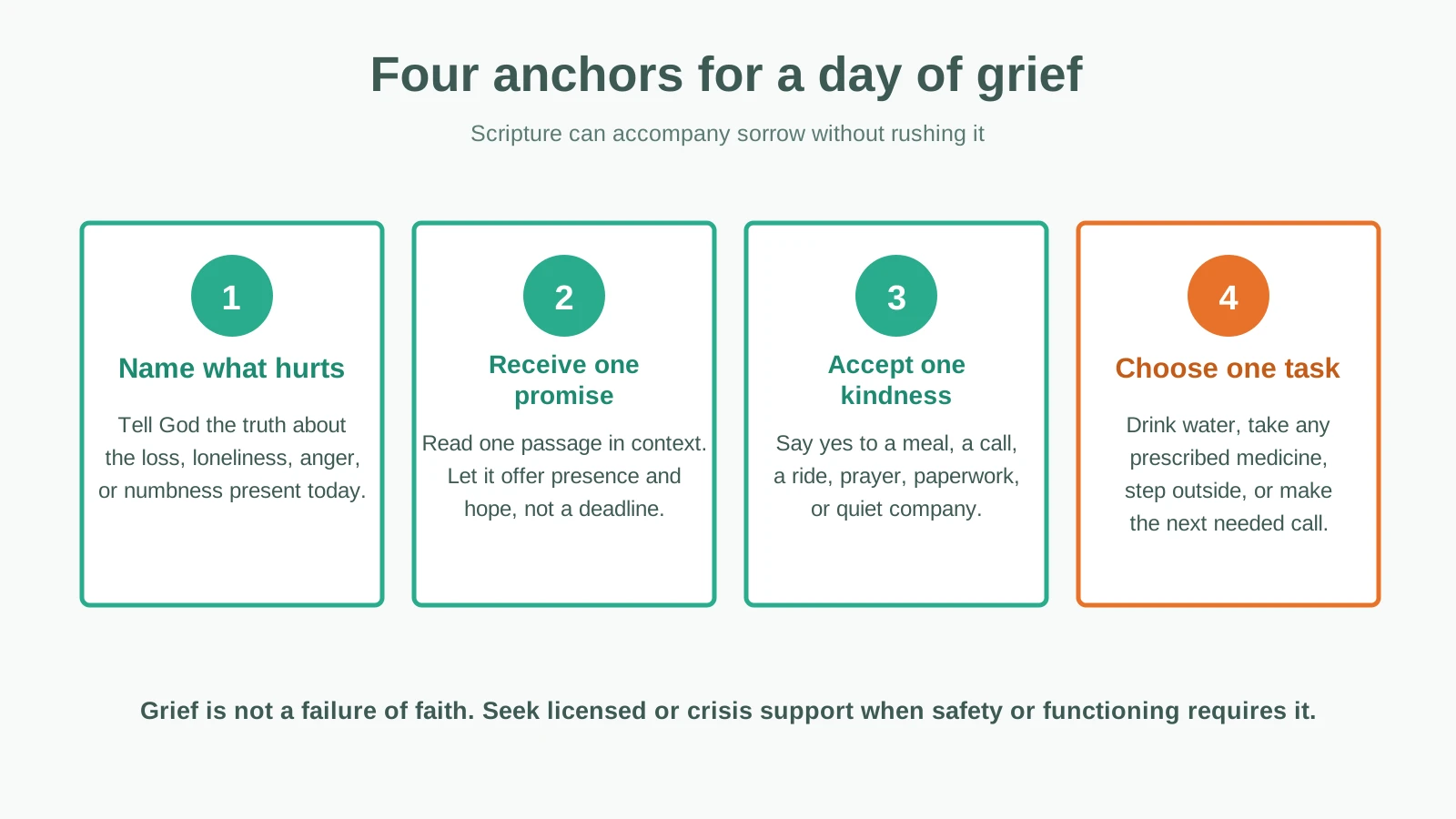
For a broader look at lament, community, and grief practices, read NuWell’s guide to grieving as a Christian.
Ten Bible Verses for Losing a Spouse
Psalm 34:18: God Is Near to the Brokenhearted
“The Lord is close to the brokenhearted and saves those who are crushed in spirit.”
Psalm 34 does not deny danger or distress; David remembers calling to God from trouble. For a grieving spouse, “close” may not describe a feeling you can summon. It describes God’s posture toward the crushed in spirit. When prayer feels impossible, try only this: “Lord, be close to me in this room.”
Psalm 23:4: The Shepherd Walks Through the Valley
“Even though I walk through the darkest valley, I will fear no evil, for you are with me.”
The Shepherd does not shame the sheep for being in a dark valley. He goes with them and guides them. Grief can make tomorrow feel too large, so let this verse shrink the horizon: ask for enough light for the next necessary step, not a map of the rest of your life.
Psalm 68:5: God Defends Those Left Vulnerable
“A father to the fatherless, a defender of widows, is God in his holy dwelling.”
In the biblical world, widowhood often brought financial and social vulnerability. This verse reveals God’s character and calls God’s people to reflect it through concrete protection and care. It is not a promise that every practical problem will resolve right away. It is permission to ask your church, family, or trusted friends for help with meals, rides, paperwork, home repairs, or finances.
Lamentations 3:22–23: Mercy Meets Each Morning
“Because of the Lord’s great love we are not consumed, for his compassions never fail. They are new every morning.”
These words rise from a book of communal catastrophe; they are not cheerful words pasted over pain. The writer remembers God’s character while surrounded by loss. “New every morning” does not require you to feel renewed every morning. It invites you to receive today’s portion of mercy without solving tomorrow.
Grief can make prayer and daily decisions feel isolating
NuWell offers non-clinical, Scripture-grounded pastoral support online across the United States. Talk with our care team about what kind of support fits right now, without pressure.
Isaiah 43:2: God’s Presence in Overwhelming Waters
“When you pass through the waters, I will be with you.”
Isaiah first speaks God’s covenant reassurance to Israel, so we should not turn it into a guarantee that believers will avoid every painful loss. It does show something consistent about God: He does not abandon His people in overwhelming circumstances. On a hard wave of a day, breathe slowly and pray the line as written: “You will be with me.”
Matthew 5:4: Mourning Is Not Disqualified From Blessing
“Blessed are those who mourn, for they will be comforted.”
Jesus does not say mourning is pleasant. He names mourners as people God sees and will comfort in His kingdom. Tears do not place you outside faithfulness. You can gently decline pressure to celebrate before you have been allowed to mourn.
John 11:35: Jesus Wept
“Jesus wept.”
Jesus weeps at Lazarus’s tomb even though He knows resurrection is moments away. His tears dignify sorrow and show that confidence in God’s power can sit alongside anguish over death. Your grief is not evidence that you have forgotten the resurrection. Love mourns a real absence.
2 Corinthians 1:3–4: Comfort Is Received and Shared
“The Father of compassion and the God of all comfort, who comforts us in all our troubles.”
Paul writes about comfort in the middle of affliction, not escape from it. The passage also pictures comfort moving through community. You do not have to become someone else’s helper right away. For now, let another person sit with you, bring dinner, go to an appointment with you, or hear the same memory again.
1 Thessalonians 4:13–14: Christians Grieve With Hope
“You do not grieve like the rest of mankind, who have no hope. For we believe that Jesus died and rose again.”
Paul does not say Christians do not grieve. He roots grief in Jesus’ death and resurrection. If your spouse died trusting in Christ, this passage offers hope without minimizing the present separation. If you are uncertain about your spouse’s faith, you do not have to settle what only God can judge; you can entrust the person you love to God’s justice and mercy.
Revelation 21:4: Death Will Not Last Forever
“He will wipe every tear from their eyes. There will be no more death or mourning or crying or pain.”
This promise belongs to John’s vision of God dwelling with His people in the renewed creation. It does not demand that tears stop now. It tells us why Christian hope can survive them: death, mourning, and pain are temporary intruders in God’s final future.
For more passages suited to prayer, memorial readings, or sympathy notes, see 25 short Bible verses about death and dying.
A Gentle Scripture Practice for This Week
This sequence draws on several movements of the RESTORE Path: Recognize the wound, Establish safety, Separate truth from distortion, Tend what was wounded, Orient your identity in Christ, and Rebuild healthy patterns. Take it one movement at a time.
Choose one verse.
Do not make yourself absorb all ten. Pick the line that feels most honest or most needed today.
Name today’s loss.
Finish the sentence, “Today I miss…” Specific grief is often easier to carry than the demand to process everything at once.
Turn the verse into a short prayer.
“Shepherd, stay with me in this valley” is enough.
Ask for one concrete kindness.
Request a meal, a ride, help with a bill, company at church, or ten minutes of listening without advice.
Protect basic care.
Eat something simple, take any prescribed medication, drink water, and rest when you can. Contact a medical professional about concerning physical symptoms.
Make no rushed spiritual verdicts.
A hard day does not prove God has left you, and a lighter moment does not betray your spouse.
Review at the end of the week.
Notice what helped you stay honest, connected, and able to take the next faithful step.
When More Support Is Wise
Grief itself is not a mental-health diagnosis. The National Institute on Aging notes that people who are grieving often have trouble sleeping, little interest in food, problems with concentration, and a hard time making decisions.[5] Practical help, church community, a grief group, and pastoral care can all matter.
NuWell’s non-clinical online pastoral counseling may fit when you want prayer, Scripture-grounded reflection, help rebuilding daily rhythms, or space to explore grief and faith. You can also compare kinds of Christian grief support.
Choose a licensed mental-health professional, such as the counselors at Grace Christian Counseling, when grief stays intense and keeps disrupting daily life, or when depression, trauma symptoms, panic, substance use, or prolonged grief may need assessment or treatment.[6] A physician can help with significant sleep, appetite, medication, or other physical concerns. NuWell does not diagnose or treat prolonged grief disorder.
If you are thinking about suicide or self-harm, call or text 988 or chat at 988lifeline.org. If you are in immediate danger, call 911. NuWell is not an emergency service.
Frequently Asked Questions
Is it wrong for a Christian to feel angry after a spouse dies?
No. Scripture contains candid lament, protest, confusion, and sorrow. Anger can be part of grief; it is not automatic proof of weak faith. Bring it honestly to God and to a trustworthy person. Seek licensed support if anger feels unsafe, uncontrollable, or is impairing daily life.
Which Bible verse is best for the loss of a husband or wife?
There is no single best verse for every day. Psalm 34:18 speaks to brokenheartedness, Psalm 23:4 to companionship in darkness, John 11:35 to permission for tears, and 1 Thessalonians 4:13–14 to resurrection hope. Choose the passage that meets today’s need without forcing an emotion.
Does moving forward mean leaving my spouse behind?
No. Learning new routines or experiencing joy does not erase love or memory. Moving forward means learning to carry the relationship’s significance while engaging the life and responsibilities still before you. There is no universal timetable.
Hope for the Next Step
The Bible does not offer a shortcut around the death of your spouse. It offers the presence of God in the valley, permission to mourn, people who can help carry practical burdens, and the resurrection of Jesus as the ground of hope. Today, one verse and one honest request for help may be enough.
Talk with NuWell’s care team about whether online pastoral counseling, Christian life coaching, licensed care, or another resource is the wisest fit.
For Scripture that speaks to other kinds of bereavement, explore NuWell’s collection of comforting Scripture for times of loss.

This article was researched with the help of AI and reviewed and edited by Stephen Luther, MEd, MSEd, LPC, for accuracy, Scripture references, and faithfulness to NuWell’s non-clinical scope.
Stephen Luther, MEd, MSEd, LPC, is Executive Director and Founder of Grace Christian Counseling and a licensed professional counselor. He holds a master’s degree in Education and a master’s degree in Marriage and Family Therapy from Duquesne University and has helped children, adolescents, and adults since 1997. His licensed clinical role at Grace Christian Counseling is distinct from NuWell’s non-clinical pastoral counseling and Christian life coaching services.
Scope note: This article is educational and pastoral. It is not diagnosis, psychotherapy, medical treatment, individualized professional advice, or emergency care. NuWell provides non-clinical pastoral counseling and Christian life coaching.
Sources
- Bible Gateway. Psalm 23 and Psalm 34, New International Version.
- Bible Gateway. Psalm 68:5; Lamentations 3:22–23; Isaiah 43:2, NIV.
- Bible Gateway. Matthew 5:4; John 11:35; 2 Corinthians 1:3–4, NIV.
- Bible Gateway. 1 Thessalonians 4:13–18 and Revelation 21:1–5, NIV.
- National Institute on Aging. Coping With Grief and Loss.
- American Psychiatric Association. Prolonged Grief Disorder.
- 988 Suicide & Crisis Lifeline. Get Help.
Scripture quotations taken from The Holy Bible, New International Version® NIV®. Copyright © 1973, 1978, 1984, 2011 by Biblica, Inc.™ Used by permission. All rights reserved worldwide.
