

Scripture and spiritual growth
You know a belief is not true, yet it keeps directing your reactions. You pray, promise to change, and still return to the same fear, bitterness, secrecy, control, or shame. Christians often call this kind of entrenched pattern a spiritual stronghold.
Understanding the spiritual strongholds meaning in Scripture can help when it leads to truth, repentance, wise support, and patient practice. It becomes harmful when it turns every symptom into a demon, every setback into failure, or every mental-health need into a lack of faith.
Quick answerIn 2 Corinthians 10, a stronghold is Paul’s picture for arguments and proud claims that resist the knowledge of God. In pastoral use, “spiritual stronghold” can describe a deeply reinforced belief or response that keeps shaping life against God’s truth. It is not a diagnosis, a fixed identity, or automatic proof of demonic activity.
2 Corinthians 10:4-5 (NIV)“The weapons we fight with are not the weapons of the world. On the contrary, they have divine power to demolish strongholds. We demolish arguments and every pretension that sets itself up against the knowledge of God, and we take captive every thought to make it obedient to Christ.”
Paul writes to a conflicted church and defends a ministry shaped by Christ rather than worldly power. His weapons are not coercion or spectacle. In the very next phrase, he defines what is being demolished: arguments and pretensions raised against knowing God. The immediate emphasis is truth and allegiance, not a catalog of hidden spirits.
The Bible Uses “Stronghold” in More Than One Way
In the Old Testament, a stronghold can be a literal fortress. It can also describe God himself as refuge: “The Lord is my rock, my fortress and my deliverer… my stronghold” (Psalm 18:2, NIV; see also Psalm 144:2). The image is therefore not inherently evil. A fortress protects whatever is inside. That is what makes the metaphor useful: an entrenched belief can feel protective even while it keeps pain, sin, or distortion in place.
A careful definition stays close to 2 Corinthians 10. A spiritual stronghold is not simply a difficult feeling. Grief, fear after danger, unwanted intrusive thoughts, physical illness, or symptoms of a mental-health condition should not be casually relabeled as spiritual rebellion. For the broader landscape of spiritual battle in Scripture, see NuWell’s overview of types of spiritual warfare.
Nor should “stronghold” become a villain label for another person. Saying “you have a spirit of control” may sound discerning while avoiding specific behavior, evidence, and responsibility. Name what happened. Test interpretations. Leave diagnosis to qualified clinicians and spiritual claims to humble, accountable discernment.
Pastoral experience: A recurring, non-identifying pattern in pastoral care is that the most stubborn cycle often contains both a protective story and a painful cost. “If I stay in control, I cannot be hurt” may once have helped someone survive uncertainty, yet now damages trust. Change begins when the story can be named without shame and tested in the light of Scripture, present reality, and wise support.
How Strongholds Become Reinforced
An entrenched pattern is rarely one isolated thought. It often includes a loop:
Something activates it
A criticism, memory, temptation, conflict, or loss sets the pattern in motion.
A familiar conclusion
“I am unsafe,” “I must win,” “God has abandoned me,” or “I can never change.”
Brief relief
A person withdraws, controls, numbs, lashes out, conceals, or gives up, and distress briefly drops or an image is protected.
The loop strengthens
Each repetition reinforces the pattern and damages faith, responsibility, relationships, or daily functioning.
This description is practical, not diagnostic. It helps you observe how repetition builds strength. Some loops primarily involve sinful choices requiring confession and accountability. Some grow around trauma effects, grief, or illness requiring licensed or medical care. Many involve more than one layer.
To see what happens before and after a repeated action, you can map a behavior cycle step by step.
Biblical Restoration Care begins with Recognize the wound, Establish safety, and Separate truth from distortion. These movements prevent two common mistakes: excusing harmful behavior because pain is present, and shaming pain as though it were merely bad behavior.
Discernment Without Fear or Denial
Christians affirm a spiritual reality, yet Scripture does not invite panic. Ephesians 6:10-18 calls believers to stand in truth, righteousness, the gospel of peace, faith, salvation, God’s word, and prayer. These are practices of allegiance and endurance. They do not require sensational explanations. Use four lanes of discernment:
- Biblical truth. What does the passage say in context? Is the belief consistent with God’s character and the gospel?
- Moral responsibility. Is there a choice to confess, repair, stop, or bring into accountability?
- Whole-person reality. Could sleep, medication, trauma, substance use, hormones, illness, or a mental-health condition be contributing?
- Relational safety. Is someone using spiritual language to frighten, control, isolate, or bypass consent and responsibility?
Prayer and appropriate professional care are not rivals. A person can seek God, use practical tools, consult a physician, and work with a licensed clinician. Scripture should never be used to stop prescribed medication, prevent assessment, or declare that symptoms prove spiritual failure.
A Seven-Day Practice for Challenging a Stronghold
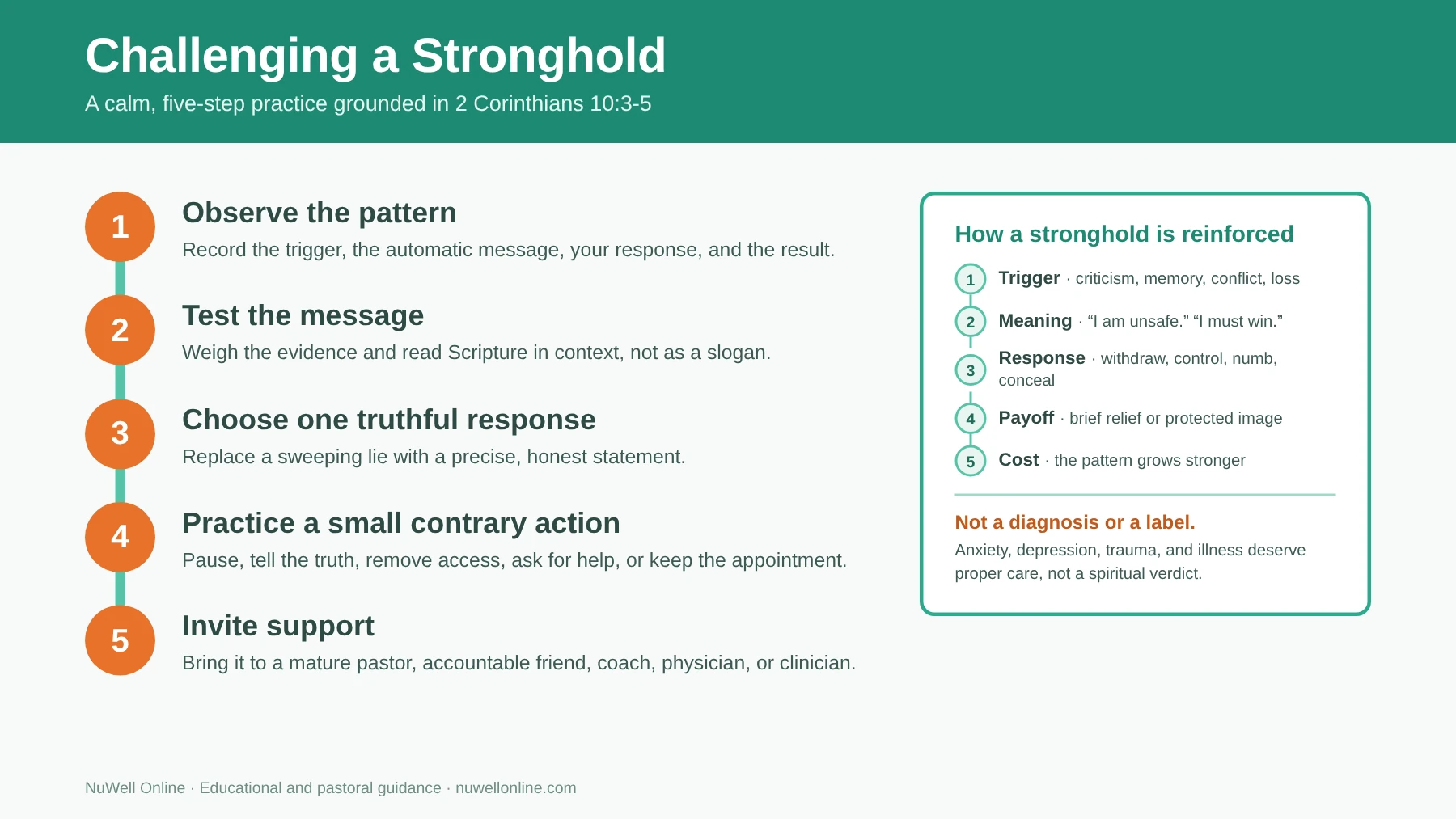
Observe the pattern
For one week, record the trigger, the automatic message, your body’s response, your action, and the result. Do not edit the record to look spiritual.
Test the message
Ask what evidence supports it, what evidence challenges it, and what Scripture says in context. Avoid using a verse as a slogan that denies real grief or danger.
Choose one truthful response
Sweeping lie“I will always be rejected.”
Precise truth“Rejection has hurt me, but it does not define my identity or remove every safe relationship.”
Anchoring that truth in your identity in Christ keeps the pattern from becoming a permanent label.
Practice a small contrary action
Tell the truth, pause before reacting, remove access to a temptation, make restitution, ask for help, attend the appointment, or return to a healthy routine.
Invite support
Bring the pattern to a mature pastor, accountable friend, pastoral counselor, coach, physician, or licensed clinician as the need requires. Secrecy strengthens many cycles, and shame often keeps people silent. NuWell’s article on Christian shame vs conviction can help you tell the difference.
Review the fruit
Look for growing honesty, freedom, responsibility, love, and steadiness. Do not demand instant emotional relief as the only sign of progress.
Repeat without spectacle
Entrenched patterns are usually weakened through repeated truth and practice. A setback is information for the next faithful step, not proof that Christ has abandoned you. This is where Tend what was wounded, Orient identity in Christ, and Rebuild healthy patterns become practical. The path is flexible pastoral care, not a rigid protocol or promise of guaranteed results.
Safety and the Right Level of Care
Spiritual language must not replace safety. If a church leader, spouse, or helper uses claims about demons, submission, forgiveness, or “rebellion” to control your choices, isolate you from care, demand secrecy, or threaten consequences, seek independent support. Abuse is not a stronghold to solve together. The National Domestic Violence Hotline describes it as a pattern of behaviors used to maintain power and control.
Seek licensed mental-health care when intrusive thoughts, panic, depression, trauma symptoms, mania, psychosis, compulsions, substance use, or impaired functioning need assessment or treatment. If anxiety is the main concern, start with NuWell’s overview of Christian counseling for anxiety. Seek medical care for sudden changes, sleep disruption, medication concerns, or physical symptoms. Do not stop treatment because someone offered a spiritual explanation.
In immediate danger, call 911.
If you may harm yourself or someone else, call or text 988 or chat at 988lifeline.org. For relationship abuse, contact the National Domestic Violence Hotline at 800-799-SAFE (7233) or text START to 88788. NuWell is not an emergency service.
When NuWell May Fit
NuWell’s non-clinical online pastoral counseling may fit when you want to explore Scripture, prayer, spiritual confusion, shame, forgiveness, accountability, or relational patterns. Christian life coaching may fit when the primary need is present-focused goals, habits, and accountability. NuWell does not provide diagnosis, psychotherapy, addiction treatment, or medical care.
A careful intake conversation can help identify the best next step, including a referral elsewhere.
Frequently Asked Questions
Is every repeated sin a spiritual stronghold?
Not necessarily. “Stronghold” is a metaphor, not a formal category for ranking sin. The term can be useful for an entrenched pattern, but clear language about the actual choice and its consequences is often more helpful.
Are anxiety or depression spiritual strongholds?
No automatic conclusion is warranted. Anxiety and depression can involve many biological, psychological, social, relational, and spiritual factors. Prayer and Scripture may be meaningful supports, while licensed assessment or medical care may also be appropriate.
Can a Christian have a stronghold?
Christians can hold distorted beliefs, repeat destructive habits, resist truth, and need repentance and support. That does not erase their identity in Christ or prove possession. The New Testament calls believers toward renewed thinking (Romans 12:2), truthful community, and faithful practice.
Freedom Grows in Truth and Practice
A stronghold is not your name. The Biblical image helps you identify what has become fortified against truth, then respond with the resources God provides: Scripture in context, prayer, repentance, community, wisdom, responsible care, and repeated action. Begin with one pattern, one truthful sentence, and one accountable next step.
Tell us what feels stuck, and NuWell’s care team can help you consider pastoral counseling, coaching, licensed care, or another resource.
You can also see how NuWell’s process works.

This article was researched with the help of AI and reviewed and edited by Stephen Luther, MEd, MSEd, LPC, for accuracy, Scripture references, and faithfulness to NuWell’s non-clinical scope.
Stephen Luther, MEd, MSEd, LPC, is Executive Director and Founder of Grace Christian Counseling and a licensed professional counselor. He holds a master’s degree in Education and a master’s degree in Marriage and Family Therapy from Duquesne University and has helped children, adolescents, and adults since 1997. His licensed clinical role at Grace Christian Counseling is separate from NuWell’s non-clinical pastoral counseling and Christian life coaching services.
Scope note: This article is educational and pastoral. It is not diagnosis, psychotherapy, medical treatment, individualized professional advice, or emergency care. NuWell provides non-clinical pastoral counseling and Christian life coaching.
Sources
- 2 Corinthians 10:1-6, New International Version.
- Psalm 18:2; Psalm 144:2; Romans 12:2; Ephesians 6:10-18 (NIV).
- National Domestic Violence Hotline. Understand Relationship Abuse.
- 988 Suicide & Crisis Lifeline.
