

Three people describe themselves as Christian counselors: a pastor, a coach with a ministry certificate, and a state-licensed therapist who integrates faith. Their roles are not interchangeable. If you are wondering how to choose a Christian counselor you can trust with a painful part of your story, the word “Christian” is only the starting point.
Choosing faithful, accountable care
Quick answerLook beyond the label. Ask what role the person is serving in, what training and accountability apply, how Scripture and prayer are used, what confidentiality means in that setting, how the person handles disagreement and safety, and when they refer. A good provider is warm and Biblically grounded, but also clear about limits, respectful of your agency, and willing to say, “This is outside my scope.”
Knowing how to choose a Christian counselor starts with clear criteria. These are selection criteria, not a verdict on someone’s character. A poor fit is not automatically unsafe, and disagreement is not automatically spiritual abuse. Look for patterns and for how concerns are repaired.
How to Choose a Christian Counselor: Start With the Role, Not the Label
“Christian counselor” is a broad phrase. Before comparing personalities, identify what service you need.
| Role | Primary work | What to verify |
|---|---|---|
| Pastor or ministry caregiver | Prayer, discipleship, spiritual guidance, church care | Ministry role, training, supervision, privacy policy, conflicts of interest, and referral plan |
| Non-clinical pastoral counselor | Structured spiritual and relational support | Education, pastoral credentials, scope statement, accountability, fees, privacy, and referral plan |
| Christian life coach | Goals, habits, accountability, leadership, and growth | Training, coaching agreement, boundaries, scope, and when coaching stops and referral begins |
| Licensed Christian therapist | Assessment and psychotherapy within a state-regulated scope | Active license in your state, discipline history, relevant clinical training, and telehealth rules |
Use our comparison of pastoral counseling and licensed therapy and our guide to whether online Christian pastoral counseling fits to choose a category. Verify a clinical license on the issuing state board’s website. For pastoral care or coaching, ask who trains, supervises, and receives complaints. A ministry certificate is not state authorization to practice psychotherapy.
How to Choose a Christian Counselor: Seven Traits to Look For
Honest scope and verifiable qualifications
A trustworthy provider explains what they are qualified to do and names the actual degree, license, certification, ministry role, or supervision arrangement. They do not use “counseling” to imply psychotherapy when the service is pastoral. Ask: “In this setting, are you acting as a pastor, coach, non-clinical pastoral counselor, or licensed clinician?” Then ask where you can verify the answer.
Biblical integrity joined with humility
A Christian counselor should handle Scripture carefully and in context. James 3:1 warns that teachers “will be judged more strictly” (NIV). Spiritual authority calls for humility, not certainty about every motive or symptom. Look for someone who distinguishes Biblical conviction from opinion or denominational custom, welcomes questions, and avoids reducing every struggle to sin, weak faith, or demonic activity.
Faith integration that respects consent
Ask what faith integration looks like, whether prayer requires permission, and what happens if you question an interpretation. Spiritual care should not use a verse to bypass grief, apology, boundaries, medical care, or follow-through. The American Counseling Association’s Code of Ethics, which does not govern every pastoral helper, offers a useful benchmark: clients deserve understandable information about services, qualifications, methods, limitations, risks, fees, and their freedom to stop.1
Safety, agency, and accountability
A good counselor does not demand loyalty or treat questions as rebellion. They respect your conscience and understand that forgiveness is not reconciliation, reconciliation is not restored trust, and restoration never requires unsafe access. Ask where concerns can be raised. Accountability should exist outside the private relationship, especially when the provider is also your pastor, employer, or friend.
Skilled listening and a collaborative relationship
Compassion is more than a gentle tone. A capable helper listens before interpreting, checks understanding, remembers the goal, and balances encouragement with appropriate challenge. In licensed psychotherapy, a meta-analysis of 295 studies covering more than 30,000 patients found a positive association between the working alliance and outcomes.2 That does not prove warmth produces change or transfer directly to pastoral care, but it supports evaluating collaboration and shared goals.
Clear confidentiality and boundaries
“Everything is confidential” is too vague. Ask what is documented, who can access it, what exceptions apply, and how privacy works in couples or family conversations. Church care may follow different laws and policies than health care. Boundaries also cover contact, social media, gifts, fees, touch, and dual relationships. The provider carries primary responsibility for them; you should not have to protect the helper from their own needs.
Readiness to refer and collaborate
Wise providers do not discourage medical evaluation, licensed therapy, substance-use treatment, or domestic-violence support merely because those services are not overtly Christian. Referral is not abandonment; it can show that your welfare comes before keeping a client.
Pastoral experience: A recurring pattern is that people initially ask, “Is this person nice and Christian?” More useful questions are: What role is this person serving? Can I ask hard questions? Are the limits clear? What happens when the provider does not know? Clarity grows when people seek truthful scope, accountable practice, and a relationship where honest feedback is safe.
Our care team can explain NuWell’s non-clinical pastoral counseling and Christian coaching roles, learn what you are seeking, and tell you when another kind of care would be wiser.
Questions to Ask a Christian Counselor Before You Commit
Use a consultation or first meeting to ask:
- What role are you serving in, and what service am I receiving?
- What qualifications, supervision, and relevant experience do you have?
- How do you use Scripture and prayer, and how do you respond to disagreement?
- What are the limits of confidentiality, especially online or with couples?
- How do we set goals and review progress?
- What boundaries apply outside sessions?
- What is outside your scope, and how do you refer?
- What are the fees, communication limits, and emergency procedures?
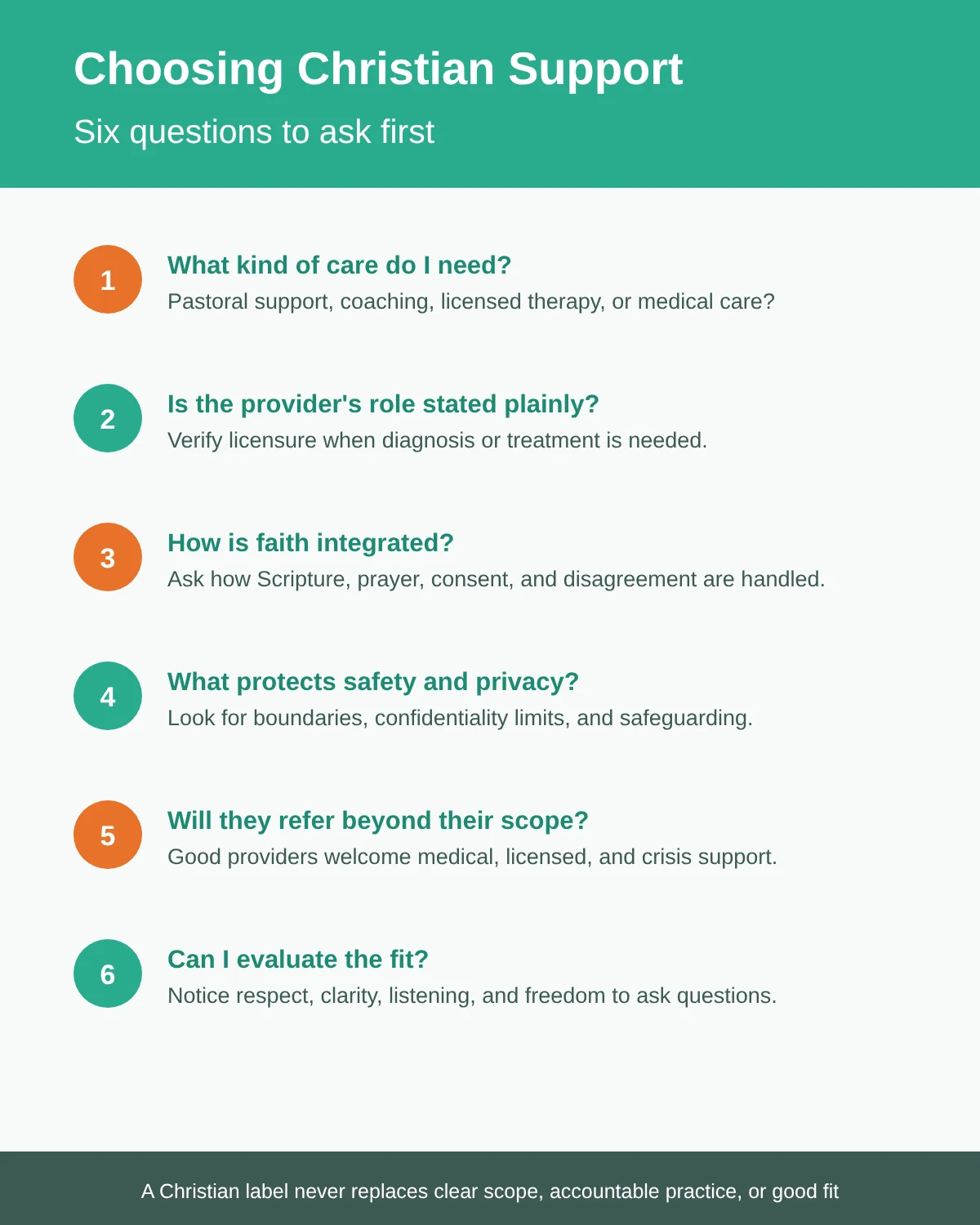
Notice the manner of answering. Clear responses are encouraging; defensiveness, vagueness, or pressure to book quickly is useful information.
Christian Counselor Red Flags
Red flags matter as much as good traits when you decide how to choose a Christian counselor. Pause and seek another opinion when a provider repeatedly:
- misrepresents credentials or refuses to clarify whether the work is pastoral, coaching, or licensed treatment;
- promises healing, victory, a saved marriage, or a guaranteed timeline;
- attributes every symptom to sin, weak faith, or spiritual attack;
- uses Scripture, prophecy, submission, or forgiveness to silence questions or preserve unsafe access;
- discourages appropriate medical, psychiatric, substance-use, or domestic-violence care;
- minimizes threats, coercive control, sexual pressure, stalking, or violence as a communication problem;
- insists on couples sessions when one partner is afraid or could face retaliation;4
- pressures secrecy, creates financial or emotional dependence, crosses sexual or relational boundaries, or lacks outside accountability;
- talks freely about other clients, which raises questions about how your story will be handled; or
- reacts to feedback with shame, intimidation, spiritual superiority, or retaliation.
A single mismatch in style may call for a conversation. Deception, exploitation, coercion, retaliation, sexual misconduct, or unsafe advice calls for distance and appropriate reporting or specialized support.
Try This Seven-Day Selection Process
- Name the need. Write one sentence about the concern and its effect on daily life.
- Establish safety. Check for danger, self-harm risk, coercion, severe symptoms, withdrawal, or inability to function.
- Choose the role. Decide whether to begin with pastoral counseling, coaching, licensed therapy, medical care, a specialized program, or crisis support.
- Verify two candidates. Check credentials, training, scope, and complaint pathways.
- Ask the same five questions. Compare answers about role, faith integration, confidentiality, boundaries, and referrals.
- Review the first conversation. Did you feel heard, free to disagree, and clear about the next step?
- Choose, clarify, or leave. Continue, raise a repairable concern, or select someone else.
This sequence reflects four movements in the NuWell RESTORE Path: Recognize the wound, Establish safety, Separate truth from distortion, and Rebuild healthy patterns. It is a flexible pastoral map, not a clinical protocol or a promise of results. Our guide to finding biblical counseling online can help with the discovery step, and this process covers how to choose a Christian counselor once you have candidates.
When NuWell Fits, and When Another Level of Care Comes First
Our online pastoral counseling may fit adults across the United States who are stable enough for non-clinical work and want Scripture-rooted support for spiritual confusion, church hurt, grief, shame, forgiveness, boundaries, relationships, purpose, or a life decision. Christian life coaching may fit generally stable people pursuing goals, habits, leadership, or accountability.
Begin with licensed mental-health or medical care when you need assessment, diagnosis, psychotherapy, medication evaluation, trauma or addiction treatment, eating-disorder care, or help with persistent or severe symptoms that disrupt sleep, work, judgment, self-care, or relationships. For licensed Christian counseling, we refer to our partners at Grace Christian Counseling. SAMHSA’s FindTreatment.gov can also help locate U.S. mental-health and substance-use treatment.3 Pastoral support may complement that care when roles and consent remain clear.
Safety and Level-of-Care Boundaries
Abuse is not a communication cycle. When coercive control, threats, stalking, sexual coercion, or violence may be present, do not begin joint counseling with the person causing harm. Seek individual safety planning and specialized domestic-violence support.
In immediate danger in the United States, call 911.
For suicidal thoughts, self-harm, emotional distress, or a substance-use crisis, call or text 988 or chat at 988lifeline.org. It is free, confidential, and available 24/7. NuWell is not an emergency service.
For domestic-violence support, call 800-799-SAFE (7233), text START to 88788, or chat at TheHotline.org. If your device may be monitored, use a safer device when possible.
Frequently Asked Questions
What qualifications should a Christian counselor have?
The qualifications should match the service. A licensed therapist should hold an active license in your state and relevant clinical training. A pastoral counselor or coach should clearly disclose education, credentials, supervision or accountability, scope, privacy practices, and referral limits. Christian commitment is important for faith-integrated care, but it does not replace competence or honest boundaries.
How can I verify a Christian counselor’s license?
Search the official licensing board website for the state where you will receive care, confirm that the license is active, and review any public disciplinary record. Match the provider’s full name and license type rather than relying only on a website badge or directory profile. If the person is not offering licensed care, ask what credential applies and who provides accountability.
Is it okay to change Christian counselors?
Yes. You may change providers when the role, expertise, faith integration, boundaries, availability, or relationship does not fit your needs. When it feels safe and the concern may be repairable, you can first name it directly. You do not need to remain in a relationship that is coercive, deceptive, exploitative, or unsafe.
Should a Christian counselor pray or use Scripture in every session?
Not necessarily. Scripture and prayer may be central to explicitly Christian care, but their timing and use should serve the agreed purpose and respect consent. A good provider can explain the approach, ask about your preferences, receive questions, and avoid using spiritual practices to bypass safety, responsibility, grief, medical care, or appropriate referral.
Find Your Best Next Step
When you think about how to choose a Christian counselor, remember that a good one will not be flawless. Look for truthful scope, competence, careful Scripture use, respect for agency, clear boundaries, accountability, and humility to refer. We can help you consider whether NuWell’s non-clinical pastoral counseling or Christian coaching fits what you are facing, and tell you when another kind of care would be wiser.
You can meet the NuWell care team, talk with us, and see whether NuWell is the right fit without pressure or obligation.

This article was researched with the help of AI and reviewed and edited by Stephen Luther, MEd, MSEd, LPC, for accuracy, Scripture references, and faithfulness to NuWell’s non-clinical scope.
Stephen Luther, MEd, MSEd, LPC, is Executive Director and Founder of Grace Christian Counseling and a licensed professional counselor. He holds a master’s degree in Education and a master’s degree in Marriage and Family Therapy from Duquesne University and has helped children, adolescents, and adults since 1997. His licensed clinical role at Grace Christian Counseling is separate from NuWell’s non-clinical pastoral counseling and Christian life coaching services.
Scope note: This article is educational and pastoral; it is not diagnosis, psychotherapy, clinical treatment, medical or legal advice, domestic-violence intervention, or emergency care. NuWell provides non-clinical pastoral counseling and Christian life coaching.
Sources
- American Counseling Association. ACA Code of Ethics (2014). Accessed October 12, 2026.
- Flückiger, C., Del Re, A. C., Wampold, B. E., & Horvath, A. O. (2018). The alliance in adult psychotherapy: A meta-analytic synthesis. Psychotherapy, 55(4), 316–340.
- Substance Abuse and Mental Health Services Administration. FindTreatment.gov. Accessed October 12, 2026.
- National Domestic Violence Hotline. Should I Go to Couples Therapy With My Abusive Partner? Accessed October 12, 2026.
- 988 Suicide & Crisis Lifeline. About 988. Accessed October 12, 2026.
