

What Is Splankna Therapy and How Does It Work?
Splankna therapy is billed by its creators as the first Christian protocol for energy psychology. The mind-body connection is central to how it operates. Practitioners suggest that traumatic life events, unresolved grief, and subconscious emotions become physically “stored” within the body’s nervous and energetic systems.
When a painful event occurs, a person often forms ungodly beliefs, vows, or emotional patterns in response to that wound. Splankna attempts to resolve these issues by pairing theological tools—such as prayer, repentance, and forgiveness—with physiological and energetic release mechanisms.
To explore how these concepts are structured, many individuals review faith-based Splankna Therapy protocols to see how prayer is woven alongside physical touchpoints. The goal of this synthesis is to clear emotional blocks quickly while asking Jesus Christ to bring freedom to the root cause of the trauma.
Core Protocols of Splankna Therapy
The actual workflow of Splankna combines four distinct modalities into a single structured system:
- Applied Kinesiology (Muscle Testing): Practitioners use subtle physical resistance, often testing the strength of a client’s arm, to communicate with the subconscious mind. The theory asserts that the body will show physical weakness when presented with emotional stress or false beliefs, allowing the practitioner to pinpoint specific ages, events, and feelings linked to trauma.
- Thought Field Therapy (TFT): Based on the idea of biological energy meridians, TFT involves tapping on specific physical points along the body while focusing on an emotional trigger to release trapped emotional charge.
- Neuro-Emotional Technique (NET): This process pairs physical contact on meridian points with deep breathing and focused mental imagery to neutralize stored negative emotions.
- Eye Movement Desensitization and Reprocessing (EMDR) Elements: Rapid eye movements or bilateral stimulation are used to help reprocess traumatic memories in the brain.
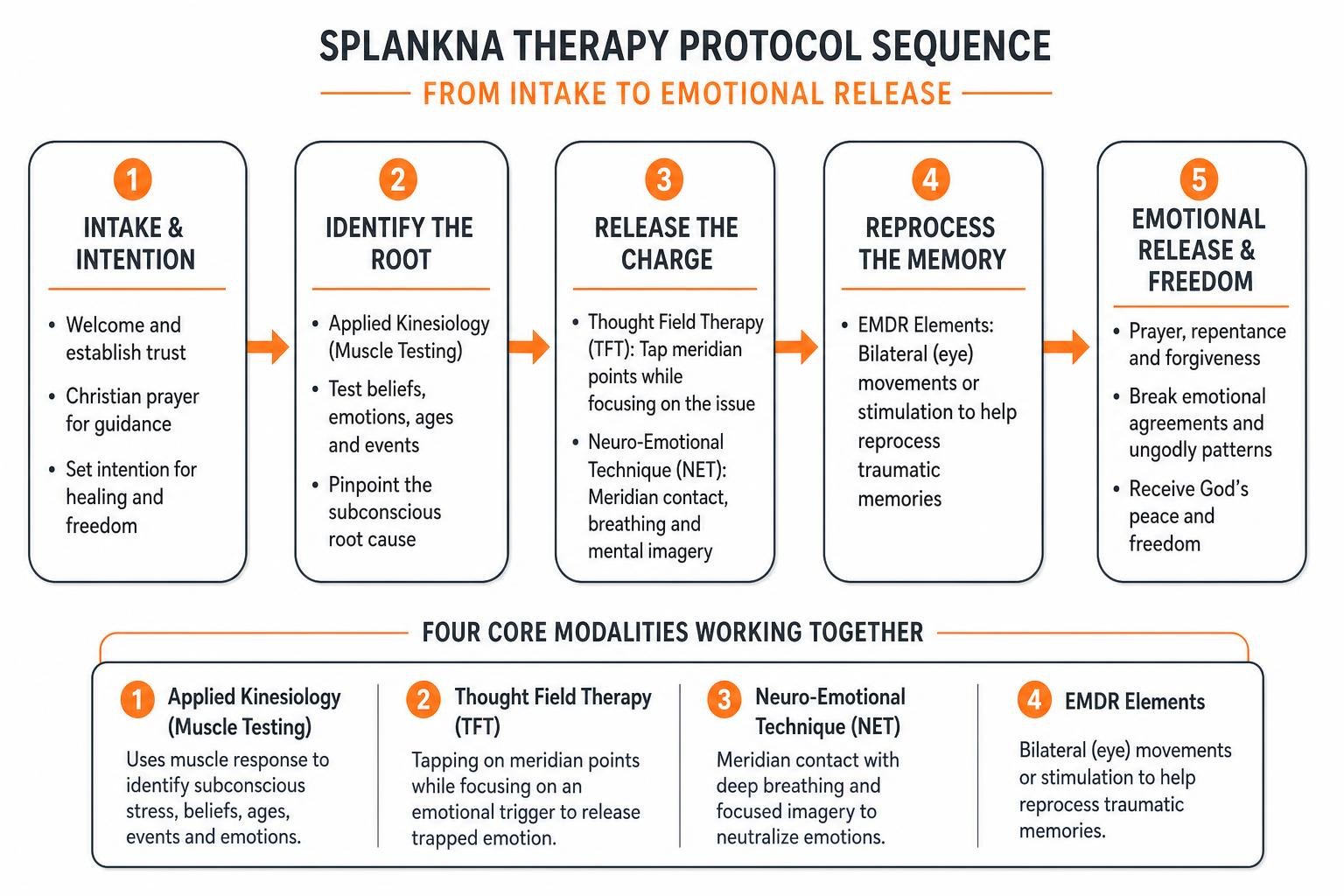
Practitioners utilize Splankna for emotional release to address subconscious patterns. During a session, once a subconscious emotion is identified via muscle testing, the practitioner leads the client through targeted tapping and meridian contact, followed by targeted prayers to break emotional agreements, forgive offenders, and receive God’s peace.
Greek Origins: Understanding the Meaning of Splankna
The name of the modality comes from the ancient Greek word splanchna (often transliterated as splankna). In classical and biblical Greek, the term refers literally to the internal organs, the intestines, or the “bowels.”
In the ancient world, the gut was viewed as the physical seat of deep, visceral emotion—much like modern culture views the heart as the center of love. The New Testament uses splanchna to describe the profound, gut-level compassion of Jesus Christ when He saw the hurting crowds (Matthew 9:36) and in passages like Colossians 3:12, which instructs believers to put on “bowels of mercies” or heartfelt compassion.
Splankna therapy draws upon this scriptural terminology to argue that deep emotional wounding resides in the physical body and that God desires to bring restoration to these inner regions of human experience.
Theological Analysis and Biblical Perspectives
When evaluating any healing modality, believers must exercise spiritual discernment. As we seek restoration, our worldview must remain anchored in biblical authority rather than pragmatic outcomes. When navigating trauma through faith, Christians are called to evaluate both the mechanism of healing and the spiritual source behind it.
At NuWell we have found that many believers pursue alternative modalities out of a genuine desire for relief after years of unresolved pain. However, we must carefully consider how energy psychology aligns with the person and work of the Holy Spirit.
Evaluating Splankna Therapy Through Scripture
The primary theological critique of Splankna centers on whether its foundational premises reflect biblical truth or unscriptural philosophies. Scripture gives clear guidance on how we guard our hearts and minds:
“See to it that no one takes you captive through hollow and deceptive philosophy, which depends on human tradition and the elemental spiritual forces of this world rather than on Christ.” — Colossians 2:8
Splankna attempts to “redeem” energy psychology by renaming life-force concepts and dedicating sessions to Jesus. However, critics highlight fundamental tensions between biblical counseling principles and energy-based assumptions:
| Dimension | Biblical Pastoral Care | Energy Psychology Assumptions |
|---|---|---|
| Source of Truth | The inspired Word of God and the Holy Spirit | Subconscious body energy and muscle response testing |
| Nature of the Problem | Fallen human condition, spiritual wounds, and sin | Trapped energetic frequencies and meridian blockages |
| Path to Freedom | Repentance, prayer, Christ’s atonement, renewal of the mind | Physical tapping on meridians, energetic clearing, and body algorithms |
| Role of the Counselor | Shepherding, discipleship, and prayerful guidance | Facilitator of energetic and subconscious diagnosis |
| Spiritual Power | Sovereign work of the Holy Spirit alone | Universal life force channeled through physical systems |
Biblical prayer is relational communication with God, relying on His sovereignty, grace, and timing. In contrast, mechanical protocols that treat spiritual healing like a biological algorithm risk bypassing the transforming work of the Holy Spirit.
Spiritual Discernment and Syncretism Concerns
Syncretism occurs when biblical faith is blended with non-Christian philosophical systems. The concepts underlying thought field therapy, meridian lines, and applied kinesiology originate from traditions that view the universe through an impersonal, pantheistic life-force lens rather than a personal Creator God.
While Splankna practitioners explicitly reject non-Christian spiritual worldviews and dedicate their work to Jesus, theological critics point out that adopting the mechanics of energy systems carries spiritual risks. Scripture repeatedly warns God’s people against borrowing spiritual technologies from surrounding cultures to worship or hear from God (Deuteronomy 12:30-32).
At NuWell we have seen that true emotional wholeness is best achieved when care remains transparently grounded in the sufficiency of Scripture, pastoral guidance, and scientifically sound methods that do not rely on unverified energetic theories.
Comparing Holistic Modalities and Evidence-Based Care
God designed human beings as unified creatures of body, soul, and spirit. It is entirely appropriate to care for the physical body and the nervous system alongside the spiritual heart. The key difference lies in distinguishing between evidence-based physiological care and speculative energy practices.
Modern neuroscience confirms that trauma impacts the central nervous system, muscle tension, and heart-rate variability. Somatic therapies, gentle movement, controlled breathing, and physical wellness techniques directly support nervous system regulation without invoking invisible energy meridians. If you are exploring physical health support, working with an established clinic like ESSMC North Huntingdon Office | Physical Therapy Near Me offers licensed, evidence-based care for the musculoskeletal system.
True holistic wellness honors the way God constructed our biology. By embracing wholeness through holistic counseling, believers can address physical stress, emotional processing, and spiritual sanctification without crossing into theological ambiguity.

Biblically Grounded Alternatives for Trauma
Believers seeking trauma care do not have to choose between clinical excellence and faith. Sound alternatives exist that integrate clinical rigor with orthodox Christian discipleship:
- Christian Cognitive Behavioral Therapy (CBT): Helps individuals identify cognitive distortions and realign their thought lives with the truth of Scripture (Romans 12:2; 2 Corinthians 10:5).
- Standard Clinical EMDR: Administered by licensed mental health professionals without energetic muscle testing, helping the brain process traumatic memory networks through bilateral stimulation.
- Scripture Meditation and Pastoral Prayer: Cultivating deep, contemplative prayer rooted in the Psalms, allowing the Holy Spirit to bring peace and comfort to deep grief.
- Dedicated Pastoral Counseling: Working through shame, relational ruptures, and spiritual questions with trained ministers who provide structured discipleship.
For those facing deep emotional distress, specialized online Christian counseling for trauma offers a safe, clinically responsible path to recovery. Pairing this with biblically centered mental health counseling ensures that your emotional healing remains anchored in the living hope of Jesus Christ.
Frequently Asked Questions

Is Splankna approved by mainstream psychology?
Splankna therapy is not formally recognized or endorsed by major psychological organizations such as the American Psychological Association (APA). While individual components like standard EMDR have extensive empirical backing, applied kinesiology (muscle testing) and Thought Field Therapy are widely viewed within mainstream clinical science as lacking sufficient empirical validation.
Clinical psychologists generally categorize energy psychology techniques as experimental or alternative modalities due to the absence of large-scale, double-blind clinical trials demonstrating that “energy meridians” are the active mechanism of change.
What happens during a typical session?
A standard session generally follows a four-step framework:
- Intake Assessment and Opening Prayer: The practitioner and client invite the Holy Spirit to guide the session, dedicating the time to Jesus Christ.
- Muscle Response Testing: The practitioner tests muscle resistance to identify specific subconscious emotions or ages associated with an emotional wound.
- Meridian Point Contact: The client holds or taps specific acupressure points while recalling the identified memory or emotion to clear the physiological stress response.
- Prayer and Forgiveness: The session concludes with targeted prayers breaking ungodly agreements, forgiving individuals involved in the wound, and asking God for restoration.
How does biblical counseling differ from energy healing?
Biblical pastoral care rests entirely on the sufficiency of Scripture, the redemptive work of Jesus Christ, and the personal presence of the Holy Spirit. It views suffering through the lens of human experience in a fallen world and seeks heart transformation, repentance, and spiritual maturity within the fellowship of the church.
Energy healing, by contrast, operates on the assumption that emotional distress stems from disruptions in an invisible biological energy field that can be mechanically balanced. Biblical counseling does not attempt to manipulate subconscious energy; rather, it shepherds the soul toward reliance on God’s promises and healing grace.
Conclusion
Every person walking through trauma, grief, or emotional distress was created for more than a life defined by pain. God deeply cares about your emotional wellness, and His heart is toward your complete healing & wholeness.
While Splankna therapy seeks to bridge faith and alternative healing, believers must carefully weigh its energetic foundations against the clear light of Scripture. We encourage you to seek methods that place faith first, honor Christ’s sufficiency, and rely on proven, biblically sound practices.
At NuWell Online, our pastoral counselors and certified Christian coaches provide a compassionate, Scripture-rooted environment to help you process trauma and find lasting peace. You do not have to walk through recovery alone—schedule faith-centered pastoral counseling today and take your next step toward emotional freedom in Christ.
This article was researched with the help of AI and reviewed and edited by Jordan Oliver for accuracy, Scripture references, and faithfulness to NuWell’s non-clinical scope.
Jordan is an author, ordained minister, and online host for His Glory TV, sharing biblically grounded insights on faith, prayer, and spiritual growth. She is the co-founder of Triple-Braided Cord Co., an intercessory prayer and healing ministry inspired by Ecclesiastes 4:12.
Jordan holds a Bachelor’s degree in Communications and Religious Studies from High Point University and is a certified Spiritual Life Coach through iCoachLife in Nashville, Tennessee. Drawing from her ministry, coaching, and academic experience, she creates trustworthy, faith-based content that helps readers grow in their relationship with God. Learn more about Jordan here.
