

You confess the same concern again. You reread the passage, search one more explanation, or ask another trusted Christian whether you sinned. Relief comes for a few minutes. Then the doubt returns with a new detail: But what if I left something out? What if I did not mean the prayer? What if God is still displeased? When that cycle keeps repeating, the question of scrupulosity vs conviction becomes very personal.
Faith, doubt, and appropriate care
Understanding scrupulosity vs conviction is not a matter of finding a perfect spiritual test. Conviction can call a Christian toward truthful confession and repair. Scrupulosity is a form of obsessive-compulsive disorder (OCD) involving religious or moral obsessions and compulsions. Only a qualified clinician can diagnose OCD. This guide helps you notice patterns, understand the limits of pastoral guidance, and choose an appropriate next step without turning a checklist into a verdict.
Quick answerConviction may be painful, but it usually concerns something specific and points toward a proportionate response such as confession, apology, restitution, or changed conduct. A possible scrupulosity pattern keeps demanding certainty, returns after repeated checking or reassurance, and can consume time or disrupt worship, work, sleep, and relationships. The content may sound spiritual; the repeating anxiety-relief loop is the reason to seek a licensed OCD assessment. Pastoral support can continue alongside that care.
What Christian Scrupulosity Is and Is Not
The National Institute of Mental Health describes OCD as a long-lasting disorder involving uncontrollable, recurring thoughts, repetitive behaviors, or both. Its list of possible obsessions includes unwanted thoughts involving religion, and its list of compulsions includes praying or repeating words silently.1 Prayer itself is not a symptom. What matters is function: a practice may become part of an OCD cycle when it is repeatedly used to neutralize fear or obtain certainty and brings only temporary relief.
The International OCD Foundation describes scrupulosity as a subtype of OCD involving religious or moral obsessions. Examples can include persistent fear of blasphemy, sin, punishment, impurity, or not believing correctly, followed by excessive confession, repeated prayer, research, reassurance seeking, or avoidance.2 These examples are educational, not proof that any one person has OCD.
Ordinary Christian practices should not be pathologized. Thoughtful self-examination, confession, prayer, studying Scripture, and asking a pastor a sincere question can all be healthy. Strong emotion does not prove scrupulosity, and calm emotion does not prove conviction. A clinician looks at the broader pattern, including repetition, loss of control, distress, time, avoidance, and interference with daily life.
Scrupulosity vs Conviction: Compare the Pattern, Not Just the Feeling
| Discernment question | Ordinary moral or spiritual concern may look like | A possible scrupulosity pattern may look like |
|---|---|---|
| What starts it? | A specific action, omission, belief, or relationship concern. | An intrusive “what if” or doubt that may shift as soon as one version is answered. |
| What does the question seek? | Truth, responsibility, wisdom, or repair. | Complete certainty that no sin, error, blasphemy, or danger is possible. |
| What happens after an answer? | You can usually act, learn, and let the matter rest. | Checking, confession, research, prayer, or reassurance brings brief relief, then doubt returns. |
| What is the impact? | Concern is proportionate and leaves room for worship, work, sleep, and relationships. | The loop becomes distressing, time-consuming, avoidant, or disruptive. |
| Who should assess it? | A wise pastor or mentor may help clarify theology and responsibility. | A licensed clinician with OCD expertise should assess and treat; pastoral care may complement that work. |
This comparison cannot diagnose you. It is a conversation aid. Our guide to Christian shame versus conviction may fit better when the main struggle is a global verdict such as “I am beyond grace.” This page serves a different question: whether recurring religious doubt and certainty-seeking may need OCD-informed licensed care.
Pastoral experience: In pastoral conversations, we sometimes hear Christians ask the same moral or theological question in slightly different forms, hoping the next answer will finally make the fear stop. The concern may sound like a request for better doctrine, yet the relief lasts only briefly and the question returns. That pattern does not establish a diagnosis. It does signal that another reassurance-filled conversation may be less helpful than inviting a licensed OCD specialist to assess what is happening while pastoral care remains available for faith questions.
Why Reassurance Can Feed Intrusive Religious Thoughts
Reassurance is a normal expression of care. In OCD, however, repeated reassurance can function like a compulsion: it lowers anxiety for the moment and teaches the mind to seek certainty again when doubt returns. The International OCD Foundation cautions faith leaders that providing reassurance, even to simple questions, serves to maintain the OCD cycle.3
- An unwanted religious or moral doubt appears.
- Anxiety and urgency rise: “I must settle this now.”
- You check, confess, research, repeat a prayer, or ask for reassurance.
- Relief arrives briefly.
- The doubt returns, often with a new angle, and the cycle restarts.
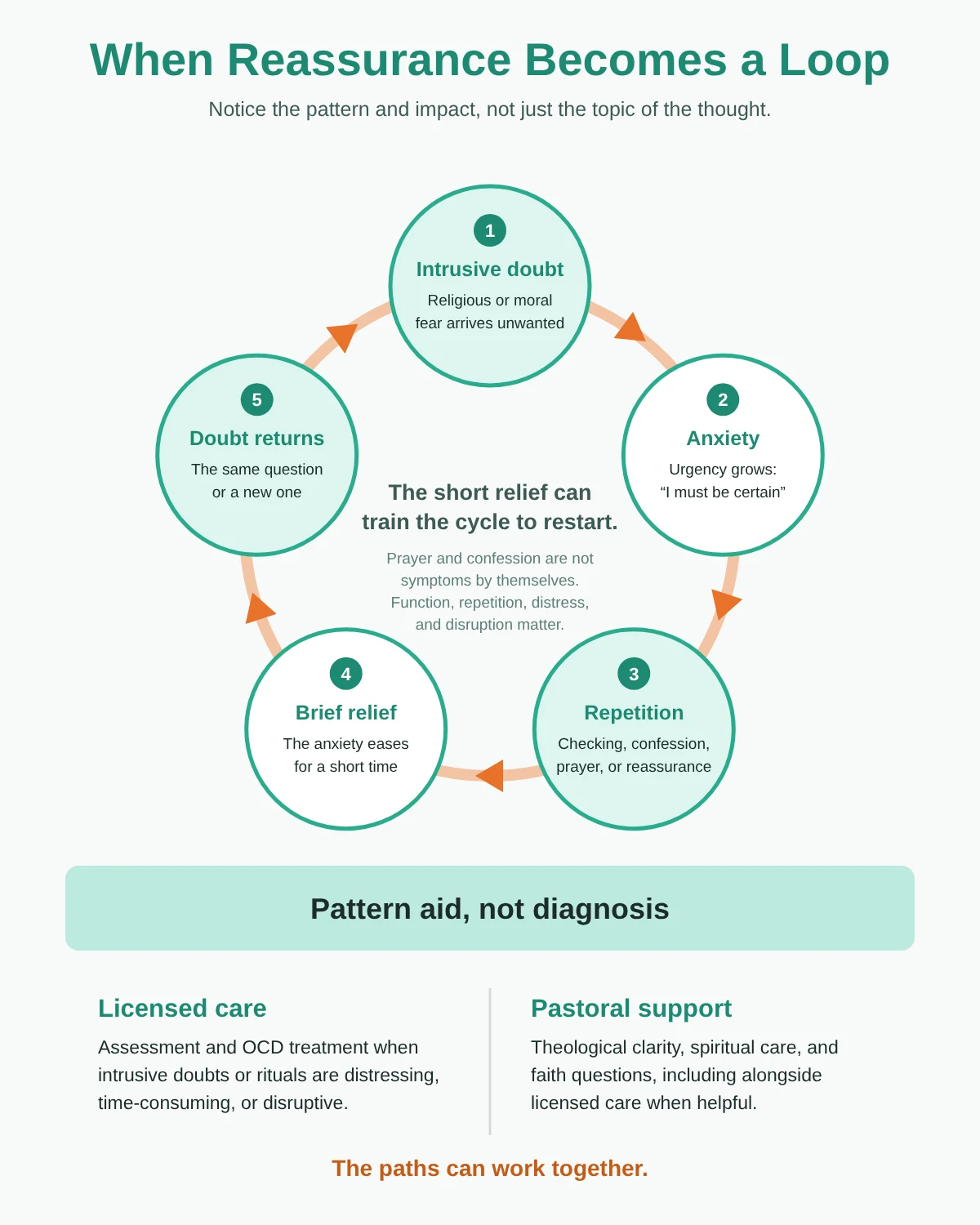
The graphic is a pattern aid, not a diagnosis. Prayer and confession are not symptoms by themselves; function, repetition, distress, and disruption matter. When you weigh scrupulosity vs conviction in your own life, this loop is often the clearest signal to watch for.
Five Next Steps for Christian Scrupulosity That Do Not Require Self-Diagnosis
Record the pattern, not a verdict
For one week, note the question, what you did to feel certain, how long relief lasted, and what the pattern interrupted. Do not use the notes to prove that you do or do not have OCD. Bring them to a licensed provider as concrete information.
Choose one consistent spiritual guide
If you seek pastoral input, choose one mature person who respects clinical care and will not shame you for intrusive thoughts. Moving from pastor to pastor until one answer feels certain can deepen the reassurance loop. A consistent guide can clarify your faith community’s ordinary teaching without repeatedly adjudicating every new “what if.”
Ask specifically for an OCD assessment
A general mental-health appointment may be a starting point, but ask whether the clinician has experience assessing OCD and scrupulosity. NIMH notes that diagnosing OCD can be difficult and encourages talking with a health care provider if you think OCD may be present.1 The International OCD Foundation offers a directory of clinicians who specialize in OCD.
Let pastoral and licensed care coordinate with your consent
An OCD clinician owns diagnosis and treatment. A pastor or pastoral counselor can clarify theological norms, support your spiritual life, and avoid turning care into another certainty ritual. With your permission, the two may coordinate. The International OCD Foundation notes that scrupulosity treatment may include consultation with leaders of a person’s faith tradition.2
Do not design your own exposure exercises from an article
Exposure and response prevention (ERP) is a form of cognitive behavioral therapy and, along with medication, one of the treatments research has shown most effective for OCD.4 It should begin with a trained clinician who can tailor the work to you and distinguish treatment from violating sincerely held beliefs. NuWell does not provide ERP, diagnose OCD, or direct clinical treatment.
Scrupulosity vs Conviction in Scripture: Truth Without Endless Self-Prosecution
Second Corinthians 7:10–11 distinguishes godly sorrow by its fruit: earnestness and a changed response. The passage does not offer a symptom checklist, and it should not be used to declare every repeated fear a spiritual failure. Christian conviction can take sin seriously without requiring endless self-punishment or perfect internal certainty before grace may be received.
Romans 8:1 locates the believer’s hope in Christ rather than in the ability to achieve a flawless feeling of innocence. That promise should be taught with care, not used as one more reassurance phrase that must be repeated until anxiety disappears. Sound theology and OCD treatment answer different parts of the problem. They need not compete, and holding both is often how the scrupulosity vs conviction question finally becomes manageable.
Our RESTORE Path can serve as a flexible pastoral map alongside appropriate licensed care. It is not an OCD protocol and does not replace treatment:
- Recognize the wound. Name the pattern without turning it into your identity.
- Establish safety. Put clinical and crisis support in place when needed.
- Separate truth from distortion. Distinguish faithful conviction from the demand for impossible certainty.
- Tend what was wounded. Make room for fear, fatigue, and grief.
- Orient identity in Christ. Rest in his finished work rather than a perfect feeling.
- Rebuild healthy patterns. Practice spiritual rhythms in coordination with qualified care.
- Engage the life God intended. Return to worship, relationships, and calling with growing freedom.
Which Kind of Support Fits Christian Scrupulosity?
When the loop is distressing or disruptive
- intrusive religious or moral doubts are recurring, unwanted, and difficult to control;
- checking, confession, reassurance, avoidance, or repeated mental acts are time-consuming or bring only brief relief;
- the pattern disrupts worship, sleep, work, school, relationships, or daily functioning; or
- you want assessment, diagnosis, psychotherapy, or medication guidance.
Use the IOCDF directory or ask a primary-care provider for an OCD-informed referral. For licensed Christian counseling, we refer to our partners at Grace Christian Counseling.
Alongside licensed care
- you want non-clinical Biblical guidance about grace, confession, doubt, identity, or spiritual practices;
- you need a consistent pastoral voice that will respect your licensed treatment plan;
- church experiences or distorted teaching have complicated your picture of God; or
- you want prayerful support without asking a pastor to diagnose or treat OCD.
Learn how online pastoral counseling at NuWell works, or compare pastoral counseling and licensed therapy.
Christian life coaching is usually not the first lane for active, impairing obsessions or compulsions; it may become useful later for forward-looking routines and goals once clinical needs are addressed. If your main concern is general worry rather than repeated religious doubt, our article on when anxiety feels like a lack of faith may fit better.
When Safety Cannot Wait
Intrusive thoughts do not automatically mean a person wants to act on them. Even so, urgent help is appropriate when you may harm yourself or someone else, cannot keep yourself safe, are unable to care for basic needs, or are in a severe emotional or substance-use crisis.
In immediate danger in the United States, call 911.
For suicide, self-harm, emotional distress, or a substance-use crisis, call or text 988 or chat at 988lifeline.org. The Lifeline is free, confidential, and available 24/7. NuWell is not an emergency service.
Frequently Asked Questions
Is Christian scrupulosity a lack of faith?
No. Scrupulosity is a form of OCD involving religious or moral obsessions and compulsions. It can attach to beliefs a person values deeply. Having intrusive thoughts or an OCD pattern does not by itself establish the strength, weakness, or sincerity of someone’s faith.
Can a pastor diagnose scrupulosity?
No. A pastor or pastoral counselor may notice a recurring pattern, clarify theology, and recommend an evaluation, but diagnosis belongs to a qualified licensed clinician. NuWell provides non-clinical pastoral counseling and Christian life coaching, not diagnosis or OCD treatment.
Should I stop praying if prayer feels compulsive?
Do not make that decision from an article. Prayer is not a symptom by itself. A licensed OCD clinician can help assess how prayer is functioning and develop a treatment plan that respects your faith. A consistent faith leader may help clarify ordinary practices without supplying repeated certainty.
Can pastoral counseling replace ERP for scrupulosity?
No. Pastoral counseling can support faith questions, spiritual practices, and theological clarity, but it does not replace licensed OCD treatment. ERP is a specialized form of cognitive behavioral therapy and should be guided by a trained clinician.
How do I find licensed help for possible scrupulosity?
Ask whether the clinician assesses OCD and has training or experience in exposure and response prevention. The International OCD Foundation has a resource directory, and a primary-care provider may also help with a referral. You can continue pastoral support alongside licensed care when both providers understand their roles.
Find Your Best Next Step
Sorting out scrupulosity vs conviction does not require you to settle the diagnosis or solve every religious question before asking for help. Begin by naming the loop and its impact. If repeated doubt and certainty-seeking are consuming time or narrowing your life, arrange an OCD-informed licensed assessment. If you also want non-clinical support for theology, prayer, identity, or church-related wounds, we can walk alongside that care.
You can meet the NuWell care team, talk with us, explore your options, and see whether NuWell is the right fit without pressure or obligation.

This article was researched with the help of AI and reviewed and edited by Stephen Luther, MEd, MSEd, LPC, for accuracy, Scripture references, and faithfulness to NuWell’s non-clinical scope.
Stephen Luther, MEd, MSEd, LPC, is Executive Director and Founder of Grace Christian Counseling and a licensed professional counselor. He holds a master’s degree in Education and a master’s degree in Marriage and Family Therapy from Duquesne University and has helped children, adolescents, and adults since 1997. His licensed clinical role at Grace Christian Counseling is separate from NuWell’s non-clinical pastoral counseling and Christian life coaching services.
Scope note: This article is educational and pastoral; it is not diagnosis, psychotherapy, clinical treatment, legal advice, or emergency care. NuWell provides non-clinical pastoral counseling and Christian life coaching.
Sources
- National Institute of Mental Health. Obsessive-Compulsive Disorder: When Unwanted Thoughts or Repetitive Behaviors Take Over. Accessed October 12, 2026.
- International OCD Foundation. What Is OCD & Scrupulosity? Accessed October 12, 2026.
- International OCD Foundation. For Faith Leaders. Accessed October 12, 2026.
- International OCD Foundation. Exposure and Response Prevention (ERP). Accessed October 12, 2026.
