

Church hurt and discernment
You leave a meeting replaying every word. A leader dismissed your concern, a friend repeated something you shared privately, or a church decision left you grieving. You know you were hurt. But another question is harder: Was this ordinary conflict, harmful leadership, or spiritual abuse?
Church hurt vs. spiritual abuse is not a contest over whose pain counts. Church hurt is a broad description for painful experiences in a faith community. Spiritual abuse is narrower: a repeated pattern that uses spiritual authority, Scripture, belonging, or access to God to control, shame, exploit, or silence. Harmful leadership can sit between those categories: it may cause serious damage even when a coercive pattern has not been established.
Quick answerLook beyond one painful moment to the pattern, the power difference, whether accountability works, and what happens when someone questions the leader or tries to leave. Repair may fit a mutually safe conflict. Distance and independent counsel may be wiser when leadership is harmful. When fear, retaliation, isolation, threats, sexual misconduct, or coercive control may be present, safety comes before confrontation or reconciliation.
Church Hurt vs. Spiritual Abuse at a Glance
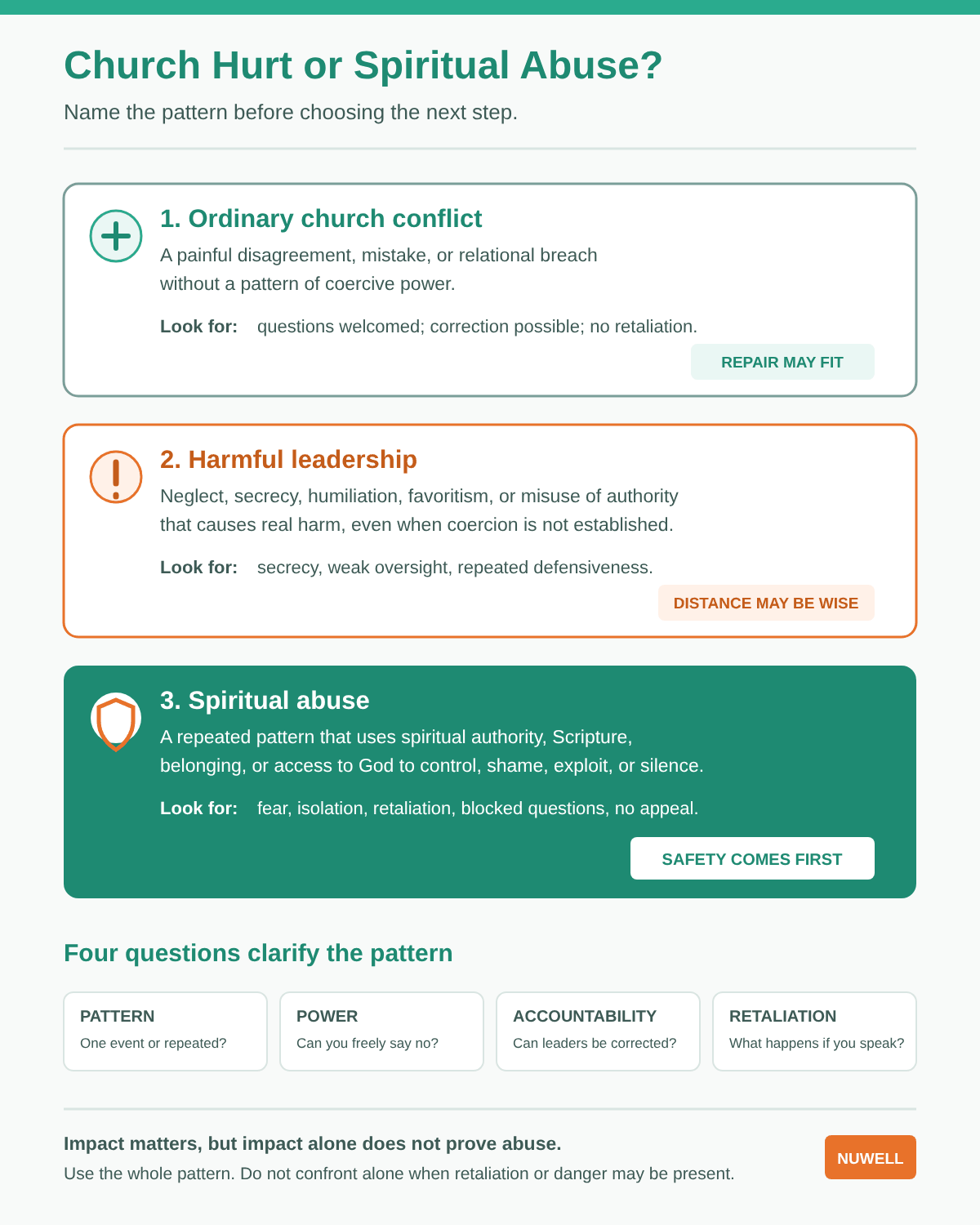
| Pattern | What you may notice | Next step that may fit |
|---|---|---|
| Ordinary church conflict | A painful disagreement, mistake, or relational breach without a pattern of coercive power. Questions are welcomed, correction is possible, and no one retaliates. | Repair may fit: name the specific action and ask for concrete change. |
| Harmful leadership | Neglect, secrecy, humiliation, favoritism, or misuse of authority that causes real harm, even when coercion is not established. Watch for weak oversight and repeated defensiveness. | Distance may be wise: pause involvement and seek counsel outside the leader’s authority. |
| Spiritual abuse | A repeated pattern that uses spiritual authority, Scripture, belonging, or access to God to control, shame, exploit, or silence. Look for fear, isolation, retaliation, blocked questions, and no appeal. | Safety comes first: do not confront alone; seek independent guidance or specialized help. |
Ordinary church conflict
Christians can misunderstand one another, communicate poorly, make an unfair decision, or fail to care well. The harm may be real. In a repairable conflict, however, people remain free to disagree, ask questions, step away, seek counsel, and tell the truth without punishment. Leaders can be corrected, and apology or restitution is possible.
Harmful leadership
Some conduct is more serious than an ordinary misunderstanding: repeated humiliation, broken confidentiality, favoritism, reckless advice, financial secrecy, ignored complaints, or an institution protecting its reputation instead of people. These patterns deserve clear naming and accountability. They do not need to meet a diagnostic label before you take wise distance or seek independent support.
Spiritual abuse
Spiritual abuse uses sacred trust as leverage. A leader, spouse, family member, or religious system may claim divine authority to override conscience, demand secrecy, control relationships or money, block access to outside help, or make belonging depend on compliance. The National Domestic Violence Hotline describes spiritual abuse as including the use of religious beliefs to manipulate, shame, or rationalize other abuse.3
Research language is still developing. A 2022 systematic review found substantial variation in how religious or spiritual abuse and trauma were defined across 25 studies.2 That is one reason an online checklist cannot adjudicate a whole situation. It can help you notice patterns and choose a safer next step.
Pastoral experience: In pastoral conversations, we often hear people describe the same confusing sequence: a concern is first treated as a misunderstanding, then as disloyalty, and finally as evidence that the person is spiritually unhealthy. The turning point is often not the original disagreement but what happens after a respectful question. Curiosity and accountable repair create room for truth; shame, isolation, and retaliation close that room.
Four Questions That Clarify the Pattern
Is this one event or a repeated pattern?
A single harsh comment can wound deeply. Repetition adds different information. Write down what happened, when it happened, who was present, what was said, and what followed. Stay specific. “I was asked not to raise that concern again, and my volunteer role was removed the next day” is more useful than “They are all toxic.”
How is spiritual power being used?
Pastors and ministry leaders carry influence because people trust them with Scripture, prayer, belonging, and vulnerable parts of life. Healthy leadership treats that influence as stewardship. Coercive leadership treats it as entitlement. Notice whether “God told me,” submission language, public prayer, church discipline, or fear of losing community is being used to force a personal, financial, sexual, medical, marital, or ministry decision.
Does accountability actually work?
A policy on paper is not the same as working oversight. Can a concern reach someone outside the accused leader’s direct authority? Are conflicts of interest disclosed? Are allegations documented and examined without coaching the reporter toward silence? Does leadership accept proportionate consequences, or does every process return control to the same person?
What happens when someone says no, asks questions, or leaves?
This question often reveals the difference between disappointment and control. A healthy church may feel sad when someone leaves, but it does not threaten God’s punishment, recruit friends to monitor the person, sabotage employment or relationships, expose confidential information, or portray every question as rebellion. Retaliation, shunning, surveillance, threats, and forced secrecy are serious warning signs.
Impact matters even when intent is unclear. At the same time, distress by itself does not prove that every mistake was abuse. The most responsible assessment holds pain, conduct, context, power, and pattern together.
Choose a Proportionate Next Step
When the conflict appears mutually safe
- Name the specific action and impact without assigning a global label.
- Ask for a concrete repair: correction, apology, restored confidentiality, restitution, or a changed process.
- Use a wise witness or neutral mediator when that would improve clarity.
- Watch what happens over time. An apology matters; changed conduct makes repair credible.
When leadership is harmful or accountability is weak
- Pause volunteering, meetings, giving, or direct contact if space is needed for clear thinking.
- Preserve relevant messages, dates, policies, and your own factual notes.
- Seek counsel outside the leader’s chain of authority. A trusted pastor from another church, denominational safeguarding contact, attorney, licensed professional, or advocate may fit the concern.
- Do not let pressure for quick forgiveness substitute for truth, responsibility, or protection. NuWell’s guide to Christian forgiveness and restored trust explores that distinction.
When coercion, retaliation, or danger may be present
Do not assume a private Matthew 18 meeting is the first or safest step. Matthew 18 does not cancel civil authority, safeguarding duties, wise witnesses, or protection of vulnerable people. Do not alert a person who may destroy evidence, intensify surveillance, retaliate, or endanger someone. Sexual abuse, assault, stalking, credible threats, financial crimes, or suspected abuse of a child or vulnerable adult may require specialized advocacy, legal advice, law enforcement, or the appropriate reporting authority rather than an internal church process.
In immediate danger in the United States, call 911.
If sexual assault is involved, RAINN’s National Sexual Assault Hotline is available at 800-656-HOPE (4673), by texting HOPE to 64673, or by online chat.5
If the spiritual abuse is part of intimate-partner abuse, contact the National Domestic Violence Hotline at 800-799-SAFE (7233), text START to 88788, or use thehotline.org. Use a safer device when possible because internet activity may be monitored.3
For suicide, self-harm, emotional distress, or an alcohol or drug-use crisis, call or text 988 or use 988lifeline.org.5 NuWell is not an emergency or abuse-response service.
A Biblical Standard for Spiritual Leadership
Scripture does not treat spiritual authority as immunity from questions. Ezekiel 34 confronts shepherds who feed themselves while neglecting and scattering the flock. Jesus contrasts Gentile rulers who “lord it over” others with leadership expressed through service (Mark 10:42-45). Peter tells elders to shepherd willingly and eagerly, “not lording it over those entrusted to you” (1 Peter 5:2-3, NIV).
These passages do not mean every unpopular decision is abuse. They do establish direction: Christian leadership should resemble Christ’s truth, service, protection, and accountability. Ephesians 4:25 calls believers to put away falsehood and speak truthfully. That command applies to institutions and leaders as well as to the person reporting harm.
Forgiveness must not be used to erase responsibility. Forgiveness is not reconciliation. Reconciliation is not restored trust. Restored access should not move faster than safety, repentance, accountability, and observable change. Leaving an unsafe church or declining a private meeting does not place a person outside God’s care.
Use the RESTORE Path Without Forcing a Timeline
NuWell’s RESTORE Path is a flexible pastoral map, not a rigid protocol or guaranteed sequence. Four movements are especially useful for this decision:
- Recognize the wound. Name what happened and what it cost without minimizing or exaggerating.
- Establish safety. Protect your ability to think, speak, worship, seek counsel, and make decisions without retaliation.
- Separate truth from distortion. Test claims such as “questioning me means questioning God” against Scripture in context and wise, independent counsel.
- Tend what was wounded. Make room for grief, anger, lost community, and spiritual confusion without rushing a return.
Later movements may include Orient identity in Christ, Rebuild healthy patterns, and Engage the life God intended. They do not require restored access to the person or institution that caused harm.
Choose Support by the Need
When you are functioning and safe
Online pastoral counseling at NuWell may fit when you are functioning day to day, there is no immediate safety threat, and you want non-clinical support to examine Scripture, grief, forgiveness, boundaries, and faithful next steps. Christian life coaching may fit later when you are generally stable and want forward-focused help rebuilding routines, community, purpose, or spiritual practices.
When symptoms are severe or persistent
Licensed mental-health care may be the better next step when symptoms are severe, persistent, or interfering with sleep, work, relationships, or basic daily functioning, or when you want assessment or trauma treatment. NIMH recommends considering professional help when symptoms are severe or distressing and last two weeks or more, or when usual tasks become difficult.4
Medical, legal, sexual-assault, domestic-violence, child-protection, or emergency services may be necessary when those needs are present. Pastoral and licensed care can sometimes work alongside each other. NuWell’s guide to therapy for spiritual abuse explains how to evaluate licensed support. The goal is not to force your experience into one label. It is to choose support that matches the actual need and does not pressure you toward silence, premature reconciliation, or renewed access.
Frequently Asked Questions
Is every painful church experience spiritual abuse?
No. Church hurt is a broad term that can include conflict, exclusion, broken confidentiality, doctrinal disagreement, neglect, or leadership failure. Spiritual abuse is a more specific pattern involving spiritual power used to control, shame, exploit, or silence. Both can cause real harm and deserve an honest response.
Should I confront a pastor or church leader?
Only when confrontation is safe and appropriate. A direct conversation may help in a mutually safe conflict. Do not confront alone when there may be threats, retaliation, sexual misconduct, child harm, stalking, evidence destruction, or coercive control. Seek independent guidance first.
Can I leave a church without abandoning my faith?
Yes. Leaving one congregation is not the same as leaving Christ. You may need time, distance, pastoral support, licensed care, or a slower process of finding a healthy church. NuWell’s guide to finding a healthy church after spiritual abuse offers questions for that later decision.
Does forgiveness require reconciliation or restored trust?
No. Forgiveness, reconciliation, trust, and access are related but distinct. Reconciliation requires participation from more than one person. Trust grows through truthful, accountable conduct over time. Boundaries and consequences may remain necessary.
Find Your Best Next Step
You do not need a perfect label before you take one wise step. Name what happened, notice how power and accountability function, and choose support that protects truth and safety.
Talk with NuWell’s care team about pastoral counseling, Christian life coaching, or a referral to another kind of care, without pressure or obligation.

This article was researched with the help of AI and reviewed and edited by Stephen Luther, MEd, MSEd, LPC, for accuracy, Scripture references, and faithfulness to NuWell’s non-clinical scope.
Stephen A. Luther, MEd, MSEd, LPC, is Executive Director and Founder of Grace Christian Counseling and a licensed professional counselor. He holds a master’s degree in Education and a master’s degree in Marriage and Family Therapy from Duquesne University and has helped children, adolescents, and adults since 1997. His licensed clinical role at Grace Christian Counseling is separate from NuWell’s non-clinical pastoral counseling and Christian life coaching services.
Scope note: This article is educational and pastoral. It is not diagnosis, psychotherapy, clinical treatment, legal advice, individualized professional advice, domestic-violence intervention, or emergency care. NuWell provides non-clinical pastoral counseling and Christian life coaching.
Sources
- Ambroziak, A., Toussaint, L., & Webb, J. R. (2024). “I’m hurt,” “Stay away,” “I do not belong”: Understanding church hurt, unforgiveness, and religious disaffiliation. Integratus, 2(4), 306-323. The study’s samples were small; it is used here for its operational definition, not a prevalence estimate.
- Ellis, H. M., Hook, J. N., Zuniga, S., et al. (2022). Religious/spiritual abuse and trauma: A systematic review of the empirical literature. Spirituality in Clinical Practice, 9(4), 213-230.
- National Domestic Violence Hotline. What Is Spiritual Abuse? and Get Help. Accessed October 9, 2026.
- National Institute of Mental Health. My Mental Health: Do I Need Help? Accessed October 9, 2026.
- 988 Suicide & Crisis Lifeline and RAINN’s National Sexual Assault Hotline. Contact details verified October 9, 2026.
