

Ministry leadership and care choices
The sermon is taking longer than it used to. A late-night message makes your chest tighten. You are physically present at dinner, but part of you is still solving a church problem. Then Sunday arrives, and you wonder why work you once carried with energy now feels heavy and distant.
Those can be pastor burnout signs, but one hard week is not enough to define the pattern. Pay attention to what is persistent, what is changing, and what is spilling into your health, family, judgment, and ability to serve. Burnout is not a diagnosis or proof that your calling has ended. It is a reason to stop pretending that unlimited availability is faithfulness and to choose support that matches the need.
Quick answerLook for a sustained pattern of exhaustion, growing distance or cynicism toward ministry, and a reduced sense that your work is effective. Then ask three questions: Is it persisting or worsening? Is daily functioning affected? Is there any risk of harm? Spiritual strain and ministry boundaries may fit non-clinical pastoral support. Persistent mood, sleep, concentration, substance-use, trauma, or functioning concerns call for licensed or medical care. Immediate danger or risk of self-harm requires urgent help.
This guide is written for pastors and ministry leaders. For a broader explanation of burnout and general first steps, read NuWell’s general guide to pastoral counseling for burnout.
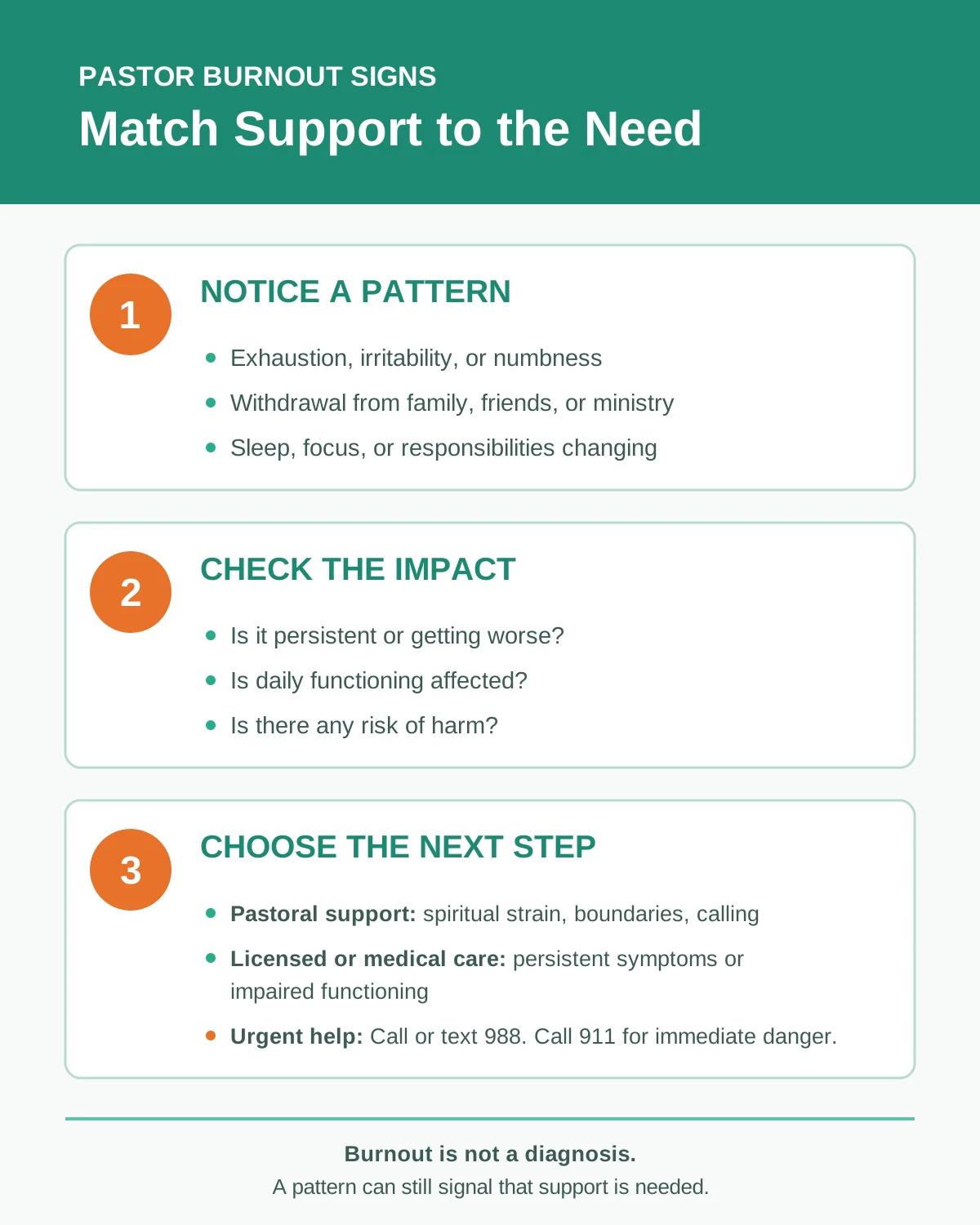
What Pastor Burnout Signs Can Look Like
The World Health Organization classifies burnout as an occupational phenomenon, not a medical condition. It describes three dimensions: energy depletion or exhaustion, increased mental distance or cynicism toward one’s job, and reduced professional effectiveness.1 Ministry is more than employment, but pastors still work inside roles, schedules, systems, and expectations. That makes the occupational frame useful without reducing a calling to a job description. Research on clergy burnout is still uneven, so treat these signs as a pattern to notice rather than a statistic to measure yourself against.2
Your energy no longer returns
Normal fatigue often improves after sleep, a lighter day, or a genuine break. With burnout, a day off may barely touch the depletion. Sermon preparation stretches longer. Small decisions feel expensive. You may become more forgetful, procrastinate on ordinary tasks, or rely on adrenaline to get through Sunday and then crash.
People begin to feel like demands
A pastor can care about people and still notice growing distance. Hospital calls, conflict, staff questions, and requests for prayer may start to feel like interruptions rather than parts of ministry. Irritability, numbness, sarcasm, or a private wish that everyone would stop needing you can signal depletion. These reactions do not make you a bad pastor. They do tell you that your present load and support need honest review.
Your sense of effectiveness shrinks
You may assume every difficult outcome proves you failed. Wins barely register, while criticism occupies the whole week. Some leaders respond by overworking and controlling more details. Others avoid decisions, messages, or people. Either direction can reinforce the belief that nothing you do is enough.
Ministry follows you home
Family members may receive the least patient version of you because the public version used the available energy. Your spouse may feel like the church is always in the room. Children may learn that ministry emergencies outrank ordinary family presence. The point is not to add guilt. It is to notice spillover early enough to make a change.
Ask Three Questions Before You Call It “Just Burnout”
First, how long has the pattern lasted, and is it worsening? A demanding season around a funeral, crisis, or major event may resolve when the event passes. A pattern that continues through lighter weeks deserves more attention.
Second, what is changing in daily functioning? Notice sleep, appetite, concentration, decision-making, personal care, relationships, substance use, physical symptoms, and the ability to complete ordinary responsibilities. Burnout can overlap with depression, anxiety, trauma effects, sleep disorders, medication effects, and medical conditions. An article cannot sort those possibilities for you.
Third, is there any risk of harm? Thoughts of death or self-harm, inability to care for yourself, dangerous substance use, severe confusion, or immediate danger are not matters to manage through a sabbath plan alone. Use urgent, licensed, medical, or emergency support.
The National Institute of Mental Health recommends professional help when severe symptoms last two weeks or more or make ordinary tasks difficult.4 That is general guidance, not a diagnosis. A primary-care clinician or licensed mental-health professional can assess symptoms and rule out medical contributors.
Pastoral experience: In pastoral conversations, we often hear ministry leaders describe a double life of competence and depletion. They can preach, lead a meeting, and care for someone in crisis, then sit in the car because they have no energy left for the people waiting at home. We also hear how hard it is to name the problem when the pastor fears that honesty will be treated as weakness, disqualification, or a threat to the church. The recurring pattern is not a lack of love for God or people; it is a load that has become difficult to carry truthfully.
A Seven-Day Ministry Load Triage
You do not need to settle your whole future this week. Use seven days to reduce noise and gather better information.
Stop adding for one week
Do not volunteer for a new initiative, accept an optional speaking request, or solve a nonurgent problem simply because you can.
Write the actual load
List preaching, pastoral care, administration, conflict, staff supervision, digital availability, family obligations, and unseen emotional labor. A vague burden is hard to change; a visible load can be discussed.
Mark what only you can do
Keep this list short. Distinguish pastoral responsibility from tasks that can be delegated, delayed, simplified, or stopped.
Protect one recovery block now
Choose a realistic block without church email, messaging, sermon work, or crisis monitoring. Arrange coverage rather than remaining the secret backup.
Ask your household what they notice
Listen without defending the ministry. Your family cannot set the whole church schedule, but their experience is relevant evidence.
Tell one accountable person the truth
Choose a board chair, elder, supervisor, denominational leader, trusted pastor outside your system, physician, or licensed professional who can respond without exploiting the disclosure. If privacy fears are holding you back, NuWell’s article on why pastors hesitate to seek counseling walks through those concerns.
Choose the next level of support
Do not make “try harder” the only plan. Set an actual appointment or meeting and decide what information you will bring.
The U.S. Surgeon General’s workplace well-being framework emphasizes boundaries between work and non-work time, worker voice, psychological safety, autonomy, and organizational responsibility.3 The ministry context is distinctive, but the principle still matters: a burned-out pastor cannot solve every structural problem through better personal habits.
How to Talk With Your Board or Elders
Ask for a scheduled conversation rather than disclosing in a rushed hallway moment. Bring observations and specific requests, not a forced verdict about your calling.
“For the past six weeks, I have noticed persistent exhaustion, reduced concentration, and ministry work spilling into every evening. I am taking this seriously before it becomes more harmful. For the next four weeks, I am asking us to assign after-hours coverage, pause two nonessential projects, and approve time for appropriate support. I would like us to review the plan on a specific date.”
A healthy response may include questions, budget realities, and negotiation. It should not require humiliation, gossip, or a promise that nothing will change. If leaders retaliate, threaten your livelihood, demand unsafe secrecy, or block independent care, seek guidance outside that chain of authority. Preserve records only when it is safe and lawful to do so. This article is not legal advice.
Rest, Sabbatical, or Resignation?
Exhaustion can make every option look absolute: stay exactly as things are or leave immediately. Unless safety requires urgent action, create enough margin to evaluate the decision with clearer information.
A day off may help ordinary fatigue. A short leave may create room for assessment and stabilization. A sabbatical can support deeper rest, reflection, family repair, and vocational discernment when expectations, finances, coverage, and return conditions are clear. Resignation may become wise when the role is persistently unsafe, the system will not change, health or family harm continues, or the calling is moving elsewhere.
No format guarantees recovery. A sabbatical that becomes remote work is not rest. Returning to the same unexamined load may restart the pattern. Staying is not automatically faithful, and leaving is not automatically failure.
A Biblical Posture Toward Limits
In Mark 6:31, Jesus tells the disciples to come away and rest after sustained ministry demand. The verse is not a productivity trick; it recognizes that embodied servants need limits. In Exodus 18:17–23, Jethro tells Moses that carrying the people’s disputes alone is not good and urges shared responsibility. The passage does not prescribe one church governance model, but it does challenge the assumption that faithful leadership means personal control of every need.
Scripture also refuses the idea that one leader is the whole body (1 Corinthians 12). The church is a community of many members and gifts. Receiving care, sharing responsibility, and telling the truth about weakness can be acts of stewardship. Prayer and Scripture can sustain those choices. They should not be used to avoid sleep, medical evaluation, licensed care, accountability, or organizational change.
How the RESTORE Path Can Guide the Next Step
NuWell’s RESTORE Path is a flexible pastoral map, not a rigid protocol or guaranteed sequence:
Which Kind of Support Fits?
Pastoral counseling
May fit when you are functioning day to day and want Biblical guidance around spiritual strain, shame, grief, limits, identity, conflict, or calling. NuWell provides online pastoral counseling across the United States. It does not provide diagnosis, psychotherapy, clinical treatment, medical care, or emergency services.
Christian life coaching
May fit when the immediate strain is stable and you want forward-focused work on priorities, delegation, rhythms, or a transition plan. Learn more about Christian life coaching.
Licensed or medical care
May fit when symptoms are persistent, severe, worsening, or interfering with sleep, work, relationships, judgment, or self-care, or when trauma, substance use, or a mental-health condition may be involved. See pastoral counseling versus licensed therapy.
Before reaching out, you can meet NuWell’s care team and see who you would be talking with.
When Urgent Help Comes First
If you may harm yourself or someone else, cannot keep yourself safe, or face immediate danger, do not wait for a pastoral appointment.
If threats, coercive control, stalking, violence, or retaliation are part of the ministry or home situation, burnout language is not enough. Prioritize safety and seek independent specialized help. Do not let a church process replace emergency, domestic-violence, medical, legal, or law-enforcement support.
In immediate danger, call 911.
In the United States, call or text 988 or chat at 988lifeline.org for suicidal crisis or emotional distress. NuWell is not an emergency service.
Frequently Asked Questions
Is pastor burnout a mental-health diagnosis?
No. The World Health Organization classifies burnout as an occupational phenomenon, not a medical condition. Persistent exhaustion, detachment, sleep changes, hopelessness, or impaired functioning can overlap with medical or mental-health concerns, so a licensed or medical evaluation may still be appropriate.
Can I keep serving while recovering from pastor burnout?
Sometimes. The answer depends on safety, symptom severity, family impact, available coverage, and whether the church can change the conditions contributing to the pattern. A reduced load, leave, or sabbatical may help, but none should substitute for licensed or medical care when that level of support is needed.
Should a burned-out pastor resign or take a sabbatical?
No article can make that decision for you. A sabbatical may create space for rest and discernment when duties, finances, support, and return expectations are clear. Resignation may be wise when the role remains unsafe or harmful, needed changes are refused, or careful discernment points toward a different calling.
Find Your Best Next Step
You do not have to prove your faithfulness by waiting until ministry, health, or family life breaks. Name the pattern, choose one honest conversation, and match the support to the need.
Talk with our care team, explore your options, and see whether NuWell is the right fit—without pressure or obligation.

This article was researched with the help of AI and reviewed and edited by Stephen A. Luther, MEd, MSEd, LPC, for accuracy, Scripture references, and faithfulness to NuWell’s non-clinical scope.
Stephen A. Luther, MEd, MSEd, LPC, is Executive Director and Founder of Grace Christian Counseling and a licensed professional counselor. He holds a master’s degree in Education and a master’s degree in Marriage and Family Therapy from Duquesne University and has helped children, adolescents, and adults since 1997. His licensed clinical role at Grace Christian Counseling is distinct from NuWell’s non-clinical pastoral counseling and Christian life coaching services.
Scope note: This article is educational and pastoral; it is not diagnosis, psychotherapy, clinical treatment, legal advice, or emergency care. NuWell provides non-clinical pastoral counseling and Christian life coaching.
Sources
- World Health Organization. Burn-out an “occupational phenomenon”: International Classification of Diseases. May 28, 2019.
- Picornell-Gallar, D., & González-Fraile, E. (2024). Burnout syndrome among Catholic clergy: A systematic review. Journal of Religion and Health, 63(3), 1830–1848. Limited to Catholic clergy; not a prevalence estimate for all U.S. pastors.
- U.S. Office of the Surgeon General. Framework for Workplace Mental Health and Well-Being. Accessed October 15, 2026.
- National Institute of Mental Health. My Mental Health: Do I Need Help? Crisis details verified at 988 Suicide & Crisis Lifeline, October 15, 2026.
