

Why the Layers of Communication Shape Every Relationship You Have
Understanding the layers of communication can change the way you connect with the people who matter most to you.
Most of us assume communication is simply about the words we use. But it goes much deeper than that. Research and counseling practice consistently point to at least four distinct layers that shape every conversation:
- What you say — the actual words you choose
- How you say it — your tone, pace, and volume (paraverbal)
- What your body shows — facial expressions, posture, and eye contact (non-verbal)
- What’s happening inside you — your intentions, self-perception, and heart posture
When these layers work together, communication builds trust and genuine connection. When they pull in different directions, even well-meaning words can cause confusion, hurt, and distance.
This matters deeply in marriages, families, friendships, and workplaces. At NuWell Online, we have seen how many relational wounds trace back not to bad intentions, but to misaligned layers — a kind voice saying caring words while a closed posture signals something else entirely.
Whether you are navigating anxiety, grief, conflict in your marriage, or a quiet sense that something in your relationships just isn’t working — learning to understand your own communication layers is one of the most powerful steps toward healing and wholeness.
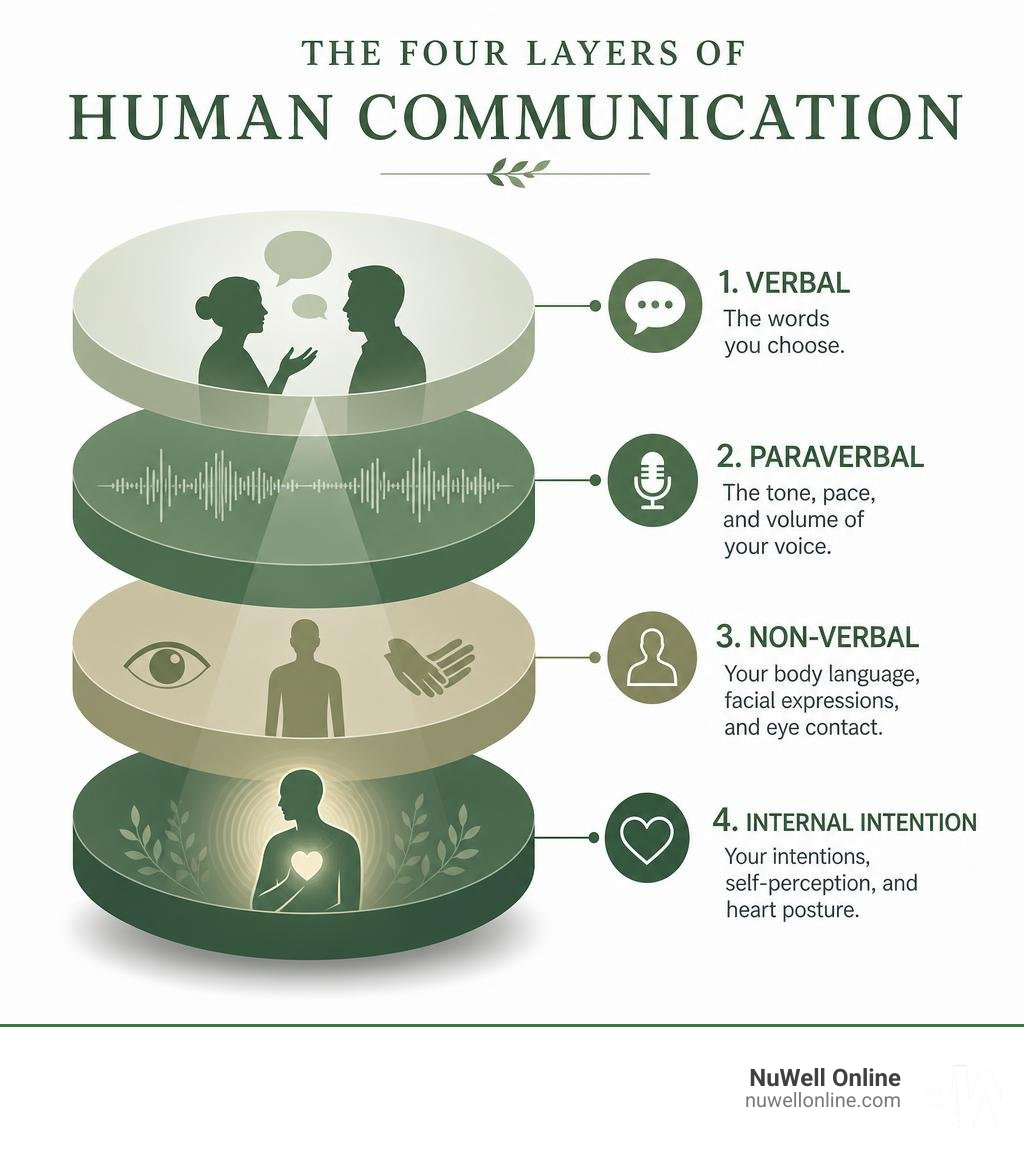
Understanding the Human Layers of Communication
Human interaction is rarely flat. To understand how we connect, we must look at the human Layers of Communication as a dynamic, multi-dimensional system. When we ask ourselves, What is Communication?, we discover it is not merely the transmission of data from one brain to another. It is a spiritual, psychological, and physical exchange.
At the surface, we have our words. But beneath that surface lie layers of tone, body movement, and ultimately, our heart posture and self-esteem. In our work with individuals and couples in North Huntingdon, PA, and across the state, we have found that the deepest layer—our internal sense of worth and security—acts as the soil from which all other layers grow. If the soil is filled with insecurity, fear, or resentment, the words and body language we produce will inevitably reflect that tension, no matter how hard we try to mask it.
The Verbal Layer: The Power of the Spoken Word
The verbal layer consists of the actual spoken words we choose. This is the structural blueprint of our message. It requires clarity, thoughtful message structure, and a commitment to truth. However, words alone are incredibly vulnerable to misinterpretation if they lack alignment with our deeper layers.
Scripture warns us repeatedly about the immense power of this layer. In our collection of Scriptures on Taming the Tongue, we are reminded that “death and life are in the power of the tongue” (Proverbs 18:21). Because words hold the power to build up or tear down, mastering this layer requires conscious effort and spiritual discipline.
To ensure your verbal communication is clear, honest, and constructive, consider these verbal alignment techniques:
- Use direct, unambiguous language: Avoid dropping vague hints; speak your needs and observations clearly.
- Structure your thoughts before speaking: Take a brief pause to organize your message so the receiver can digest it easily.
- Speak with grace and truth: Align your vocabulary with a desire to restore and help, rather than to win an argument.
- Eliminate passive-aggressive phrasing: Replace hidden barbs with honest, gentle statements of your feelings.
The Paraverbal and Non-Verbal Layers of Communication
If the verbal layer is the skeleton of our message, the paraverbal and non-verbal layers are the muscle, skin, and expression that bring it to life.
- Paraverbal communication refers to how we speak. It includes our tone of voice, speaking pace, volume, and the strategic use of pauses. A rapid, high-pitched delivery can signal anxiety or anger, while a slow, steady, warm tone invites safety and calm.
- Non-verbal communication is the silent persuader. This encompasses our physical body language, eye contact, facial expressions, and overall posture.
When we practice Healthy Communication, these two layers work in perfect harmony with our words. When a husband tells his wife, “I am listening to you,” but keeps his eyes glued to his phone while tapping his foot impatiently, his non-verbal layer completely overrides his verbal message. The human brain is wired to prioritize paraverbal and non-verbal cues over words when detecting sincerity. If there is a contradiction, we almost always believe the silent signals over the spoken ones.
Technical vs. Human Communication: The OSI Model Framework
To appreciate how structured and complex communication truly is, it can be helpful to look at how computer scientists solved the problem of machine-to-machine interaction. In information technology, engineers rely on a conceptual framework called the OSI model (Open Systems Interconnection).
Developed in the late 1970s and standardized in 1984, the OSI model divides network communication into seven distinct abstraction layers, ranging from physical hardware to high-level software applications.
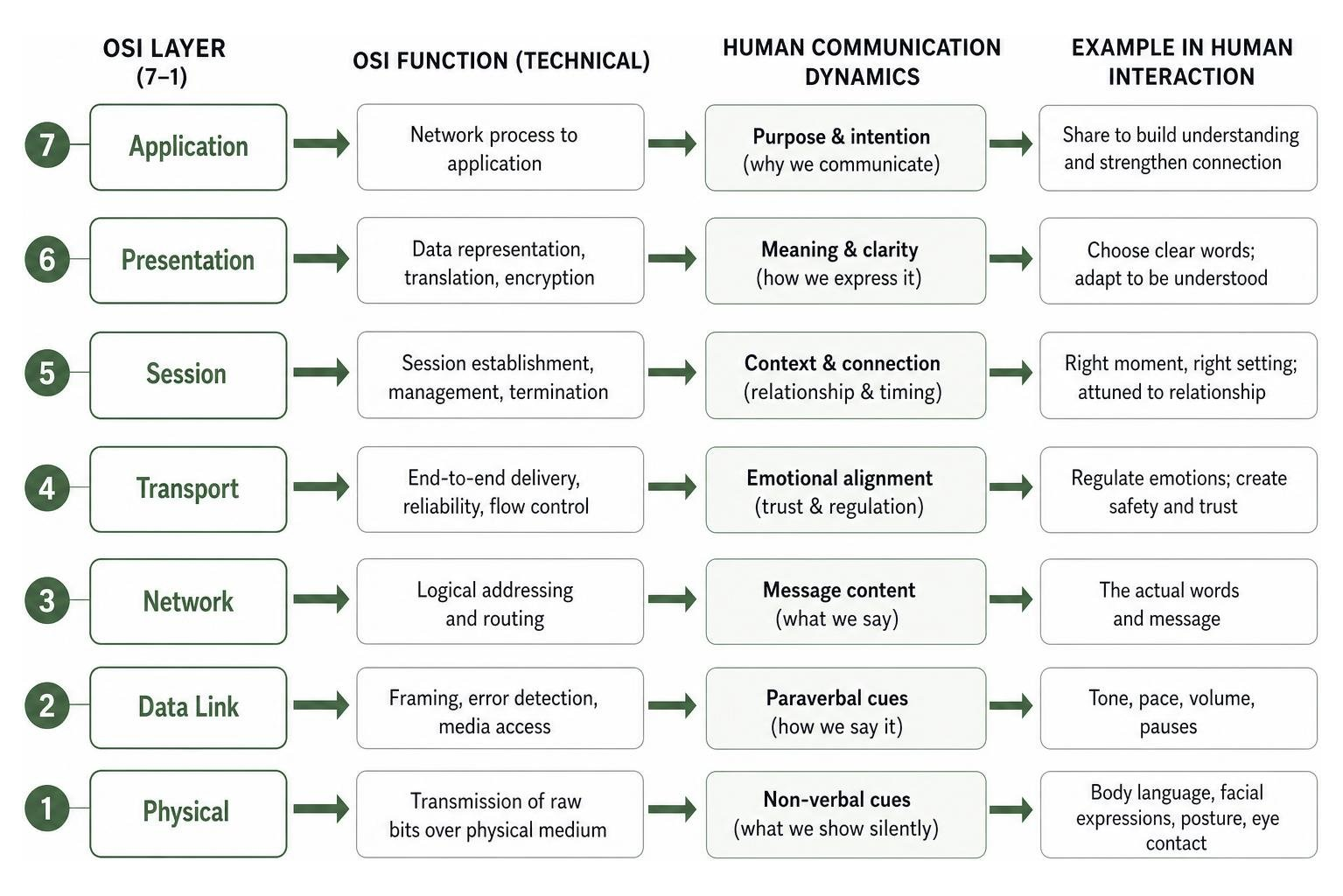
In computing, data travels down these layers on the sending device (encapsulation) and up the layers on the receiving device (decapsulation). For a detailed technical breakdown of this system, resources like What Is the OSI Model? – 7 OSI Layers Explained – AWS illustrate how protocols like HTTP, TCP, and IP interact.
While the modern internet relies more practically on the simpler TCP/IP protocol suite, the OSI model remains the gold standard for teaching, documentation, and troubleshooting. It provides a shared vocabulary. When an IT professional says, “We have a Layer 1 issue,” everyone knows there is a physical problem—like a disconnected cable or a broken fiber-optic line.
Comparing the 7-Layer OSI Model to Human Interaction
The structured nature of network protocols offers a brilliant parallel for human relationships. Just as computers require seamless coordination across physical and logical layers to exchange a single packet of data, humans require alignment across physical, emotional, and cognitive layers to share a single meaningful thought.
We can map these concepts directly to human dynamics:
| OSI Network Layer | Technical Function | Human Communication Equivalent |
|---|---|---|
| Layer 7: Application | The user interface (HTTP, SMTP, browser interaction). | Spoken Words: The surface level of conscious language and vocabulary choice. |
| Layer 6: Presentation | Translates, encrypts, and compresses data for readability. | Cognitive Framing: How we translate our internal thoughts and emotions into structured concepts. |
| Layer 5: Session | Establishes, manages, and terminates connections between devices. | Relational Connection: The active “link” of attention, eye contact, and emotional safety. |
| Layer 4: Transport | Ensures reliable delivery, packet flow control, and error checking. | Pace and Volume: Managing the flow, speed, and intensity of our speech so the other person isn’t overwhelmed. |
| Layer 3: Network | Routes data across different networks using IP addresses. | Contextual Routing: Choosing the right environment, timing, and medium (in-person, text, letter) for the message. |
| Layer 2: Data Link | Node-to-node physical transfer; packages data into frames. | Body Language & Gestures: The physical movements and expressions that carry the message. |
| Layer 1: Physical | The actual hardware (cables, electricity, radio waves). | Physical Presence: Our physical proximity, posture, vocal cords, and biological state (tiredness, stress). |
In network engineering, peer-to-peer exchange means that Layer 4 on the sending device communicates conceptually with Layer 4 on the receiving device. Similarly, in human interaction, our non-verbal layers speak directly to the other person’s non-verbal layers. If our physical presence (Layer 1) is tense, the other person’s biological nervous system detects that threat before their conscious mind (Layer 7) even processes the words we are saying.
Misalignment in the Layers of Communication: Why Misunderstandings Happen
In computers, if there is a bug at the Presentation Layer (Layer 6), the Application Layer (Layer 7) will display gibberish, even if the physical cables (Layer 1) are perfectly intact. The exact same rule applies to humans. Relational conflict, trust erosion, and deep misunderstandings almost always occur when there is a misalignment between our communication layers.
When we send “double messages”—saying one thing but signaling another—we confuse the receiver. This confusion breeds insecurity and defensive reactions. Over time, chronic misalignment creates distinct, unhealthy Types of Communicators. Some people become passive-aggressive, using polite words wrapped in a biting tone. Others become entirely closed off, their rigid body posture acting as a firewall that blocks any emotional data from getting through.
Practical Examples of Misaligned Layers of Communication
Consider how easily these misalignments play out in daily life:
- The “I’m Fine” Enigma: A spouse stands with arms tightly crossed, shoulders hunched, avoiding eye contact, and says in a sharp, clipped tone, “I’m fine. Do whatever you want.” The verbal layer says “go ahead,” but the non-verbal and paraverbal layers scream “if you do this, there will be consequences.” The receiver is left walking on eggshells, unsure which layer to respond to.
- The Forced Apology: A coworker apologizes for a mistake, but their eyes are rolling and their voice is dripping with sarcasm. Because the paraverbal layer contradicts the verbal layer, the apology feels empty and insincere, eroding trust rather than rebuilding it.
- The Distracted Parent: A parent tells their child, “Tell me about your day, I’m listening,” but continues typing an email, never looking up. The child quickly learns that the parent’s physical presence is occupied, making the verbal invitation feel like a hollow formality. If you find yourself in this dynamic, it may be time to ask: Are You Listening?
In each of these cases, the breakdown happens because the sender is unwilling or unable to align their internal intentions with their outward expression.
Strategies to Master All Layers of Communication for Deeper Connection
Mastering the layers of communication is not about performing a set of artificial social tricks. It requires genuine heart work, emotional intelligence, and consistent self-awareness.

At NuWell Online, we believe that true communication mastery begins with active listening—not just listening to the words being said, but listening to the tone, watching the body language, and sensing the emotional needs of the person in front of you.
When we slow down and examine our own Communication Features, we can begin to align our layers intentionally. If we are feeling angry or defensive, we can acknowledge that internal state before we speak, preventing those negative emotions from corrupting our tone and body language.
Cultivating the Deepest Layer: Self-Esteem and Intentionality
At the very foundation of all human communication lies our heart posture and our sense of identity. If you do not know who you are in Christ, your communication will often be driven by a desperate need for self-protection, validation, or control.
When we base our self-esteem on God’s unchanging love, we no longer have to use our communication layers as weapons or shields. We are freed to speak with authentic, grace-filled speech.
At NuWell, we have found that spiritual healing and emotional wholeness go hand in hand. When you experience the healing power of Christian counseling or Christian life coaching, your heart posture naturally shifts from fear to love. As a result, your body language relaxes, your tone becomes gentler, and your words naturally align with truth.
Frequently Asked Questions about Communication Layers
What are the main layers of human communication?
The four primary layers of human communication are:
- Verbal: The actual words and vocabulary we choose to speak.
- Paraverbal: How we say those words, including our vocal tone, volume, pace, and pauses.
- Non-Verbal: Our physical body language, posture, eye contact, and facial expressions.
- Internal Intention / Heart Posture: Our underlying motivations, emotional state, and level of self-esteem that drive the entire interaction.
How does the OSI model relate to human communication?
The OSI model is a conceptual framework that breaks down complex computer networking into seven structured abstraction layers. In human communication, we also operate across multiple structured layers (from our physical presence up to our spoken words). Just like in networking, a failure or misalignment at any single layer of human interaction can completely corrupt or block the message from being successfully received.
How can I fix misaligned communication layers in my relationships?
Fixing misaligned communication requires intentional self-reflection and active listening. Start by pausing before you speak to check your internal heart posture. If you feel tense or defensive, address that emotion internally first. Practice matching your body language and tone to your words. If you struggle to resolve these communication barriers on your own, seeking support through professional Pastoral Counseling or Christian Life Coaching can provide you with the personalized tools needed to restore relational harmony.
Conclusion
We were created for deep, meaningful connection. We were not made to live in isolation or to struggle through constant relational friction. If your relationships are feeling strained, or if you feel like your messages are constantly getting lost in translation, you don’t have to navigate this path alone.
At NuWell Online, we walk alongside you on your journey toward healing and wholeness. By integrating Biblical truths with practical, science-informed tools, our pastoral counselors and certified Christian life coaches help you peel back the layers of stress, fear, and insecurity to discover the authentic communicator God designed you to be.
If you live in the North Huntingdon, PA area or anywhere across Pennsylvania, and you are ready to take your first step toward healthier, more vibrant relationships, we invite you to explore our services at NuWell Online. Let us help you align your heart, your words, and your life for deeper connection.
Ready to transform your relationships? Learn more about our Pastoral Counseling services and book your online session today.
This article was researched with the help of AI and reviewed and edited by Jordan Oliver for accuracy, Scripture references, and faithfulness to NuWell’s non-clinical scope.
Jordan is an author, ordained minister, and online host for His Glory TV, sharing biblically grounded insights on faith, prayer, and spiritual growth. She is the co-founder of Triple-Braided Cord Co., an intercessory prayer and healing ministry inspired by Ecclesiastes 4:12.
Jordan holds a Bachelor’s degree in Communications and Religious Studies from High Point University and is a certified Spiritual Life Coach through iCoachLife in Nashville, Tennessee. Drawing from her ministry, coaching, and academic experience, she creates trustworthy, faith-based content that helps readers grow in their relationship with God. Learn more about Jordan here.
