
When Faith Meets Healing: Finding Christian Therapy for Abuse
Christian therapy for abuse is a faith-integrated approach that combines evidence-based psychological methods with Biblical truth to help survivors heal — body, mind, and spirit.
If you’re looking for Christian abuse counseling, here’s what you need to know right away:
- What it is: Therapy that weaves Scripture, prayer, and a Biblical worldview into proven trauma treatment methods
- Who it helps: Survivors of physical, emotional, sexual, spiritual, or domestic abuse who want their faith to be part of their healing
- How it works: Licensed or pastoral counselors use tools like trauma-informed care and cognitive behavioral therapy alongside Biblical principles
- Where to start: NuWell Online offers confidential, online Christian counseling for abuse survivors — no insurance required
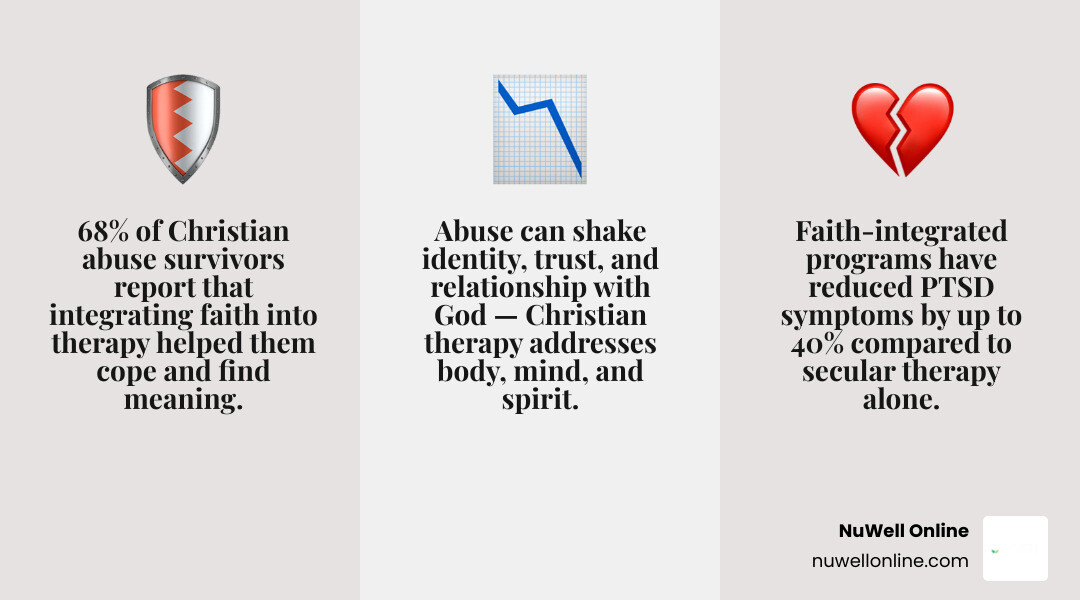
- What to expect: Research shows faith-integrated programs have helped reduce PTSD symptoms by up to 40% compared to secular therapy alone
Abuse leaves deep wounds. And for many Christian survivors, those wounds go beyond the physical or emotional — they can shake your sense of identity, your trust in others, and even your relationship with God.
You were created for more than this pain.
At NuWell Online, we’ve seen how powerful it is when healing and wholeness become possible through a counseling approach that honors both your trauma and your faith. Studies show that 68% of Christian abuse survivors report that integrating faith into therapy helped them cope and find meaning. That’s not a small thing — that’s the difference between surviving and truly healing.
This guide walks you through everything you need to know about Christian therapy for abuse — from the types of abuse it addresses, to how forgiveness is handled carefully, to how you can find the right counselor for your journey.
Christian therapy for abuse word guide:
Understanding Christian Therapy for Abuse

Abuse is a multifaceted trauma that affects every area of a person’s life. When we experience abuse, it doesn’t just impact our thoughts or emotions; it alters how we perceive ourselves and how we relate to our Creator. Christian therapy for abuse is designed to address this intersection of psychological trauma and spiritual identity.
At NuWell, we have seen that many survivors struggle with deep-seated questions: Where was God when this happened? Why did he let this occur? These are natural, heavy questions. Survivors are often met with unhelpful stigmas in church circles, leading them to wonder: can christians struggle with mental illness or trauma? The answer is a resounding yes.
By coping with mental illness and trauma through a lens of grace, Christian therapy helps survivors understand that their psychological struggles are not a sign of weak faith, but rather a normal human response to severe trauma.
Types of Abuse Addressed in Faith-Based Settings
Abuse can take many forms, and a professional Christian therapist is trained to recognize and treat each one with clinical skill and spiritual sensitivity:
- Physical Abuse: Direct physical harm or threats of violence within relationships.
- Emotional and Psychological Trauma: Constant belittling, gaslighting, and control. This includes the unique pain of healing from narcissistic parenting, where a parent’s self-centeredness leaves deep emotional scars on a child’s developing sense of self.
- Sexual Abuse: Any non-consensual sexual contact or exploitation, which requires highly sensitive, trauma-informed clinical care.
- Domestic and Intimate Partner Violence: According to research on intimate partner violence, approximately 1 in 4 women and 1 in 9 men experience severe intimate partner physical violence, contact sexual violence, or stalking. Faith-based counseling is frequently sought by these survivors as they navigate safety and recovery.
- Spiritual Abuse: The misuse of spiritual authority to control, manipulate, or hurt someone, which we will explore in detail below.
Christian Therapy vs. Secular Therapy
While secular therapy offers vital, evidence-based tools for trauma recovery, it often leaves the spiritual dimension untouched. For a believer, compartmentalizing faith during therapy can feel like trying to heal with one hand tied behind your back.
At NuWell, we believe in shattering stigmas surrounding mental health in the church. We work on reconciling religion and therapy so that you do not have to choose between clinical excellence and your Christian values.
Below is a comparison of how these two approaches differ and overlap:
| Feature | Secular Therapy | Christian Therapy for Abuse |
|---|---|---|
| Primary Foundation | Clinical psychology and empirical research. | Clinical psychology integrated with a Biblical worldview. |
| View of Identity | Self-actualization and personal empowerment. | Identity rooted in being a beloved child of God. |
| Source of Truth | Humanistic principles and scientific data. | Scripture, prayer, and science-informed psychological tools. |
| Role of Faith | Generally kept separate or treated as a secular coping skill. | Actively woven into the healing process as a primary source of strength. |
| Approach to Forgiveness | Focused on emotional release and moving forward. | Explored through Christ’s grace, emphasizing boundaries and safety. |
Key Therapeutic Approaches and Faith Integration
True healing requires a holistic approach. In christian therapy for abuse, we do not simply quote Bible verses to cover up deep wounds. Instead, we use clinically proven, trauma-informed care methods that honor your nervous system while inviting the Holy Spirit into the healing room.
If you are looking for online christian counseling for trauma, you will experience therapy that honors both emotional processing and spiritual growth. We focus on navigating trauma through faith by helping you gently process what happened without forcing you to relive the pain before you are ready.
How Christian Therapy for Abuse Integrates Science and Scripture
Our minds and bodies were designed by God with incredible capacity for resilience. Christian therapists utilize tools like Cognitive Behavioral Therapy (CBT) to identify and reframe destructive, distorted thought patterns that abuse leaves behind (such as “This was my fault” or “I am unlovable”).
This clinical tool aligns beautifully with the Biblical mandate to “be transformed by the renewing of your mind.” We look at scripture and scars how biblical counseling navigates deep trauma to show how God’s Word speaks directly to suffering.
This integration is highly effective. According to research on faith-integrated PTSD reduction, faith-integrated therapy programs have demonstrated a significant 40% reduction in PTSD symptoms among participants compared to standard secular therapy alone. Integrating spiritual coping mechanisms—which a 2020 survey noted are used by 85% of Christian therapy clients dealing with abuse—allows survivors to process trauma at a much deeper, soul-level.
Rebuilding Identity, Self-Worth, and Trust in God
Abuse strips away a person’s sense of self-worth, leaving them feeling broken and discarded. In our sessions, we focus on embracing wholeness the power of holistic counseling.
We guide you to realize that your identity is not defined by what was done to you. You are “fearfully and wonderfully made” (Psalm 139:14). Rebuilding trust in God after abuse can take time, especially if the abuser used religious language. We provide a safe, non-judgmental space where you can express anger, doubt, and grief to God, knowing He can handle your hardest emotions.
Addressing Spiritual Abuse and Religious Trauma
One of the most painful forms of trauma is spiritual abuse. This occurs when Christian leaders or church systems use scripture, fear, or pastoral authority to manipulate, control, and exploit others. Over 50% of Christian counselors report that spiritual abuse is a common underlying issue in the cases of domestic or childhood abuse they treat.
If you have experienced this, you know how disorienting it is when the place that was supposed to be a sanctuary becomes a source of harm. Learning how to go about recognizing spiritual abuse is the first step toward freedom. You can read more about everything you need to know about spiritual abuse to help make sense of your experiences.
Healing from Church Hurt and Christian Religious Trauma
When pastoral authority is weaponized, survivors often experience “church hurt” or deep Christian religious trauma. Healing requires specialized church hurt counseling that honors your pain without dismissing your faith.
Through how to find therapy for spiritual abuse and reclaim your life, we walk with you to untangle God’s true character from the actions of those who misused His name. We help you rebuild a healthy, vibrant relationship with Scripture and community on your own terms, at your own pace.
The Role of Forgiveness without Re-victimization
In many Christian environments, survivors are prematurely pressured to “forgive and forget.” In professional christian therapy for abuse, we approach forgiveness with extreme care to avoid re-victimization.
- Safety is Always First: God does not call you to stay in an abusive, unsafe environment. Setting firm, unyielding boundaries is a holy and necessary act.
- Forgiveness is Not Reconciliation: You can forgive someone from a distance to free your own heart from bitterness, but reconciliation requires repentance and safety.
- Grief Must Come First: Before you can forgive, you must be allowed to grieve. We utilize healing the hurt with biblical grief counseling to help you mourn the losses, validate your anger, and process the pain of what was taken from you.
Finding the Right Christian Therapy for Abuse Practitioner
When seeking a therapist, it is vital to find someone who is both spiritually aligned and clinically equipped to handle complex trauma.
Look for the characteristics of a good christian counselor, which include active listening, clinical credentials, and a deep, humble faith. A solid professional will possess the characteristics of a christian counselor who understands trauma-informed care and does not use spiritual platitudes to bypass clinical issues.
For guidance on how to evaluate professionals, see our resource on finding trustworthy online christian counseling.
Frequently Asked Questions about Christian Therapy for Abuse
Can Christian therapy help if my abuse occurred within a church?
Yes. Many survivors feel that secular therapists do not understand the nuances of church dynamics or the depth of their faith. Our specialized church hurt counseling is specifically designed to help you heal from spiritual manipulation, process religious trauma, and reclaim your relationship with God in a safe, supportive environment.
How does a Christian therapist handle safety in abusive relationships?
Safety is our absolute priority. God values your life, dignity, and safety above any relationship structure. We assist you in safety planning, establishing strict physical and emotional boundaries, and connecting you with crisis resources. We also offer faith-based relationship therapy and healing hearts with higher help when it is safe and appropriate to work on relationship dynamics, though we never recommend couples therapy while active abuse is occurring.
Is online Christian counseling effective for deep trauma?
Absolutely. Online therapy provides a high level of comfort, privacy, and convenience, allowing you to receive care from the safety of your own home. There are many benefits of online christian counseling, including access to specialized trauma therapists who may not be available in your immediate local area. You can learn more about the unique online christian counseling perks and see how easy it is to get christian therapy online with our team.
Conclusion: Your Journey to Healing and Wholeness
You do not have to carry the heavy burden of abuse alone. Healing is a journey, but with the right blend of evidence-based psychological tools and Biblical truth, true restoration is possible.
At NuWell Online, based in North Huntingdon, PA, we are dedicated to helping survivors find hope, safety, and renewal. Our licensed pastoral counselors and certified Christian coaches are ready to walk alongside you.
Take the first step on your journey toward recovery. Learn more about our pastoral counseling services and book an online session with us today. Your story is not over, and God is ready to meet you right where you are.
This article was researched with AI and heavily edited by Jordan Oliver for accuracy and relevance.
Jordan is an author, ordained minister, and online host for His Glory TV, sharing biblically grounded insights on faith, prayer, and spiritual growth. She is the co-founder of Triple-Braided Cord Co., an intercessory prayer and healing ministry inspired by Ecclesiastes 4:12.
Jordan holds a Bachelor’s degree in Communications and Religious Studies from High Point University and is a certified Spiritual Life Coach through iCoachLife in Nashville, Tennessee. Drawing from her ministry, coaching, and academic experience, she creates trustworthy, faith-based content that helps readers grow in their relationship with God. Learn more about Jordan here.
