

Marriage and communication
You are halfway through the same tense conversation, and you can feel your ability to listen disappearing. One of you is speaking faster. The other is going quiet. Staying in the room seems likely to make things worse, but walking away could feel like rejection.
If you need to take a break during an argument, the goal is not to escape the issue. A healthy break names what is happening, reassures your spouse that the conversation matters, sets a specific return time, and follows through. That structure turns space into care instead of silence into punishment.
Quick answerSay, “I care about this, and I want to finish the conversation. I am too worked up to listen well right now. Can we pause and come back at 7:30?” Then use the break to settle, pray, and prepare to listen. Return when you promised. If you need to reschedule once, name another specific time rather than leaving the issue open-ended.
A Healthy Pause Is Not Stonewalling
A healthy pause is a clearly named, time-limited break taken so both people can return with more self-control and attention. It includes care, a reason, a return plan, and follow-through.
Stonewalling is disengagement that leaves the other person without a reliable path back into the conversation. It can look like silence, one-word answers, leaving without explanation, scrolling through a phone, or repeatedly refusing to revisit the issue. Sometimes that shutdown grows out of overwhelm rather than contempt. Naming the behavior does not diagnose a spouse, assign a fixed identity, or prove abuse. What matters is the function of the silence and what happens next.
A responsible pause
“This matters. I need a break. I will return.”
Overwhelmed shutdown
“I do not know how to stay present.” It still needs responsibility, support, and a plan for reconnection.
Punitive silence
“You will not get a response until you give in or suffer enough.” That is not a healthy conflict tool.
Coercive control
Coercive control uses silence, threats, fear, surveillance, money, spiritual pressure, or retaliation to dominate. That is not a mutual communication cycle.
Research on couple conflict describes demand-withdraw patterns as associated with more negative emotion and fewer constructive behaviors, but the pattern should not become a villain label. Context matters. Brief withdrawal can sometimes help de-escalation; the absence of dependable return and repair is what makes it relationally costly.
If the same sequence repeats even after good intentions, see why you keep having the same argument in marriage. That companion guide focuses on the larger pursue-withdraw cycle; this page focuses on how to pause and return in one heated moment.
Pastoral experience: In pastoral conversations, we often hear couples describe a painful mismatch: one spouse believes, “If we stop now, this will never be resolved,” while the other believes, “If we keep going, I will say something harmful.” The tone changes when the couple stops debating whether a break is allowed and agrees on what makes the break trustworthy: reassurance, a return time, and follow-through.
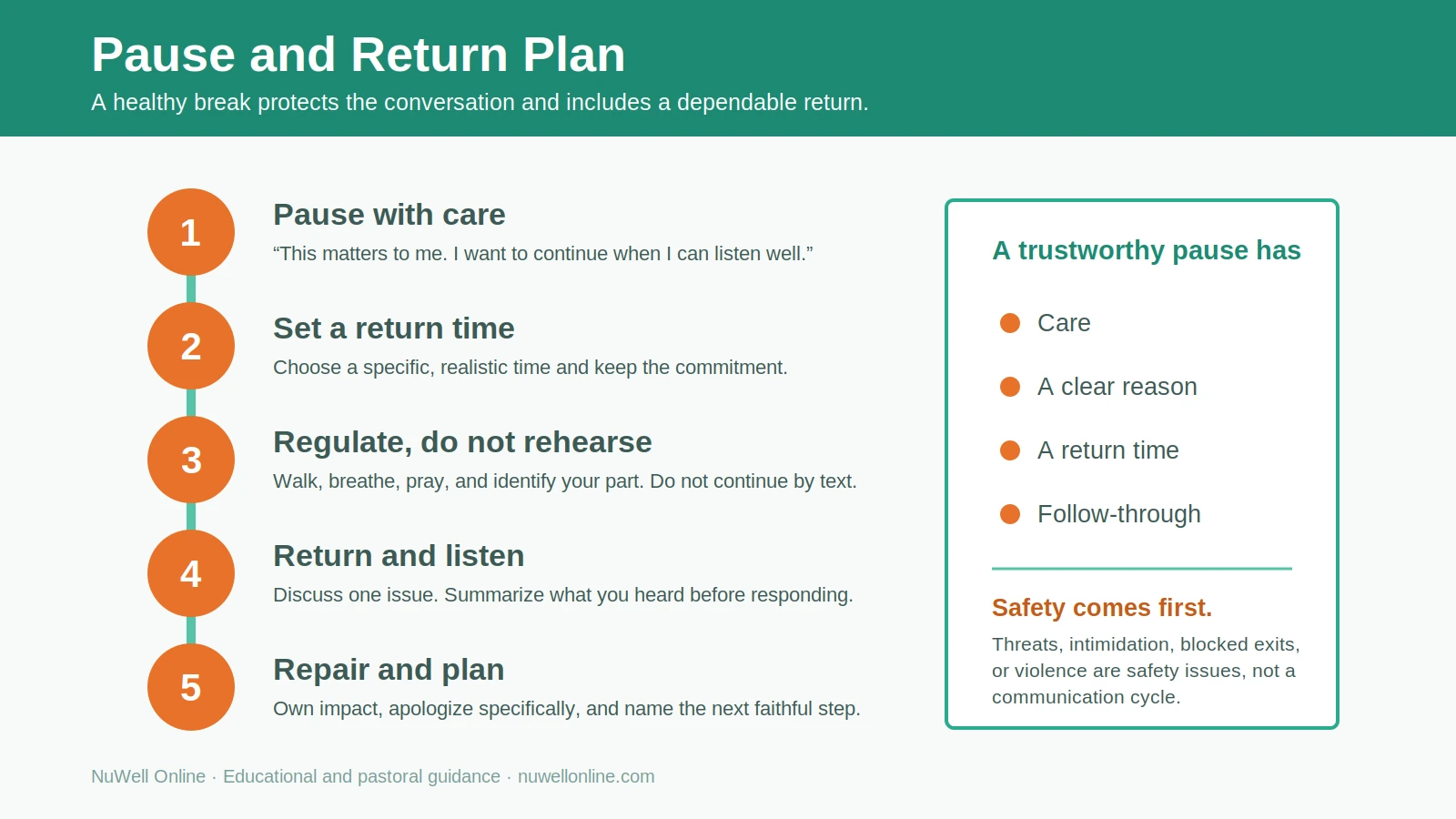
The Pause-and-Return Plan
Practice this sequence before the next hard conversation. It is easier to use a shared plan when neither of you is already at the edge of your capacity.
Agree on a neutral pause signal
Choose a word or short sentence either spouse can use: “I need our pause,” or “Can we reset?” The signal should not mean “I win,” “You are too much,” or “Stop talking.” It means, “I want to protect this conversation from what is happening in me right now.”
Agree that either person may request the pause. Also agree that the person requesting it is responsible for proposing the return time. That small detail keeps the spouse who wants space from holding all the control.
Notice the point where listening is slipping
Do not wait for shouting or a slammed door. Look for your earlier signals: racing thoughts, heat in your face, a tight chest, repeated interruptions, rehearsing a rebuttal, going blank, or hearing every sentence as an attack. These signals are not a diagnosis. They are practical information that your ability to respond wisely is narrowing.
James calls believers to be “quick to listen, slow to speak and slow to become angry” (James 1:19, NIV). That is not a command to remain in a harmful room. In an ordinary, mutually safe conflict, it is an invitation to notice when you are no longer listening and take responsibility before anger chooses your words.
Ask for the break with care and a return time
Use all three parts:
Care“I love you, and this matters to me.”
Capacity“I am too activated to listen well right now.”
Return“Can we come back to this at 7:30 after the kids are settled?”
A return time should be realistic and reasonably soon. Some relationship educators suggest at least 20 minutes for settling and generally returning within a day. Treat that as a useful guideline, not a biological rule or spiritual test. Sleep, work, caregiving, health, and safety may require a different plan. The essential promise is not a magic number; it is dependable re-entry.
Regulate rather than continue the argument alone
The break is not a recess for building a stronger prosecution. Avoid drafting angry texts, recruiting family members to take sides, monitoring your spouse, using alcohol or substances to numb, or replaying only the worst interpretation of what was said.
Instead, choose one or two grounding actions:
- Walk, stretch, breathe slowly, or drink water.
- Pray honestly for wisdom, self-control, and your spouse’s good.
- Write the one issue you need to discuss, without adding ten old grievances.
- Ask, “What part is mine to own? What do I still need to understand?”
- If contact during the break escalates either person, agree to pause texts too.
This is practical guidance, not treatment. If panic, trauma symptoms, substance use, or another mental-health concern is shaping the conflict, licensed or medical care may be the better support.
Return, listen, and repair
Come back when you promised, even if your opening sentence is, “I am still nervous, but I want to keep my word.” Begin by naming the impact of the interruption: “I know my leaving felt scary,” or “I know my pushing made it hard for you to think.” Acknowledging impact does not require taking responsibility for harm you did not cause.
Choose one issue. Let one spouse speak for a few minutes while the other summarizes before responding. Ask, “Did I understand you?” Then switch. If either of you spoke harshly, offer a specific apology and name the behavior you will change.
When the immediate conversation is steady enough to solve the actual disagreement, use NuWell’s five-step guide to Biblical conflict resolution in marriage.
Ephesians 4 holds truth, restrained anger, gracious speech, and kindness together. “Do not let the sun go down” (Ephesians 4:26, NIV) should encourage timely repair, not force a late-night confrontation when neither person can think clearly. Prompt repair can include setting a trustworthy time to continue.
Reschedule once if needed, then address the pattern
If you return and one person still cannot participate constructively, reschedule once with another specific time: “I am not ready enough to do this well. Can we try tomorrow at 9:00 after breakfast?” Do not let repeated rescheduling become indefinite avoidance.
If pauses repeatedly fail, one spouse never returns, or every conversation rapidly escalates, the pattern itself needs attention. The next faithful step may be pastoral support, coaching, or licensed couples care, depending on the level and type of concern.
A Biblical Posture for the Break
Christian conflict is not measured by who quotes Scripture first or who stays in the room longest. Faithfulness includes truthful speech, self-control, concern for the other person, repentance when we cause harm, and peace “if it is possible” and “as far as it depends on you” (Romans 12:18, NIV). That verse does not make one spouse responsible for manufacturing a mutual outcome.
Prayer during a pause can be simple: “Lord, show me what is true, what is mine to own, and how to speak with grace.” Prayer should open us to responsibility. It should not be used to announce that God agrees with our argument or to pressure a spouse into silence.
How the RESTORE Path Supports This Moment
NuWell’s RESTORE Path is a flexible pastoral map, not a rigid protocol. Four movements are especially relevant:
Recognize the wound.
Notice what this argument is touching: fear, disappointment, shame, or an old breach of trust.
Establish safety.
Confirm that both people can speak, pause, and disagree without fear or punishment.
Separate truth from distortion.
Test catastrophic thoughts such as “If we stop, we will never resolve anything” or “If I feel overwhelmed, I am incapable of conflict.”
Rebuild healthy patterns.
Practice a reliable pause, return, listening turn, apology, and next step.
When a Communication Break Is Not the Right Framework
This plan assumes an ordinary conflict in which both spouses can speak freely, say no, leave a room, and return without retaliation. Threats, intimidation, blocked exits, stalking, property destruction, physical or sexual violence, monitoring, controlling money or transportation, isolating a spouse, weaponizing Scripture, or punishing boundaries are safety issues. Abuse is not a communication cycle, and couples work can increase risk when coercive control is present.
If you may be experiencing abuse, seek individual support and make decisions with a trained domestic-violence advocate.
In immediate danger, call 911.
The National Domestic Violence Hotline is available at 800-799-SAFE (7233), by texting START to 88788, or at thehotline.org. If conflict is connected with thoughts of suicide, self-harm, or an emotional or substance-use crisis, call or text 988 or visit 988lifeline.org. NuWell is not an emergency or domestic-violence service.
Choose the Right Kind of Support
NuWell offers online pastoral counseling and Christian life coaching across the United States. Pastoral counseling may fit when both spouses participate voluntarily and want Biblical guidance and practical support for a recurring relationship pattern. Christian life coaching may fit when the marriage is generally safe and stable and you want forward-focused practice, shared goals, and accountability. You can also review NuWell’s Christian marriage support and meet the care team.
Licensed mental-health care may fit better when severe distress, trauma symptoms, a mental-health condition, or substance use is affecting communication, or when clinical assessment and treatment are needed. Medical, substance-use, domestic-violence, or emergency services may also be the right next step. NuWell’s pastoral counseling and coaching are non-clinical services; they do not provide diagnosis, psychotherapy, clinical treatment, or emergency care.
Frequently Asked Questions
How long should a break during an argument last?
Long enough for both people to regain the ability to listen, but with a specific plan to return. Twenty minutes to several hours is often practical; sometimes the next day is more realistic. Avoid treating a time limit as a rule that overrides sleep, health, caregiving, work, or safety.
What if my spouse will not let me take a break?
In a mutually safe relationship, explain the plan before conflict and use a clear return time. If your spouse blocks you from leaving, threatens you, follows to intimidate you, or retaliates for taking space, treat that as a safety concern rather than a communication problem and contact an individual support or domestic-violence resource.
What if my spouse asks for breaks but never returns?
Name the pattern outside the argument: “I want to respect your need for space, and I need a dependable return.” Agree on a specific re-entry process. If the pattern continues, seek appropriate support. You cannot create mutual repair by yourself.
Take One Faithful Pause, Then Return
A good break does not erase the conflict. It creates enough room to bring your better attention, truer words, and steadier love back to it. Agree on the signal. Name a return time. Use the space well. Then keep your word.
If you would like faith-rooted support for a recurring conflict pattern, talk with NuWell’s care team, explore your options, and see whether pastoral counseling or coaching is the right fit, without pressure or obligation.
You can also see how NuWell’s process works.

Stephen Luther, MEd, MSEd, LPC, is the founder and Executive Director of Grace Christian Counseling, where he serves in a licensed clinical role and has worked with children, adolescents, adults, and families since 1997. He also contributes leadership and educational insight to NuWell Online. NuWell’s pastoral counseling and Christian life coaching are non-clinical services and are distinct from Stephen’s licensed practice at Grace Christian Counseling.
Scope note: This article provides educational and pastoral information. It is not diagnosis, psychotherapy, clinical treatment, legal advice, domestic-violence intervention, or emergency care.
Sources
- Papp, L. M., Kouros, C. D., & Cummings, E. M. (2009). Demand-withdraw patterns in marital conflict in the home. Personal Relationships. Used cautiously as association, not diagnosis or causation.
- Laurent, H. K., Powers, S. I., Laws, H., et al. (2013). HPA regulation and dating couples’ behaviors during conflict. Physiology & Behavior. Study of dating couples; not generalized to every marriage.
- The Gottman Institute, “Conversational Boundaries Without Stonewalling” and “Manage Conflict – Part 4”. Practical educator guidance, not a NuWell clinical prescription.
- National Domestic Violence Hotline and 988 Suicide & Crisis Lifeline. Contact information reverified October 1, 2026.
