

Biblical discernment
You can pray sincerely and still not know which job to take, whether to move, how to respond to a strained relationship, or when to change direction. The pressure rises when every option carries a cost and you fear that one imperfect choice could place you outside God’s will.
Learning how to make godly decisions does not require pretending that uncertainty has disappeared. It asks you to bring your whole decision before God: what Scripture makes clear, what facts you know, what responsibilities you carry, whose counsel is trustworthy, what motives are operating, and what action you can take faithfully now.
Quick answerA godly decision is not a guess dressed up as certainty. Begin with clear Scripture and safety, pray for wisdom, gather the facts, test your motives, seek counsel from people who are wise and free of controlling interests, compare consequences, and take one responsible step. When two options are Biblically permissible, faithfulness may look like choosing wisely without receiving a dramatic sign.
What Makes a Decision Godly?
Obedience comes first
A choice that requires deception, exploitation, adultery, retaliation, or neglect of a real responsibility does not become wise because it feels peaceful. Here, discernment begins with obedience and honest accountability.
Freedom within a moral frame
Scripture may not name one required employer, neighborhood, school, treatment option, timetable, or ministry role. It gives a moral frame and forms the kind of person who can choose well.
“Godly” describes the posture and process of the decision; it does not guarantee a painless outcome. Romans 12:1–2 connects discernment with a life offered to God and a mind being renewed in view of his mercy. The passage does not promise private instructions for every choice. It calls believers to become people who can test what is good while living faithfully in the real world.
Why Christians Get Stuck
Indecision is not a diagnosis, a permanent identity, or proof that your faith is weak. You may be missing information. You may be grieving what every option costs. You may be trying to protect people you love. You may also be afraid that responsibility will feel heavier once you choose.
Common traps include waiting for a sign while avoiding available facts, asking more people until someone confirms the answer you already want, treating anxiety as proof that an option is wrong, or treating calm as proof that God has endorsed it. Emotions matter, but they are information to understand, not an infallible voting system.
Pastoral experience: People sometimes ask for a sign when what they need is permission to make a responsible choice without perfect certainty. Others keep collecting counsel until someone endorses the option they prefer. Progress often begins when the decision is stated plainly, real responsibilities are separated from imagined catastrophe, and the person chooses the next faithful step they can honestly own.
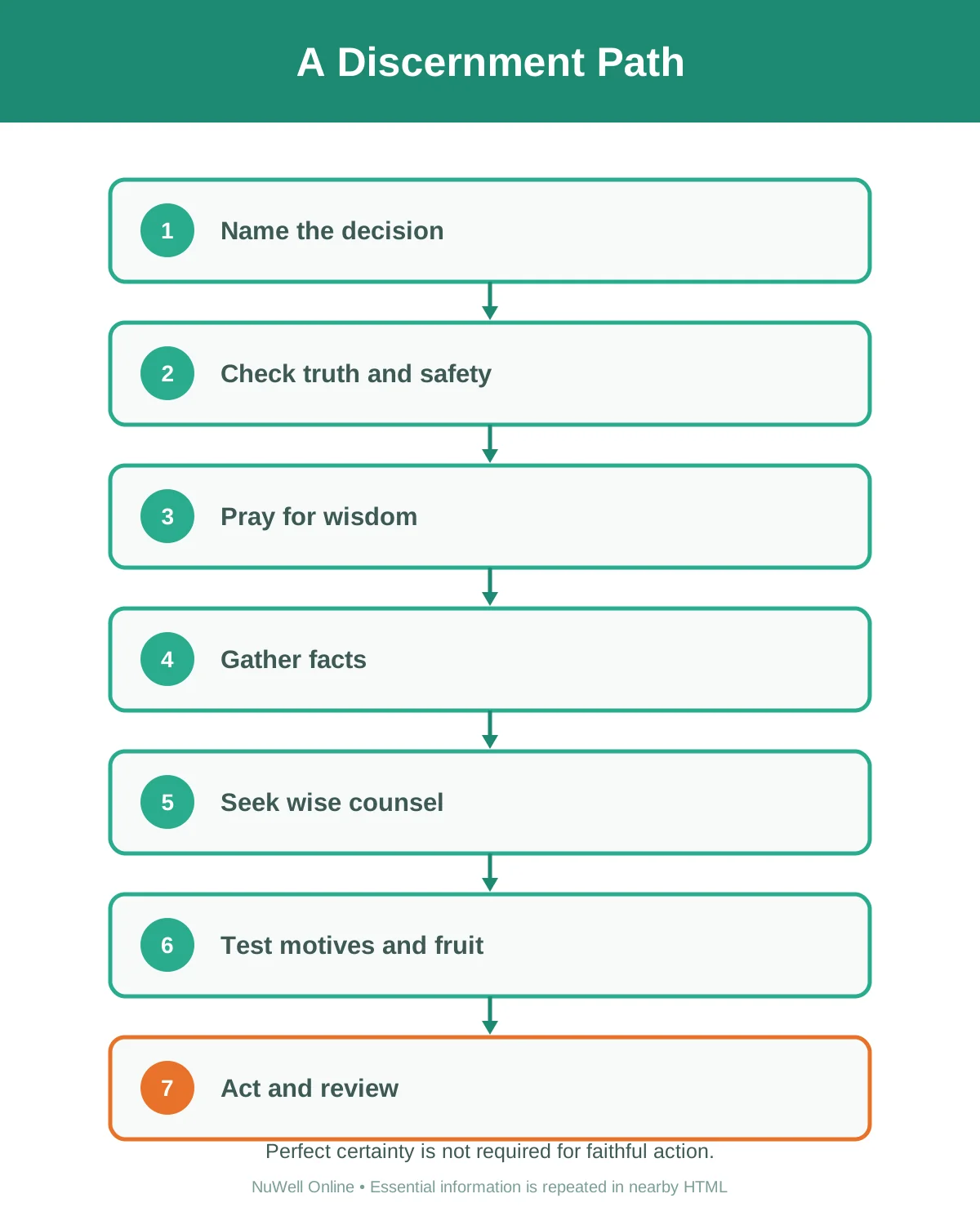
Seven Steps for Making a Godly Decision
Name the actual decision
Write one sentence that identifies the choice, the deadline, the people affected, and what happens if you delay. A vague problem produces vague prayer and endless research.
Rule out what contradicts truth or safety
Remove options that depend on sin, coercion, deception, retaliation, or ignoring a clear obligation. If abuse, threats, stalking, sexual coercion, or financial control is present, this is not an ordinary shared decision. Private safety planning comes first.
Pray for wisdom and surrendered motives
James 1:5 invites believers in trials to ask God for wisdom. Pray not only for the outcome you want, but for courage to hear correction, release pride, and accept the cost of faithfulness.
Gather facts and qualified input
Learn what can be known. Medical, legal, financial, vocational, or child-related decisions need relevant expertise. Pastoral reflection can help you consider faith and values, but it should not replace a clinician, attorney, financial professional, or safeguarding advocate.
Seek wise counsel without outsourcing agency
Proverbs commends counsel (Proverbs 15:22), but the number of opinions does not make an answer divine. Choose advisers who understand the subject, tell you the truth, respect your freedom, and do not benefit from controlling the result.
Test motives, consequences, and likely fruit
Ask what fear, pride, resentment, people-pleasing, love, duty, or stewardship may be shaping you. Consider who bears the risk, whether the choice is reversible, and what kind of character the process is cultivating.
Choose one faithful step and set a review point
Make the best responsible decision available, record why you made it, and decide when new information would justify review. Trusting God does not mean claiming certainty you do not possess.
A Biblical Discernment Test
James 3:13–18 contrasts selfish ambition with wisdom shown through humble conduct. Wisdom from above is described as pure, peace-loving, considerate, submissive, full of mercy and good fruit, impartial, and sincere (NIV). Use those qualities as questions, not as a formula that produces an automatic answer.
Does the process require manipulation or concealment? Can you explain the decision truthfully? Are you willing to hear relevant evidence? Does your plan show mercy without abandoning justice or boundaries? Are you asking others to carry risks you refuse to acknowledge? Sincere discernment welcomes light.
Philippians 4:6–8 teaches believers to bring concerns to God and to dwell on what is true and worthy. God’s peace guards the believer in prayer; it should not be reduced to an emotional approval meter. Colossians 3:15 likewise speaks in a communal context, not merely about private impressions.
When “God’s Will” Language Becomes Pressure
A pastor, spouse, parent, coach, or counselor should not use “God told me” to seize authority over another adult’s body, money, health care, church, career, relationships, or conscience. Wise helpers can interpret Scripture, ask questions, identify risks, and name responsibilities. They should not manufacture certainty or punish disagreement as rebellion. If family pressure is the main obstacle, see NuWell’s guide to Christian boundaries with controlling parents.
If someone monitors you, threatens consequences, blocks access to money or care, forces sexual contact, stalks you, isolates you, or retaliates when you set a boundary, seek private help.
In immediate danger, call 911.
In the United States, contact the National Domestic Violence Hotline at 800-799-SAFE (7233), text START to 88788, or chat at thehotline.org. Use a safer device if your activity may be monitored.
For suicidal crisis or emotional distress, call or text 988 or chat at 988lifeline.org. NuWell is not an emergency service.
A Decision Practice for This Week
On one page, write: the decision; the deadline; clear Biblical and moral non-negotiables; the realistic options; known facts; missing facts; people affected; qualified counsel needed; risks; responsibilities; the smallest reversible next step; and a review date. Then stop researching long enough to act on the next useful question.
Sort your questions into three columns: what you know, what you can learn, and what no one can guarantee. Act on the middle column first. Ask the physician what the recovery window usually involves, the attorney what the rule in your state actually is, the employer what the offer includes, or the family member what commitment they can realistically make. This keeps imagination from masquerading as evidence.
For options that are hard to reverse, slow down and build safeguards. For options that are easy to reverse, a small experiment may reveal more than another week of rumination. A trial schedule, informational meeting, written budget, or defined conversation can produce real information without pretending that you have chosen the entire future.
This practice reflects several RESTORE movements:
When NuWell May Fit and When Other Help Is Better
Pastoral counseling
May fit when spiritual confusion, shame, church hurt, prayer, or Biblical interpretation is central. Learn about online pastoral counseling.
Christian life coaching
May fit when you are stable, looking forward, and want help clarifying goals, habits, and accountability. Explore Christian life coaching.
Licensed and other professional care
Choose licensed mental-health care when persistent anxiety, compulsive reassurance, trauma symptoms, depression, substance use, or impaired daily functioning needs assessment or treatment. See pastoral counseling vs therapy.
Both NuWell services are non-clinical and available online across the United States. Use medical, legal, financial, vocational, domestic-violence, or emergency professionals for needs within their expertise; pastoral care can complement that support when roles are clear. You can read how the NuWell process works or meet NuWell’s practitioners before reaching out.
Conclusion
You may not receive perfect certainty before you choose. You can still make a godly decision: tell the truth, protect safety, honor clear responsibilities, pray for wisdom, gather facts, receive counsel, and take the next faithful step. God’s faithfulness is larger than your ability to predict every outcome.
Related reading: If someone is using “God told me” to pressure your decision, read about spiritual manipulation in Christian dating. For how God makes Himself known, see general and special revelation.
Frequently Asked Questions
How do I know whether a decision is God’s will?
Begin with what Scripture clearly teaches, then consider safety, responsibilities, facts, motives, wise counsel, and likely consequences. When several options remain Biblically permissible, you may need to choose responsibly without claiming perfect certainty.
What if both choices are Biblically acceptable?
Compare the real costs, people affected, stewardship responsibilities, reversibility, and likely fruit of each option. Pray for wisdom, seek relevant counsel, and choose the faithful step you can honestly own.
Does feeling peace mean God approves my decision?
Peace can be meaningful, but an emotional state is not an infallible approval signal. Test the decision against Scripture, truth, safety, facts, responsibilities, and wise counsel rather than using calm or anxiety as the only guide.
How long should I wait before making a decision?
Wait long enough to gather the information and counsel the decision reasonably requires, but set a real deadline. Delay can create costs of its own. Urgent safety, medical, legal, or crisis decisions require qualified help rather than an extended discernment exercise.
Find Your Best Next Step
Share what you are facing and ask what kind of support best fits. Some decisions are easier to see clearly with someone beside you.
Talk with our care team, explore your options, and see whether NuWell is the right fit—without pressure or obligation.

This article was researched with the help of AI and reviewed and edited by Stephen A. Luther, MEd, MSEd, LPC, for accuracy, Scripture references, and faithfulness to NuWell’s non-clinical scope.
Stephen A. Luther, MEd, MSEd, LPC, is Executive Director and Founder of Grace Christian Counseling and a licensed professional counselor. He holds a master’s degree in Education and a master’s degree in Marriage and Family Therapy from Duquesne University and has helped children, adolescents, and adults since 1997. His licensed clinical role at Grace Christian Counseling is distinct from NuWell’s non-clinical pastoral counseling and Christian life coaching services.
Scope note: This article is educational and pastoral. It does not provide diagnosis, psychotherapy, medical treatment, legal or financial advice, domestic-violence services, or emergency care. NuWell provides non-clinical pastoral counseling and Christian life coaching.
Sources
- Scripture references: Romans 12:1–2; James 1:5; James 3:13–18; Philippians 4:6–8, New International Version (NIV).
- National Domestic Violence Hotline. Get Help. Verified October 15, 2026.
- 988 Suicide & Crisis Lifeline. 988lifeline.org. Verified October 15, 2026.
- NuWell. Pastoral Counseling vs. Traditional Therapy.

Dear nuwellonline.com webmaster, You always provide great resources and references.
Hi nuwellonline.com admin, Thanks for the well-researched and well-written post!
Dear nuwellonline.com webmaster, Keep the good content coming!